SHOP NOW, PAY LATER




















 Informed Sport
 Informed Choice
 NSF Certified for Sport
 HASTA Certified

Take ashwagandha when it matches your main goal: morning with breakfast for daytime stress and energy, about half an hour to an hour and a half before bed for sleep, or about 60 minutes before training for exercise support. Split dosing (morning and night) works too if you want both effects. Clinical trials generally use 250 to 600 mg daily, with benefits building over several weeks, so check with a clinician first if you’re pregnant, nursing, or on medication.
TL;DR:
- Taking ashwagandha in the morning supports daytime stress management and energy, especially if taken with breakfast, but effects build gradually over weeks.
- Consuming ashwagandha 30 to 90 minutes before sleep can promote faster or deeper sleep, particularly for stress related to bedtime racing thoughts.
- Pre-workout doses should be taken about 60 minutes before exercise, ideally with a small carbohydrate snack, to align with its active window during training.
- Doses between 250 and 600 mg daily, maintained consistently over 6 to 12 weeks, are typical, but effects vary due to different extracts and individual responses.
- Combining split doses for stress and sleep, or adjusting timing based on monitored personal outcomes, improves results and helps tailor the supplement routine.
Table of Contents
- What’s the Best Ashwagandha Timing for Your Goal?
- How Much Ashwagandha Should You Take and When Will You Notice It?
- Splitting Doses Around Meals and Workouts
- How to Build and Test Your Own Ashwagandha Schedule
- Is Ashwagandha Safe? Interactions and Who Should Skip It
- What to Check on the Label Before You Buy
- Why Most Ashwagandha Advice Misses the Point
- Where to Find Ashwagandha and Supporting Supplements That Fit Your Routine
- Sources
What’s the Best Ashwagandha Timing for Your Goal?
Ashwagandha doesn’t work like caffeine or a pre-workout stimulant. It’s an adaptogen, meaning it’s thought to help the body regulate its stress response over time rather than deliver an instant jolt. That’s why timing should follow your goal, not the clock.
Morning or daytime, for stress and energy. Taking your dose with breakfast is the standard approach if you’re using ashwagandha to manage everyday stress or support steady energy through the day. The idea is calm alertness, not sedation, so most people who report feeling “wired and tired” less often are the ones taking it earlier in the day. This slot suits anyone dealing with work pressure, a demanding schedule, or general anxiety that peaks during waking hours.
Evening or night, for sleep. If sleep is the priority, timing shifts toward the end of the day. A window of 30 to 90 minutes before bed gives the compound time to take effect without you having to guess at an exact minute. Some people notice it helps them fall asleep faster; others notice deeper, less interrupted sleep rather than a faster onset. This slot fits people whose stress shows up as racing thoughts at bedtime rather than daytime tension.
Before exercise, for performance. For strength or endurance work, taking ashwagandha about 60 minutes before exercise is the commonly advised window. That lead time lines up with when the compound is thought to be active in the body during a training session. If you already follow a pre-workout routine, this is simply another supplement to add to that same 60 minute countdown.
Split dosing, for both. Some people don’t want to pick one goal. A common approach is 150 to 300 mg in the morning and a similar dose in the evening, capping the daily total within the typical clinical range. This works well for someone managing daytime stress while also struggling to wind down at night, effectively covering both ends of the day.
How Much Ashwagandha Should You Take and When Will You Notice It?
Clinical trials have not settled on one universal dose, but most land between 250 mg and 600 mg per day, taken consistently over 6 to 12 weeks.
What the trials found: One study tracking sleep quality found a 72% improvement in participants taking ashwagandha, compared to 29% on placebo, over a six-week trial. That’s a meaningful gap, but it’s one trial using one extract at one dose.
A few things to keep in mind before you set expectations:
- Effects tend to build gradually. Most reviews suggest giving it 4 to 8 weeks before judging whether it’s working, since acute, same-day effects are uncommon.
- Starting conservative, around 250 to 300 mg daily, and reassessing after a few weeks is a reasonable approach before increasing toward the upper end of the clinical range.
- Broader evidence reviews report small-to-moderate improvements in anxiety and sleep on average, but note high variability between studies, likely because trials use different extracts, doses, and populations.
- Not every study used the same product. Some trials rely on specific standardized extracts, and a dose from one may not behave the same as an equal dose from another.
Patience matters more than precision here. Taking 400 mg at 8:00 AM sharp every day isn’t the goal. Taking a consistent dose, at a consistent general time, for a consistent number of weeks, is.
Splitting Doses Around Meals and Workouts
Splitting your dose isn’t complicated, but a few details make it work better in practice.
- Morning and evening split: Take 200 to 300 mg with breakfast and a similar amount 30 to 90 minutes before bed, keeping your daily total inside the standard range.
- Pre-workout timing: Take your full or partial dose about 60 minutes before training, paired with a light carbohydrate snack to help with tolerance and to fit naturally into a pre-workout routine.
- With food, always: If ashwagandha upsets your stomach on an empty stomach, taking it alongside a meal or snack, rather than a large one, generally resolves it.
How to Build and Test Your Own Ashwagandha Schedule
Think of this less as picking the “right” answer and more as running a short personal experiment.
- Step 1: Pick your primary goal (stress, sleep, or performance) and choose the matching timing plan above.
- Step 2: Commit to that schedule for 4 to 8 weeks before changing anything. Switching times every few days makes it impossible to tell what’s actually working.
- Step 3: Track a few simple metrics: sleep duration and quality, a daily stress or energy rating out of 10, and workout notes if performance is the goal.
A basic notes app or a paper sleep diary works fine. You’re not running a lab study, just gathering enough personal data to make an informed call.
If your metrics haven’t budged after two months, that’s your signal to try split dosing or shift your timing window rather than assume the supplement doesn’t work for you.
Pro Tip: Keep your tracking dead simple, one line a day. A “stress: 6/10, slept 7 hrs, felt okay” note takes ten seconds and tells you more after six weeks than a detailed log you abandon after four days.
Stop and check with a doctor if you notice unusual fatigue, digestive distress that doesn’t improve, or any signs that don’t match your baseline.
Is Ashwagandha Safe? Interactions and Who Should Skip It
Ashwagandha isn’t risk-free for everyone, and timing advice only matters if you’re a good candidate to take it in the first place.
A few interaction categories are worth checking against your current medications before you start:
- Sedatives and sleep aids: Combined sedative effects can be stronger than expected.
- Thyroid medication: Ashwagandha may influence thyroid hormone levels.
- Immunosuppressants: Its immune-modulating effects can work against these drugs.
- Blood thinners and blood pressure medication: Both interactions are plausible and under-studied.
Pregnant or breastfeeding individuals, people with thyroid or autoimmune conditions, those with liver disease, and anyone on multiple prescriptions should talk to a clinician before starting.
Short-term use appears to be generally well tolerated, but long-term safety over multiple years isn’t well established, and ongoing use should be reviewed with a clinician rather than continued indefinitely on autopilot.
Reported side effects include stomach upset, nausea, diarrhea, drowsiness, headache, and rare liver concerns. Stop use and get medical attention if you notice yellowing skin or eyes, severe abdominal pain, or any symptom that feels serious rather than mild. It’s also worth reading how supplement interactions play out in other categories if you’re stacking multiple products.
What to Check on the Label Before You Buy
Not all ashwagandha products are built the same, and the label tells you most of what you need to know. Look for the specific extract name (standardized extracts behave differently from raw root powder), the milligrams per serving, the total servings per container, and any mention of third-party or batch testing.
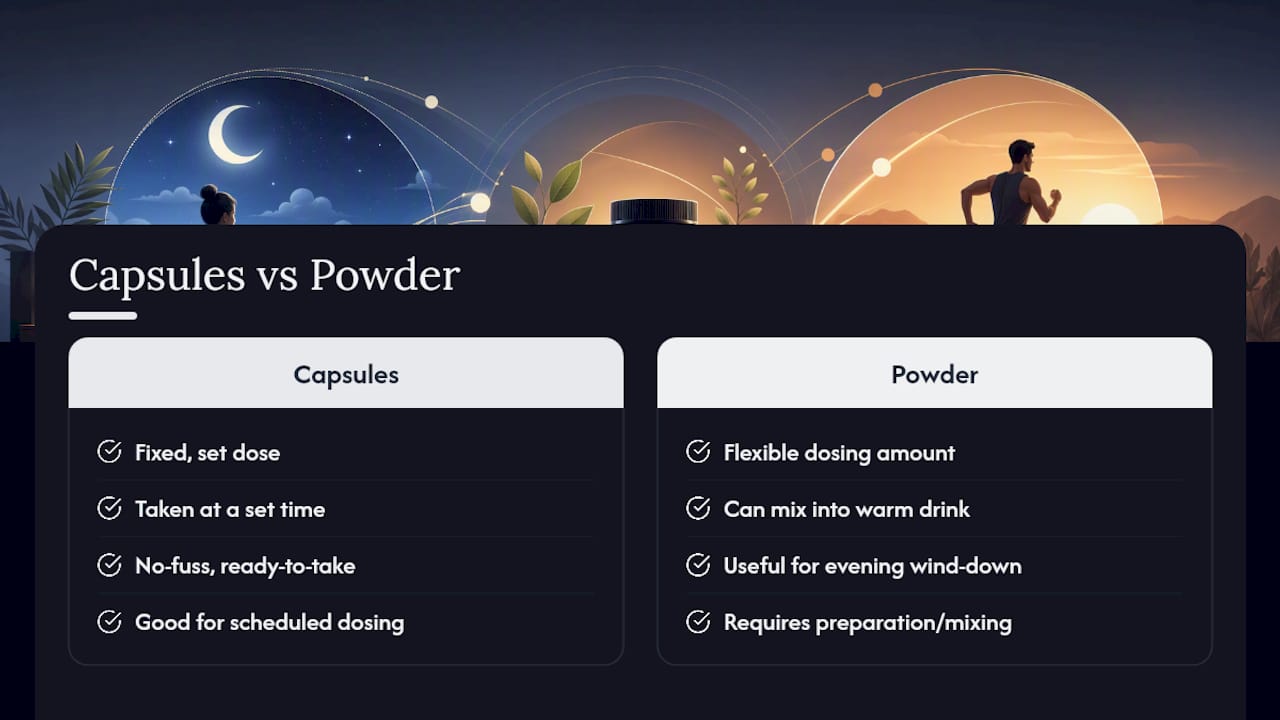
Capsules suit anyone who wants a fixed, no-fuss dose at a set time. Powder gives you more flexibility, useful if you’re mixing an evening dose into a warm drink as part of a wind-down routine. Buying from a supplier with transparent, fully disclosed ingredient lists takes the guesswork out of comparing one product to another. Whatever you choose, run it by a healthcare professional if you’re on medication or managing a health condition.
Why Most Ashwagandha Advice Misses the Point
Most articles on this topic answer the wrong question. They chase a single “best time” as if ashwagandha behaves like a stimulant with a clean window of action. It doesn’t. The honest answer is that timing is a tool for matching the supplement to a goal, not a fixed rule to follow.
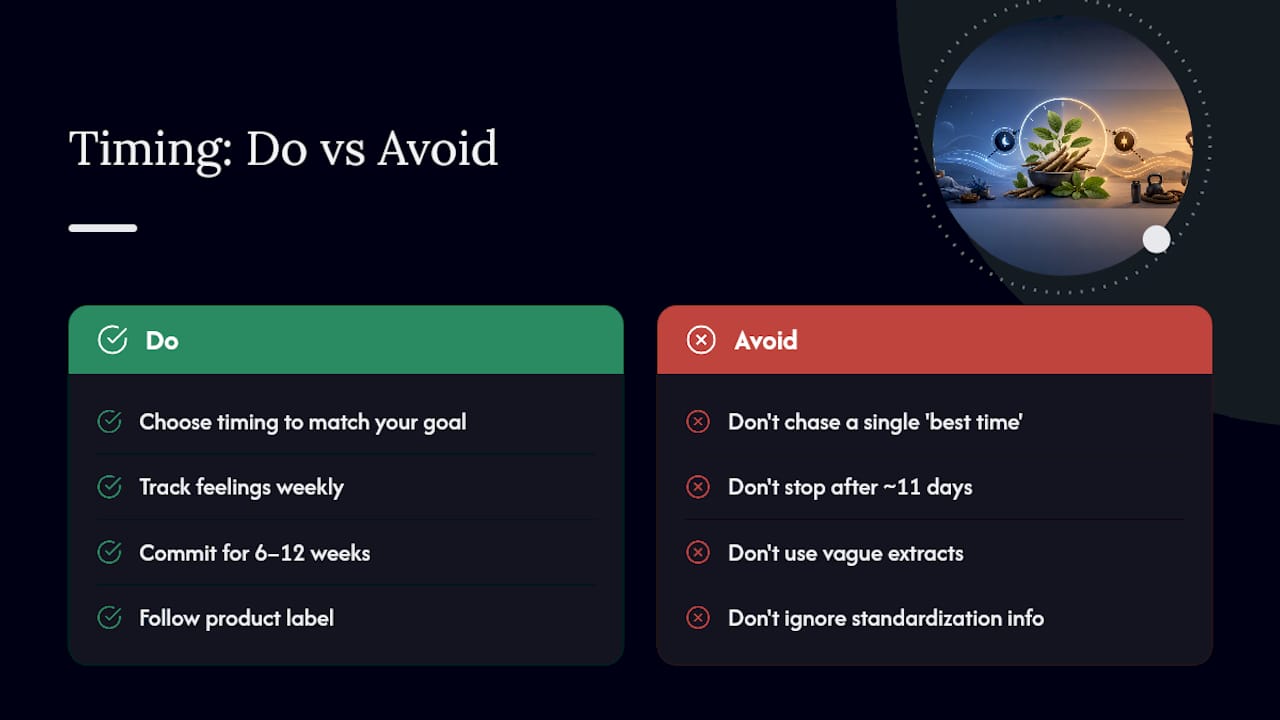
What’s underrated here is tracking. People will debate morning versus night for paragraphs, then take the supplement for eleven days and give up. The trial data points to 6 to 12 week timelines for a reason. If you’re not writing down how you feel week over week, you have no way to know if your schedule is actually working or if you just got lucky with a good week of sleep.
My honest take: pick the timing that matches your primary goal, commit to it for two months, and treat the label on your product as seriously as the clock. A vague extract with no standardization listed will make any timing advice moot.
— Blake
Where to Find Ashwagandha and Supporting Supplements That Fit Your Routine
Whatever slot you land on, whether that’s a morning stress-and-energy stack or a pre-training routine built around a 60 minute countdown, Supplements with fully disclosed ingredients and batch testing make it easy to actually run the 4 to 8 week trial this article recommends.

If your goal is training performance, pairing your ashwagandha schedule with a stim-free pre-workout keeps your pre-exercise routine simple, since you’re already timing one supplement 60 minutes out. Recovering afterward matters just as much as the lead-up, and a clean isolate protein with transparent ingredient listing rounds out a stress-and-recovery stack without adding guesswork to what you’re putting in your body. Browse the full range and pick the products that match the timing plan you decided to test.
This article is general information, not a substitute for advice from a qualified doctor. Consult a qualified healthcare professional about your own circumstances before acting on anything here.
Sources
- Ashwagandha benefits, side effects, and safety concerns | Harvard Health
- Clinical evidence summary (PMC7309667)
- Ashwagandha — Office of Dietary Supplements (NIH)
- This Is the Best Time to Take Ashwagandha | Prevention