SHOP NOW, PAY LATER








 Informed Sport
 Informed Choice
 NSF Certified for Sport
 HASTA Certified

You're standing in the supplement aisle after work, looking for a scoop that'll help the session without turning bedtime into a fight. The best low stim pre workout NZ shoppers should buy is the one with a clear caffeine number, real pump actives, and no anti-doping surprises. If the tub can't show that on the label, skip it.
| Product | Caffeine per serve | Key actives | Serves per tub | RRP (NZD) | Price per serve | Batch tested |
|---|---|---|---|---|---|---|
| Musashi Pre-Workout Zero Caffeine | 0 mg | 22% citrulline malate, 18% beta-alanine, 13% creatine monohydrate, 11% BCAAs | Not stated in verified data | Not stated in verified data | Not stated in verified data | Not stated in verified data |
| NZ Protein NOS v2 | 150 mg | 6,000 mg L-citrulline 2:1, 3,200 mg beta-alanine, 2,500 mg betaine anhydrous, 1,000 mg taurine, 1,000 mg L-tyrosine | Not stated in verified data | Not stated in verified data | Not stated in verified data | Not stated in verified data |
| Musashi Pre-Workout 225g | 250 mg | 2,000 mg citrulline malate, 1,200 mg beta-alanine, 1,200 mg creatine monohydrate | Not stated in verified data | Not stated in verified data | Not stated in verified data | Informed Sport |
| Healthspan Elite Kick-Start Caffeine | 50 mg per tablet | Fine-grained caffeine dosing | Not stated in verified data | Not stated in verified data | Not stated in verified data | Not stated in verified data |
Table of Contents
- What Low Stim Means on an NZ Label
- Ingredients to Prefer and Ingredients to Skip
- Drug-Tested Athletes and Batch-Tested Certification
- How to Read a Pre-Workout Label Like an NZ Shopper
- Low Stim Pre-Workout Options Compared Side by Side
- Matching the Formula to Your Training Window
- Three NZ Supps Profiles Worth Considering
- Buying From NZ Supps, Shipping, and Common Questions
What Low Stim Means on an NZ Label
A 5pm session is where low stim matters. You want drive in the gym, not a wide-awake 11pm brain, so read caffeine per serve on the back of the tub first. In New Zealand, added caffeine has to be declared, and the label also has to show the average caffeine per serve and per 100 g or 100 mL, plus the advisory statement for caffeine-sensitive groups when the product meets the supplement-food rule MPI labelling guidance.
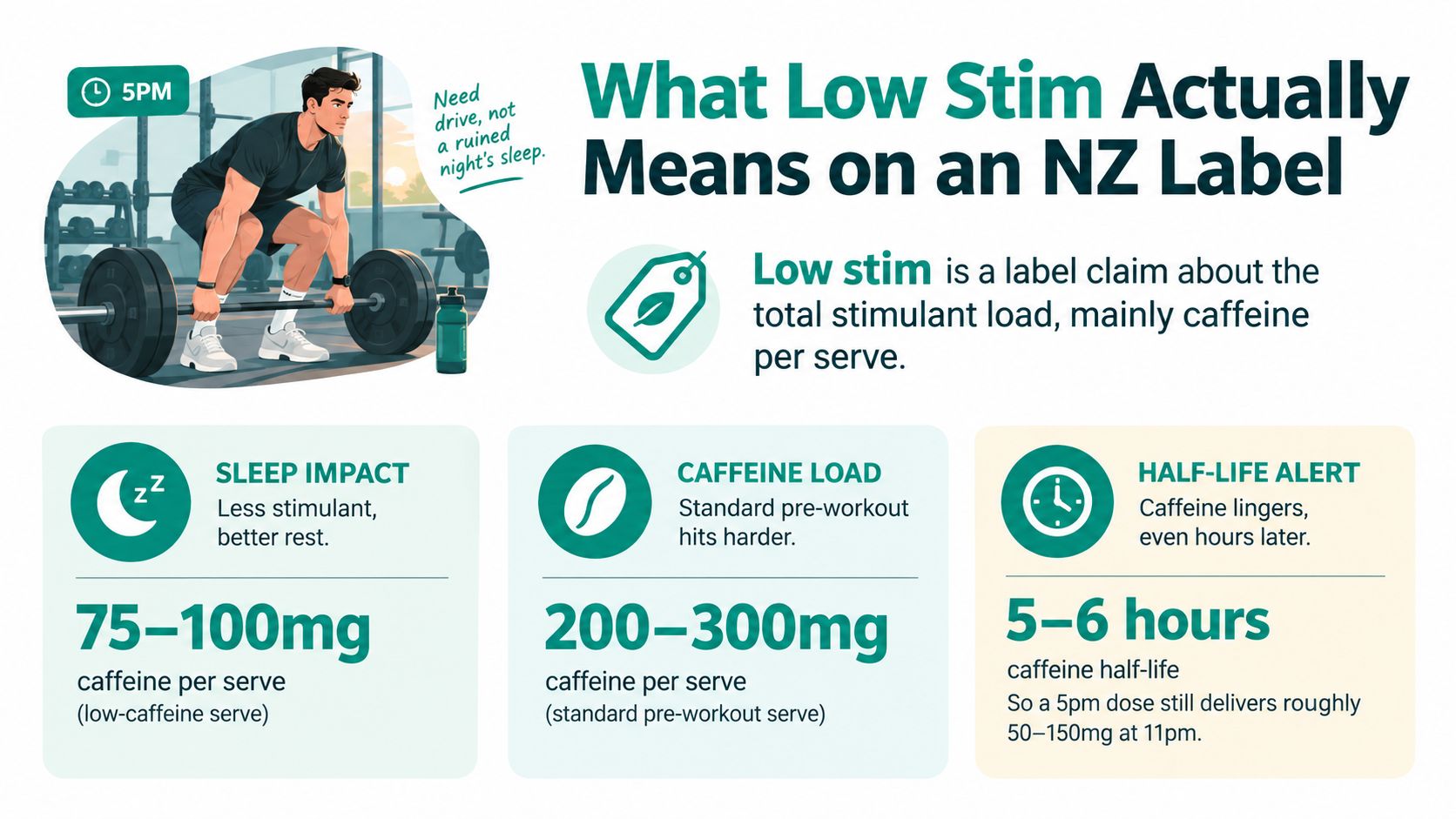
Read the milligrams, not the mood
"Low stim" is not a fixed legal category. On an NZ shelf, it usually means the brand is keeping stimulant load modest, but the panel decides the truth. A 0 mg pump formula contains no stimulants at all, a 50 mg product is very light, a 150 mg scoop is moderate, and 250 mg is not low stim in practice.
Practical rule: if the tub doesn't show the caffeine number clearly, treat the front label as advertising, not information.
Hidden caffeine sources are the next problem. Green tea extract, guarana, yerba mate, and green coffee bean can add stimulant load without making it obvious on the front. The ingredient panel has to expose those sources in New Zealand, so use that to your advantage, then compare the total against your own daily budget. NZ health guidance commonly uses 400 mg/day from all sources as the reference point, which is the line I'd use for everyday decision-making here Food Standards caffeine reference.
The cleanest way to shop is simple. Check the caffeine per serve first, then scan for hidden caffeine-bearing ingredients, then decide whether the product fits your timing. If you train late, the number on the scoop matters more than whatever the tub says about “energy”. For the fully stim-free end of the spectrum, see the NZ Supps guide to stim-free pre-workout in NZ.
Ingredients to Prefer and Ingredients to Skip
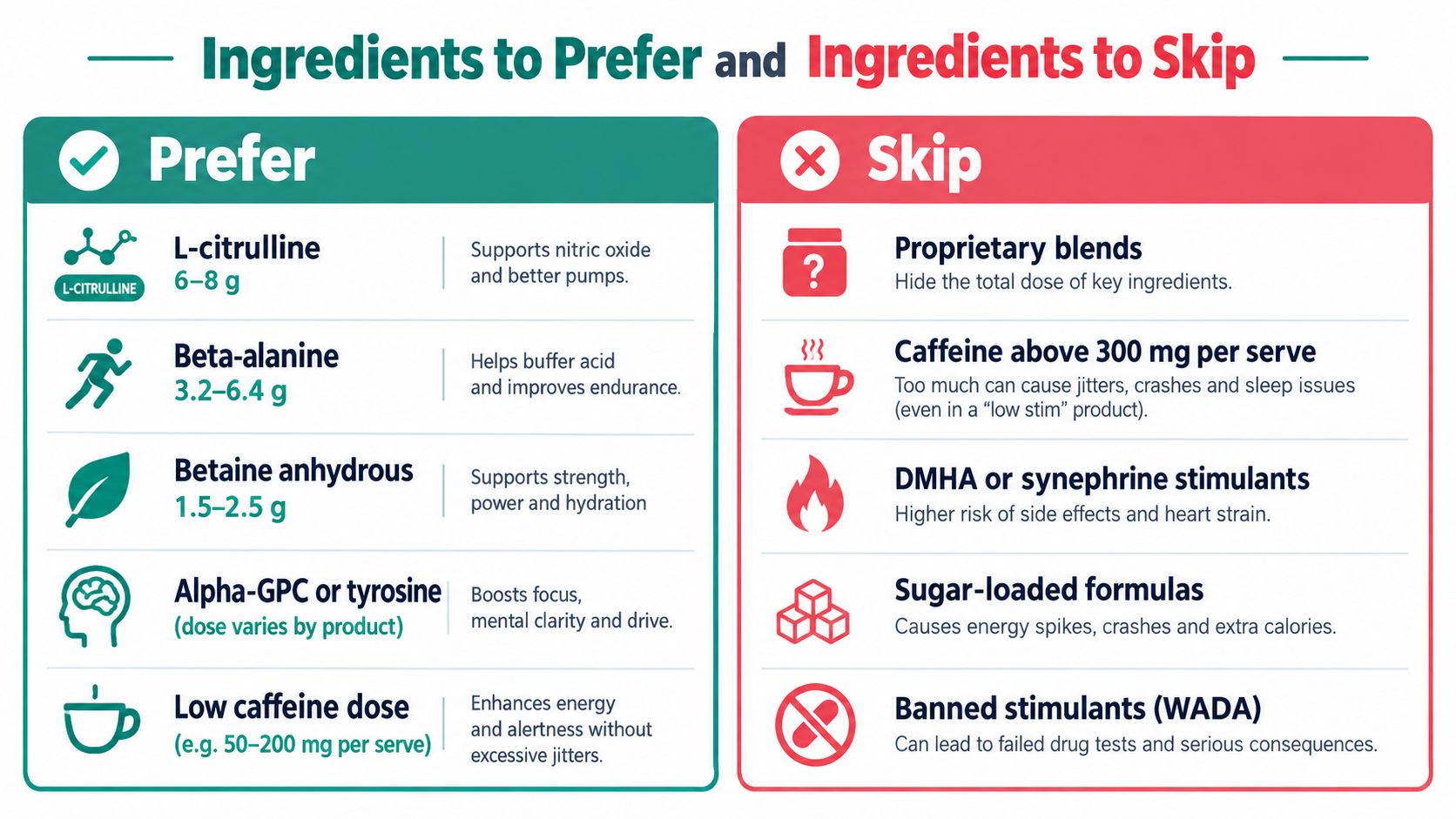
The label shouldn't start with stimulants. It should start with the ingredients that do the work. For a low stim pre workout NZ buyer, the backbone is usually L-citrulline, beta-alanine, creatine monohydrate, betaine, L-tyrosine, and taurine. Those are the ingredients that tell me the formula is built for training, not just for a buzz.
Build the formula around grams, not hype
If a product is supposed to be a pump formula, I want to see L-citrulline in the 6 to 8 g range, or a clearly disclosed citrulline source that makes sense on the panel. Beta-alanine should be there in a meaningful dose, not just a token sprinkle. Creatine monohydrate belongs in a daily-use product at a proper serving, while betaine and L-tyrosine are useful tells that the brand thought about output and focus instead of just chasing a sharp caffeine hit.
The best labels make these amounts easy to read. That's where a panel like NZ Protein NOS v2 stands out, because it shows 6,000 mg L-citrulline 2:1, 3,200 mg beta-alanine, 2,500 mg betaine anhydrous, 1,000 mg taurine, and 1,000 mg L-tyrosine alongside 150 mg caffeine. You can compare that sort of label against a product that hides behind a “proprietary blend” and know which one is giving you actual dosage clarity.
Skip this fast: proprietary blends, sugar-heavy tubs, and formulas that stack stimulant sources to disguise weak pump dosing.
Also skip the nonsense ingredients that pad a label without improving it. If a product leans on a vague “energy blend”, asks you to trust a mystery mix, or stuffs in extra sweeteners and fillers, move on. And if the front says low stim but the panel puts the caffeine load well above a sensible personal limit, that's not a low stim product, that's a marketing exercise.
The cleanest rule is this. Read the actives by grams per serve, then check whether the caffeine source is transparent. If the pump side is weak and the stimulant side is loud, the formula is upside down.
Drug-Tested Athletes and Batch-Tested Certification
Low stim and safe for tested sport are not the same thing. A tub can be light on caffeine and still be a bad bet for a tested athlete if it isn't batch-tested properly. In New Zealand, contamination risk is a real issue, not a theoretical one, and that matters because supplement labels don't tell you everything that ended up in the scoop Sport Integrity Commission guidance.
Certification beats confidence
For drug-tested athletes, Informed Sport is the label fact that matters most. It's a batch-testing system, and the product or batch carrying the logo has been tested against more than 250 prohibited substances Informed Sport app page. That's why I'd rather see a recognised certification mark than a vague claim about being “clean” or “natural”. Musashi NZ lists Pre Workout 225g on its Informed Sport certification page, and that's the kind of concrete check that helps before competition Musashi certification page.
If you're tested, don't shop by flavour first. Shop by batch-testing status first.
The reason this is so important is simple. A low stim tub can still contain ingredients that trip batch testing, especially if the brand uses aggressive stimulant compounds or doesn't control sourcing tightly. The practical way to narrow the field is to use a Tested for Sport filter before you even compare caffeine milligrams. That cuts out the wrong tubs early and saves you from chasing a product that looks tidy on the shelf but isn't safe for your sport.
The other useful distinction is that certification should be checked against the live batch, not just assumed from the brand name. If you're buying for a service, competition, or a federation that tests, I'd treat certification as mandatory and caffeine level as the second filter. The wrong order leads people to buy the wrong tub for the wrong reason. The right order is batch test, then serve strength, then flavour.
Here's the short version. Low stim helps with sleep and sensitivity. Batch-tested certification helps with compliance. You need both if you're serious about tested sport. For the basic checking process, the cleanest place to start is the NZ Supps guide to supplement testing in NZ.
How to Read a Pre-Workout Label Like an NZ Shopper
Start with serve size and serves per tub. If you don't know that, you can't calculate cost or work out how much stimulant you're really getting. After that, go straight to caffeine per serve, then ignore the shiny bits on the front until you've checked the actual ingredient panel.
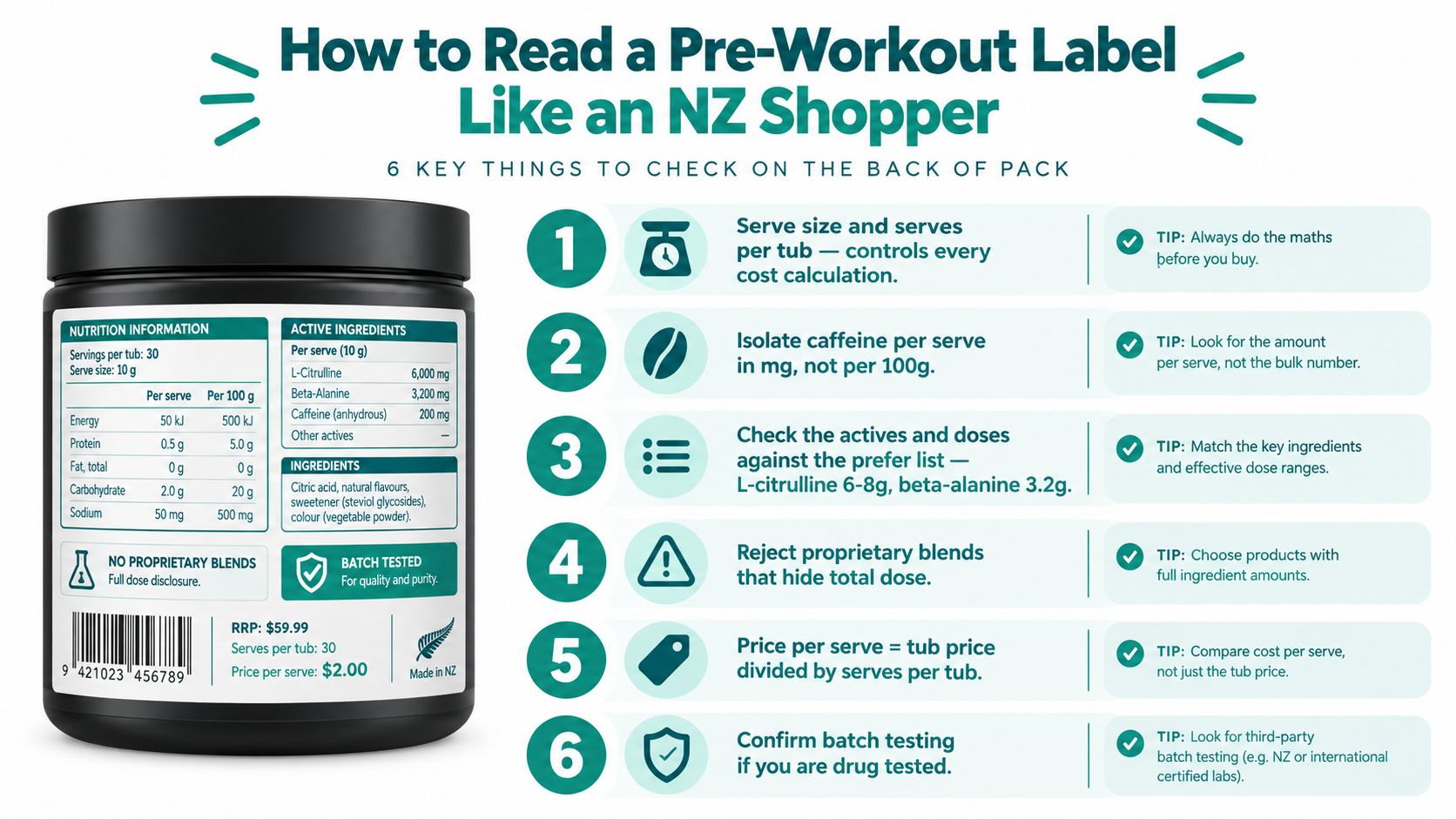
Read the panel in order
- Serve size and serves per tub. This controls every cost calculation and tells you how long the tub will last.
- Caffeine per serve in mg. Use this, not vague energy claims or per-100 g figures.
- Actives and doses. Compare them against the useful ranges, especially citrulline, beta-alanine, and creatine.
- Proprietary blends. If the label hides totals, you can't judge value or dose.
- Price per serve. Divide tub price by serves per tub. That's the key figure.
- Batch testing. If you're drug tested, this sits above taste, branding, and even caffeine level.
A useful NZ example is the NZ Supps range of pre-workouts, because the store surfaces low stim and pump options with per-serve comparisons rather than forcing you to guess from the front label. That makes it easier to compare a tub with 50 mg of caffeine against one with 150 mg or 250 mg, and it keeps the decision anchored to the actual scoop rather than the marketing copy. For more on caffeine disclosure, the NZ Supps guide to pre-workout caffeine content in NZ is the right companion read.
The bit most shoppers miss is price per serve. A cheaper-looking tub can be more expensive workout for workout if it has fewer serves or a larger scoop that burns through the container quickly. That's why I don't care much about the tub size on its own. I care about what one serve costs, what it contains, and whether the label is honest enough to compare properly.
If the panel is clear, you'll know whether you're buying a light stimulant hit, a pump formula, or a middle-ground pre-workout that still fits a daily caffeine budget. If the panel is fuzzy, the product is asking you to trust it more than it deserves.
Low Stim Pre-Workout Options Compared Side by Side
Start with the number on the label, then work upward only if your training time and caffeine budget allow it. A true zero-stim formula belongs first, followed by light caffeine, then moderate caffeine for lifters who want a clearer hit without drifting into high-stim territory. If you want a wider browse across NZ options, you can also compare pre workouts in NZ through the collection page and filter by the feel you want.
| Product | Caffeine per serve | Key actives | Batch tested |
|---|---|---|---|
| Musashi Pre-Workout Zero Caffeine | 0 mg | 22% citrulline malate, 18% beta-alanine, 13% creatine monohydrate, 11% BCAAs | Not stated in verified data |
| Healthspan Elite Kick-Start Caffeine | 50 mg per tablet | Fine-grained caffeine dosing | Not stated in verified data |
| NZ Protein NOS v2 | 150 mg | 6,000 mg L-citrulline 2:1, 3,200 mg beta-alanine, 2,500 mg betaine anhydrous, 1,000 mg taurine, 1,000 mg L-tyrosine | Not stated in verified data |
| Musashi Pre-Workout 225g | 250 mg | 2,000 mg citrulline malate, 1,200 mg beta-alanine, 1,200 mg creatine monohydrate | Informed Sport |
The comparison is useful because it strips the decision back to the only numbers that really matter here, caffeine and declared actives. Musashi Pre-Workout Zero Caffeine is the cleanest pick for a 5pm trainer who wants to protect sleep and still get pump ingredients. Healthspan Elite Kick-Start Caffeine suits someone who wants the smallest measured nudge and prefers to control caffeine in tablet form instead of committing to a scoop. NZ Protein NOS v2 is the clearer all-rounder if you want a stronger stimulant hit alongside a more serious pump stack. Musashi Pre-Workout 225g sits higher on the stim scale and is the one to watch if batch testing matters, because Informed Sport appears on the label details provided.
That leaves the buying call. If you train late, choose the zero-caffeine tub and stop there. If you train early and still want a lift, start with the 50 mg tablet or the 150 mg option, not the 250 mg scoop. If you are already running coffee through the day, use the guide to Australian caffeine options as a reminder to keep your total caffeine budget under control instead of stacking another hard hit onto a busy day.
The label should do the work for you. If it does not clearly state caffeine per serve, actives, and testing status, skip it and keep looking.
Matching the Formula to Your Training Window
The right product depends more on the clock than on the brand. A 0 mg pump formula fits the late-afternoon or evening lifter who wants drive but doesn't want sleep wrecked by a caffeinated scoop. A 50 mg option suits the person who's already had coffee and still wants a nudge without pushing too hard.
Match the serve to the session
If you train before work and don't drink coffee, a 150 mg pre-workout can make sense because it gives a noticeable lift without looking like a full-strength stim product. If you're a fasted trainer who skips morning coffee entirely, that moderate lane is often the cleaner pick than a big caffeine load. If you're already well caffeinated from the day, the smarter move is to go stim-free and keep the session ingredients focused on pumps and endurance instead.
Good rule for night training: if the scoop risks sleep, don't justify it with branding.
Creatine and beta-alanine don't need to be tied to one perfect minute before training. They're more useful when the total weekly pattern is consistent, so don't overthink timing if the label gives you a proper daily dose. For tested sport, the deciding factor is still certification first, because flavour, price, and pump numbers all come second to compliance.
That's why the same product won't suit everyone. The sleepless evening lifter, the early shift worker, and the tested athlete all need a different filter. Once you know your training window, the label starts telling you which tub belongs in your bag.
Three NZ Supps Profiles Worth Considering
A shelf-read turns this category into three clear profiles. Musashi Pre-Workout Zero Caffeine is the obvious pick for a late session or a caffeine cut, because the tub stays stimulant-free and still gives you citrulline malate, beta-alanine, creatine, and BCAAs. It also makes the cleanest sense when sleep comes first.
Choose by situation, not by noise
NZ Protein NOS v2 sits in the middle. It gives the everyday gym-goer a real pump formula with 150 mg caffeine, plus citrulline, beta-alanine, betaine, taurine, and tyrosine on the panel. The failure point is plain too, 3,200 mg beta-alanine can be a rough feel for users who hate tingles, so if you dislike that skin-crawl sensation, this one will annoy you.
Musashi Pre-Workout 225g is the stronger-stim option at 250 mg caffeine per serve and carries Informed Sport status. That makes it the cleaner call for early training, shift work, or tested athletes who need a batch-tested label and can handle more caffeine. It is a poor choice for anyone sensitive to stimulants or training close to bed.
The details matter as much as the caffeine count. Musashi Pre-Workout Zero Caffeine is the no-nonsense night option. NZ Protein NOS v2 is the balanced middle lane if you want focus and a noticeable hit without jumping to the top end. Musashi Pre-Workout 225g is the one to read carefully if drug testing or a higher daily caffeine load is part of your week.
Pick the tub for the session you run, the sleep you need after it, and the label you can defend. Front-of-pack promises do not train for you.
Buying From NZ Supps, Shipping, and Common Questions
Orders leave the Palmerston North warehouse, and weekday orders placed before 1 pm are set up for same-day dispatch. Shipping is free over $99, and the store supports Afterpay, major cards, Apple Pay, and Google Pay, which makes it easy to buy one tub or build a stack without stuffing the cart with things you don't need. The site also has a Tested for Sport filter, plus a 30-day return window and loyalty points on every order.
Quick questions buyers actually ask
How much caffeine is too much? Use the total daily budget, not just the scoop, and count coffee, cola, and energy drinks with the pre-workout.
Can I switch from high stim to low stim fast? Yes, but start by cutting the scoop size and checking the total daily caffeine load.
Can I stack creatine and beta-alanine with low stim pre-workout? Yes, if the label doses make sense and you're not duplicating too much across products.
Will a stim-free formula still suit night training? Yes, and that's exactly where it's strongest.
What if the tub is out of stock? Don't replace it with a random higher-stim product. Match the same caffeine band or wait for the right batch.
If you want a cleaner way to shop the category, go straight to the label facts, compare the serve sizes, and keep certification in view if you're tested. That's the difference between buying a tub that fits your training and buying one that just sounds good on a thumbnail.
If you want a faster way to narrow the field, start with the product pages, check the caffeine per serve, and only then decide whether you need stim-free, light stim, or a batch-tested option. Visit NZ Supps and compare the low stim range against your own training window, sleep sensitivity, and daily caffeine budget before you buy.