SHOP NOW, PAY LATER













 Informed Sport
 Informed Choice
 NSF Certified for Sport
 HASTA Certified

Yes. Vitamin C is a required cofactor for collagen formation, so pairing a collagen source with vitamin C, whether from food or a supplement, is biologically sound and widely recommended for skin, joint, and tendon support. Most research uses collagen doses from a few grams up to 15 g paired with moderate vitamin C amounts commonly used in clinical trials. Take it any time for general skin support, or 30 to 60 minutes before exercise if you’re targeting tendons and ligaments.
TL;DR:
- Taking collagen with vitamin C enhances collagen synthesis, especially when using doses of 2.5 to 15 grams of collagen and around 50 to 100 mg of vitamin C daily.
- Higher vitamin C doses above 1,000 mg per day may cause gastrointestinal discomfort, so sticking near the RDA often suffices for most users.
- Consistent supplementation over at least two months is necessary to observe visible improvements in skin or joint health, with benefits more pronounced in older adults and athletes.
- Collagen type, source, and label transparency are key factors in selecting effective supplements; marine collagen suits those with seafood allergies, and plain ascorbic acid effectively supports collagen formation.
- Combining collagen and vitamin C from food sources like citrus or kiwifruit can be nearly as effective as supplements, particularly if intake is maintained daily.
Table of Contents
- How Vitamin C Enables Collagen: The Biochemistry Made Practical
- What the Best Clinical Evidence Says
- Dosing, Timing, and Forms That Actually Work
- Picking a Supplement: What to Look for on the Label
- Safety, Side Effects, and When to Check With a Clinician
- Why Trust This Guide
- An Editorial Take on Collagen and Vitamin C
- Where to Find Collagen and Vitamin C Products
- Sources
- FAQ
How Vitamin C Enables Collagen: The Biochemistry Made Practical
Collagen can’t hold its shape without vitamin C. Your body builds collagen’s signature triple helix using two enzymes, prolyl hydroxylase and lysyl hydroxylase, and both require vitamin C to function. Skip the vitamin C, and those enzymes stall. The result is weaker, less stable collagen strands, which is exactly why sailors on months-long voyages without fresh produce developed scurvy: their gums bled, old wounds reopened, and skin lost integrity because collagen synthesis had effectively shut down.
That’s an extreme case, but it illustrates the mechanism at a smaller scale that matters for anyone taking a collagen supplement. If your vitamin C intake is marginal, adding collagen peptides without also covering your vitamin C needs is a bit like buying bricks without mortar.
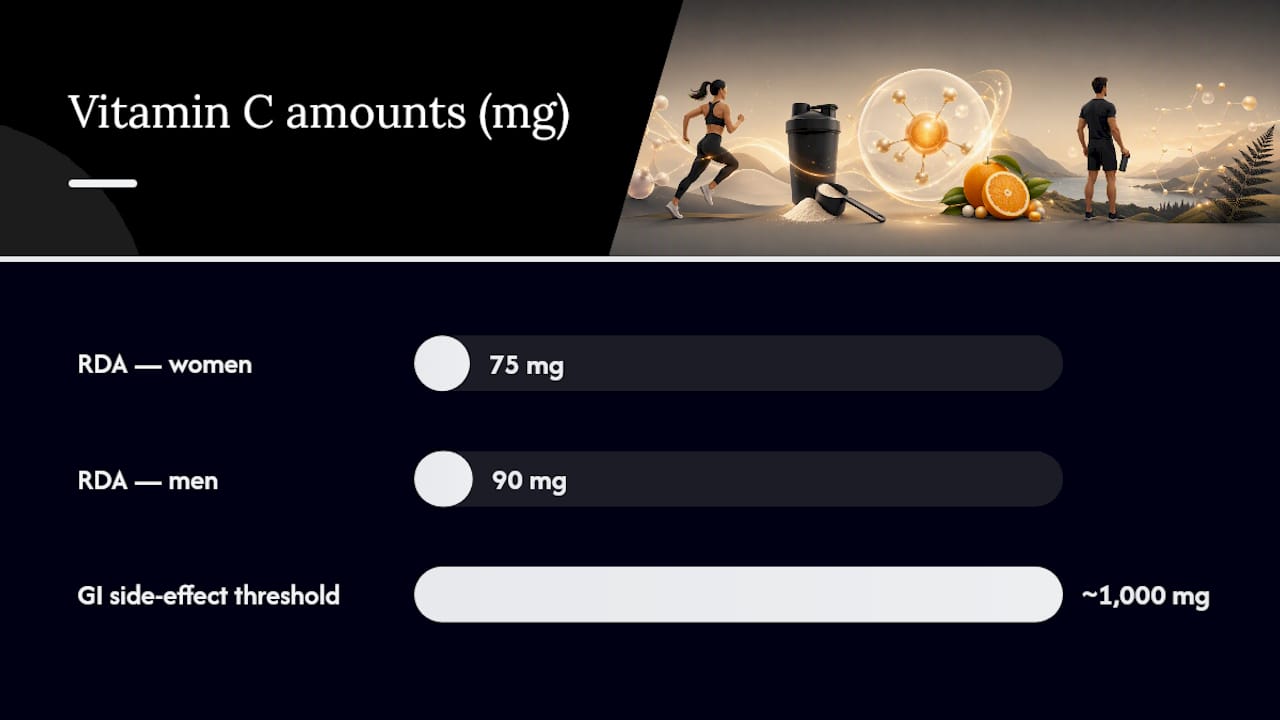
The National Institutes of Health sets the recommended daily allowance at 75 mg for women and 90 mg for men, enough to prevent deficiency and support normal collagen turnover. Research studies and supplement labels often go well beyond that:
- RDA: approximately 75 mg/day for women and 90 mg/day for men
- Typical clinical trial doses: moderate vitamin C amounts commonly used in skin-focused studies
- Some research trials use higher vitamin C doses within a moderate range
- Doses above about 1,000 mg/day may increase the likelihood of gastrointestinal side effects
Pro Tip: If you eat citrus, kiwifruit, or capsicum daily, you may already be close to covering your vitamin C needs without extra supplementation.
What the Best Clinical Evidence Says
The most cited human trial on this exact pairing is a 2017 randomized, double-blind, crossover study. Participants drank a vitamin C beverage with either 5 g or 15 g of gelatin an hour before short bursts of exercise. The 15 g dose roughly doubled PINP, a blood marker that reflects new collagen production, with the increase holding up over a 72-hour window. Researchers also took blood serum collected after supplementation and applied it to engineered ligament tissue in the lab. That tissue showed improved collagen deposition and better mechanical properties, suggesting the effect isn’t just a number on a lab report.
A few things temper the excitement. PINP is a short-term biomarker, not proof that your Achilles tendon is stronger three months later. Studies tracking skin elasticity and joint comfort over 8 to 12 weeks show measurable improvement, but outcomes vary by age, baseline nutrition, and how consistently people actually took the supplement.
Pro Tip: Don’t expect visible skin changes in week one. Collagen remodeling is slow, and most trials measuring skin outcomes run at least two months before seeing a meaningful shift.
Who benefits most from this combination?
- Older adults, whose natural collagen synthesis slows with age
- Athletes and anyone rehabbing a tendon or ligament injury
- Smokers, since smoking depletes vitamin C faster than average
- People on restrictive diets who may be missing dietary vitamin C sources
Dosing, Timing, and Forms That Actually Work
Collagen vitamin C dosage doesn’t need to be complicated, but the details change depending on your goal.
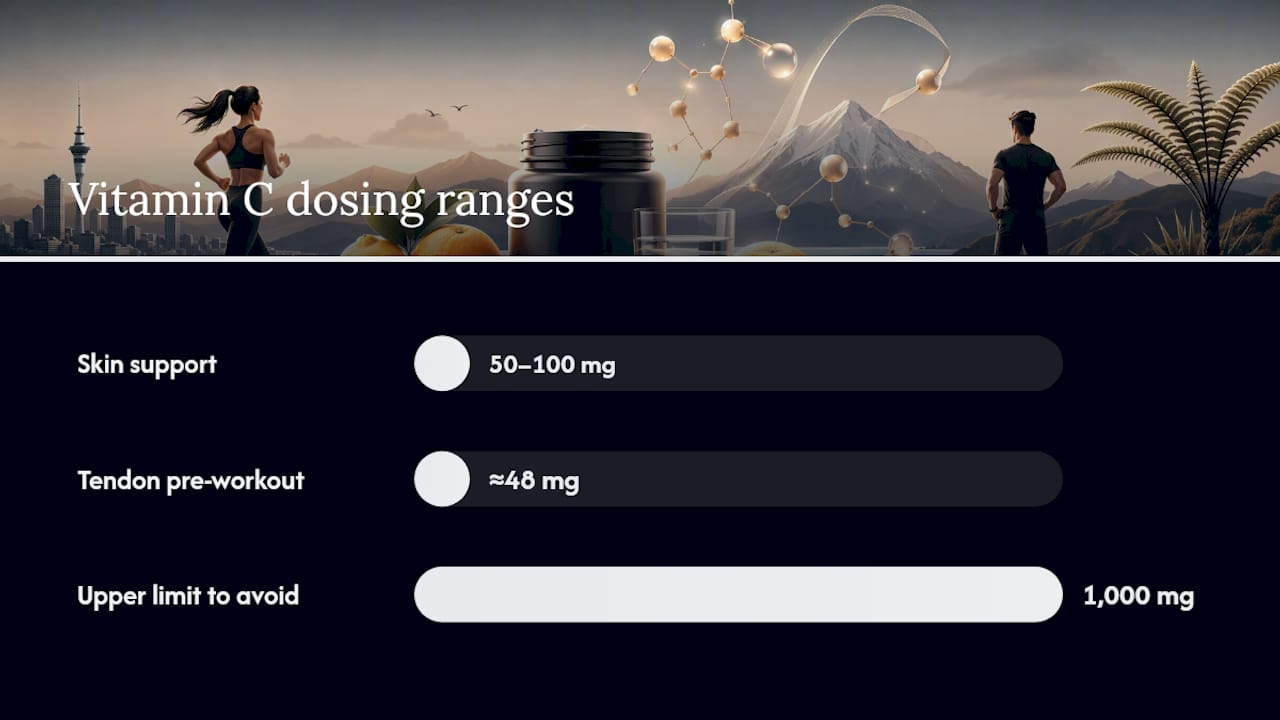
- For skin support: Aim for 2.5 to 5 g of hydrolyzed collagen peptides daily, the range most commonly used in skin-focused trials, paired with 50 to 100 mg of vitamin C.
- For tendon and ligament goals: Use around 15 g of gelatin or collagen peptides with roughly 48 mg of vitamin C, taken 30 to 60 minutes before a loading workout, mirroring the protocol from the 2017 trial.
- For general wellness: Any consistent daily collagen serving with vitamin C works. Timing matters less than consistency here.
- On vitamin C amount: Stick near the RDA unless you’re specifically chasing research-level doses, and avoid routinely exceeding 1,000 mg a day, since that’s where gastrointestinal upset becomes more common.
Forms matter too. Hydrolyzed collagen peptides mix easily into coffee or a smoothie and carry no taste. Gelatin is a cheaper option that works well as a pre-exercise gel or drink, though it sets when cold. Gummies and pre-fortified powders trade some dosing precision for convenience. Topical vitamin C and collagen creams are common in skincare, but they act on the skin’s surface layer and work through a different mechanism than oral supplementation, so think of them as complementary rather than a replacement.
Pro Tip: Splitting your vitamin C dose, say half at breakfast and half at dinner, keeps blood levels steadier than one large dose, since your body can only absorb so much vitamin C at once.
If you’re new to structured supplementation and want a simple starting stack, a beginner-friendly supplement guide can help you build a routine before adding specialty products like collagen.
Picking a Supplement: What to Look for on the Label
Not every collagen powder with vitamin C on the label delivers a useful amount of either ingredient. Check these details before buying:
- Collagen grams per serve. Under 2 g is often just there for the label, not for a meaningful effect.
- Collagen type. Bovine and marine collagen are both hydrolyzed into similar peptides, though marine sources tend to come from fish skin and are worth checking if you have seafood allergies. A marine versus bovine collagen comparison breaks down how each performs over an 8 to 12 week window.
- Vitamin C form and amount. Plain ascorbic acid works just as well as buffered or “gentler” forms for supporting collagen synthesis, so don’t pay a premium chasing a fancier label claim.
- Additives and allergens. Watch for unnecessary fillers, artificial sweeteners, or shared-facility allergen warnings if you have sensitivities.
- Transparency. Favor brands that list exact collagen and vitamin C amounts per serve rather than hiding behind a vague “collagen blend.”
A product like Gaspari Bone Broth Collagen shows the kind of straightforward labeling worth looking for: a clear collagen source and a serving size you can actually track. Our Pillar Collagen Repair review looks at another option with vitamin C built in.
Safety, Side Effects, and When to Check With a Clinician
Collagen with vitamin C is generally well tolerated. The main issue people run into is mild gastrointestinal upset, usually from vitamin C doses well above 1,000 mg rather than from the collagen itself. Allergic reactions are possible if you’re sensitive to the collagen’s source, particularly marine collagen if you have shellfish or fish allergies.
On drug interactions, there’s no strong evidence linking collagen supplementation to problems with common medications, including antidepressants like citalopram. That said, always confirm with a pharmacist before combining high-dose vitamin C with any prescription, since individual medication regimens vary.
Check with a clinician first if you’re pregnant, breastfeeding, managing chronic kidney disease, or have a history of oxalate kidney stones, since high vitamin C intake can be a factor for that last group specifically.
Why Trust This Guide
This guide draws on a randomized human trial published in the American Journal of Clinical Nutrition and the NIH’s clinical fact sheet on vitamin C, the two most rigorous sources available on this topic. Nzsupps built this piece around what the evidence actually shows, not marketing claims, and stocks a curated range of supplements with fully disclosed ingredient lists so you can verify dosing yourself before buying. This article was written by Blake, drawing on peer-reviewed research and nutrition science reporting rather than personal product testing.
An Editorial Take on Collagen and Vitamin C
My honest routine looks unglamorous: a scoop of collagen peptides in my coffee most mornings, alongside a vitamin C-rich breakfast like kiwifruit or capsicum. On heavier training days, I’ll swap that for 15 g of gelatin with vitamin C about 45 minutes before lifting. Nobody sees skin changes in two weeks, so don’t chase that. Give it two to three months, and don’t skip the actual fruit while you’re at it.
— Blake
Where to Find Collagen and Vitamin C Products
Some retailers offer full ingredient transparency down to the gram, so you’re never guessing what’s actually in the tub. Product pages may list collagen grams per serve, vitamin C dose where relevant, and ingredient breakdowns, with products stored and shipped in New Zealand rather than sourced through grey-market imports.
If you’re ready to build a routine around collagen and vitamin C, start by browsing the full supplement range, where you can compare collagen types, serving sizes, and vitamin C content side by side before you commit. Check the label, match it to the dosing guidance above, and pick what fits your goal, whether that’s skin support or tendon recovery.
Sources
- Vitamin C–enriched gelatin supplementation before intermittent activity augments collagen synthesis (Am J Clin Nutr. 2017)
- Vitamin C - Health Professional Fact Sheet
This article is general information, not a substitute for advice from a qualified doctor. Consult a qualified healthcare professional about your own circumstances before acting on anything here.
FAQ
Is it good to take collagen with vitamin C?
Yes. Vitamin C is a required cofactor for collagen synthesis, so combining the two supports the process rather than just supplying raw material. Most people pair a daily collagen serving with 50 to 100 mg of vitamin C, either through food or a supplement.
Can I take a collagen supplement with citalopram?
There’s no strong evidence of a harmful interaction between collagen and citalopram. Still, confirm with a pharmacist before combining any supplement with a prescription antidepressant, since individual regimens differ.
What are the first signs that collagen is working?
Skin and joint changes from collagen supplementation typically take 8 to 12 weeks to show up in research studies, not days. Early signs some people report include slightly improved skin hydration or less joint stiffness, but consistent daily use matters more than any early signal.
What are the side effects of taking vitamin C with collagen?
The most common side effect is mild gastrointestinal upset, usually tied to vitamin C doses above 1,000 mg per day rather than the collagen itself. Allergic reactions can occur if you’re sensitive to the collagen’s source, such as marine collagen for those with fish or shellfish allergies.