SHOP NOW, PAY LATER

















 Informed Sport
 Informed Choice
 NSF Certified for Sport
 HASTA Certified


Creatine monohydrate helps runners with repeated hard efforts, including hills, intervals, sprints and gym work, not steady aerobic mileage. Take 3 to 5 g daily, including rest days, and you don't need a loading phase.
You're probably weighing it up before a new training block, with hills on the schedule, a strength session in the week and a race where every extra bit of body mass matters. Most creatine advice is written for lifters. For a runner, the useful question is narrower: will it improve the hard parts of training enough to justify possible water-weight gain, gut disruption or supplement risk?
For many runners, the answer is yes, but only when the product and timing match the event. For others, particularly those focused on steady marathon pace or a strict race-weight target, it may be the wrong trade.
Table of Contents
- What Creatine Actually Does for a Runner
- Where the Evidence Stops and Starts
- Dosing, Loading, and Timing Around Your Runs
- Body Mass, Hills, and the Race-Day Trade-Off
- Drug-Tested Runners and NZ Anti-Doping Reality
- Powder Versus Gummies and What NZ Supps Stocks
- Stacking Creatine With Protein, Electrolytes, and Pre-Workout
- FAQs and the Runner's Decision Checklist
What Creatine Actually Does for a Runner
Most creatine content assumes you're trying to lift heavier or add muscle. A runner logging 40 to 80 km a week has a different problem. Creatine monohydrate supports repeated high-intensity efforts, but it isn't a shortcut to faster steady-state running.
Inside muscle, creatine combines with phosphate to form phosphocreatine. That phosphocreatine helps replenish ATP, the immediate energy source used during short, powerful efforts. When you sprint up a hill, surge during an interval or drive through the final stages of a race, your muscles need ATP quickly. A larger phosphocreatine supply can help you repeat those efforts with less drop-off.

Match the supplement to the session
Creatine makes the most sense when your training week includes:
- Hill sprints: Short, steep efforts demand high power.
- Track intervals: Repeated hard repetitions rely more heavily on rapid energy turnover than easy mileage.
- Finishing kicks: A late surge has a different energy demand from an even-paced cruise.
- Strength training: Squats, deadlifts, calf work and single-leg exercises all contain repeated high-intensity efforts.
- Team-sport-style accelerations: Runners who also play football, hockey or another stop-start sport have a clearer use case.
It makes less sense if your only goal is to make a long, even-paced run feel easier. Creatine doesn't act like caffeine, and it won't provide an immediate buzz before a workout. It works through regular intake and muscle saturation.
Practical rule: Take creatine for the quality of the hard work, not because you expect it to transform ordinary aerobic mileage.
That distinction matters for creatine for runners NZ. A 5 km runner with regular intervals and a finishing kick has a stronger reason to test it than a recreational runner who only does relaxed continuous runs. A trail runner doing steep climbs may also find the rationale more convincing than someone preparing for a flat event where body mass is tightly controlled.
Where the Evidence Stops and Starts
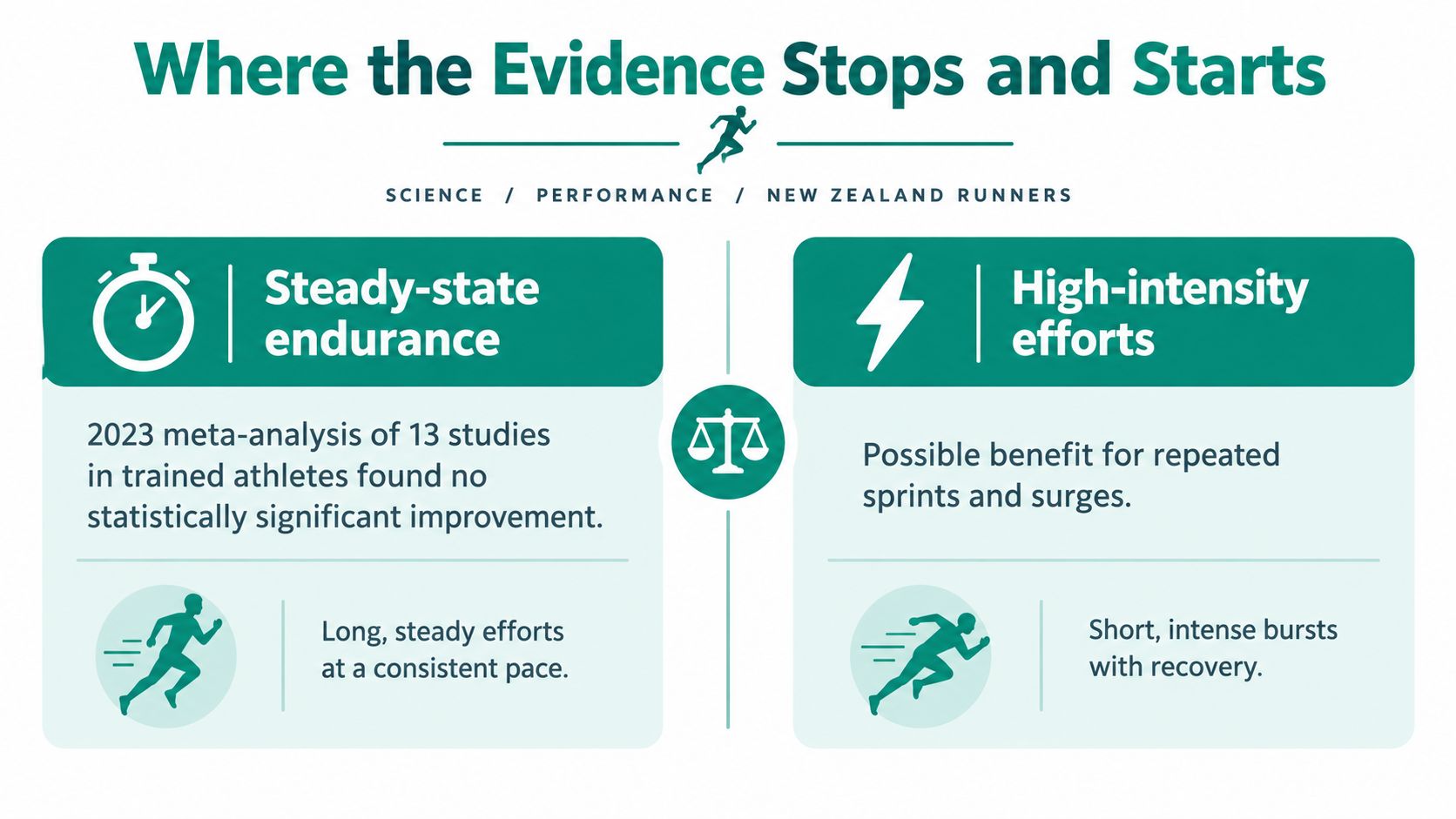
The cleanest endurance evidence is not especially exciting. A 2023 systematic review and meta-analysis pooled 13 studies involving trained participants and found no statistically significant improvement in endurance performance, with a standardised mean difference of -0.07, a 95% confidence interval from -0.32 to 0.18, and a p-value of 0.47. The review concluded that creatine monohydrate was ineffective for the endurance performance tested in that population. (Read the full endurance meta-analysis)
That finding should change how runners judge the supplement. Don't buy creatine expecting a direct improvement in an uninterrupted aerobic effort. A tempo run, long run or steady marathon block doesn't automatically become faster because creatine is in your cupboard.
Why the hard efforts are different
A review of creatine and endurance performance reported that benefits were more likely when exercise included surges in intensity or a fast finish, because those efforts require a greater contribution from anaerobic energy production. It cited a triathlete trial where 6 g per day for five days improved sprint-interval anaerobic performance by 18% without impairing endurance performance. The trial reported no effect on oxygen uptake or blood lactate after the intervals. (Review of creatine and endurance performance)
The practical interpretation is simple. Creatine may help you repeat short, hard efforts inside an endurance programme, even though it isn't a dependable endurance enhancer on its own. That could mean better hill repetitions, stronger interval execution or a more forceful finish, not a smoother easy run.
For a useful wider framework on judging whether a supplement deserves a place in your routine, see this guide to evidence on supplement effectiveness. Apply the same standard here: identify the exact performance task, then ask whether the research matches it.
Dosing, Loading, and Timing Around Your Runs
You do not need a fancy protocol here. For runners, 3 to 5 g of creatine monohydrate daily is the standard play. Take it every day, including rest days, and judge it over weeks, not over one session.
Loading is optional. I usually tell runners to skip it first time round. Big short-term doses are more likely to irritate the gut, muddy the picture on body mass, and create hassle during blocks where you already have enough going on with long runs, hills, and workouts. If you want creatine to support training, steady daily use is the cleaner way to do it.
Timing is mostly about compliance. Breakfast works. Post-gym works. A post-run meal works. Dinner works. Taking it with food is practical, and pairing it with carbohydrate or protein is fine, but there is no need to treat creatine like a pre-run performance shot. It is not that.
Start it according to your training calendar, not your enthusiasm. In base training, begin once your week is settled so you can tell what changes. In a build phase, it fits best when interval work, hill reps, or strength sessions are becoming more important. In taper or race week, keep using it only if it is already part of your routine. Do not introduce it for the first time there. If you are mapping that out around a goal race, find your training timeline.
Then watch the basics closely for the first two to three weeks. Track body mass under similar conditions. Pay attention to uphill feel, stride rhythm, and whether hard sessions feel better or just heavier. If your stomach complains, split the daily dose into smaller serves and avoid taking a bigger amount right before a long, hot, or hard run.
If you want a straight dosing reference, use this guide on how much creatine per day.
Body Mass, Hills, and the Race-Day Trade-Off
You feel this decision most on the course, not in a supplement tub. If your week includes hill reps, rolling long runs, or a goal race with climbs, any bump in body mass matters because you have to carry it over every step. The review on endurance performance points out that creatine can increase body mass, and that can work against athletes in weight-bearing sports such as running. (Review discussion of body mass and running)
So judge creatine by the phase of training and the event in front of you.
For a runner trying to sharpen hill power, finish a 10 km strongly, or get more from gym work, that trade can be worth it. For a runner chasing a flat road marathon at a tightly managed race weight, it often is not. That is the runner's version of the creatine question, and it matters more than gym-bro advice about loading fast and hoping for the best.
Use a simple check during an ordinary block. Weigh under similar conditions across the week. Then match that trend against what matters on the run: how you handle climbs, how smooth pace changes feel, and whether you are completing key reps with decent mechanics instead of grinding through them. If body mass goes up and session quality does not, stop pretending it is helping.
Gut comfort still counts. Big pre-run doses can stir up gastrointestinal issues, especially before long, hot, or hard sessions. Split the daily amount if needed. Keep it away from the runs where a sloshy stomach will ruin the session.
Race week is not the time to experiment. Trial it well before the event, inside normal training, and decide from actual running feedback. If you are building toward 21.1 km and want the wider training picture around heat, recovery, and terrain, the Thermo Recovery Wear training guide is a useful reference. Your call should come down to distance, hills, and whether the extra mass pays its way.
Drug-Tested Runners and NZ Anti-Doping Reality
You can buy a tub with a legal-looking label in NZ and still fail a test. That is the problem drug-tested runners need to solve first, before arguing about scoop size or flavour.
A 2017 New Zealand sports-supplement warning reported that 19% of untested sports supplements surveyed in Australia and New Zealand were contaminated with substances banned in sport, and contamination could produce a positive test and expose athletes to bans of up to four years (New Zealand sports-supplement warning). That warning was not aimed only at creatine. It applies to the wider supplement market, which is exactly why a runner should treat plain creatine monohydrate and a random imported pre-workout very differently.
For club runners who never get tested, that may sound remote. For national-level athletes, juniors moving into higher competition, and anyone under a federation policy, it is a real purchasing rule. Buy only products with a clear chain of trust. If a seller cannot show what the product is, where it came from, and whether the batch was checked, skip it.
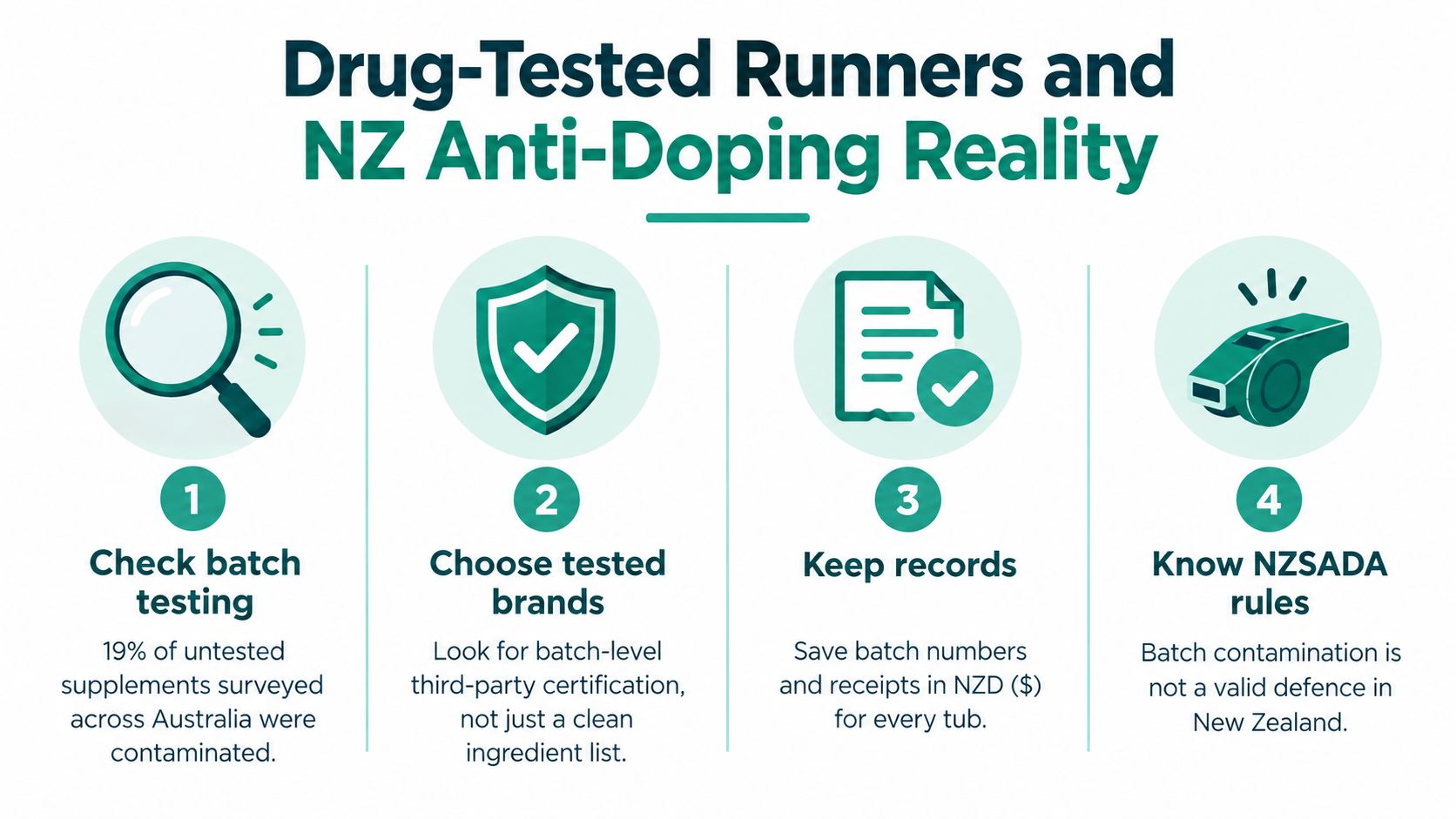
Start with the label, but do not stop there. Informed Sport, Informed Choice, NSF Certified for Sport, and HASTA are useful third-party certification schemes. They reduce risk. They do not remove it. If you ever see “WADA approved” on a supplement, treat that as a red flag, because WADA does not approve supplements.
Good compliance is boring. That is why it works.
Keep a screenshot of the product page. Photograph the tub and batch number. Save the receipt. Log the date you started, the dose you used, and the reason you added it. If your sport body or sports dietitian gives guidance, keep that too. Global DRO is for medications, not supplement certification, so do not use it as proof that a creatine product is safe for sport.
Watch this short explainer before adding a supplement to a tested athlete's routine:
If you want a practical buying filter, use this guide to batch-tested creatine options in NZ. Then do your own paperwork properly. For tested runners, the safest creatine is the one with credible certification, traceable batch details, and records you can present.
Powder Versus Gummies and What NZ Supps Stocks
For most runners, powder is the straightforward choice. A single-ingredient micronised creatine monohydrate makes the dose clear, mixes into a meal or drink and avoids the extra ingredients that can appear in flavoured or stimulant-containing blends.
Gummies have one advantage: convenience. They can suit travel or runners who repeatedly forget a scoop. But the label dose decides whether they work. If one serve doesn't provide the full intended amount, you need to count the gummies accurately rather than assuming the format is equivalent.
NZ Supps stocks micronised creatine powders and creatine gummies, with product pages showing ingredient information and per-serve pricing. Use the creatine collection to compare the current range before buying.
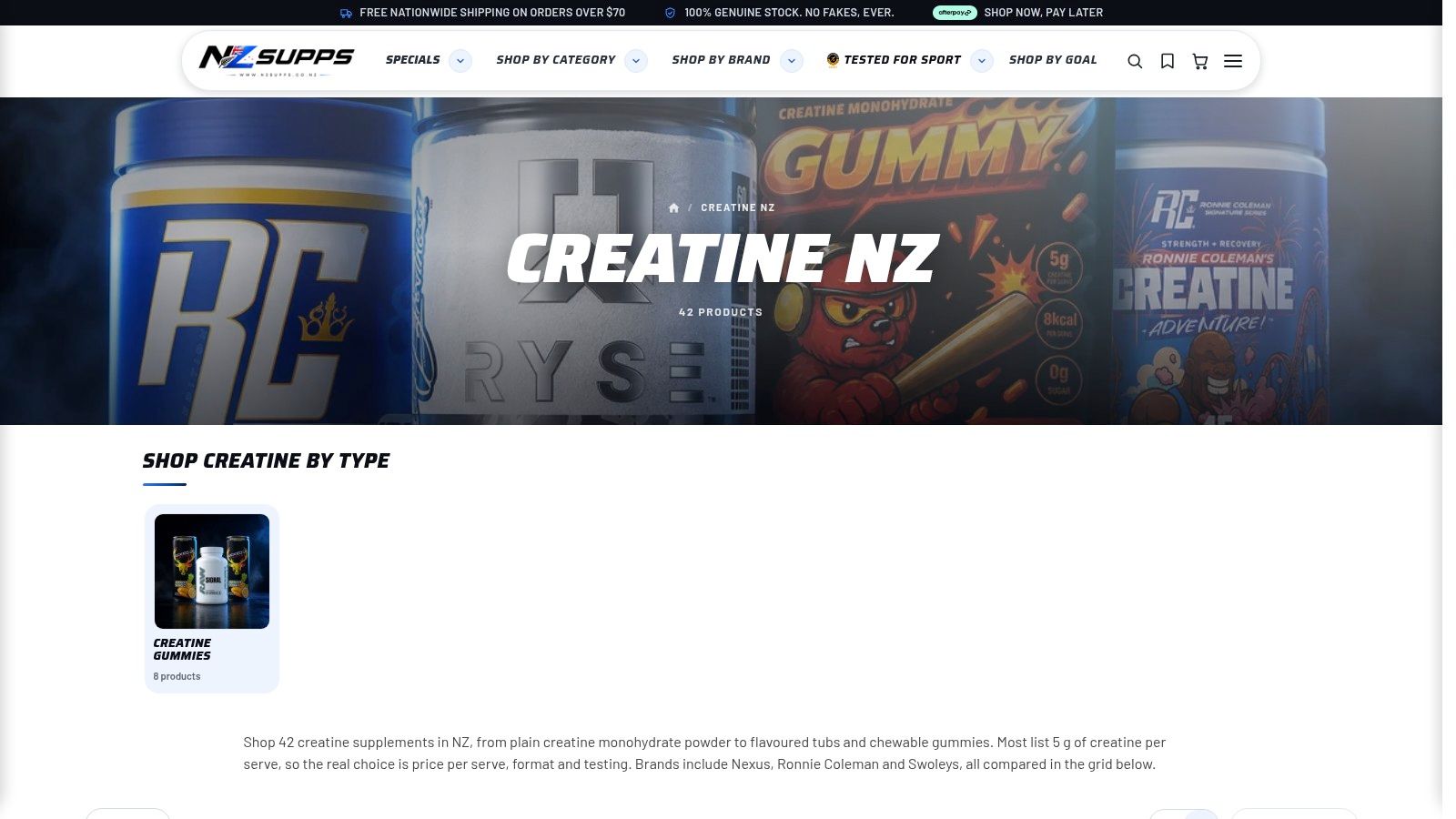
Creatine formats NZ Supps stocks
| Format | Typical serve | Creatine per serve | Price per serve | Best for |
|---|---|---|---|---|
| Micronised monohydrate powder, unflavoured | Follow product label | Follow product label | Check current product price | Daily use and flexible mixing |
| Micronised monohydrate powder, flavoured | Follow product label | Follow product label | Check current product price | Runners who prefer a prepared drink |
| Creatine gummies | Follow product label | Follow product label | Check current product price | Travel and runners who forget scoops |
For a runner wanting a plain daily option, compare the micronised creatine monohydrate powder. If convenience is the deciding factor, review the creatine gummies and check how much creatine the full serving provides.
Don't compare tubs by sticker price alone. Divide the price by the labelled number of serves, then check the creatine amount per serve. The cheapest-looking product isn't necessarily the cheapest way to reach your daily dose. For the practical differences between formats, read creatine gummies versus powder in NZ.
Stacking Creatine With Protein, Electrolytes, and Pre-Workout
Creatine works best as part of an organised training routine, not as a random addition to every drink. Keep the roles separate so you know what each product contributes.
Protein is useful around hard sessions when a meal isn't practical or when your daily food intake falls short. Choose a clearly labelled product and use it for convenience, not because a shake can replace a sound training diet. Runners who tolerate dairy can compare the whey protein range, while plant-based runners should check the ingredient panel for a suitable alternative.
Electrolytes fit long, hot or heavily sweaty sessions. They don't replace ordinary hydration planning, and they aren't a reason to take creatine at a particular time. Compare electrolytes for NZ training by serving information and ingredients rather than bright flavour claims.
Keep pre-workout for quality work
Pre-workout belongs with intervals, hill sessions or gym work when you already know how you respond to stimulants. It isn't necessary for every easy run, and a stimulant-containing formula can complicate sleep, gut comfort and race preparation.
Use the pre-workouts available in NZ to compare high-stim, low-stim and non-stim options. Read the full label before combining products, particularly if your flavoured creatine contains caffeine or other active ingredients.
A single-ingredient monohydrate is easier to assess than a proprietary blend. Look for the exact creatine amount, the full ingredient list, the serving size and any tested-for-sport certification. Then compare price per serve, not just the tub price.
Avoid stacking a pre-workout that already contains creatine with a separate scoop until you've added the amounts together. Under-dosing is common when a runner assumes the product's front label tells the whole story. Overcomplicating the stack also makes it harder to identify a gut reaction or a change in training feel.
FAQs and the Runner's Decision Checklist
Are gummies as effective as powder?
They can be, if the full serving provides the same labelled creatine dose. If each gummy only supplies 1 to 2 g, you need enough gummies to reach your intended daily amount. Powder is usually easier to measure and evaluate.
Do I need a loading phase?
No. Take 3 to 5 g daily, including rest days. Consistent use reaches saturation within two to three weeks, so loading isn't required for a normal training block.
Should I take creatine in race week?
Don't start it in race week. If you've already used it consistently and it agrees with you, there's no automatic reason to stop. Race week is for repeating a tested routine, not introducing a new variable.
Is creatine suitable for drug-tested NZ runners?
It can be, provided you choose a sealed product with independent batch testing and document the exact batch. Don't rely on a clean ingredient panel, an unknown overseas seller or a claim that a supplement is “WADA approved”.
Before buying, answer these questions:
- Do my sessions include hills, intervals, sprints or strength work?
- Can I accept possible body-mass change for my event?
- Will I take 3 to 5 g consistently?
- Can I verify the product, batch and certification?
- Have I tested it well before race week?
If the answer is no to the first two questions, spend your money on food, training structure and recovery before adding creatine.
NZ Supps offers NZ-held creatine powders and gummies, ingredient-led product comparisons and a Tested for Sport filter for runners who need a more organised buying process. Visit NZ Supps to compare current creatine options, check per-serve details and build a supplement routine that fits your training calendar.