SHOP NOW, PAY LATER









 Informed Sport
 Informed Choice
 NSF Certified for Sport
 HASTA Certified

You're leaving the gym, dinner's still a way off, and the bars on your phone all promise something different: the best protein bars for muscle gain are the ones that fill your actual protein and energy gap at a sensible cost. For competitive athletes, that choice also needs an exact-batch anti-doping check, not just an impressive protein number.
A compact protein serving might solve your problem. But if you're struggling to eat enough across the day, choosing the lowest-calorie bar could work against the reason you're buying it.
Table of Contents
- Compare Protein Bars Before You Buy
- Read Labels for Protein Density and Value
- Choose Between Dense Protein and Meal Style Bars
- Inspect Protein Sources and Ingredient Red Flags
- Build a Protein Bar Strategy Around Training
- Apply Anti Doping Checks for Competitive Athletes
- Make a Final Protein Bar Decision
Compare Protein Bars Before You Buy
You've trained after work and need something before dinner. A bar that adds useful protein without replacing dinner could fit neatly. On another day, you've missed lunch while travelling, and the same small bar might leave a much larger energy gap unresolved.
Those are different buying decisions. Rank bars against the eating occasion, not against a universal winner. Protein quantity matters, but so do calories, carbohydrate, ingredient tolerance and what you pay for the protein you receive.
Start with the protein bars available to compare, then check the exact flavour and pack size. Under MPI's retail food-labelling guidance, nutrition quantities appear per serving and per 100 g, allowing you to compare bars of different sizes.
NZ Supps protein bar comparison
Quest Protein Bars, Grenade Protein Bars and MusclePharm Combat Sport Bar are relevant products to investigate. However, current product-page URLs, complete flavour-specific panels and live prices aren't available to verify, so they can't support an honest numerical ranking.
| Product | Serve size | Protein | Calories | Key ingredient amounts | Price per serve | Cost per 10 g protein |
|---|---|---|---|---|---|---|
| Quest Protein Bars | Check exact flavour label | Not verified | Not verified | Check declared sources and quantities | Check current pack price | Calculate after price and protein are confirmed |
| Grenade Protein Bars | Check exact flavour label | Not verified | Not verified | Check declared sources and quantities | Check current pack price | Calculate after price and protein are confirmed |
| MusclePharm Combat Sport Bar | Check current label | Not verified | Not verified | Check declared sources and quantities | Check current pack price | Calculate after price and protein are confirmed |
These are comparison candidates, not ranked recommendations. A brand-level description isn't enough to establish the contents, value or certification of the particular bar you'll receive.
Buying rule: If the price, serving definition or nutrition panel is missing, leave the ranking unfinished rather than guessing.
Compare the format as well as the flavour
If convenience is your main reason for buying a bar, include other protein formats in your decision. Peak Performance's guide to match protein powder to your goals offers another framework for considering that choice, although it doesn't establish any bar's label values.
My recommendation is to shortlist by purpose first: compact protein, additional energy, dietary suitability or competition use. Only then compare prices. Otherwise, you can end up paying more for a technically impressive bar that solves the wrong problem.
Read Labels for Protein Density and Value
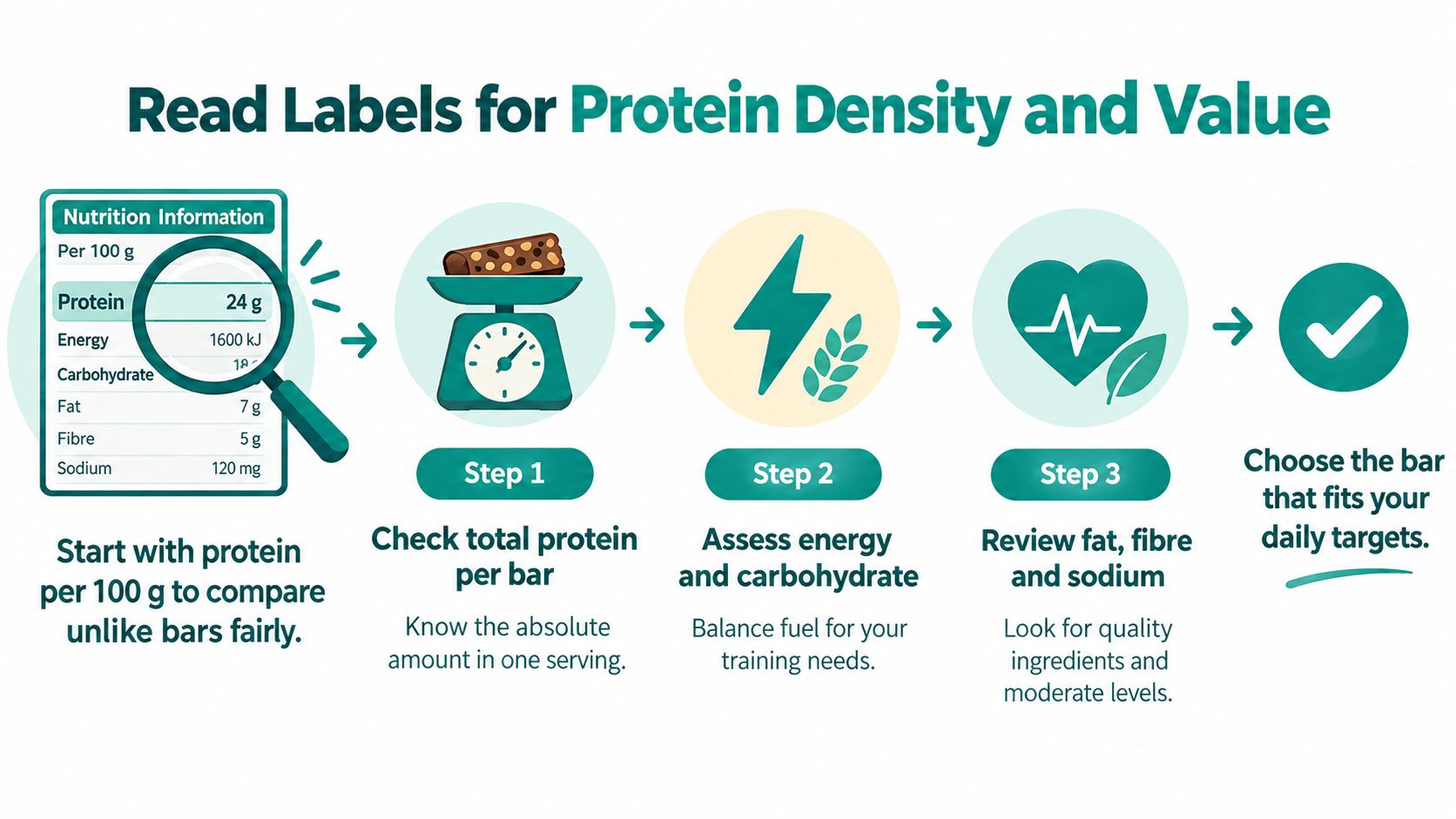
A larger bar can contain more protein without being more protein-dense. Protein per serve tells you what you'll eat; protein per 100 g tells you how concentrated it is. Neither figure replaces the other.
The infographic below summarises the label-reading sequence. Treat the final choice as a match to your own eating plan, rather than a search for universally “moderate” nutrient levels.
Put unlike bars on the same basis
Use the actual packet figures in these calculations. They work for different serving sizes without requiring an invented example.
- Protein density: Divide protein grams per serve by serving weight in grams, then express the result per 100 g.
- Price per serve: Divide the pack price by the number of labelled servings, not automatically by the number of wrappers.
- Cost per 10 g of protein: Divide the price per serve by protein grams per serve, then multiply by 10.
- Protein per calorie: Divide protein grams by calories per serve. Use this as a description of the bar, not an automatic quality score.
For two differently sized bars, calculate each density separately before comparing them. If the larger bar supplies more protein but has lower density, you're buying more total food, not necessarily a more concentrated protein source.
Then calculate your remaining daily protein gap and divide it by the protein in the bar you're considering. That gives the mathematical contribution required, not a recommendation to meet the whole gap with bars.
Check whether there's a gap to fill
The New Zealand adult nutrition evidence reported median usual protein intakes of 102 g daily for males and 71 g for females, with 98% of adults meeting the recommended average requirement. Those population findings don't establish an individual athlete's ideal intake, but they do challenge the assumption that everyone needs extra protein products.
A bar earns its place by improving a specific eating occasion, not simply by adding protein to an already adequate day.
Don't let front-of-pack wording settle the decision. “High protein” doesn't tell you the price efficiency, carbohydrate contribution or suitability for your routine. Record those separately, and treat undisclosed ingredient quantities as unknown rather than filling in the blanks yourself.
Choose Between Dense Protein and Meal Style Bars
A dense protein bar and a meal-style bar can both be sensible choices. The difference is what you need alongside the protein, particularly when your next meal is uncertain.
Think of the choice as part of a broader eating pattern, rather than a contest between snack labels.

When compact protein makes sense
If your meals already supply the energy and carbohydrate you've planned, a protein-focused bar may be the more precise addition. You're buying a predictable contribution in a convenient format, not trying to cover a missed meal.
That doesn't make the lowest-calorie option automatically better. For someone deliberately adding food to support muscle gain, minimising energy can be an unnecessary restriction.
When more food is the better fit
A meal-style bar with more carbohydrate and energy may suit a travel day or a gap between substantial meals. But the phrase “meal-style” shouldn't persuade you that the product replaces everything you'd normally eat.
The New Zealand Food Composition Database covers more than 3,400 foods, recording protein alongside carbohydrate, fat, fibre, sodium and other nutrients. That broader approach is useful: compare the bar with realistic alternatives, not just other bars.
- Protein already covered: Choose according to the energy or carbohydrate contribution you still need.
- A substantial meal gap: Consider whether the bar needs accompanying food.
- A smaller protein contribution: Pairing a bar with milk, yoghurt or a normal meal may fit better than paying for a larger headline number.
- Known ingredient intolerance: Favour a formulation you already tolerate, particularly near training.
Use the video as additional viewing, not as evidence of a particular product's current composition.
For the convenience-versus-cost question, compare protein bars and protein shakes for value. My preference is to pay a convenience premium only when it solves a real access problem. If you're already home with food available, the wrapper itself adds little practical value.
Inspect Protein Sources and Ingredient Red Flags
Turn the packet over before deciding what its protein claim means for you. Look for the named protein source, the full ingredient list and any quantities the manufacturer declares.
A nutrition panel reports total protein. It doesn't necessarily disclose how much comes from each ingredient in a blend, so don't infer proportions that the label doesn't provide.
Separate source information from marketing
For a dairy-containing bar, identify the named milk-derived ingredients rather than relying on a broad description. For a plant-based choice, identify the actual plant sources and check the complete formulation.
If you avoid dairy, inspect the ingredients and relevant allergen statements. If you want a vegan product, check the whole bar, including coatings and other ingredients, rather than assuming a plant protein source settles the question.
- Declared source: Can you identify what supplies the protein?
- Blend transparency: Are individual quantities disclosed, or only a combined blend?
- Dietary fit: Does the complete ingredient list meet your requirements?
- Added ingredients: Are there active ingredients you didn't intend to buy?
A missing ingredient amount is an information limitation, not proof of poor quality. But it does limit how confidently you can compare that formula with a more transparent alternative.
Review the whole panel
The New Zealand food-labelling framework discussed in the British Journal of Nutrition separates protein from energy, fat, saturated fat, carbohydrate, sugars and sodium. Read those entries together instead of treating the protein line as the entire assessment.
Check fibre and sweeteners too, especially if you already know certain formulations don't agree with you. The guide to sugar alcohols in protein bars is useful background when reviewing that ingredient list; it shouldn't replace your own tolerance history.
Ingredient check: An unfamiliar name isn't automatically a red flag. An unanswered question about something you need to avoid is a reason to pause.
Before adding a bar to your regular shop, make sure you can explain why its source, formulation and overall nutrition suit you. “The packaging looked cleaner” isn't a substitute for that assessment.
Build a Protein Bar Strategy Around Training
Start with the day, not the workout finish time. The New Zealand Institute of Health and Fitness identifies 1.2 to 1.7 g of protein per kilogram of body weight daily as meeting the needs of most athletes, while noting that increased needs are often met through greater total food intake.
Use that guidance as a planning benchmark, with individual advice where appropriate. It's not a reason to add a bar before checking what your meals already provide.
The graphic illustrates a planning sequence, but its higher target range and fixed post-workout timing aren't the recommendations used in this guide. Follow the cited daily benchmark and your actual meal schedule rather than treating the graphic's timing as compulsory.
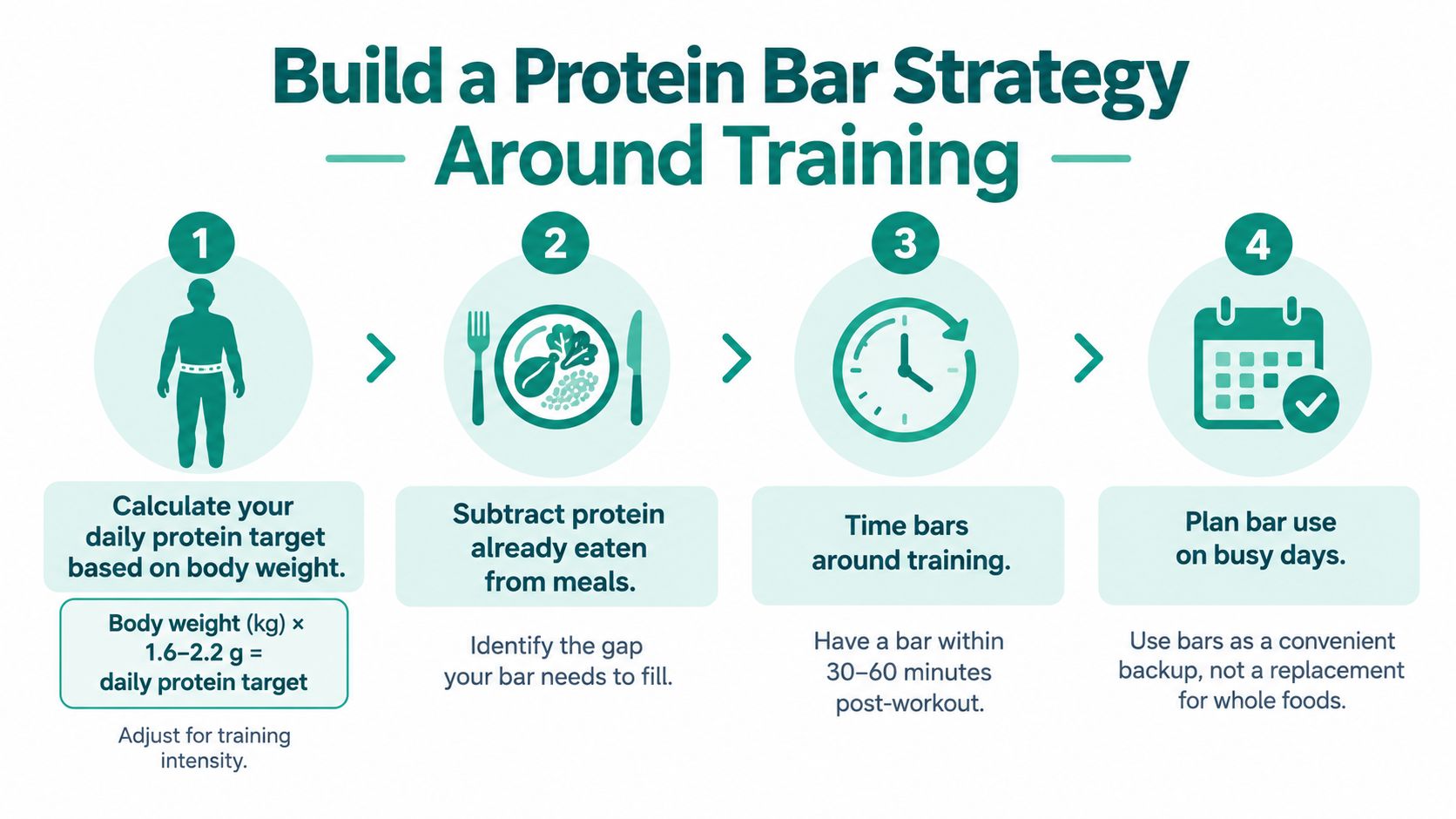
Calculate the job before buying the bar
Multiply body weight by the relevant daily protein benchmark. Subtract the protein you expect from meals and other planned food, then assess whether there's a meaningful gap.
Keep the units consistent: body weight in kilograms and protein in grams. Use actual food and label information rather than assuming every lunch or dinner contributes the same amount.
Remaining protein gap = daily protein target minus protein already planned from food.
The calculation also helps expose an unnecessary purchase. If meals already cover your target, buying a higher-protein bar may add convenience or enjoyment, but it isn't filling a protein shortfall.
Match the plan to the day
- A gym-goer with a low-protein lunch: Consider improving lunch first. If that isn't practical, a bar between meals can provide a predictable contribution.
- A strength trainee travelling for work: Pack a suitable bar as backup for uncertain food access. Decide what accompanying food you'll need if a meal is delayed.
- Someone trying to add energy: Use the bar as an addition rather than unconsciously replacing another snack or reducing dinner.
Don't build the routine around an assumed narrow post-workout deadline. A practical reason to eat a bar after resistance training is that a normal meal isn't available, not that its wrapper creates a special muscle-building opportunity.
Before a busy day, identify the likely gap and choose the serving to match it. Afterwards, check whether it helped you follow the plan or merely displaced food you would otherwise have eaten.
Apply Anti Doping Checks for Competitive Athletes
For a drug-tested athlete, a strong nutrition panel isn't enough to complete the buying decision. Nutritional suitability and prohibited-substance risk are separate questions.
HPSNZ reports 19% contamination in a survey of untested sports supplements available in Australia and New Zealand. That finding concerns untested sports supplements, not a measured contamination rate for protein bars specifically.
The Sport Integrity Commission's supplement guidance warns that athletes remain strictly liable for prohibited substances found in their samples. Familiar branding, natural-looking packaging and an ordinary snack format don't establish anti-doping safety.
Check the product and the exact batch
Use a separate risk-reduction process before accepting a bar into your competition routine:
- Inspect every ingredient: Include active ingredients, flavouring components and blends. Ask about anything you can't identify.
- Check the product: Follow relevant New Zealand supplement guidance rather than relying on a retailer description alone.
- Inspect certification scope: Confirm whether the testing addresses prohibited substances, not merely nutritional label accuracy.
- Match the batch: Obtain documentation corresponding to the exact lot number on the product you'll use.
- Keep records: Retain the packaging and certificate until the product is finished.
Tested for Sport filtering can help you identify products associated with Informed Sport, Informed Choice, NSF Certified for Sport and HASTA. Treat those names as starting points for checking the applicable programme, product and documentation, not as interchangeable assurances.
Don't confuse reduced risk with no risk
Independent testing reduces risk but doesn't eliminate it. A certificate for another batch, another flavour or another product isn't the documentation you need for the bar in your hand.
Brand trust can help you choose where to investigate. It can't replace exact-product and batch verification.
Use the explanation of how supplements are tested for banned substances to understand the checks. Competitive athletes should also seek advice from a doctor or sports dietitian before using supplements.
If the documentation can't be matched, don't describe the product as cleared. An attractive price or protein figure doesn't resolve that missing evidence.
Make a Final Protein Bar Decision
The most useful purchase is often the bar that improves an awkward eating occasion, not the one with the biggest number on the front. Choose a role first, then choose a product that can demonstrate it fits.
An Auckland study of 327 community-dwelling older adults found that 56.6% of men and 61.7% of women fell below its eating-occasion protein threshold. That population isn't interchangeable with gym-goers, but the finding illustrates why a daily total can conceal uneven meal-level intake.
Use a final checkout check
Return to your comparison and confirm the details for the exact product you're buying:
- Serving definition: Check what the listed serving includes.
- Nutritional fit: Review density, serving contribution and the energy or carbohydrate you need.
- Value: Use the current pack price in your protein-cost calculation.
- Ingredients: Confirm dietary suitability and familiar tolerance.
- Competition requirements: Resolve the relevant documentation before purchase.
For a compact protein contribution, favour a bar that provides the required amount without unnecessary bulk. When you need additional energy or carbohydrate, a meal-style option may fit better. For vegan or dairy-avoiding shoppers, ingredient suitability is a condition of purchase, not a minor tie-breaker.
The best value isn't the cheapest wrapper. It's the suitable serving you'll actually use for the purpose you bought it.
The best protein bars for muscle gain are therefore conditional winners. Without current labels, prices and applicable batch records, a confident brand ranking would be less useful than an honest shortlist.
Buy the bar that makes your eating plan easier to follow. Don't expect any single snack to compensate for a poorly organised diet or training routine.
NZ Supps offers protein bars alongside other protein formats, with comparison tools and Tested for Sport filtering to help narrow your options. Visit NZ Supps to check the current range, compare the exact flavour's label and price, and request batch information where your sport requires it.