SHOP NOW, PAY LATER











 Informed Sport
 Informed Choice
 NSF Certified for Sport
 HASTA Certified


Between meetings, between sets, or heading out the door, a biscuit can be the easiest thing to grab. Whey protein bars are a convenient, portion-controlled way to add animal protein between meals or around training, but they aren't a meal replacement. The protein bars range is worth browsing if portability is the job. The useful question isn't whether a bar is marketed as high protein, it's whether its label, size and price suit the moment you need it for.
Table of Contents
- Are Whey Protein Bars Worth Using
- What a Whey Protein Bar Actually Is
- How Much Protein You Actually Get
- Dairy, Allergens and the NZ Label
- When a Whey Protein Bar Makes Sense
- Picking a Bar That Actually Pays Off
- The Honest Take on Whey Protein Bars
Are Whey Protein Bars Worth Using
Yes, when portability is the job. A bar stays in your bag, needs no shaker and no fridge, and comes with a declared Nutrition Information Panel you can check before you buy. That earns its place between a work meeting and training, or on a day when your next proper meal is hours away.
A bar is not automatically better than yoghurt, eggs or a scoop of whey with water. Ordinary food brings protein plus other nutrients, while a bar is a packaged snack whose ingredients and energy vary by product. National HealthEd guidance frames high-protein supplements as concentrated protein sources for people who train, not a universal requirement, so treat the bar as a tool for a specific gap rather than a daily default.
My rule: Buy a bar for the job it does. If you need something portable and portioned, it can make sense. If you're near a kitchen and have time for food, compare it with that instead.
Judge a bar by its protein per serve, protein density, sugar, energy, ingredients and price per serve, not by the size of the "high protein" claim on the wrapper. Two bars can sit side by side on the shelf and do completely different jobs.
The label comparison method below works for any bar on the shelf, and the products referenced are ones available through NZ Supps.
What a Whey Protein Bar Actually Is
A whey protein bar is a packaged bar that uses whey, a milk-derived protein, as a main protein source. On labels, whey usually appears as concentrate or isolate, and in a finished bar it sits alongside whatever gives the product its texture and taste: syrups, fibres, fats, coatings, flavourings, sweeteners. The ingredient list tells you what is in the bar. The Nutrition Information Panel tells you what the bar delivers.
Read both. I do, every time, because the front of the wrapper tells you almost nothing.
A plant-based bar swaps dairy protein for sources such as pea, soy or rice. A standard snack bar leans on oats, fruit, nuts or syrup, and often carries far less protein than a bar built around a protein ingredient. Those categories overlap heavily in taste and texture, so a wrapper's style is a poor guide to a bar's nutritional role.
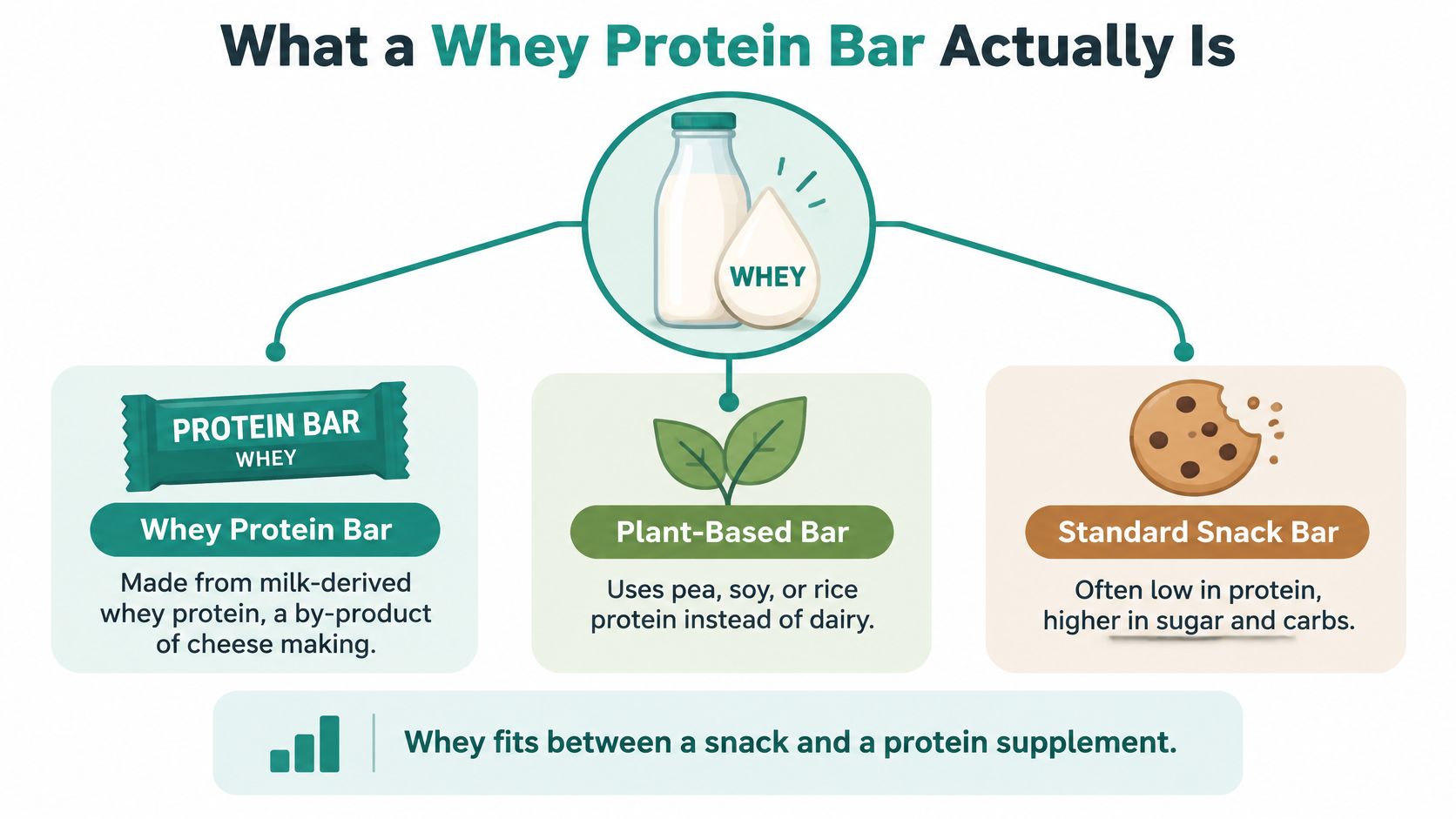
The useful comparison is source, convenience and composition. Whey powder is a protein ingredient you mix yourself, with little else in the scoop. A whey bar takes a similar protein source and packages it with other ingredients in a ready-to-eat format. A plant-based bar gives you a non-dairy protein, and its sugars, fats and energy still need checking on the panel. A snack bar can be a perfectly reasonable snack without being a concentrated protein product at all.
New Zealand's FOODfiles database records nutrients in foods eaten locally, but a finished bar's own panel is the right source for its declared nutrition. Syrups, fibres, fats and coatings can shift a bar's profile well away from any generic reference entry, so compare products on what their labels declare.
The practical takeaway: a whey protein bar is a tool with a job, not a lifestyle product. If ordinary food already covers your day, training alone is not a reason to add one.
How Much Protein You Actually Get
The front of the wrapper shouts one protein number. The Nutrition Information Panel is where you find out what it means. Read protein per serving first, then check the per-100 g column, which puts bars of different sizes on the same footing. Twenty grams in a small bar is a different proposition to twenty grams in a large one.
Context helps before you compare products. HealthEd reports median protein intakes from the 2008/09 New Zealand Adult Nutrition Survey of 102 g per day for men and 71 g for women aged 19–70, against recommended dietary intakes of 64 g and 46 g respectively, while males aged 14–18 recorded a median of 107 g per day against a recommended 65 g (HealthEd's protein supplement guidance). Those figures describe a population, so don't treat them as your target. If you want a daily number that fits your training and bodyweight, use this guide to how much protein per day in NZ.
Among the bars NZ Supps stocks, the headline protein figures sit close together. Quest Bars list 21 g of protein from a milk and whey isolate blend, and Grenade Protein Bars list approximately 20 g from a casein and whey blend. Serve weight, sugars, energy and price all shift between flavours, so pull those off the pack or the current product listing.
| Bar | Protein per serve | Protein blend | Serve size | Sugars |
|---|---|---|---|---|
| Quest Bar | 21 g | Milk and whey protein isolate | Varies by flavour | Varies by flavour |
| Grenade Protein Bar | Approximately 20 g | Casein and whey blend | Varies by flavour | Varies by flavour |
Two calculations turn those labels into a real comparison. Protein density is protein per serve divided by serve weight, times 100. Cost per gram is the bar's price divided by its grams of protein. Say a bar weighs 60 g, carries 21 g of protein and sells for $4.50: that works out to 35 g of protein per 100 g and roughly 21 cents per gram. Run the same maths on any two bars on the shelf and the stronger option usually shows itself.
Chasing the biggest protein number is a trap. A smaller bar often wins on protein density and cost per gram, and it leaves more room for the rest of your day.
Dairy, Allergens and the NZ Label
Whey protein comes from milk. A whey bar may also list ingredients such as milk solids or casein, so it isn't suitable for someone with a milk allergy. Lactose intolerance is different from a milk allergy, but don't assume a whey bar is low in lactose just because it contains protein. Check for an explicit lactose-related claim and ask the manufacturer if the label doesn't answer your question. This guide to protein powder and lactose intolerance can help clarify what to look for.
Read the current package, not an old review or a retailer description. New Zealand Food Safety recalled Snack Switch Plant Protein Bars after undeclared milk was identified, a reminder that a plant-based description alone doesn't establish allergen safety (Snack Switch recall information). If you have a serious allergy, check the ingredient and allergen statements carefully and contact the manufacturer if anything is unclear.
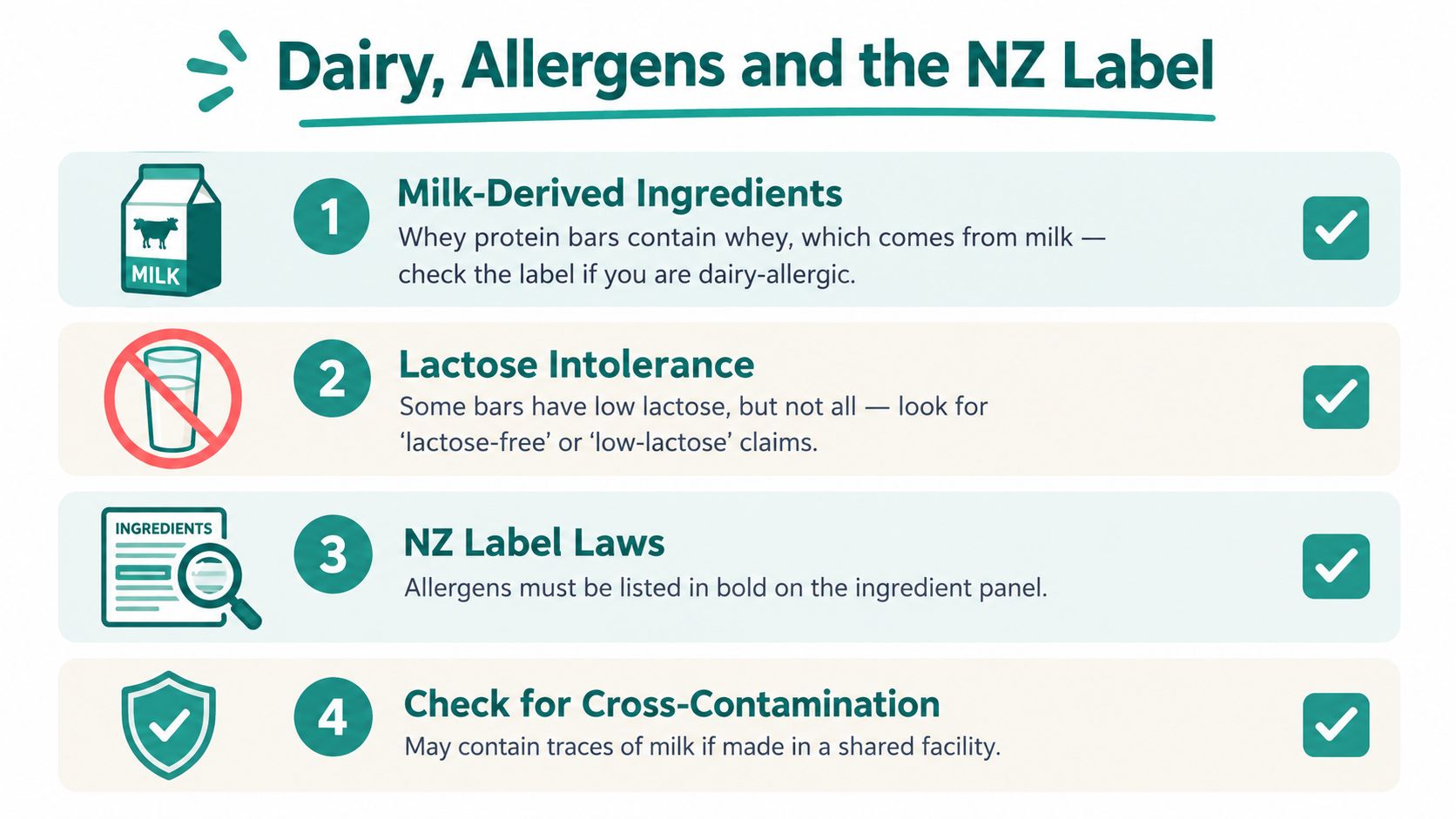
New Zealand's supplemented-food rules also give you practical checks. A package must prominently identify the product as a supplemented food, describe its true nature, and show the supplier's name and New Zealand business address (Food (Supplemented Food) Standard 2016). Look for a clear product identity and supplier details before buying.
Read the whole panel
The Nutrition Information Panel helps you compare protein, carbohydrate, fat, energy, sodium and sugars per serving and per 100 g. The ingredient list gives another useful clue: ingredients are listed in descending order by weight, so the early entries make up more of the product than those further down. Check for whey concentrate, whey isolate, milk solids, casein and any shared-equipment or cross-contact statement that matters to you.
A front-of-pack claim such as “high in protein” or “low in sugar” isn't a substitute for the panel. MPI says businesses must be able to substantiate nutrition content claims and provide the relevant nutrition information (MPI guidance on reading food labels). If supplier details are missing, the product identity is unclear, or the allergen information doesn't answer your needs, don't guess. Choose another product or ask the supplier for clarification.
When a Whey Protein Bar Makes Sense
A bar earns its place when the format solves a real problem. It's ready to eat, easy to carry and doesn't require you to mix a drink. Whey powder is often the more flexible option if you have water, a shaker and a moment to prepare it. Neither format is automatically better; choose the one that fits the situation and the label facts.
Before training, look at the bar's carbohydrate, sugars, energy and serving size alongside protein. There's no single profile that suits every session or person. If you already have a meal or snack that works, don't add a bar just because it's sold as pre-workout fuel.
After training, a bar can be convenient if a meal isn't available straight away. Compare its declared protein and other nutrients with what you'd get from a shake or food. If you can make a shake, powder lets you choose how much to use; if you're heading straight to work or travelling, a bar avoids preparation.
A desk-side or travel snack is where the format can be especially practical. Keep one in a bag for a delayed meal or a long shift, but judge it as a snack rather than assuming it replaces a balanced meal. The same goes between meetings: the portion is set by the package, but whether the bar suits you depends on its full panel and ingredients.
Drug-tested athletes need batch checks
For athletes subject to anti-doping rules, treat a protein bar as a supplement-risk product, not as automatically safe because it looks like food. Sport Integrity Commission Te Kahu Raunui warns that manufacturing can create cross-contamination risk, and strict liability means an athlete remains responsible for a prohibited substance found in their sample even if contamination was accidental or unknown (Sport Integrity Commission guidance on supplements).
Match the batch number and expiry date on the bar to a certificate from an independent testing programme, such as Informed Sport or Informed Choice, before use. Batch testing increases confidence for the tested batch, but it can't guarantee that every unit is free of banned substances. Keep a record of the product and batch where required for doping-control documentation.
Picking a Bar That Actually Pays Off
Four calculations turn a shelf of bars into a like-for-like comparison: protein density, sugar per 20 g of protein, energy per 20 g of protein, and cost per 20 g of protein. Run all four on every product you consider, because a bar that leads on one measure can trail on another. As noted earlier, New Zealand food-composition data is commonly presented per 100 g, which helps when bars come in different weights, while the package gives you the product-specific numbers.
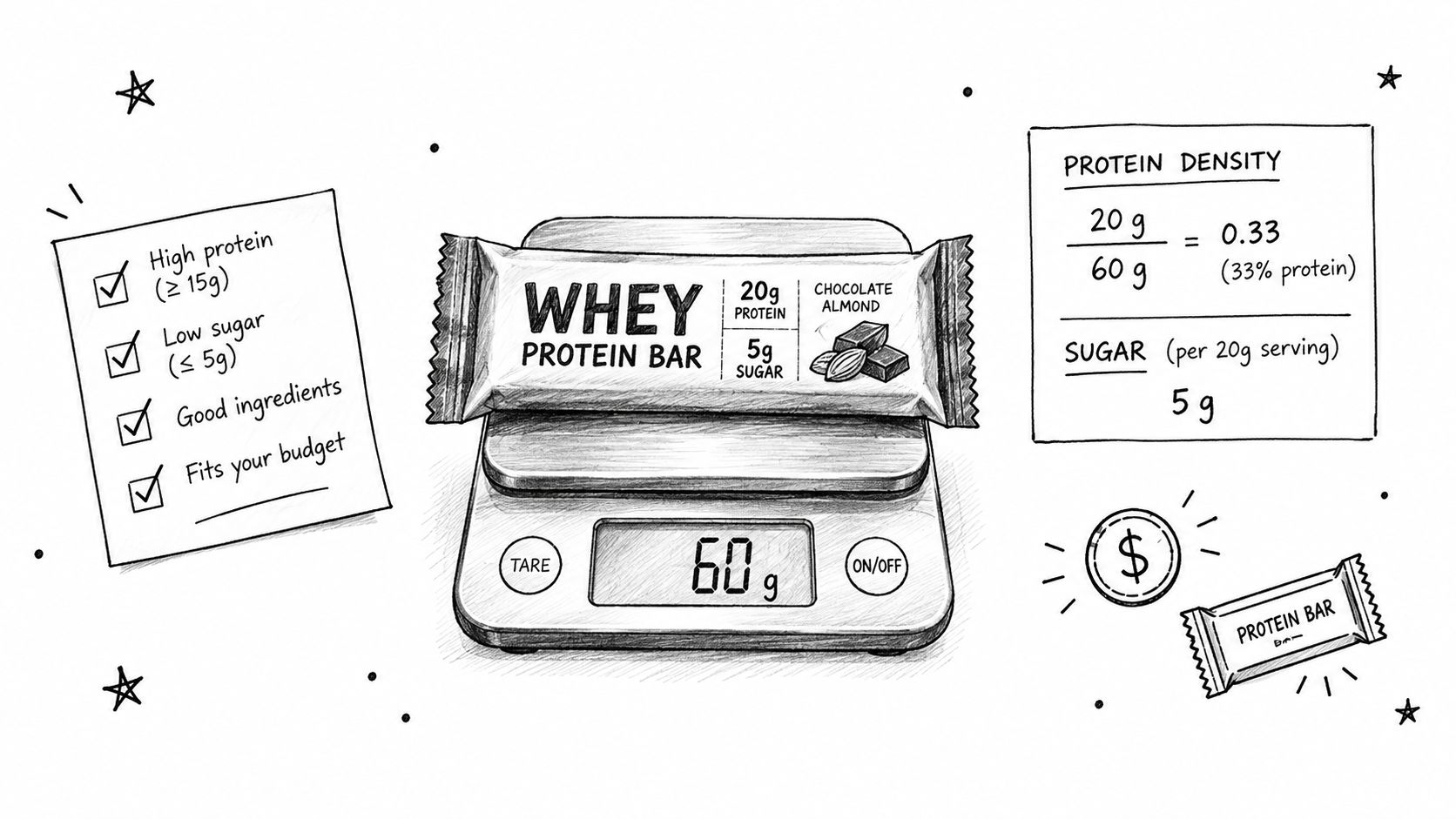
- Protein density: Divide grams of protein by the total bar weight in grams.
- Sugar per 20 g of protein: Divide the bar's sugar by its protein, then multiply by 20.
- Energy per 20 g of protein: Divide the declared energy by protein grams, then multiply by 20.
- Cost per 20 g of protein: Divide the price per bar by its protein grams, then multiply by 20.
The numbers give you a fair comparison before you decide whether you want a compact snack, a higher-energy option or a convenient protein serving. Price per serve is easy to read off a shelf edge. Cost per 20 g of protein is the figure that makes bars of different sizes and protein amounts comparable, since a cheaper bar can still cost more for the protein it delivers. For a fuller look at protein bars versus protein shakes on value, include the preparation and portability that matter in your own routine.
My quick shelf check: confirm the serve size, read protein per serve, compare sugars and energy, scan the ingredients for milk allergens and added fibres, confirm the New Zealand supplier, then weigh the price against the protein delivered. Use the same method for a plant-based bar. Protein source matters, and so does the rest of the panel.
The Honest Take on Whey Protein Bars
More protein on the wrapper doesn't automatically make a bar the better choice. Whey protein bars provide a portable serving of milk-derived protein, while plant bars and whey powder have different ingredients and formats. The right one depends on the job: a portable snack, a protein top-up or an option you can eat when a shake isn't practical.
Check the current label for serving size, protein, sugars, energy, ingredients, allergen statements and supplier details. Then compare protein density and cost using the figures on the pack. That approach beats buying on flavour names or front-of-pack claims alone.
If a bar fits your routine, browse the protein bars collection and compare the current product labels before choosing.
Shop all protein bars at NZ Supps.
NZ Supps offers whey and plant-based protein options alongside bars and snacks, with product information to help you compare ingredients and per-serve value. Browse the range at NZ Supps and choose a format that fits the moment you need it for.