SHOP NOW, PAY LATER














 Informed Sport
 Informed Choice
 NSF Certified for Sport
 HASTA Certified


3 to 5 grams of creatine monohydrate per day is the standard maintenance amount for most adults, taken consistently every day. Take that dose on training days and rest days alike.
But if you're a drug-tested athlete in New Zealand, there's a more important question than how much creatine per day: can you verify the exact batch in the tub you're using? A sensible dose doesn't remove the risk of a contaminated product, so your plan needs to cover both dosing and product selection.
Table of Contents
- The Standard Daily Maintenance Amount
- Loading Phase Versus Gradual Saturation
- Navigating Batch Testing for Drug-Tested Athletes
- Comparing Top Creatine Products in New Zealand
- Safety Considerations and Special Populations
- Building a Consistent Daily Routine
The Standard Daily Maintenance Amount
For most New Zealand athletes and gym-goers, 3 to 5 grams of creatine monohydrate daily is the practical evidence-based range. RNZ reported this range as beneficial across sexes for outcomes including high-intensity performance and recovery, with daily use taken consistently, including on rest days. Read the RNZ explanation of creatine dosing.
This is a maintenance approach, but it also works as a starting protocol. You take a measured amount each day and allow muscle creatine stores to build progressively. Regular daily use takes approximately three weeks to fully saturate body tissues, so missing the occasional workout day and then doubling the next dose isn't the right approach.
Why consistency beats perfect timing
Creatine isn't a stimulant that depends on an immediate pre-training effect. The useful habit is to take the same daily amount often enough to keep stores supplied. A scoop with breakfast, lunch, or a post-training meal can all work if that routine makes missed servings less likely.
The dose applies across male and female athletes who perform high-intensity training. It also avoids a common mistake, treating a larger scoop as automatically more effective. Once a practical maintenance routine is in place, the main decision is whether you need faster saturation, not whether you should continually increase the daily amount.
Practical rule: Choose a clearly labelled creatine monohydrate product, measure the serving accurately, and take it every day rather than only when you lift.
A 300 g container provides approximately 60 to 100 daily servings at 3 to 5 g per serving, before differences in scoop size are considered. If you're comparing forms or labels, this guide to find your best creatine can help you assess monohydrate against alternative formats without confusing the product form with the dose.
Loading Phase Versus Gradual Saturation
Want muscle creatine stores up quickly, or would you rather keep dosing simple and easier to control day to day? That choice matters even more for drug-tested Kiwi athletes, because the protocol has to fit the product-checking routine you can follow.
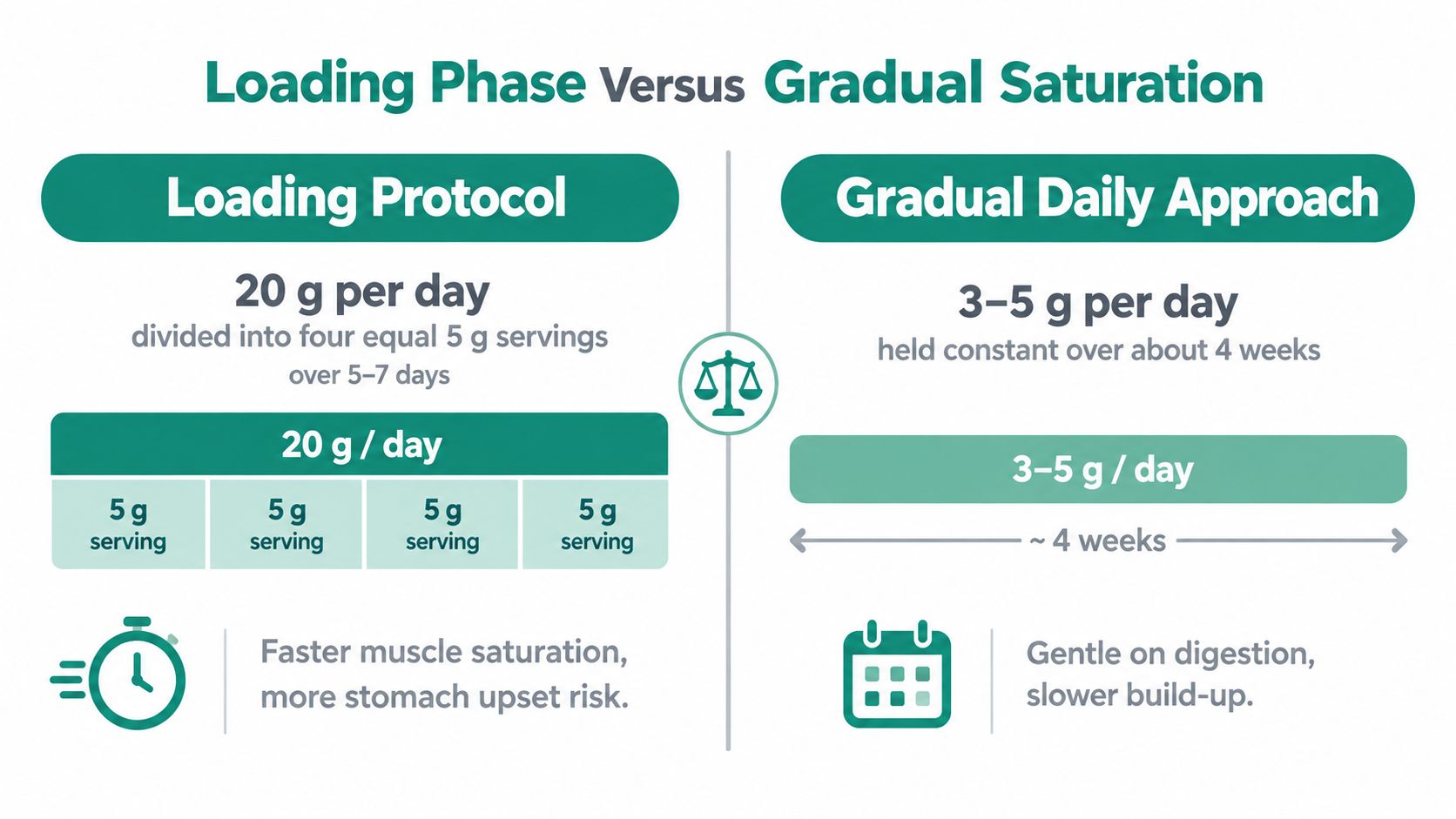
A loading phase is optional. It changes how quickly saturation happens, while the maintenance dose remains the same once loading ends. The commonly used protocol is 20 g of creatine monohydrate per day, split into four 5 g servings, for 5 to 7 days, then reduced to a lower daily maintenance amount. For a practical NZ-focused overview, see this guide to the creatine loading phase.
The two practical options
| Approach | Daily amount | Timeline | Main trade-off |
|---|---|---|---|
| Loading | 20 g, split into four 5 g servings | 5 to 7 days | Faster saturation, greater gastrointestinal discomfort risk |
| Gradual approach | 3 to 5 g | About four weeks, versus roughly three weeks reported elsewhere for full saturation | Slower build-up, simpler routine |
The practical difference is speed versus simplicity. A loading phase can suit an athlete trying to raise stores before a hard training block, travel period, or competition-heavy stretch. It also creates more moving parts. Four servings in a day means more chances to miss a dose, mistime one around training, or irritate your gut if the serves are taken too close together.
The gradual approach is usually easier to execute. One daily serve is simpler on rest days, simpler when travelling, and often simpler for athletes already checking labels, batch details, and certificates before anything goes in the kit bag.
For tested athletes, that real-world trade-off matters. The best dosing protocol is the one you can repeat consistently with a single-ingredient product you have properly vetted, not the one that looks fastest on paper.
Navigating Batch Testing for Drug-Tested Athletes
A daily creatine dose can be physiologically reasonable while the product itself remains unsuitable for a tested sport. New Zealand guidance states that no supplement is approved by WADA or the Sport Integrity Commission, and athletes should verify that the batch certificate exactly matches the product they possess. Review HPSNZ guidance on choosing dietary supplements.
That distinction matters because athletes face strict liability for substances found in their samples. Contamination can occur in New Zealand, and a popular ingredient or natural positioning doesn't guarantee that a finished blend is competition-safe.
A defensible product-checking process
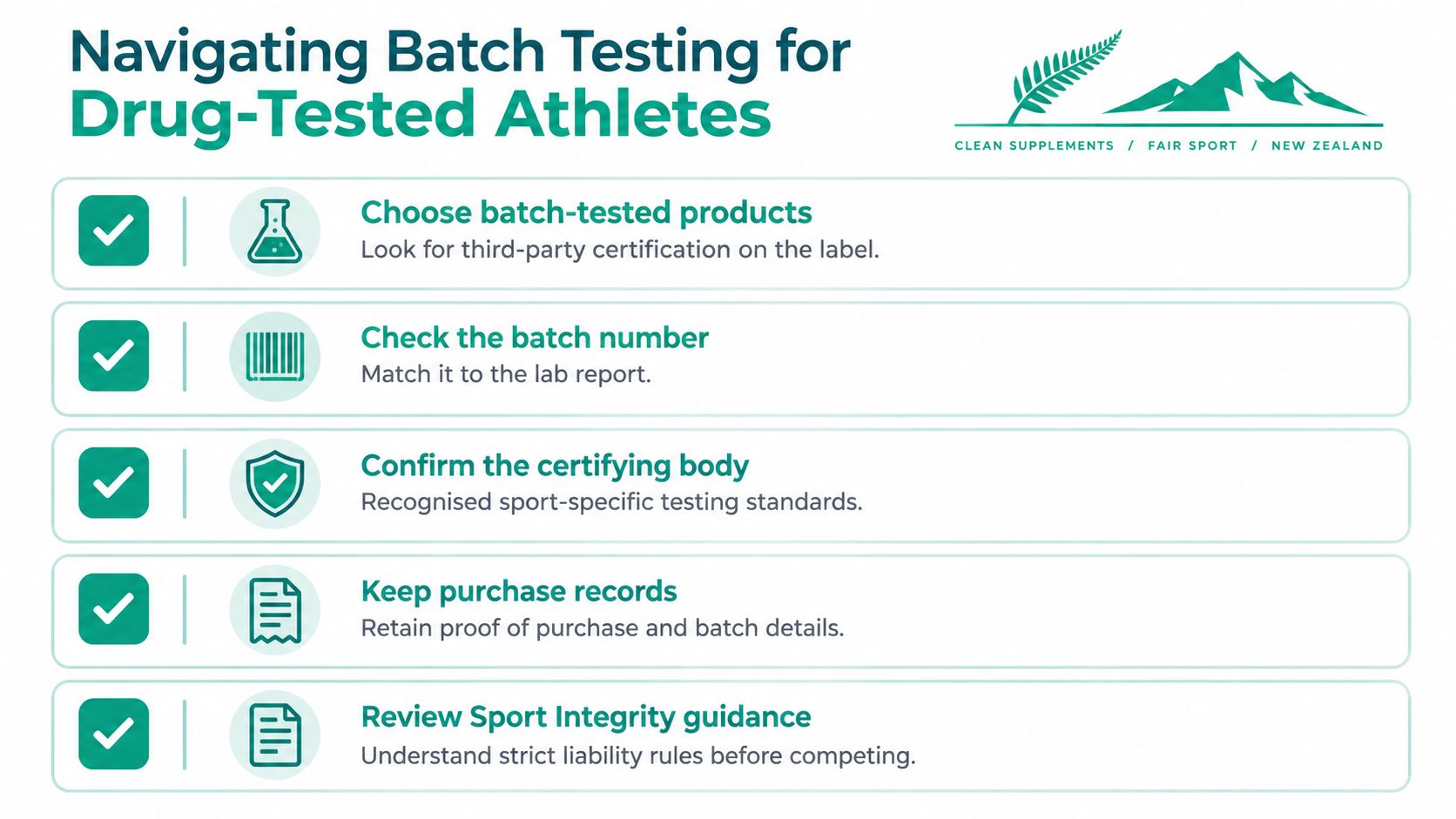
- Choose a batch-tested product. Prefer a single-ingredient creatine monohydrate where possible, particularly if you don't need stimulants, hormones, weight-loss ingredients, or a proprietary blend.
- Match the batch number. The lot printed on the container must correspond to the laboratory certificate. A certificate for another production run doesn't verify the tub in your gym bag.
- Confirm the certifying body. Look for recognised sport-specific testing standards and check the certifier's database when one is available. Informed Sport and HASTA are examples of certification names athletes may encounter, but the label alone isn't the complete verification.
- Keep your records. Retain the sealed container, receipt, product name, and batch details. Documentation won't prevent contamination, but it gives you a clear product trail.
- Check current guidance. Read Sport Integrity information and speak with your sports dietitian or team medical professional if the supplement isn't essential to your programme.
A clean ingredient label answers what the product contains. Batch verification addresses whether the exact container has been tested.
For a more detailed purchasing checklist, use this batch-tested creatine guide for NZ athletes. The lowest defensible dose is usually preferable when it meets your objective, but dose discipline and product verification are separate responsibilities.
Comparing Top Creatine Products in New Zealand
Product choice should start with the label, not the front-of-pack claim. Check the form of creatine, the amount per serving, the number of servings, and whether the exact batch has an independent certification relevant to tested sport.
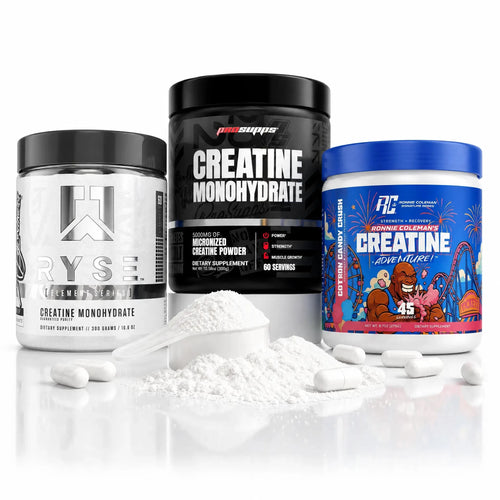
NZ Supps stocks creatine powders and gummies, alongside other sports nutrition formats. You can compare creatine products in NZ by ingredient disclosure and serving information, then assess whether the format suits your routine.
Top Creatine Products Compared
The table below shows the fields that matter when comparing products. A precise price-per-serve comparison requires the current product price and serving count, which can change, so check the live product page before purchase.
| Product | Serve size | Batch tested | Price per serve |
|---|---|---|---|
| NZ Supps creatine monohydrate powder | Check current label | Check product batch certification | Check current product page |
| NZ Supps flavoured creatine option | Check current label | Check product batch certification | Check current product page |
| NZ Supps creatine gummies | Check current label | Check product batch certification | Check current product page |
The unflavoured micronised powder is generally the most straightforward format for a standard 3 to 5 g protocol and can be mixed into water or a shake. A flavoured powder may be easier to use if taste is the barrier, but compare the full ingredient panel rather than assuming every scoop contains only creatine.
Gummies require extra attention to the serving definition. Confirm how many pieces make one serving and how many grams of creatine that serving provides. A product that uses a familiar “serving” size isn't automatically equivalent to a powder serving.
For product-specific comparisons, see the NZ creatine buying guide. If you're drug-tested, filter your options by the exact certification and verify the lot rather than treating all creatine-labelled products as interchangeable.
Safety Considerations and Special Populations
The standard range is intended for most healthy adults, but it isn't a universal instruction for every person or circumstance. Anyone with kidney disease, anyone taking relevant medicines, and anyone who is pregnant or breastfeeding should obtain professional medical advice before using creatine.
Health Canada's monograph describes a loading option of 15 to 20 g per day, with no more than 5 g in a single dose, for 5 to 7 days, followed by 2 to 5 g per day for maintenance. It also describes a gradual option of 3 to 5 g per day for at least four weeks, followed by 2 to 5 g daily, and advises people with a kidney disorder or those who are pregnant or breastfeeding to seek professional guidance. Review the Health Canada creatine monograph.
When the standard range may not be the right starting point
The International Society of Sports Nutrition position stand notes that some larger athletes may need approximately 5 to 10 g per day to maintain full stores, while 3 to 5 g daily remains the standard range for most users. Read the ISSN position stand.
That isn't a reason to increase your dose automatically. Body size, muscle mass, training load, diet, current use, and professional oversight all affect the decision. A larger dose also creates more product cost and may be harder to tolerate, without guaranteeing a greater outcome for the average user.
Don't confuse a creatine-containing pre-workout with a complete creatine protocol. A formula may include creatine in a smaller amount alongside other ingredients, so read the label and calculate the total amount you take across products.
For wider sports fuelling context, an elite football nutrition guide can be useful, but it shouldn't replace individual advice from a qualified practitioner. Stop treating supplement decisions as isolated from training, food, medical history, and drug-testing requirements.
Building a Consistent Daily Routine
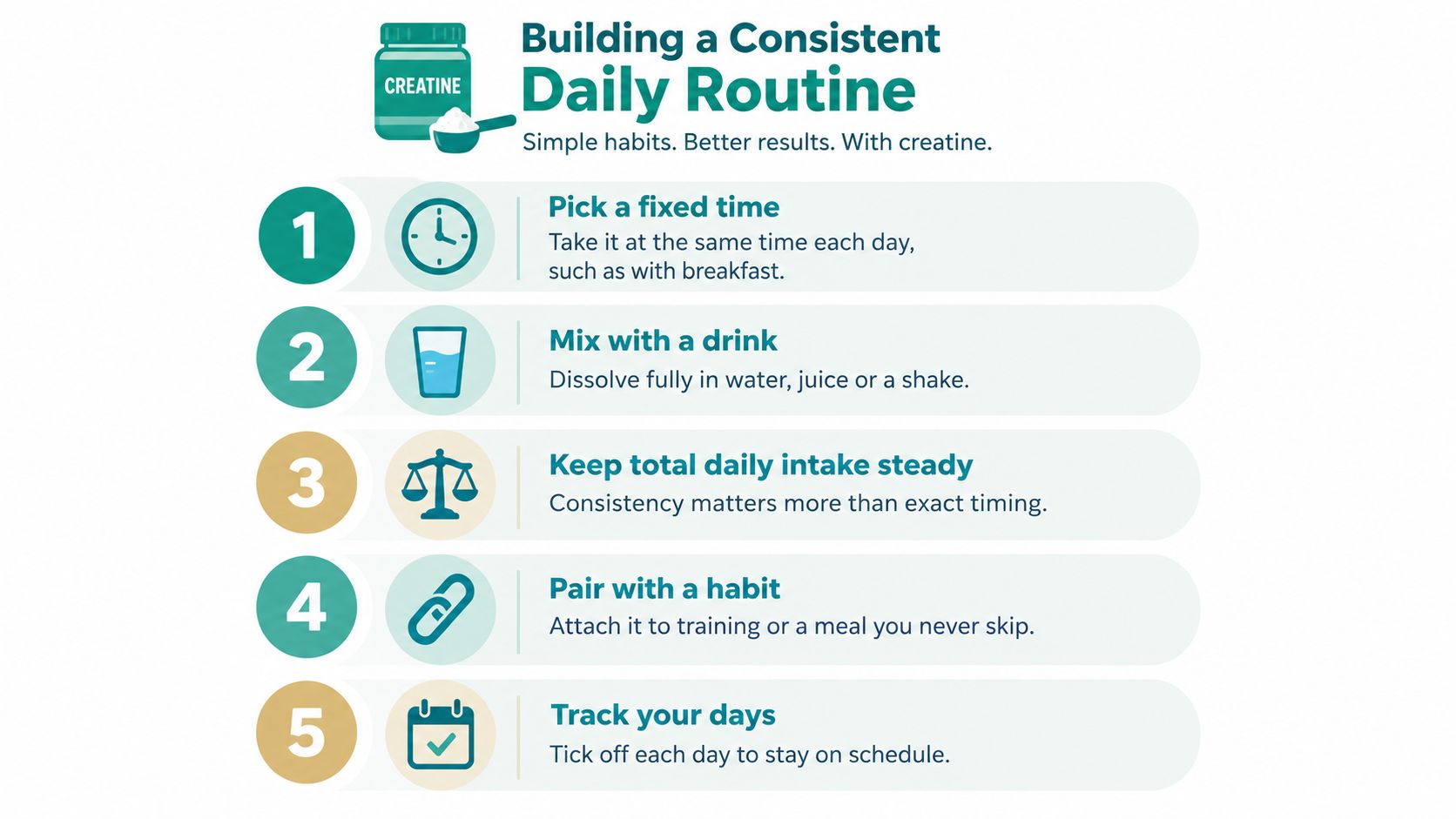
How do you make creatine intake stick when training times shift, work gets busy, or you're away for a weekend meet? Build the dose into something that already happens every day, and make the routine easy to repeat under pressure. For Kiwi athletes who may be tested, that routine also needs to protect product verification. If you swap tubs, travel with loose powder, or forget which batch you opened, you make compliance harder than it needs to be.
Make the routine automatic
- Pick one anchor habit. Put the container beside your breakfast items, shaker, or another item you use every morning.
- Measure the serving. Follow the label and avoid guessing with a rounded or heaped scoop.
- Mix it properly. Micronised powder usually goes down easily in water, juice, or a shake if you stir or shake it well.
- Make rest days foolproof. Muscle stores do not care whether the day includes a gym session, so a breakfast-based habit is often more reliable than tying creatine to training.
- Track the habit. A phone reminder, calendar tick, or supplement log cuts down the usual, "Did I already take it?" problem.
- Keep batch details with the routine. If drug testing applies, store the tub where you can read the lot details easily, and keep a quick photo of the label before travel or repacking.
Perfect timing matters less than repeatability. A single daily maintenance serving is easier to carry, measure, and stick with than a more complicated setup, and that usually wins over time. If a higher intake leaves your stomach unsettled, split it into smaller servings across the day. You do not need to load to build a useful routine.
Start with 3 to 5 g of creatine monohydrate daily, keep the dose steady, and confirm the exact batch if you compete under drug-testing rules. NZ Supps lists creatine powders and gummies with serving details that help you compare formats and check available batch-testing information before you buy. Visit NZ Supps if you want a clearly labelled option to fit that routine.