SHOP NOW, PAY LATER









 Informed Sport
 Informed Choice
 NSF Certified for Sport
 HASTA Certified

A proprietary blend is a mix of ingredients listed together on a Supplement Facts panel under one name, with a combined weight disclosed but no breakdown of how much of each ingredient it actually contains. That single gap is the whole story: you know what’s in the mix and roughly how much it weighs in total, but you can’t tell if a key ingredient is dosed for real effect or barely present. Caution matters most in stimulant-heavy or performance-focused products, where a few hidden milligrams can matter a lot.
TL;DR:
- Proprietary blends list combined weights and ingredient names but do not disclose individual ingredient doses, making it hard to assess efficacy and safety.
- Labelling regulations allow hidden stimulant amounts within blends, but regulators can access exact formulas during inspections and compliance reviews.
- Products with long ingredient lists, high dose categories, or no third-party testing should be approached with caution, especially in dose-sensitive categories like pre-workouts.
- Dividing the total blend weight by the number of ingredients can reveal if most ingredients are likely dosed for effect or are minimal scraps.
- Separately declaring caffeine and transparent testing standards strongly reduces risks associated with hidden stimulant loads.
Table of Contents
- What Counts as a Proprietary Blend?
- Why Manufacturers Use Proprietary Blends
- How Labeling Rules Actually Work
- Risks and Red Flags Worth Knowing
- A Checklist for Evaluating Any Blend
- How Nzsupps Approaches Ingredient Transparency
- Trade Secrets Versus the Right to Know
- Sources
- FAQ
What Counts as a Proprietary Blend?
Under federal labeling rules, a proprietary blend must disclose the identity of every ingredient it contains and the total combined weight of the blend, but not each ingredient’s individual amount. That’s the legal core of it: names, yes; math, no. You’ll see the concept marketed under a handful of interchangeable terms: “blend,” “complex,” “matrix,” or “proprietary formulation.” Different words, same disclosure gap underneath.
Ingredients inside the blend are listed in descending order by weight, meaning whatever appears first theoretically makes up the largest share. That ordering rule comes straight from Perspectives on the Use of Proprietary Blends in Dietary Supplements, a peer-reviewed analysis that also notes proprietary blends show up on a meaningful share of supplement labels in the NIH’s own database, making them far from a fringe practice. Order gives you a hint about priority.
Why Manufacturers Use Proprietary Blends
Trade secret protection is the primary driver. A brand that spends years testing ratios of caffeine, beta-alanine, and coralline doesn’t want a competitor buying one bottle, running a lab test, and cloning the formula by next quarter. Bundling ingredients under a blend name without exact amounts makes reverse engineering slower and more expensive, even when it’s rarely impossible.
Marketing plays a role too. A named blend, something like “Focus Matrix” or “Thermo Complex,” reads as proprietary technology rather than a list of commodity ingredients, and that perception supports premium pricing.
Industry groups defend the practice on those grounds. The Council for Responsible Nutrition argues that the proprietary blend allowance protects trade secrets and encourages formulation innovation, while regulators still retain access to exact formulas during inspections and other compliance activities. That’s a real distinction worth sitting with: the FDA can see what you can’t. The gap isn’t between the manufacturer and the government. It’s between the manufacturer and you.
How Labeling Rules Actually Work
The Dietary Supplement Health and Education Act of 1994, paired with 21 CFR 101.36, is the legal foundation that permits proprietary blends in the first place. Ingredients must be named and listed by descending weight, but only the total blend weight needs a number attached, a structure confirmed by the PMC analysis of proprietary blend labeling.
A few specifics matter more than the general rule:
- Vitamins and minerals regulated under 21 CFR 101.36(b)(2) must show individual amounts even inside a blend. That carve out doesn’t extend to herbs, amino acids, or other dietary ingredients.
- Caffeine sometimes gets separate, declared dosing on the front of the label even when it also sits inside a blend on the back panel. That practice varies by brand, not by law.
- When a blend combines multiple caffeine sources, like guarana, yerba mate, and green tea extract, declared “caffeine anhydrous” amounts may not capture the full stimulant load. That nuance comes straight from the PMC review’s discussion of caffeine sourcing, and it’s the kind of detail most shoppers never see coming.
- Regulators can request the exact formula, including individual ingredient quantities, during facility inspections or compliance reviews, per OPSS’s explainer on proprietary blends. You can’t see the numbers. The FDA can.
Risks and Red Flags Worth Knowing
Hidden stimulant load is the risk that sends people to the emergency room, not the one that ruins a workout. When a pre-workout blend hides three separate caffeine sources plus epinephrine or DMHA under a single “Energy Complex” name, a consumer stacking two products a day, say a pre-workout and a fat burner, has no reliable way to add up total stimulant exposure. That’s a real safety concern raised directly by OPSS’s guidance on proprietary blends.
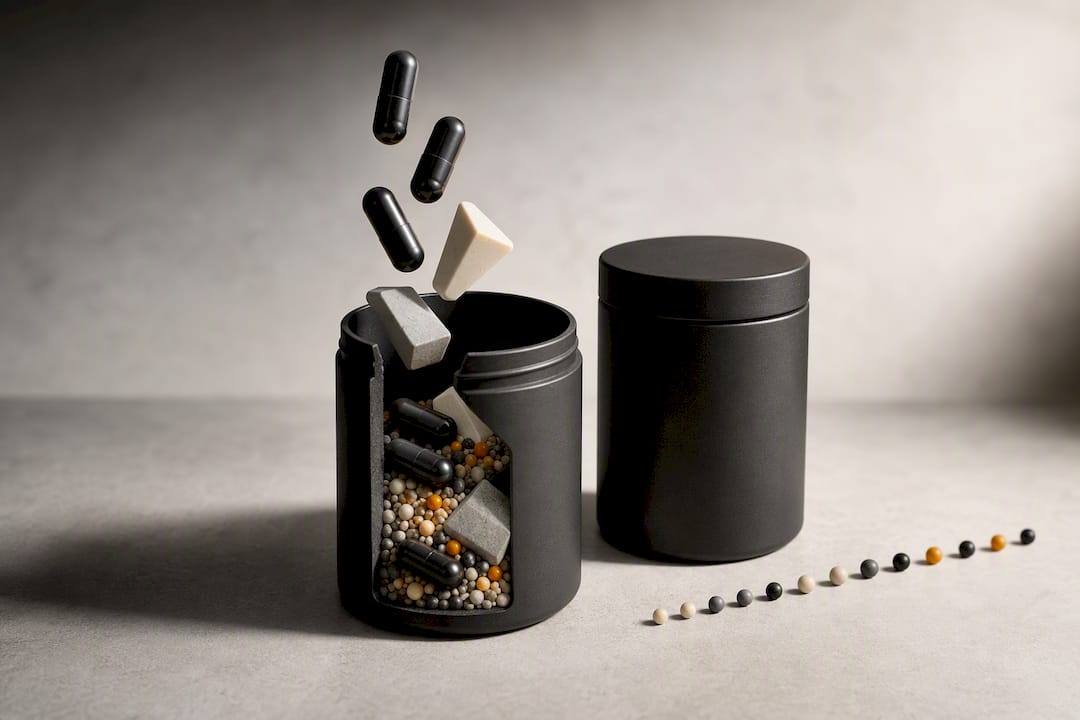
A second, quieter problem is trace dosing, sometimes called “fairy dusting.” A brand adds an expensive or trendy ingredient, think ashwagandha or an exotic adaptogen, at a fraction of the dose used in the clinical studies that made it popular, purely so the label can name-drop it.
Pro Tip: Count the ingredients inside the blend, then divide the total blend weight by that number. If a 5-gram blend lists twelve ingredients, most of them are getting scraps, no matter how impressive the label sounds.
Watch for these patterns specifically:
- Long ingredient lists (eight or more) crammed into a modest total weight
- Marketing-heavy blend names with no accompanying dose transparency anywhere on the label
- Products in dose-sensitive categories, pre-workouts, fat burners, testosterone boosters, and nootropics, that rely entirely on blends with zero standalone dosing
- No batch number, lot code, or way to request a certificate of analysis
Effect depends on dose. Nutrition research consistently ties efficacy to specific intake levels, and when dose data is concealed, neither researchers nor consumers can verify whether a product does what it claims.
A Checklist for Evaluating Any Blend
Work through this before you buy, not after:
- Divide total blend weight by ingredient count. A 3,000mg blend with four ingredients has room for real doses. The same weight spread across eleven ingredients almost certainly doesn’t.
- Use ingredient order as a rough priority signal, not a dose estimate. First on the list usually means “most by weight,” never “clinically dosed.”
- Prioritize products that declare caffeine or other stimulants separately from the blend. Separate dosing removes the biggest stacking risk entirely.
- Look for third-party testing. A certificate of analysis, NSF Certified for Sport, or Informed-Sport status confirms what’s actually in the bottle, a step OPSS specifically recommends when label information falls short. Nzsupps’s guide to checking supplement testing walks through exactly what to look for.
- Skip anything with a long, jargon-heavy blend name and no verifiable batch or testing claims. If a brand can’t back up its formula with paperwork, that’s the answer.
Proprietary blends aren’t automatically a dealbreaker. A science-first breakdown of the practice points out that a blend used for flavor support or a non-dose-sensitive botanical carries far less risk than one hiding stimulant amounts in a pre-workout.
How Nzsupps Approaches Ingredient Transparency
Nzsupps lists full ingredient information on product pages wherever a brand provides it, so shoppers can see what they’re buying before checkout rather than after. Products like unflavored creatine and amino options tend to carry the clearest disclosures, since fewer flavoring agents mean fewer things to hide. If a listing doesn’t answer a question, batch testing, lot numbers, exact stimulant content, reaching out to the retailer directly is always the right next step before adding it to your cart.
Trade Secrets Versus the Right to Know
Manufacturers have a legitimate reason to protect formulas they spent real money developing. That reasoning falls apart, though, the moment a blend hides stimulant doses in a product someone is stacking with three other supplements. Transparency should scale with risk: flavor botanicals can hide behind a blend name, but anything affecting your heart rate or hormone levels shouldn’t. Use the checklist above, favor brands that test and disclose, and treat a vague blend name as a question mark, not a red flag automatically, but never a green light either.
— Blake
This article is general information, not a substitute for advice from a qualified doctor. Consult a qualified healthcare professional about your own circumstances before acting on anything here.
Sources
- Proprietary blends: What does this mean?
- Perspectives on the Use of Proprietary Blends in Dietary Supplements
- Proprietary blends in dietary supplements protect trade secrets and foster innovation
- DOI nutrition research (2023)
FAQ
Why are proprietary blends bad?
They aren’t inherently bad, but they hide individual ingredient amounts, which makes it impossible to verify whether a product is dosed for real effect or barely contains an active ingredient at all.
What is a proprietary blend good for?
Blends can protect a manufacturer’s trade secrets and formulation research, and they carry lower practical risk in categories like flavor systems or non-dose-sensitive botanicals where exact amounts matter less for safety.
Are proprietary blends safe to consume?
Most are safe when used as directed, but the real risk comes from stacking multiple products with hidden stimulant content, since you can’t add up total exposure across brands without disclosed doses.
What ingredients should I avoid in supplements without disclosed doses?
Be most cautious with stimulants (multiple caffeine sources, synephrine, DMHA-type compounds) and any ingredient tied to hormone or cardiovascular effects, since these are the categories where an unknown dose carries the highest real-world risk.