SHOP NOW, PAY LATER

















 Informed Sport
 Informed Choice
 NSF Certified for Sport
 HASTA Certified

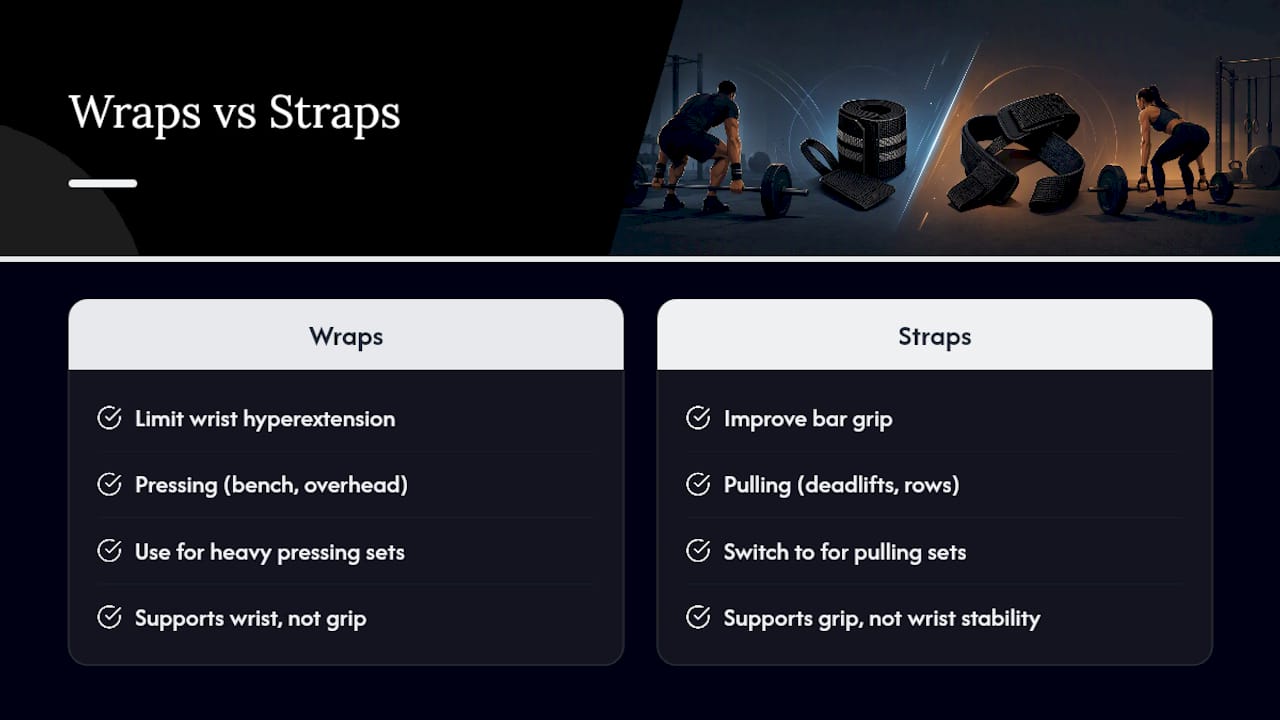
Wrist wraps stabilize your wrist during pressing movements. Lifting straps free your grip during heavy pulls. That’s the whole decision tree in one sentence: reach for wraps when you’re bench pressing, overhead pressing, or grinding through heavy dips, and reach for straps when your grip gives out before your back or hips do on deadlifts, rows, and shrugs.
Most competitive lifters own both and never confuse the two. A wrap on a deadlift does nothing for your grip. A strap on a bench press does nothing for your wrist. Here’s the quick breakdown:
- Pressing movements (bench, overhead press, heavy dips): wrist wraps for joint stability
- Pulling movements (deadlifts, rows, shrugs, rack pulls): lifting straps for grip endurance
- Both accessories together: common in serious training programs, used selectively rather than on every set
The rest of this guide covers why each tool works the way it does, how to buy the right one, and how to use them without letting them become a crutch.
Key Takeaways
Wrist wraps stabilize the joint for pressing movements while lifting straps transfer grip load to the wrist for pulling movements, and neither one substitutes for the other.
| Point | Details |
|---|---|
| Match tool to failure point | Use wraps when your wrist is the limiter on presses; use straps when grip fails first on pulls. |
| Save accessories for working sets | Keep warm-ups raw and reserve wraps or straps for heavy top sets to protect long-term adaptation. |
| Train grip separately | Program double overhand or mixed-grip work on non-strap days so grip strength keeps developing. |
| Buy based on stiffness and material | Choose wrap stiffness for your load range and strap material (nylon or leather) for durability. |
| Pair accessories with real recovery | Nzsupps offers disclosed-ingredient protein and pre-workout options to support the training these accessories protect. |
Table of Contents
- What Are Wrist Wraps?
- What Are Lifting Straps?
- Wrist Wraps vs Straps: Five Core Differences
- How Do You Choose Between Wraps and Straps?
- How to Use Wrist Wraps and Lifting Straps Correctly
- What Are the Benefits and Downsides of Each?
- Why Coaches Recommend Owning Both
- What Should Lifters Actually Do With This Information?
- Ready to Round Out Your Training Setup?
- Frequently Asked Questions
- Sources
What Are Wrist Wraps?
Wrist wraps are a length of stiff or semi-stiff fabric, usually 12 to 36 inches long, that you wind around your wrist and secure with a velcro closure or thumb loop. Most are built from an elastic polyester and cotton blend, though some heavier-duty versions add nylon threading for extra rigidity. The wrap compresses the wrist joint and limits how far it can bend backward under load, which is the exact movement that causes wrist strain during a heavy bench press or overhead press.
The mechanism is straightforward: compression plus restricted range of motion equals a joint that feels locked in place instead of wobbling under the bar. Wrist wraps stabilize the joint specifically for movements where hyperextension is the risk, not movements where grip strength is the bottleneck. That’s why you’ll see wraps on a competitive bencher’s wrists and almost never on a deadlifter mid-pull.
Stiffness and length vary a lot between models, and that variance matters more than most buyers realize:
- Short, elastic wraps (12 to 18 inches): light support, good range of motion, suited to moderate loads or bodybuilding-style pressing work
- Long, stiff wraps (24 to 36 inches): near-rigid support once fully wound, favored by powerlifters handling near-max singles
- Thumb-loop closures: faster to put on and remove between sets
- Velcro-only closures: more adjustable tension, slower to reapply
Pro Tip: If your wrist wrap lets you bend your wrist more than 10 to 15 degrees once fully tightened, it’s too loose to do its job on a max-effort set. It should feel restrictive, not just present.
What Are Lifting Straps?
Lifting straps are lengths of cotton, nylon, or leather webbing that wrap around the bar and your wrist, creating a mechanical connection that holds the bar in place even after your fingers start to fail. Instead of your grip alone holding a loaded barbell, the strap distributes that load onto your wrist and forearm, which is why straps let you pull weight your hands could never hold on their own.
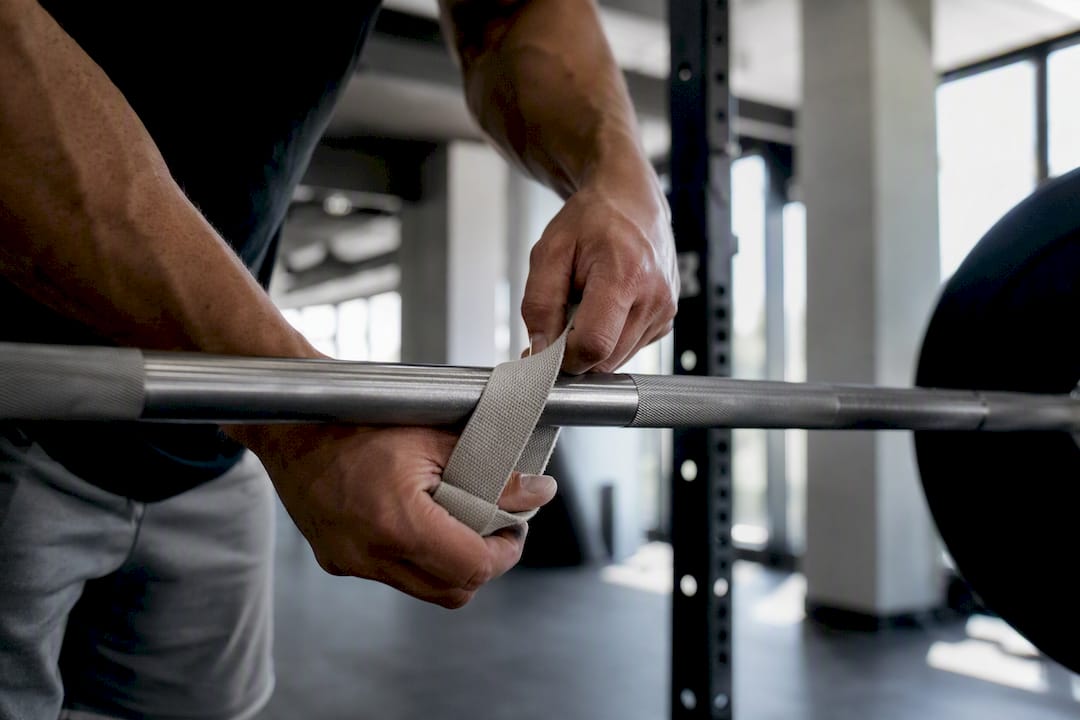
There are two dominant styles. Closed-loop straps (sometimes called lasso straps) have a fixed loop you slide your hand through before winding the tail around the bar. Figure-8 straps loop through themselves twice, creating a fixed connection to the bar that some lifters find more secure for max-effort pulls but slower to release. Lifting straps work by transferring load from the fingers to the wrist through that wraparound connection, not through raw finger strength.
Material choice affects both feel and lifespan:
- Cotton straps: cheap, slightly stretchy, wear out faster under heavy rotation
- Nylon straps: stronger, less stretch, hold up longer under max loads
- Leather straps: most durable option, breaks in over time, higher upfront cost
Length matters too. Straps that run 18 to 24 inches suit most lifters, while taller lifters or those pulling from a deficit often need the longer end of that range to get enough wrap around the bar without running out of material.
Wrist Wraps vs Straps: Five Core Differences
The confusion between these two accessories usually comes down to people not realizing they solve opposite problems. Here’s the side-by-side that should settle it.
- Purpose. Wraps stabilize a joint. Straps compensate for grip fatigue. One protects your wrist from bending too far; the other keeps a bar in your hand after your forearms give up.
- Materials and feel. Wraps are short, elastic, and built for compression. Straps are longer, less elastic, and built for tensile strength around a bar. You feel a wrap tightening on your wrist. You feel a strap locking your hand to the barbell.
- Best exercises. Wraps earn their keep on bench press, overhead press, and heavy dips, where wrist extension under load is the injury risk. Straps earn their keep on deadlifts, barbell rows, rack pulls, and shrugs, where grip fails before the target muscles do.
- Training adaptation and competition rules. Grip strength is trainable, and leaning on straps for every pulling set slows that adaptation. Competition context matters too: most federations restrict strap use to specific lifts or ban them outright in deadlift-only meets, so a lifter training for competition needs to know the rulebook before building a program around straps. Wraps face fewer restrictions since they support a joint rather than replacing a lift’s core difficulty.
- Where one can’t substitute for the other. This is the mistake beginners make most often: strapping in for a bench press does nothing for wrist support, and wrapping your wrists for a deadlift does nothing for your grip. The two tools solve different failure points, and using the wrong one just means you show up to the lift unprotected against the actual limiting factor.
That fifth point deserves a little more attention because it’s where new lifters waste money. A $30 pair of wraps won’t save a deadlift where your hands are slipping off the bar at 400 pounds. A pair of straps won’t stop your wrist from folding backward under a heavy bench press. Match the tool to the failure point, not the exercise category in general. Someone doing heavy Romanian deadlifts and also grinding through close-grip bench press in the same session genuinely needs both tools in the same gym bag, just for entirely different sets.
How Do You Choose Between Wraps and Straps?
Start with the actual limiting factor in your training, not the accessory that looks more advanced. If your wrist aches or feels unstable during pressing work, that’s a wraps problem. If your hands open up before your back finishes the pull on deadlifts or rows, that’s a straps problem. Plenty of lifters need both, just not on the same lift.
Training goal shapes the decision too. Strength-focused lifters chasing heavy singles and doubles tend to need both tools sooner, since near-maximal loads expose both wrist instability and grip limits at the same time. Hypertrophy-focused lifters doing higher-rep pulling work often reach for straps earlier, simply to get enough volume in before grip becomes the bottleneck for the muscles they’re actually trying to train.
Competition status changes the math again. If you’re training for a powerlifting meet, check your federation’s equipment rules before you build strap use into your program, since some competitions restrict where straps are allowed and you don’t want to discover that two weeks before a meet.
What to look for when buying:
- Wraps: stiffness level matched to your load range, length (24 inches plus for serious pressing work), closure type (thumb loop for speed, velcro for adjustability)
- Straps: loop style (closed-loop for quick release, figure-8 for max security), material (nylon or leather for durability), length matched to your bar diameter and hand size
A short buying checklist before you order either:
- Identify which lifts actually expose your weak point (wrist vs grip)
- Pick stiffness or material based on your typical working load, not your max
- Confirm length works for your hand size and bar type
- Check competition rules if you compete
- Buy once, buy right. Cheap wraps go limp after a few months; cheap straps fray at the stitching
How to Use Wrist Wraps and Lifting Straps Correctly
Putting on wrist wraps:
- Loop the thumb loop over your thumb, or start winding directly if it’s a velcro-only model
- Wind the wrap around your wrist, working from the hand toward the forearm, overlapping each pass slightly
- Pull tension as you wind, tighter than feels comfortable but stopping short of pain
- Secure the velcro closure and test wrist movement; you should feel restricted, not numb
If you feel tingling, numbness, or pins and needles, loosen it immediately. That’s a sign of restricted blood flow, not proper support.
Threading lifting straps:
- Slide your hand through the loop so the strap sits across your palm
- Wrap the tail of the strap around the bar, moving away from your body
- Wind it around a second time for extra grip on max-effort pulls
- Rotate your wrist to tighten the connection before initiating the pull, and confirm you can release it quickly if needed
Neither accessory belongs on your warm-up sets. Coaching guidance across strength sports consistently recommends training warm-ups raw and saving wraps or straps for the working sets where load actually challenges your wrist stability or grip. Save the accessories for the weight that demands them, not the bar-only warm-up.
Pro Tip: Program dedicated grip work, like double overhand holds or mixed-grip progression on lighter deadlift variations, on a separate day from your strap-assisted heavy pulling. That keeps your grip developing instead of quietly regressing behind your straps.
What Are the Benefits and Downsides of Each?
Both accessories genuinely earn their place in a serious lifter’s routine, but neither one is free of trade-offs.
Benefits:
- Heavier loading becomes possible once the limiting joint or grip is supported
- Wrist pain during pressing often drops noticeably once a wrap limits hyperextension
- Volume tolerance improves on pulling days when straps remove grip as the bottleneck
Downsides:
- Overusing straps on every pulling set can stall grip strength development over time, since the muscles and connective tissue in the forearm adapt to whatever demand you actually place on them
- Wraps can create a false sense of security that masks poor wrist positioning instead of correcting it
- Strap use with inconsistent technique can load one wrist more than the other, creating asymmetric strain over time
Neither tool fixes bad mechanics. A wrap won’t correct a wrist that’s already misaligned under the bar, and a strap won’t fix a deadlift setup that’s putting uneven load through your hands. Use both to support good technique, never to paper over bad technique.
Why Coaches Recommend Owning Both
Veteran coaches rarely treat this as an either-or decision. The common practice among experienced lifters is straightforward: carry both, and deploy each one based on the lift in front of you and the phase of training you’re in. A powerlifter in a heavy bench block reaches for wraps. The same lifter, three weeks later in a deadlift-focused block, reaches for straps instead.
Nzsupps stocks training accessories alongside the recovery and performance products lifters actually pair them with, and the same principle that applies to buying wraps or straps applies to supplements: check what’s actually in the product before you commit to it. That’s the standard Nzsupps holds its own curated selection to, with disclosed ingredients on every listing rather than vague proprietary blends.
A few things worth knowing before you shop:
- Fit and stiffness vary meaningfully between models, so match the accessory to your actual training load rather than buying whatever’s cheapest
- Educational resources on proper use matter as much as the product itself, since misuse cancels out most of the benefit
- Pairing accessories with a solid recovery routine, including adequate protein intake, supports the strength gains you’re using them to chase in the first place
What Should Lifters Actually Do With This Information?
Beginners don’t need either accessory yet. Spend your first several months building raw grip and wrist strength before reaching for support gear, because accessories introduced too early just mask weaknesses you haven’t developed yet.
Intermediate lifters should introduce wraps for heavy pressing sets and straps for high-volume pulling work, keeping both reserved for working sets rather than every rep of every session. Advanced lifters chasing max-effort singles typically need both tools regularly, but should still program dedicated grip work weekly so straps stay a tool rather than a dependency. Train your grip like you train any other weakness, and save the accessories for when the weight actually demands them.
Ready to Round Out Your Training Setup?
Wraps and straps solve the mechanical problems this guide just walked through, but the accessory drawer is only half the equation. What you put in your body between sessions determines how well your wrists and grip actually hold up to that heavier loading in the first place.
Nzsupps carries protein options built for the recovery demands of heavier pressing and pulling work, including the Basic Supplements Isolate in Chocolate, a straightforward 72-serve option with fully disclosed ingredients rather than a vague blend. If your training sessions run long and grip fatigue shows up early, a clean pre-workout like Basic Supplements Pre-Workout can help you hold intensity through your heaviest pulling sets, which is exactly when straps come into play. Whatever you choose, test the fit against your own training goals first. Browse the full accessory and recovery range at Nzsupps and pick what actually matches the lifts you’re doing this week.
Frequently Asked Questions
Are wrist straps as effective as wrist wraps for pressing movements? No. Straps address grip, not wrist stability, so they do nothing to limit wrist hyperextension during a heavy bench or overhead press. Use wraps for pressing and save straps for pulling.
Should I use wrist wraps and straps in the same workout? Yes, if your session includes both pressing and pulling work. Put wraps on for your heavy bench sets and switch to straps when you move to deadlifts or rows later in the same session.
Do lifting straps weaken your grip over time? Overusing straps on every pulling set can slow grip development, since your forearms adapt to whatever demand you place on them. Program separate grip work to avoid that stagnation.
Can wrist wraps fix poor wrist positioning during a bench press? No. Wraps limit hyperextension but don’t correct bar path or hand placement. Fix your setup first, then use wraps to support a joint that’s already positioned correctly.
What’s the difference between closed-loop and figure-8 lifting straps? Closed-loop straps release quickly and suit lifters who need to drop the bar fast, while figure-8 straps lock more securely to the bar, which some lifters prefer for max-effort pulls but makes quick release harder.
Sources
- Wrist Straps vs Wrist Wraps | Eleiko
- Wrist wraps vs lifting straps: which do you need? | Lift5x5
- Lifting Straps vs Wrist Wraps: What’s the Difference? Battle Bunker