SHOP NOW, PAY LATER












 Informed Sport
 Informed Choice
 NSF Certified for Sport
 HASTA Certified

The EAA vs BCAA difference is one number: nine versus three. EAAs contain all nine essential amino acids your body cannot make. BCAAs are just three of those nine: leucine, isoleucine and valine. If you want the more complete amino supplement, choose EAAs. And if you already eat enough complete protein across the day, you may not need either tub at all.
That is the useful EAA vs BCAA answer. BCAAs are not fake ingredients, and EAAs are not magic protein without food. They are different-sized pieces of the same protein picture. Your muscles need all the essential amino acids to build new protein, while the three BCAAs have specific signalling and metabolic roles inside that process.
The label can make this harder than it needs to be. Some products called BCAAs also contain all nine EAAs. Others add electrolytes, caffeine or carbohydrates. Read the full panel before deciding what the name means.
EAA vs BCAA at a glance
| Question | EAA | BCAA |
|---|---|---|
| What is included? | All nine essential amino acids | Leucine, isoleucine and valine |
| Can the body make them? | No | No, they are three of the EAAs |
| Can the serve supply all essential building blocks? | Yes, if all nine are present in useful amounts | No |
| Best first option for muscle protein support | More complete than BCAA alone | Limited without the other EAAs |
| Needed with adequate complete protein? | Often optional | Often optional |
What are essential amino acids?
Protein is built from amino acids. Nine are called essential because your body cannot make enough of them, so they need to come from food. They are histidine, isoleucine, leucine, lysine, methionine, phenylalanine, threonine, tryptophan and valine.
A complete protein provides all nine. Whey, milk, eggs, meat, fish and soy are familiar examples. Well-built plant blends can also supply a complete profile. Free-form EAA supplements deliver the amino acids without the rest of an intact protein food.
The 2023 International Society of Sports Nutrition position stand concludes that free-form EAAs can rapidly raise circulating EAAs and stimulate muscle protein synthesis. It also notes that all nine support a stronger and more sustained response than a smaller group alone.
What are BCAAs?
BCAA stands for branched-chain amino acid. The three are leucine, isoleucine and valine. Leucine gets the most attention because it helps switch on signalling involved in muscle protein synthesis.
Switching on the process is not the same as supplying every material it needs. New muscle protein still requires the other essential amino acids. That is why a BCAA drink can trigger part of the response without being as complete as EAAs or a whole protein serve.
A 2017 human trial found that 5.6g of BCAAs after resistance exercise increased myofibrillar protein synthesis by about 22% compared with placebo, real, but roughly half the response reported in comparable studies using complete protein with a similar BCAA amount. That is a more accurate reading than saying BCAAs either do everything or do nothing.
EAA vs BCAA: are EAAs better?
For supplying the essential building blocks for new protein, yes. EAAs include the three BCAAs plus the other six essential amino acids. A BCAA-only product cannot provide the complete set.
That does not mean everyone should buy an EAA tub. A normal serve of complete protein already includes EAAs and BCAAs. If breakfast, lunch, dinner and a protein shake cover your daily protein, an extra amino product may add convenience or flavour without filling a meaningful gap.
Start with food and total protein. The protein-per-scoop guide shows what current powders deliver, while the protein collection covers whole-protein options. Consider a free-form amino supplement after those basics, not before them.
For a broader order of operations, read which supplements may earn a place first. It keeps an optional amino drink in proportion to food, training and the basics.
When an EAA supplement may make sense
EAAs are useful when a light, low-volume drink is more practical than a shake or meal. That can be during a long training session, early in the morning when you do not want a thick shake, or while appetite is low around hard exercise. They can also make sense when a sports dietitian has identified a specific protein-distribution problem.
They are not a full meal. They do not supply the energy, fibre, vitamins and minerals found in food, and they are not a replacement for total daily protein. Think of an EAA drink as a targeted amino dose.
Check that the panel lists all nine EAAs and states their amounts. "Amino matrix" without a clear total makes it hard to compare products. The word "EAA" on the front is a starting point, not the final check.
When a BCAA product may still suit you
A BCAA drink can be a practical flavoured training drink, especially when the formula also includes electrolytes or other ingredients you have chosen for a reason. Some people prefer the taste to plain water and drink more during a session as a result. That is a use case, not proof that BCAAs are uniquely anabolic. For a worked example, see Ghost Hydration vs Ghost BCAA.
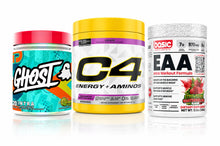
Two products in the NZ Supps range show why you need the full panel. Ghost Intra lists a 6g BCAA blend and a full nine-EAA profile, so it is not simply a BCAA-only formula. Cellucor C4 Energy + Amino lists an amino blend with 100mg of caffeine, which means it also contributes to your daily stimulant total. Recheck the live labels before you buy, because formulas and availability change.
If the product has caffeine, do not sip it like a plain hydration mix without counting the dose. If it has carbohydrates, include them in your fuelling plan. If it contains only three BCAAs, judge it as a partial amino product.
How to read an amino label
- Find the complete serving size, not a half-scoop option hidden in the directions.
- Check whether the formula lists three BCAAs or all nine EAAs.
- Look for disclosed amounts rather than a large proprietary blend.
- Check caffeine, carbohydrate, electrolytes and sweeteners around the amino formula.
- Calculate the cost per full serve.
- If you are drug tested, verify the exact product and batch with a recognised certification programme.
Ratios such as 2:1:1 describe the balance of leucine, isoleucine and valine inside a BCAA blend. They do not turn three amino acids into nine. A large ratio on the front can distract from a small total dose, so check grams first.
What should you buy first?
If you are short on total daily protein, buy food or a complete protein powder first. If protein is covered but you want a light amino drink around training, EAA is the more complete default. Choose a BCAA product when you understand the partial profile and want that exact formula for flavour, hydration or its other listed ingredients.
Want to compare EAA vs BCAA on the live labels? Browse Amino & BCAA at NZ Supps, then filter into BCAA, amino acids or intra-workout based on what the full serve contains. If you are unsure whether an amino product belongs in your routine at all, use the stack finder first.
What is the difference between EAA and BCAA?
EAAs are all nine amino acids that your body needs from food. BCAAs are three members of that group: leucine, isoleucine and valine. Every BCAA is an EAA, but six EAAs are missing from a BCAA-only supplement.
Are EAAs better than BCAAs for muscle growth?
EAAs provide the more complete set needed to make new muscle protein. BCAAs can stimulate part of the response, but the other essential amino acids can become limiting. Resistance training and enough total daily protein still matter more than choosing between two optional tubs.
Do you need BCAAs if you take protein powder?
Usually not. A complete protein powder already contains BCAAs and the other essential amino acids. An extra BCAA drink may still suit your routine, but it is not required simply because you train.
Can you take EAAs and BCAAs together?
You can, but there is often duplication because an EAA formula already includes the three BCAAs. Read both panels, add the amounts and ask what the second product contributes before combining them.
When should you take EAAs or BCAAs?
They are commonly used before, during or after training because that is when a light drink is convenient. There is no need to force exact timing when your daily protein is already covered. Follow the product directions and count any caffeine or carbohydrate in the formula.
Sources and scope
- 2023 ISSN position stand on essential amino acids
- Human BCAA ingestion and muscle protein synthesis trial
- Review of BCAAs alone and muscle protein synthesis
- Australian Institute of Sport BCAA fact sheet
- ISSN position stand on protein and exercise
This article provides general information, not personal medical or sports-nutrition advice. Speak with a registered dietitian or sports doctor if you have a health condition, follow a restricted diet, compete under anti-doping rules, or need an individual fuelling plan.