SHOP NOW, PAY LATER












 Informed Sport
 Informed Choice
 NSF Certified for Sport
 HASTA Certified

For most healthy adults, 5 g of creatine monohydrate daily can be used alongside a caffeine-containing pre-workout, with caffeine performance guidance sitting at approximately 3 to 6 mg per kg of body weight. Yes, you can take creatine and pre workout together, but the primary consideration is your total caffeine intake from every product and drink that day.
You've probably stood in the kitchen or gym changing room with a creatine tub in one hand and a pre-workout scoop in the other, wondering whether combining them is sensible. The answer usually isn't hidden in the word “stack”. It comes down to what each product contains, how much caffeine you've already had, and whether the formula is suitable for your training and sport requirements.
That distinction matters in New Zealand. A pre-workout may contain caffeine, other stimulants, creatine, botanical extracts, or a proprietary blend. Your morning coffee, an energy drink, and a second supplement can all add to the same daily stimulant total. Drug-tested athletes also need to think about contamination and batch testing, not just whether creatine and caffeine work well together.
Table of Contents
- The Short Answer
- How Creatine and Pre Workout Work Differently
- Choosing Between High-Stim, Low-Stim and Non-Stim Pre Workouts
- Calculating Your Total Daily Caffeine Intake
- What Drug-Tested Athletes Need to Know
- Sample Routines for Different Training Days
- Key Takeaways and When to Seek Advice
The Short Answer
A gym bag containing separate creatine and pre-workout products isn't automatically a problem. Creatine monohydrate and caffeine work through different physiological pathways, so there isn't a known direct creatine and caffeine incompatibility for most healthy adults. Creatine supports phosphocreatine availability for repeated high-intensity efforts, while caffeine mainly acts through adenosine-receptor blockade to increase alertness and may improve perceived exertion, muscular endurance, and anaerobic strength. The New Zealand Defence Force supplement and caffeine guidance identifies creatine monohydrate as having strong evidence for efficacy and apparent safety, and lists 5 g per day as an ongoing dose.
The part people often get wrong is treating the pre-workout scoop as the whole caffeine story. It isn't. You need to add the caffeine in your pre-workout to coffee, tea, energy drinks, fat-burners, caffeinated hydration products, and medicines used that day. The same NZDF guidance reports that caffeine is most effective for performance at approximately 3 to 6 mg per kg of body weight. For an 80 kg athlete, that's 240 to 480 mg of caffeine, which can be reached quickly when a pre-workout is combined with coffee or energy drinks.
What usually works
- Separate dosing: Take creatine daily and use pre-workout only when you want its acute stimulant effect.
- Label checking: Confirm whether the pre-workout already contains creatine, caffeine, or additional stimulants.
- Moderate stacking: Avoid adding coffee or energy drinks automatically on top of a full pre-workout serve.
- Flexible timing: Creatine doesn't need to be mixed into the pre-workout. Daily consistency matters more than the exact time.
For drug-tested athletes, the question has a second layer. The individual ingredients may be permitted, but supplement contamination remains a risk. Product selection, batch testing, and keeping the batch details are just as important as deciding whether to mix the powder.
How Creatine and Pre Workout Work Differently
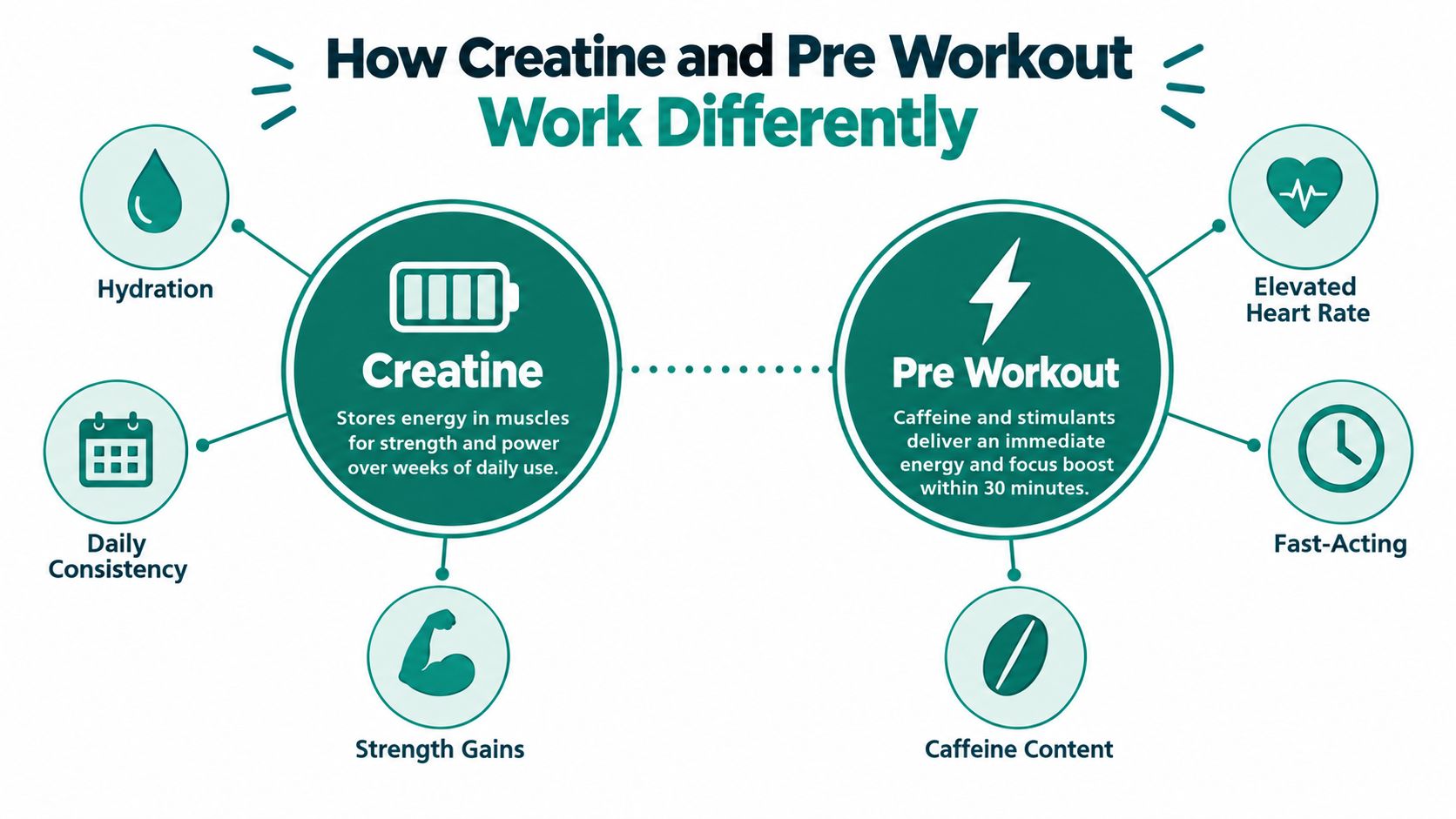
Creatine is a daily support supplement, not a switch you need to turn on immediately before your first set. Creatine monohydrate increases intramuscular phosphocreatine availability over time, giving muscles more support for repeated high-intensity efforts. The NZDF guidance states that creatine timing isn't important, so taking it with breakfast, after training, or in a pre-workout is a practical choice rather than a requirement.
Caffeine has a different job. It primarily works through adenosine-receptor blockade, which can increase alertness and may improve perceived exertion, muscular endurance, and anaerobic strength. That makes it an acute ingredient, with effects that are relevant to the session you're about to do rather than a daily accumulation strategy.
The useful distinction: Creatine rewards consistency. Caffeine rewards careful timing and dose control.
What that means at the gym
You don't need to synchronise creatine with the moment caffeine starts to feel noticeable. If taking both together helps you remember your daily creatine, that's a reasonable routine. If caffeine affects your sleep or makes you feel uncomfortable, taking creatine separately lets you keep the daily ingredient without forcing yourself to use a stimulant.
A pre-workout can also contain creatine already. Check the nutrition and ingredient panel before adding a separate powder, because the total amount may not match the daily dose you intend to use. A transparent product makes this calculation much easier than a blend that lists several ingredients without individual quantities.
For a more detailed look at practical creatine use, this guide to essential creatine advice is useful background. The main decision here remains straightforward: use creatine consistently, and treat caffeine as a separate variable that needs managing.
Choosing Between High-Stim, Low-Stim and Non-Stim Pre Workouts
Creatine doesn't decide which pre-workout category suits you. Your caffeine tolerance, training time, other drinks, and sleep pattern do. A high-stim product may suit an early strength session when you haven't had other caffeine, while a non-stim formula can make more sense if you train later or already drink coffee.
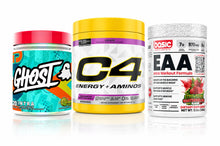
The category names aren't a substitute for reading the label. A low-stim formula from one brand may not match another, and a non-stim product should still be checked for ingredients that you personally need to avoid. If you want to compare formulas, start with pre-workouts available in NZ and look at caffeine per labelled serve rather than judging strength by scoop size.
Pre-workout categories compared
| Pre-workout type | Caffeine per serve | Key ingredients | Price per serve |
|---|---|---|---|
| High-stim | Check the individual label | Caffeine and other disclosed performance ingredients | Check current product pricing |
| Low-stim | Check the individual label | A lower-stimulant formula with disclosed active ingredients | Check current product pricing |
| Non-stim | No caffeine expected, confirm the label | Pump-focused ingredients such as citrulline or glycerol, where listed | Check current product pricing |
This table deliberately avoids pretending that every product in a category has the same formula. There is no standard pre-workout serve size or universal caffeine amount. Product labels are the reliable reference, and the price per serve needs to be calculated from the current pack size and serving directions.
Match the formula to the day
If you drink coffee before training, a low-stim or non-stim option may be easier to manage than a high-stim product. If you train in the afternoon or evening, a lower-caffeine or non-stim formula may also reduce the chance that the stimulant affects sleep. Neither choice changes how creatine works, so you can keep your creatine routine separate.
A high-stim option is the least forgiving choice for experimentation. Don't begin with a full serving if you haven't used that formula before. Half a serving lets you assess your response while keeping the initial caffeine exposure lower, provided the product label allows that approach and the powder can be divided accurately.
NZ Supps stocks formulas across high-stim, low-stim, and non-stim categories, with product pages that can be checked for the current ingredient panel and per-serve pricing. For a closer explanation of the difference, see the comparison of pump and stim pre-workouts.
Calculating Your Total Daily Caffeine Intake
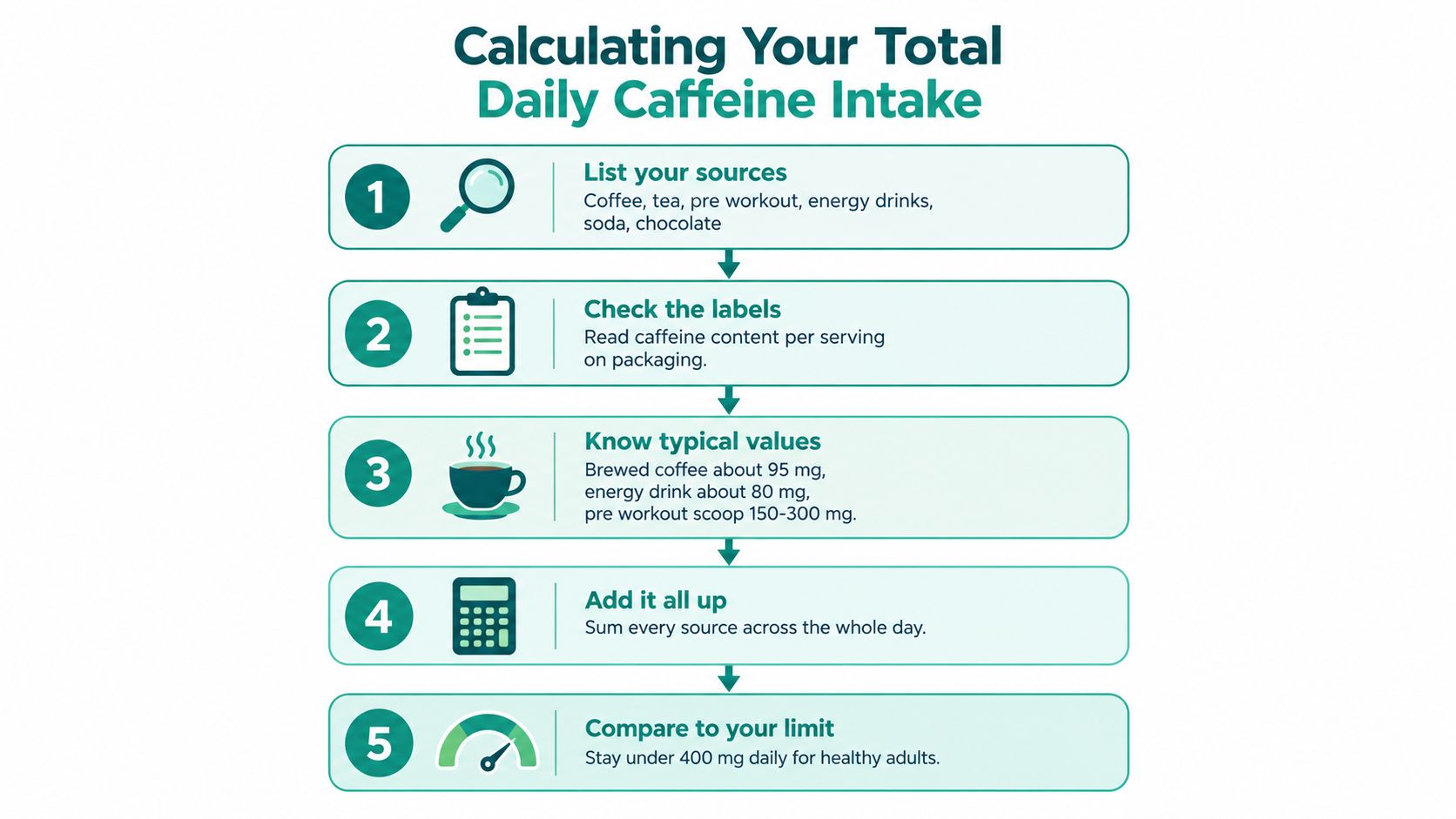
The safest practical habit is to write down every caffeine source before deciding how much pre-workout to use. Start with the amount printed on the pre-workout label, then add coffee, tea, energy drinks, energy shots, caffeinated supplements, and medicines. Don't assume a scoop is standard across brands.
New Zealand labelling gives you useful information for this calculation. Under the New Zealand Food Supplemented Food Standard 2016, applicable caffeine-containing supplemented foods must state the average caffeine quantity per serve and per 100 ml or 100 g, as relevant. Where caffeine exceeds what's needed for a technological function, the label must also carry an advisory statement about caffeine and identify groups for whom the product isn't recommended.
A practical calculation
Take an 80 kg athlete using the NZDF performance range of 3 to 6 mg per kg. That produces a range of 240 to 480 mg of caffeine, as calculated from body weight and the guidance linked above. A morning coffee plus a full pre-workout serve and an energy drink can move someone through that range without any of the products feeling unusually strong on its own.
The point isn't to turn every training day into a spreadsheet. It's to stop treating each product as an isolated decision.
- List the sources. Write down coffee, tea, pre-workout, energy drinks, energy shots, and medicines.
- Read each label. Record caffeine per serve, not just the total amount in the container.
- Check the serving direction. If the label defines one scoop as a serve, don't assume two scoops are appropriate.
- Add the day's total. Include drinks consumed earlier, not just what you take around training.
- Adjust the plan. Reduce or remove the extra stimulant source if the total feels too high for you.
The NZ Supps guide to pre-workout caffeine content is a useful label-reading reference. New Zealand Ministry of Health guidance recommends moderation and specifically advises avoiding energy drinks and energy shots. It also identifies 200 mg of caffeine per day as the pregnancy limit, so pregnancy requires a more cautious approach than applying a performance-oriented range.
Caffeine isn't automatically dehydrating in the way many gym conversations suggest. New Zealand health guidance notes that fluid from caffeinated beverages generally compensates for the acute diuretic effect, and cites no dehydration or chronic fluid imbalance at intakes up to approximately 500 mg per day in healthy adults. That doesn't make high-dose pre-workout a good default, because individual responses can include palpitations, anxiety, gastrointestinal symptoms, and sleep disruption.
What Drug-Tested Athletes Need to Know
For a drug-tested athlete, the main technical risk isn't that creatine and pre-workout are incompatible. It's that a multi-ingredient product may contain undisclosed substances or become contaminated during manufacturing. Pre-workouts can include several stimulants, botanical extracts, proprietary blends, or ingredients listed under alternative names, making the formula difficult to assess if the label isn't fully disclosed.
The Sport Integrity Commission's supplement guidance states that supplement contamination remains a risk in New Zealand. It reports that Consumer NZ found illegal drugs in six separate supplement products in 2022. The Commission also makes clear that neither it nor the World Anti-Doping Agency approves supplements, and that taking more than the label-recommended dose can be dangerous.
Batch testing matters
High Performance Sport New Zealand advises athletes to use independently batch-tested products and to check that the batch certificate matches the container exactly. That last step matters because contamination can affect one batch without affecting another. A certification logo alone isn't a substitute for checking the specific product and batch.
A sensible approach is to:
- Choose full disclosure: Prefer a label that states the amount of each relevant active ingredient rather than hiding quantities in a proprietary blend.
- Verify the batch: Match the certificate details to the container before using the product.
- Keep records: Retain the product name, batch information, and certificate for your sport-compliance records.
- Avoid stacking: Don't combine several stimulant products just because each label appears acceptable on its own.
NZ Supps has a Tested for Sport collection that lets shoppers filter for products carrying independent programmes such as Informed Sport, Informed Choice, NSF Certified for Sport, or HASTA. Its guide to how supplements are tested for banned substances explains the practical checks athletes should make before relying on a certification claim.
The key trade-off is convenience versus control. A pre-workout containing creatine may reduce the number of products in your gym bag, but a separate creatine powder can make it easier to confirm your daily amount and choose a tested stimulant formula independently.
Sample Routines for Different Training Days
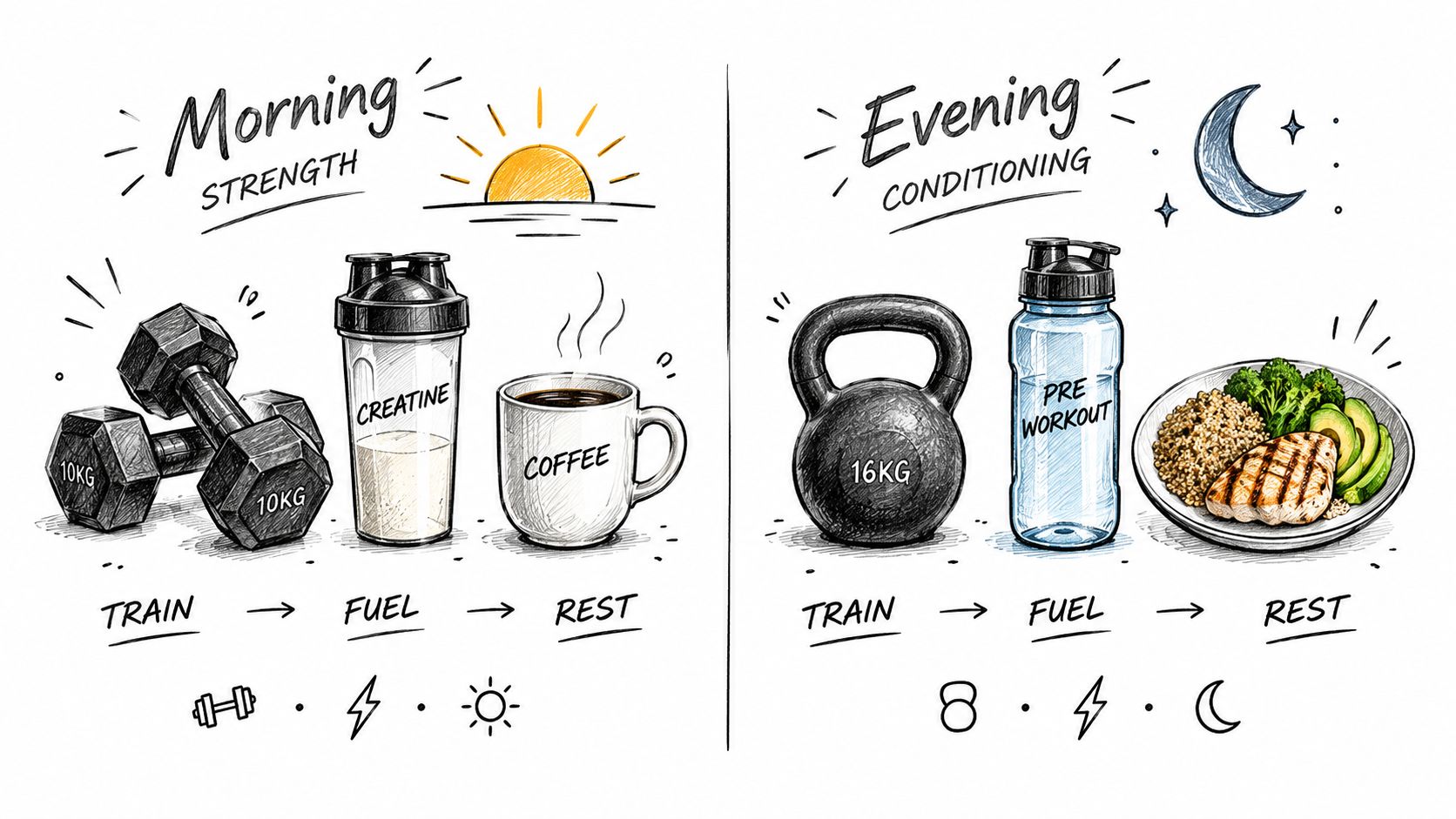
A morning strength session gives you more room to use a caffeinated pre-workout, especially if coffee isn't already part of the morning. One workable routine is breakfast, a labelled serving of pre-workout before training, and creatine mixed into the same drink or taken with the post-training meal. The creatine timing is convenient rather than essential, while the pre-workout is positioned around the session.
If you're new to the pre-workout, start with half a serving rather than copying someone else's full scoop. Check the label first, and don't add coffee or an energy drink until you know how that formula feels.
Morning strength day
- Before training: Use the chosen pre-workout according to its label. Count any coffee already consumed.
- Creatine: Take the daily creatine dose with the pre-workout, breakfast, or a later meal.
- After training: Eat and drink normally, then keep the next day's creatine dose consistent.
An afternoon gym visit needs a different decision. If you had coffee in the morning, choose a lower-caffeine pre-workout or a non-stim pump formula. If sleep has been poor or you're sensitive to caffeine, taking creatine with food and skipping the stimulant may be the more sensible training-day choice.
Afternoon conditioning day
- Earlier in the day: Record coffee, tea, and any other caffeine.
- Before training: Choose a low-stim or non-stim formula, and follow the product's serving direction.
- Creatine: Take it with a meal or after training, because it doesn't need to coincide with the stimulant effect.
These routines avoid a common mistake, using caffeine to solve a timing problem that creatine doesn't create. The right schedule is the one that supports consistent creatine use without sacrificing sleep or pushing total stimulant exposure beyond your tolerance.
Key Takeaways and When to Seek Advice
For most healthy adults, creatine and a caffeine-containing pre-workout can generally be used in the same training programme. Creatine monohydrate supports repeated high-intensity efforts over time, while caffeine provides an acute stimulant effect. The practical risks are usually excessive total caffeine, hidden ingredients, poor product quality, and individual sensitivity.
Keep these points beside your supplement shelf:
- Use creatine consistently: The NZDF guidance lists 5 g per day as an ongoing creatine dose, and says timing isn't important.
- Calculate the whole day: Add caffeine from coffee, tea, pre-workout, energy drinks, other supplements, and medicines.
- Read the label: Check caffeine per serve and whether the pre-workout already contains creatine.
- Choose carefully for sport: Use independently batch-tested products and verify the certificate against the exact container.
- Change one variable: Don't introduce a full serving of a new pre-workout while also adding several other stimulants.
Seek individual medical advice before using a stimulant product if you have a cardiovascular condition, hypertension, medication interactions, pronounced caffeine sensitivity, pregnancy, anxiety concerns, or sleep problems. Stop using the product and seek appropriate advice if you experience concerning symptoms such as palpitations or severe discomfort.
Creatine doesn't need to be taken pre-workout to be useful, and adding it to a stimulant formula doesn't make the combination automatically better. A clear label, a controlled caffeine total, and a routine you can follow consistently are more valuable than a complicated stack.
NZ Supps offers creatine powders, high-stim, low-stim and non-stim pre-workouts, plus product comparison and Tested for Sport filtering for shoppers who need clearer ingredient and batch information. Visit NZ Supps to compare the label details and choose a combination that fits your caffeine intake and training schedule.