SHOP NOW, PAY LATER














 Informed Sport
 Informed Choice
 NSF Certified for Sport
 HASTA Certified

Tendon and ligament niggles are the injuries that hang around. Muscles bounce back in days, but a cranky Achilles or a sore knee can drag on for months and quietly wreck your training. So it makes sense that collagen gets a lot of attention. Here is what the research actually tested, what it did not, and how to use collagen sensibly if you want to try it.
The short answer
- The evidence is early but encouraging. Small studies suggest collagen or gelatin before exercise may support collagen production and rehab outcomes.
- Timing matters. The research took it roughly 30 to 60 minutes before a loading session, not randomly through the day.
- It supports rehab, it does not replace it. The results came from collagen plus training, never collagen alone.
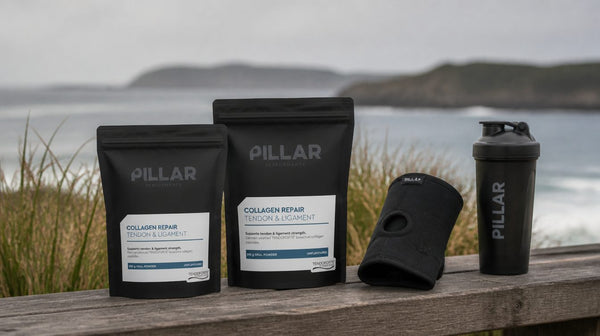
- Best fit we stock: Pillar Collagen Repair, built around Tendoforte collagen peptides with vitamin C.
This is general information, not medical advice. If you have an injury that is not improving, see a physio or your GP.
Why tendons are slow to adapt
Muscles have a rich blood supply, so nutrients get in quickly and they adapt fast. Tendons and ligaments are different. They are dense, tough bands of connective tissue, mostly made of collagen, and they get far less blood flow.
That is why they are slow to adapt and slow to recover. It is also why a sudden jump in training load often shows up as tendon pain. Your muscles are ready for more, but your connective tissue has not caught up yet.
The good news is tendons do respond to loading. They just need the right kind of load, applied consistently, over weeks and months. That is where the idea of feeding them well around training comes in.
What the research actually used
Two studies come up again and again when people talk about collagen for tendons.
Gelatin and vitamin C before exercise. In a study published in the American Journal of Clinical Nutrition, Shaw and colleagues (2017) gave people 15g of vitamin C enriched gelatin an hour before a short session of rope skipping. That roughly doubled a blood marker of collagen production. It is a small study and it measured a marker, not injury recovery, but it hinted that timing collagen around loading may matter.
Collagen peptides plus calf training. A small trial by Praet and colleagues (2019) looked at people with Achilles tendinopathy, a long-running tendon problem. Everyone did a calf training programme, and some also took specific collagen peptides. The collagen group saw better outcomes than the placebo group. Again, the collagen was added to training, not used on its own.
The honest takeaway: the research is promising, the studies are small, and every positive result paired collagen with loading. Nobody sat on the couch with a collagen drink and fixed their tendon.
How to use collagen for tendon support
Take it before you load. Aim for 30 to 60 minutes before your rehab exercises, gym session or run. The idea is to have collagen building blocks in your bloodstream while the tissue is under load.
Follow the label dose. Products differ, so stick to the serve on the tub rather than guessing. The gelatin study used 15g, but a collagen peptide product may use a different amount by design.
Include vitamin C. Your body needs vitamin C to make collagen. Pillar Collagen Repair already includes it. Our guide to collagen with vitamin C covers the pairing in more depth.
Pair it with a real rehab plan. Slow, heavy and consistent loading is what drives tendon adaptation. A physio can set this up for your specific injury. Collagen may support that work, but the programme is the main event.
Give it time. Tendons adapt over months, not days. If you try collagen, commit to a consistent block rather than a week or two.
Collagen vs whey for this job
This is a common question. Whey protein is brilliant for building and repairing muscle, but it is not especially rich in the amino acids that connective tissue uses most. Collagen is the opposite: not a great muscle builder, but full of glycine, proline and hydroxyproline, the building blocks of tendons and ligaments.
So they are not rivals. Many lifters take collagen before training and whey after, or with meals. We break the differences down fully in collagen vs whey protein.
Products that fit
Pillar Collagen Repair is the one we would point you to for tendons and ligaments. It is built around Tendoforte bioactive collagen peptides, which the brand describes as a clinically studied form developed for connective tissue, plus vitamin C. It comes in a 250g tub and a larger 510g tub, which is the better buy if you are committing to a longer rehab block. For a deeper look, read our Pillar Collagen Repair review.
Gaspari Bone Broth Collagen is more of a general collagen protein. Each scoop gives 15g of bone broth collagen from chicken, beef and turkey, with 13g of protein and zero sugar. It mixes into water, coffee or a smoothie. It is a good everyday option for joints and mobility, but it is not built around a specific tendon peptide.
If you want to compare every option, our roundup of the best collagen in NZ covers the lot.
Where NZ Supps fits
You will find both products in our range of collagen supplements, and the full Pillar Performance line if you like the brand. If you are building a wider recovery routine, our recovery range has other staples that sit well alongside collagen.
FAQ
Does collagen help tendons and ligaments? The early research is promising but still small. Studies suggest collagen or gelatin taken before exercise may support collagen production, and one small trial saw better results when collagen peptides were added to calf training. It works alongside loading and rehab, not instead of them.
When should I take collagen for my tendons? The studies timed it before training, so the common approach is 30 to 60 minutes before your rehab or loading session. The idea is to have the building blocks in your blood while the tissue is being loaded.
Should I take vitamin C with collagen? Vitamin C plays a role in how your body makes collagen, and the gelatin study used a vitamin C enriched drink. Pillar Collagen Repair already includes vitamin C, so you do not need to add more with that product.
Can collagen heal a tendon injury? No supplement heals an injury on its own. Collagen may support your rehab, but the real work is done by a good loading programme, rest where needed and advice from a physio or doctor. If you have pain that is not improving, get it checked.
Is collagen better than whey protein for tendons? They do different jobs. Collagen is rich in the amino acids connective tissue uses, while whey is the stronger pick for building muscle. Plenty of people take both: collagen before loading, whey after training or with meals.