SHOP NOW, PAY LATER

















 Informed Sport
 Informed Choice
 NSF Certified for Sport
 HASTA Certified

Cyclic dextrin gets talked about like a secret weapon. It is really just a smarter carb for drinking while you train. For the right person it makes long sessions feel easier. For everyone else, it is an expensive way to add sugar to your water bottle.
The short answer
- What it is: a fast-emptying, branched carbohydrate, also called highly branched cyclic dextrin (HBCD) or Cluster Dextrin.
- Who it helps: people training hard for longer than about 60 to 90 minutes, doing double days, or racing.
- How much: a 25g serve in your bottle is the usual starting point.
- Who can skip it: anyone doing a standard 45 to 60 minute gym session.
If that sounds like you, GAT Sport Essential Cyclic Dextrin is the one we stock. It is unflavoured, with 25g per serve.
What cyclic dextrin actually is
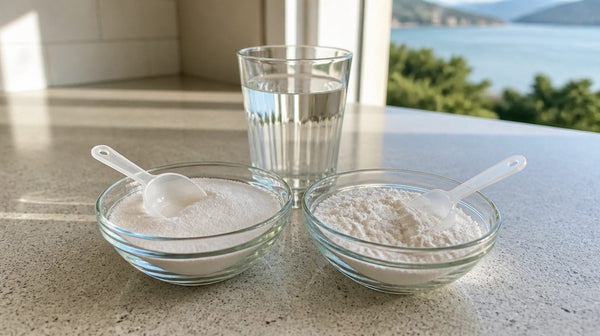
Cyclic dextrin is a carbohydrate made from starch. The name comes from its structure: a ring of glucose units with lots of branches, which makes it a large molecule that still dissolves easily. That shape is the whole point.
Most sugars and standard maltodextrin create a fairly concentrated drink. A concentrated drink tends to sit in the stomach longer, which is where the sloshing, bloated feeling comes from mid-session. Cyclic dextrin is designed to leave the stomach faster and feed a steadier stream of carbs to working muscles.
The research is small but interesting. In one small 2014 trial, athletes who drank HBCD during endurance exercise rated the effort as easier than when they drank glucose (Furuyashiki et al., 2014). That is one study with few people, so treat it as promising rather than proven. Still, it matches what a lot of riders and runners report: the same carbs, less gut drama.
If you are weighing it against the cheaper option, our post on cyclic dextrin vs maltodextrin goes through the trade-offs in detail.
Who actually needs intra-workout carbs
This is the honest part. Most people do not need carbs during training at all. If you eat a normal meal a few hours before a 45 to 60 minute session, your stored glycogen covers it easily.
Intra-workout carbs start to earn their keep when:
- Sessions run past 60 to 90 minutes. Long rides, long runs, big leg days with lots of volume.
- You train twice a day. Carbs during and after session one help you turn up with fuel for session two.
- You are racing or doing hard intervals. High intensity burns through glycogen faster.
- You train fasted early and go long. A bottle during the session can stop the wheels falling off in the back half.
For a triathlete, a Hyrox athlete or someone doing two-hour Saturday rides, cyclic dextrin makes a lot of sense. For a lifter doing an hour of upper body, it is probably wasted money.
How much to use
The standard serve is 25g, which is exactly what one scoop of the GAT product gives you. Mix it in 500 to 750ml of water and sip through the session rather than downing it at once.
How much you need beyond that depends on how long and how hard you go. We have a full guide on how many carbs per hour to aim for, so we will not repeat it all here. The short version: start low, then build up over a few weeks, because your gut needs training too.
A few pairing ideas that work well:
- For lifters doing long sessions: cyclic dextrin plus an EAA like Raw Nutrition EAA. Carbs for fuel, aminos for the muscle side, and the EAA adds flavour to the unflavoured dextrin.
- For endurance: cyclic dextrin in your bottle, plus an isotonic gel in your pocket for when you need a quick top up without a big drink.
- For hot days: add an electrolyte to the same bottle to cover sweat losses.
Who can skip it
Skip cyclic dextrin if your sessions are an hour or under, if you are in a calorie deficit and training is short, or if you are mainly lifting for strength with long rests. In those cases, water, a solid pre-training meal and maybe some electrolytes will do the job.
It is also fair to say that if normal sports drinks sit fine in your stomach, the upgrade will feel smaller. The people who notice cyclic dextrin most are the ones who have fought stomach issues on long days before.
Where NZ Supps fits
We carry GAT Sport cyclic dextrin alongside the rest of our intra-workout supplements, and our EAA and intra range has plenty of options to pair it with. If you want to see how it compares to everything else you could sip during training, read our roundup of the best intra-workout supplements.
FAQ
What is cyclic dextrin? Cyclic dextrin, also sold as highly branched cyclic dextrin (HBCD) or Cluster Dextrin, is a carbohydrate made from starch. It has a ring-shaped, branched structure and is designed to leave the stomach quickly, so you get usable carbs during training with less of that heavy, sloshing feeling.
Is cyclic dextrin better than maltodextrin? It is usually easier on the stomach and gives smoother energy for a lot of people, but it costs more. For short sessions neither really matters. For long sessions where your gut is the limit, cyclic dextrin is the one worth trying first.
How much cyclic dextrin should I take? A typical serve is 25g, which is what GAT Sport Essential Cyclic Dextrin uses. Start with one serve in your bottle for sessions over an hour, then adjust toward your carbs per hour target as your gut adapts.
Can I take cyclic dextrin if I am cutting? You can, but count it. A 25g serve is 25g of carbs, so if your sessions are under an hour and you are in a deficit, water and electrolytes are probably the better call.
Does cyclic dextrin have a flavour? GAT Sport Essential Cyclic Dextrin is unflavoured, so you can add it to water, an electrolyte drink or an EAA without changing the taste much.