SHOP NOW, PAY LATER


















 Informed Sport
 Informed Choice
 NSF Certified for Sport
 HASTA Certified

If your session runs beyond about an hour, involves repeated hard efforts, or starts in a fasted state, intra-workout carbs help preserve output. Starting with a moderate amount and increasing intake using a glucose and fructose blend for very long sessions is advisable. Test whatever you choose in training first. Gut distress ruins more race days than underfueling does.
TL;DR:
- Intra-workout carbs provide measurable performance benefits mainly during sessions longer than 75 minutes, high-intensity efforts, or fasted training, with less impact on shorter workouts.
- The ideal intake ranges from 30 to 60 grams per hour for most athletes, scaled to body weight, with higher doses reserved for multi-hour endurance sessions utilizing glucose-fructose blends.
- Maltodextrin is the most cost-effective carbohydrate source for most, while glucose-fructose mixes unlock higher absorption limits, especially above 60 grams per hour.
- Timing and concentration matter; drinks should be around 6 to 8% carbohydrate and sipped steadily starting early, not once fatigue begins.
- Gradually train your gut to tolerate higher carbohydrate loads over weeks, avoiding race-day testing and adjusting intake to prevent gastrointestinal distress.
Table of Contents
- Who Needs Intra Workout Carbs and When
- How Much Carbohydrate Should You Take In?
- Which Carb Source Should You Use?
- Picking a Delivery Format That Fits Your Sport
- Mixing the Right Concentration and Timing It Right
- How to Train Your Gut for Higher Carb Loads
- Effects on Recovery and Your Next Session
- Drawbacks and How to Avoid Them
- Should You Add Protein or Other Nutrients Intra-Workout?
- How Coaches Actually Apply This in Practice
- Where to Start Shopping for Intra-Workout Fuel
- Sources
- FAQ
Who Needs Intra Workout Carbs and When
Most gym sessions don’t need carbohydrate mid workout. Your liver and muscle glycogen generally cover about an hour of moderate output without a dip in performance. Beyond that, or with repeated high intensity, glycogen depletes and performance can decline.
The research backs a fairly specific cutoff. A review of carbohydrate ingestion during exercise found that for most gym-based resistance sessions under roughly 75 minutes, intra-workout carbs add little measurable benefit. The real payoff shows up in endurance efforts, multi-hour training blocks, and events where fatigue compounds over time.
Certain situations may require carbohydrate intake even for shorter sessions, such as fasted training, exercising in heat or altitude, multiple trainings in a day, repeated sprints late in games, or high-intensity workouts of moderate duration.
Watch your own signs rather than relying purely on the clock. Fading power output on your last few sets, a noticeably shorter sprint before you’re gassed, or slower recovery between rounds all point to glycogen running low. If you’re second-guessing whether a session needs fuel, a quick read on why intra-workout nutrition matters walks through the decision in more detail. One trial on CrossFit-trained adults found that intra-training carbohydrate ingestion produced measurable acute performance benefits in longer, high-intensity functional sessions, which suggests the endurance-only framing undersells how broadly this applies.
How Much Carbohydrate Should You Take In?
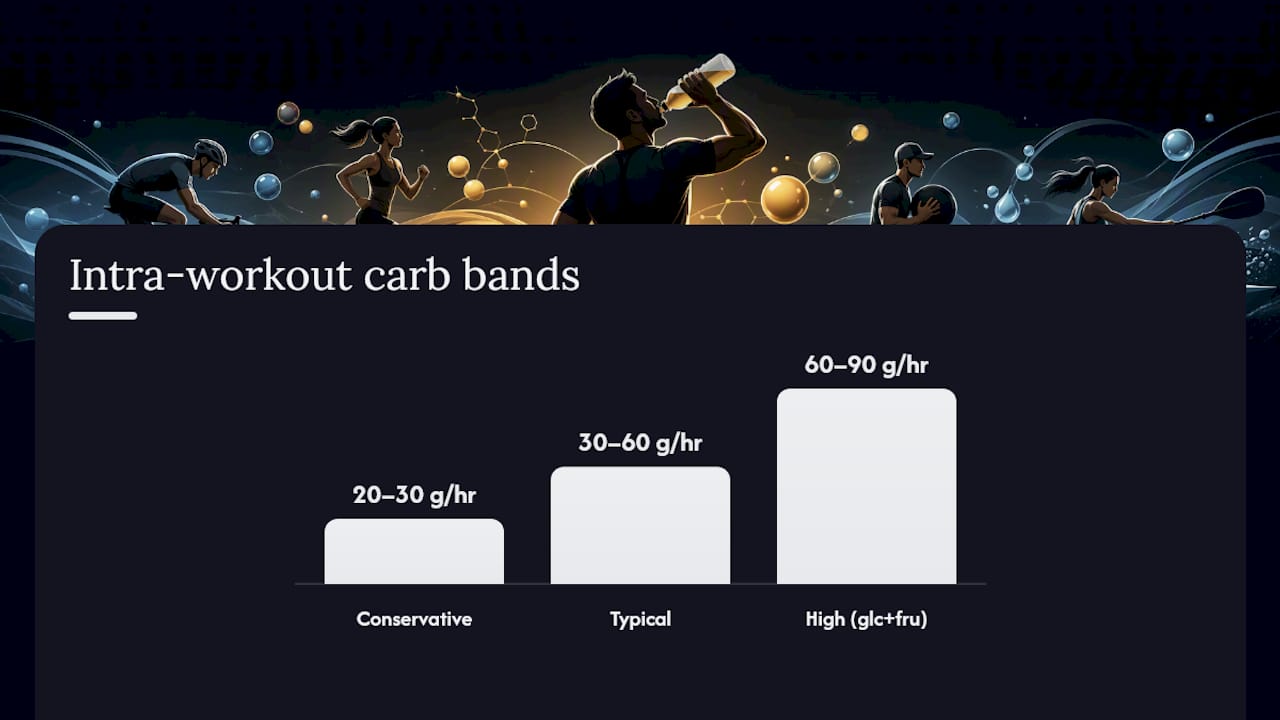
Dosing breaks into three practical bands, and picking the right one depends on session length and how trained your gut is.
Conservative (20 to 30 g/hr): suited to sessions in the 60 to 90 minute range, or for athletes just starting to introduce carbs mid workout. This dose rarely causes GI issues and is a sensible entry point.
Typical (30 to 60 g/hr): the range most reviews point to for sustained performance benefit. Meta-analyses on carbohydrate ingestion consistently show improved endurance output in this window, and it covers the majority of triathlon, cycling, and long team-sport sessions.
High range (60 to 90 g/hr): reserved for multi-hour endurance events where glycogen depletion is severe. Hitting the top of this range requires a glucose plus fructose blend, since a single sugar type caps out around 60 g/hr due to gut transporter limits.
Converting that into a per-kilogram figure helps you scale the dose to your own body rather than guessing from a generic gram target. Roughly 0.4 to 0.8 g/kg/hr covers the conservative-to-typical range for most athletes.
Dosing scaled to bodyweight can guide intake appropriately, with lower to moderate amounts recommended for most athletes, and higher intake for those undertaking long-duration or high-intensity endurance sessions.
The ceiling on single-sugar absorption isn’t arbitrary. Intestinal glucose transporters saturate around 60 g/hr no matter how much more you pour in. Pairing glucose with fructose opens a second transport pathway, and research on carbohydrate transport during exercise shows this dual-transporter approach lets total absorption climb toward 90 g/hr, which single-source glucose or maltodextrin alone can’t match.
A practical example: an 80 kg cyclist targeting 80 g/hr for a five-hour ride might mix 50 g maltodextrin with 25 g fructose per bottle, refilling roughly every hour. That hits the dual-transporter ratio without needing exotic ingredients.
- Under 60 minutes: skip intra-workout carbs unless fasted or in extreme heat.
- 60 to 90 minutes: 20 to 30 g/hr from a simple glucose or maltodextrin source.
- 90 minutes to 3 hours: 30 to 60 g/hr, single or blended source.
- Beyond 3 hours: 60 to 90 g/hr using a 2:1 glucose to fructose ratio.
Which Carb Source Should You Use?
Four ingredients dominate intra-workout products, and each behaves differently in your gut once the intensity climbs.
Dextrose (glucose): absorbs fast, spikes blood sugar quickly, and tastes noticeably sweet. It’s cheap and effective for shorter, harder efforts where a fast hit matters, but at higher concentrations it pulls water into the gut and can trigger bloating.
Fructose: metabolized through a separate pathway in the liver rather than muscle glucose transporters. On its own it absorbs slower and can cause GI upset in larger doses, but paired with glucose it unlocks the higher absorption ceiling discussed above.
Maltodextrin: a longer glucose chain that digests steadily, tastes far less sweet than dextrose, and costs less per gram. It’s the default base for most sports drinks and gels because it delivers a reliable glucose supply without overwhelming sweetness.
Highly branched cyclic dextrin (HBCD, sold as Cluster Dextrin): a specialty carbohydrate with a much larger molecular structure than dextrose or maltodextrin. According to ingredient analyses of HBCD, its lower osmolality allows faster gastric emptying, which can reduce bloating at high concentrations. It costs noticeably more than maltodextrin, and applied nutrition guidance suggests reserving it for athletes chasing very high hourly carb targets or those who get GI distress from standard carb powders. Our guide to cyclic dextrin covers what it is and who needs it.
For anyone targeting more than 60 g/hr, the 2:1 glucose to fructose ratio is the detail that actually moves the needle, not the brand of carbohydrate powder. A base of maltodextrin with a smaller fructose component, sometimes from fruit-based gels, hits that ratio without the added cost of HBCD unless gut tolerance demands it.
- Dextrose: fast, sweet, cheap, higher GI risk at high doses.
- Maltodextrin: steady, mild taste, cost-effective, the standard base carb.
- Fructose: unlocks a second absorption pathway, best used alongside glucose.
- HBCD/Cluster Dextrin: lower osmolality, gentler on the gut at high concentrations, premium price.
Picking a Delivery Format That Fits Your Sport
Drinks, gels, chews, powders, and whole foods all deliver the same carbohydrate math differently, and the right pick depends more on your sport than on any performance edge one format has over another.
Sports drinks mixed to the right concentration double as hydration and fuel, which makes them the natural choice for cycling, where a bottle cage does the carrying. Gels pack a concentrated dose into a small pouch, ideal for running or any sport where carrying liquid is awkward, but they need water alongside them to avoid concentrating stomach contents too much. Chews offer a chewable, slower-release alternative that some athletes tolerate better than gels, though they’re harder to consume while breathing hard. Powdered mixes give you full control over concentration and are the cheapest option per gram, but they require prep before training. Whole foods like bananas, dates, or rice cakes work for lower-intensity, longer efforts where digestion time isn’t a concern.
Sodium matters as much as the carbohydrate itself once sessions stretch past 90 minutes or move into heat. A starting range of 300 to 600 mg of sodium per hour covers most sweat rates, with heavier sweaters needing the higher end.
- Cyclists: bottles with a premixed carb and electrolyte solution, refilled at set intervals.
- Team-sport athletes: sideline gels or chews between plays, since bottles aren’t always accessible mid-action.
- Gym-based intra-workout use: a shaker with a diluted carb powder sipped between sets on longer sessions.
Mixing the Right Concentration and Timing It Right
A 6 to 8% carbohydrate solution is the sweet spot between fast absorption and gut comfort. That works out to 60 to 80 grams of carbohydrate per liter of fluid. Go higher and you risk slowing gastric emptying and pulling water into the intestine, which is the fast track to cramping and nausea mid-session.
- Weigh out your target carb dose for the hour, whether that’s 30 grams or 80 grams depending on your session length and body weight.
- Dissolve it into 500 to 750 mL of water to land in the 6 to 8% range, adjusting the water volume rather than the carb amount if the mix tastes syrupy.
- Start sipping in the first 15 to 20 minutes of the session, not once you already feel your legs going heavy. Waiting until you bonk means you’re playing catch up on glycogen you’ve already burned through.
- Sip every 15 to 20 minutes rather than gulping a large bolus once an hour. Steady small doses keep blood glucose level instead of spiking and crashing it.
- If a mix tastes overly sweet or sits heavy in your stomach, add more water immediately rather than pushing through. An overconcentrated drink is one of the fastest ways to trigger cramping.
Practical coaching guidance on intra-workout nutrition backs this same 6 to 8% range as the standard recommendation across most endurance and hybrid training contexts.
How to Train Your Gut for Higher Carb Loads
Your intestine adapts to repeated carbohydrate exposure the same way your muscles adapt to training load. Research on carbohydrate transport shows that athletes who practice intra-workout feeding regularly develop higher tolerated intakes over weeks, since transporter capacity increases with consistent use.
Start at 20 to 30 g/hr for two weeks, then bump the dose by roughly 10 g/hr every one to two weeks as tolerance builds, always testing in training rather than on race day.
- Bloating: dilute the mix further and slow your sip rate.
- Nausea: switch from a single glucose source to a glucose and fructose blend, which digests through two separate pathways.
- Cramping: check your sodium intake first, since low electrolytes often masquerade as a carb problem.
- Persistent GI distress despite adjustments: back off the dose and consider whether HBCD’s lower osmolality might suit your gut better than maltodextrin.
Pro Tip: Never test a new carb mix, gel, or concentration for the first time on race day or during a key competition. Rehearse it during a lower-stakes training session at least two or three times first, so you know exactly how your gut responds under load.
Persistent vomiting, severe abdominal pain, or blood in your stool during or after training are not normal fueling side effects. Stop and get medical attention if any of those show up.
Effects on Recovery and Your Next Session
Fueling adequately during a workout changes how depleted you are walking out of it, which directly shapes how fast you’re ready to train again. Athletes who take in adequate carbohydrate mid-session preserve more of their liver and muscle glycogen stores than those who train fully unfueled, leaving a smaller deficit to refill afterward.
That matters most for anyone training in consecutive days or multiple sessions within 24 hours. A depleted athlete walking into session two starts from a worse baseline, often showing reduced power output and higher perceived effort even if the workout itself is identical to session one. Intra-workout carbs don’t replace post-training nutrition, but they reduce how large a hole your recovery meal needs to fill.
There’s a secondary effect worth noting for anyone training hard on a caloric deficit. Fueling intra-workout can blunt the cortisol response tied to prolonged, glycogen-depleted training, which some athletes report as feeling less wrecked the following morning. That’s a subjective effect rather than a guaranteed outcome, but it lines up with the broader pattern: less depletion during the session generally means less to recover from afterward.
Drawbacks and How to Avoid Them
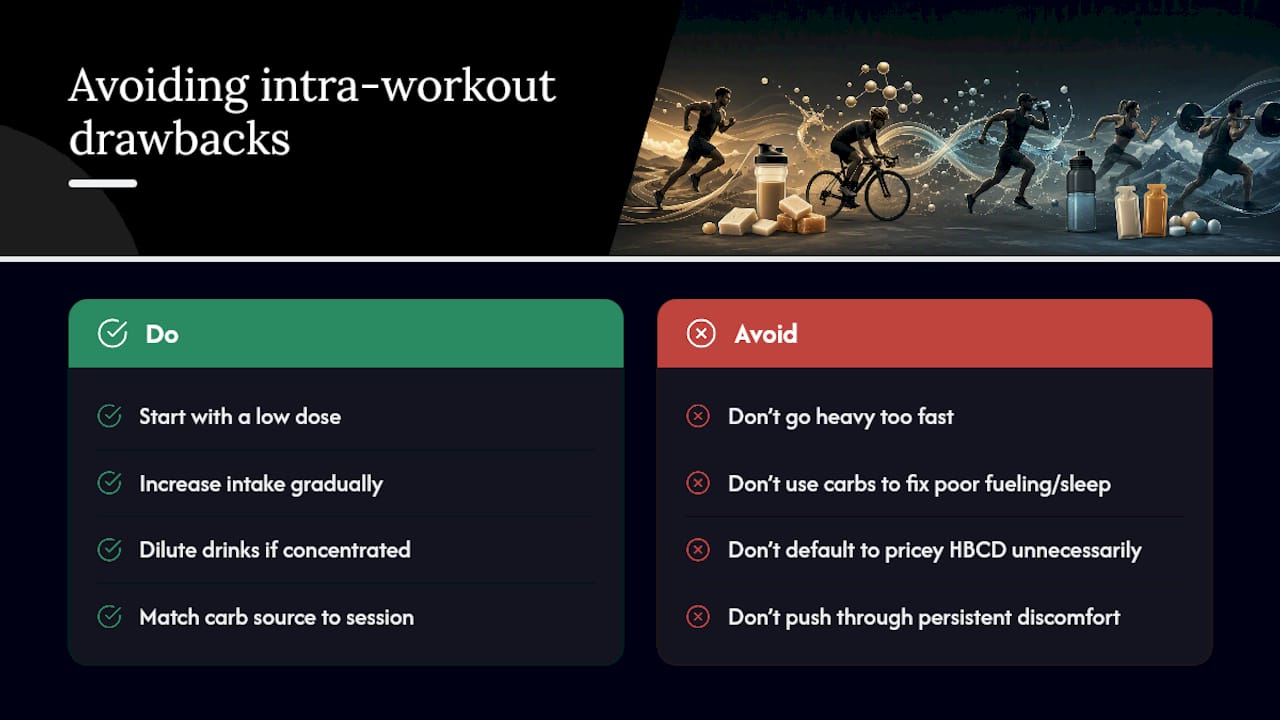
The most common complaint with intra-workout carbs is gastrointestinal distress, and it’s almost always a dosing or concentration problem rather than a reason to avoid carbs altogether. Going too heavy too fast, especially with a single sugar source like straight dextrose, pulls water into the gut and triggers bloating, cramping, or urgent bathroom stops mid-session.
Overreliance is the other risk. Some athletes lean on intra-workout carbs as a crutch for showing up under-fueled or under-slept, when the actual fix is better daily nutrition rather than a mid-session bottle. Carbs during training smooth out a legitimate glycogen deficit. They don’t fix chronic underfueling or poor sleep.
Cost adds up too, particularly with specialty ingredients like HBCD, which run notably more expensive per serving than plain maltodextrin. For most training contexts that don’t demand very high hourly intakes, that premium buys marginal comfort rather than a meaningful performance edge. Our comparison of cyclic dextrin vs maltodextrin looks at whether the premium is worth it.
The fixes are straightforward: start low, increase gradually, dilute anything that feels too concentrated, and match your carb source to your actual session demands instead of defaulting to the most expensive option on the shelf. If side effects persist despite those adjustments, dropping the dose back to your last comfortable level is a better move than pushing through discomfort hoping it resolves on its own.
Should You Add Protein or Other Nutrients Intra-Workout?
Carbohydrate does the heavy lifting for intra-workout fueling, but a small amount of protein or added electrolytes can round out the mix in specific contexts. Adding roughly 5 to 10 grams of protein to a carbohydrate drink during very long sessions, three hours or more, has shown modest benefit for reducing muscle protein breakdown during extended endurance efforts.
For sessions under that length, added protein mostly just adds cost and gut load without a clear performance return. Electrolytes are the more consistently useful addition, particularly sodium, since heavy sweating during long or hot sessions depletes electrolytes faster than carbohydrate alone. Branch chain amino acids sometimes get added to intra-workout mixes, but the evidence supporting a meaningful performance benefit from BCAAs alone during exercise is thin compared to what carbohydrate and sodium deliver.
The practical takeaway: build your intra-workout mix around carbohydrate and sodium first, and only consider adding protein once your sessions regularly stretch past the three-hour mark.
How Coaches Actually Apply This in Practice
Most coaches start conservatively regardless of sport: 20 to 30 g/hr in early training blocks, moving toward 60 g/hr or higher only once an athlete has proven they tolerate it without GI complaints. The progression matters more than the destination. An athlete who jumps straight to 80 g/hr on race day without ever testing it in training is gambling with something entirely preventable.
Individualized testing beats following someone else’s protocol. Gut tolerance, sweat rate, and sport-specific demands vary enough between athletes that a plan built for a marathoner rarely transfers cleanly to a rugby prop. Some intra-workout product ranges emphasize clear carbohydrate labeling so athletes can dose precisely rather than guess.
— Blake
Where to Start Shopping for Intra-Workout Fuel
Some retailers carry product types with fully disclosed ingredient labels so customers can dose their carbohydrate intake precisely instead of guessing from a marketing claim on the front of the tub. Look for straight cyclic dextrin powders when you want a low-osmolality base for high-intake sessions, or a carbohydrate and electrolyte blend when you’re covering both fuel and sodium in one scoop.
If you’re just getting started, the GAT Essentials Cyclic Dextrin is a straightforward, unflavored option that lets you control your own mixing ratio and dose without added sugars or flavoring interfering with your gut-training progression. Pair it with a solid post-session recovery plan, and for a deeper look at the recovery side of the equation, this guide on boosting endurance recovery is worth a read.
Start with a single bag, test your dosing in a low-stakes training session, and adjust from there. Browse the full range at Nzsupps and pick the format that fits your sport before your next big session.
Sources
- Primary, secondary and tertiary effects of carbohydrate ingestion during exercise (review)
- Highly branched cyclic dextrin and carbohydrate transport during exercise (review and commentary)
- Acute effects of intra-training carbohydrate ingestion in CrossFit trained adults (trial)
- Cluster Dextrin / HBCD — Sports Nutrition Buyer’s Guide · Carb Hack
FAQ
What Is a Good Intra-Workout Carb?
Maltodextrin is the most cost-effective base for most athletes, while a glucose and fructose blend works better for hourly targets above 60 grams. HBCD (Cluster Dextrin) suits athletes with GI sensitivity who need high intakes at lower osmolality.
Are Intra-Workout Carbs Worth It?
For sessions under 75 minutes, generally no. For endurance efforts past 90 minutes, repeated high-intensity training, or fasted sessions, research shows real performance benefits at 30 to 60 g/hr.
Is 40 Grams of Carbs Enough Before a Workout?
For most training sessions, yes, a moderate pre-workout carbohydrate intake supports adequate glycogen availability. It doesn’t replace the need for intra-workout carbs on sessions running past 90 minutes or involving repeated hard efforts.
Should You Eat Carbs While Working Out?
Only if your session is long, intense, or fasted. Shorter, lower-intensity gym sessions rarely need mid-workout carbohydrate, but anything approaching two hours or involving repeated sprints benefits from 30 to 60 grams per hour, tested in training first.