SHOP NOW, PAY LATER








 Informed Sport
 Informed Choice
 NSF Certified for Sport
 HASTA Certified

Estimate sweat rate by weighing yourself before and after a representative session, adding what you drank and subtracting any urine passed. Divide the estimated fluid loss by the session length in hours. The result helps you plan access to drinks; it does not measure how salty your sweat is or prescribe an exact drinking target.
Start with a session you actually repeat
Choose an ordinary run, ride or training session rather than a one-off sufferfest. You want a result that means something next week: similar pace, duration, clothing and weather. A cool evening jog and a hard indoor bike session deserve separate entries.
For a first attempt, a session of roughly an hour is convenient because the arithmetic is simple and there are fewer opportunities to lose track of food or toilet stops. That is a measurement choice, not a requirement to exercise for an hour or to avoid drinking.
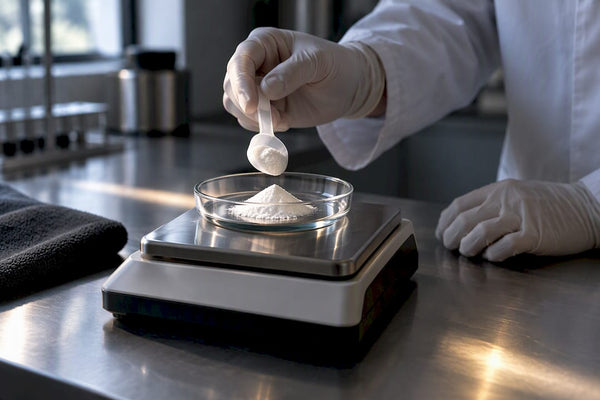
Use the same scales on a hard, level floor. Have a dry towel, a measured bottle and somewhere private to weigh without wet clothing. Record the session start and finish times. If weighing yourself is unhelpful for your relationship with food or body image, a sports dietitian can help plan hydration without making this a regular personal ritual.
Take four measurements
Empty your bladder before the first weigh-in, then record your body mass in kilograms. Use minimal, dry clothing and repeat the same approach afterwards. Do not include shoes, a phone or a sweat-soaked jacket in one reading but not the other.
Measure the drink in your bottle before and after the session. Count fluid swallowed, not water poured over your head, spilled on the track or left behind. If you refill, record each refill. Graduations on a bottle are useful, but a measuring jug can make the initial check clearer.
After exercise, towel off and weigh promptly before eating or drinking. If you need a drink first, count it. Record urine volume if you pass urine between weigh-ins. An unmeasured bathroom stop makes that attempt less reliable; do not pretend it was zero.
The field method estimates rather than directly collects sweat. National Athletic Trainers' Association fluid-replacement position statement supports measuring individual sweat rates across conditions when developing hydration plans. The practical point is to replace guesses with a repeatable observation.
Work through the calculation
For a simple session without food: estimated sweat loss in litres = pre-session mass in kg minus post-session mass in kg, plus drinks in litres, minus urine in litres. This uses the practical approximation that one kilogram of water is one litre.
Here is a hypothetical 75-minute run. The runner starts at 72.4kg, finishes at 71.8kg, drinks 0.5L and passes no urine. Estimated sweat loss is 72.4 - 71.8 + 0.5 - 0 = 1.1L. Seventy-five minutes is 1.25 hours, so estimated sweat rate is 1.1 / 1.25 = 0.88L per hour.
The runner lost 0.6kg on the scales but an estimated 1.1L through sweat because some fluid was replaced along the way. Confusing those numbers is the most common arithmetic mistake.
If 0.2L of urine had been passed during the same example, estimated sweat loss would instead be 0.9L and the rate 0.72L per hour. Urine is subtracted because that mass loss was not sweat.
Keep the units beside every number. Writing 500 when the formula expects litres gives a spectacularly wrong result. Convert 500mL to 0.5L and 90 minutes to 1.5 hours before calculating.
Copy this worksheet into your training notes
| Field | What to record |
|---|---|
| Session | Date, activity, pace or effort, conditions and clothing |
| Before and after mass | Both readings in kg, with the same weighing method |
| Drinks consumed | Litres actually swallowed |
| Urine during the test | Litres, or mark the test incomplete if unmeasured |
| Duration | Minutes divided by 60 |
| Result | Estimated loss in litres and estimated rate in L/hour |
| Notes | Spills, food, rain, unusual stops or measurement uncertainty |
Keep the original readings as well as the answer. If a later calculation looks odd, you can check the inputs rather than doing the session again. Round sensibly: a bathroom scale and marked bottle do not support a claim of precision to three decimal places.
Repeat in a few relevant conditions and keep the results separate. Label the indoor ride as an indoor ride. Averaging every session into one permanent number can hide the differences you were trying to understand.
Turn the result into a practical plan
Use the estimate to think about bottle capacity, refill access and the length of time between aid stations. For the example above, a single 500mL bottle is less than the measured total loss. That observation is useful even before choosing a drink.
It does not mean forcing exactly 0.88L each hour. Consider thirst, comfort, conditions and opportunities to drink with your sports dietitian. Do not drink beyond your losses to finish heavier. Both too little and excessive fluid can cause problems, as the NATA guidance explains.
Sweat rate cannot tell you sodium concentration. A high-volume sweater is not automatically a high-sodium-concentration sweater. Salt marks and taste do not provide a milligram-per-litre measurement. Keep the fluid calculation separate from decisions about electrolyte amounts.
Our existing guide to when electrolytes are useful explains the broader product question. The measurement here is one input, not a diagnosis or a reason to add several overlapping hydration products.
Know when the simple method is a poor fit
Wet clothes, rain, eating, long exercise duration and inaccurate drink measurements can distort the estimate. In very long sessions, changes in stored fuel and other body-mass losses make the simple calculation less representative of sweat alone. Mark an uncertain session rather than building a precise plan from it.
Do not deliberately withhold fluid to make the test easier. Normal training and careful recording are the point. Feeling seriously unwell during a session needs attention, not another weigh-in.
If a result seems implausible, check the units and scales, then repeat another day. One messy measurement should not become your race-day rule.
Where NZ Supps fits
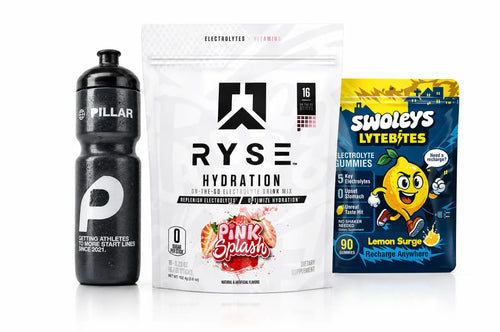
Once you know the practical job, compare the electrolyte range by the prepared serving and mixing instructions. Choose a bottle or shaker with a usable capacity and readable volume marks if measurement is part of your routine. Neither purchase is needed to begin: a household scale, measuring jug and ordinary bottle can do the initial work.
Frequently asked questions
Is sweat rate the same as weight lost during a workout?
No. The scale change is net mass change. Drinks replace some fluid while you exercise, and urine removes fluid without being sweat, so both must be accounted for.
Should I measure myself with clothes on?
Use the same minimal, dry-clothing approach before and after, or weigh privately without clothing. Wet kit left on for the second reading can conceal fluid loss.
Can I use one result all year?
Treat it as a result for those conditions. Repeat when the activity, clothing, intensity or weather changes enough to affect the session.
Does a sweat-rate test tell me how much sodium to take?
No. It estimates fluid volume, not sodium concentration. A sodium strategy needs separate consideration and should not be guessed from litres alone.
What if I eat during the session?
Food adds mass and complicates the simple version. Record it and use a more complete assessment with a qualified practitioner rather than silently ignoring it.
Do I have to replace every drop while exercising?
The calculation is not an instruction to force the same volume back in. Use it alongside thirst, tolerance and an individual plan, and avoid drinking enough to gain fluid weight.