SHOP NOW, PAY LATER












 Informed Sport
 Informed Choice
 NSF Certified for Sport
 HASTA Certified

A typical collagen serve on a New Zealand label gives you about 9 to 14 g of protein from a 10 to 15 g serve, and collagen isn't a complete protein. That protein counts toward your daily total, but it doesn't replace a whey or complete plant serve for essential amino acids.
Table of Contents
- Protein Per Serve for Collagen, Whey and Plant Powders
- Why Collagen Does Not Count as a Complete Protein
- How to Work Out Protein From a Collagen Label
- Combining Collagen With Whey or Plant Protein
- Checking a Collagen Label Before You Buy
- Which Protein Fits Your Goal and What to Buy
Protein Per Serve for Collagen, Whey and Plant Powders
Collagen can provide 90 g of protein per 100 g while delivering fewer grams per serve than whey isolate. That difference matters: scoop size sets the serving, while protein density shows how much of the powder is protein.
New Zealand label examples illustrate the calculation. The NZ Protein collagen hydrolysate nutrition panel lists one product with 9 g protein in a 10 g serving and another with 13.5 g in a 15 g serving. Both provide 90 g protein per 100 g. Their different protein totals per serve reflect serving size, not a difference in density.
Protein Per Serve by Powder Type
| Powder type | Typical serve | Protein per serve | Protein per 100 g |
|---|---|---|---|
| Collagen peptides | 10 g | 9 g | 90 g |
| Collagen peptides | 15 g | 13.5 to 14 g | 90 to 93.3 g |
| Whey isolate | 30 g | about 25 g | about 83 g |
| Whey concentrate | 30 g | about 24 g | about 80 g |
| Pea or rice blend | 30 g | about 21 to 24 g | about 70 to 80 g |
These are typical figures; check the label for the product you are considering. Whey isolate is filtered further than whey concentrate, so it generally provides more protein per serve with less carbohydrate, fat and lactose. Plant blends typically provide less protein per 30 g serve than the whey examples in the table.
Scoop size alone can mislead. A 15 g collagen serving is not 15 g of protein, and a 30 g plant-protein scoop does not necessarily match a 30 g whey-isolate scoop. Compare the serving weight and protein grams together, using this guide to protein per scoop and serving sizes.
To compare density, divide protein per serve by the serve weight, then multiply by 100. A 12 g serving with 9 g protein provides 75 g per 100 g; a 10 g serving with the same 9 g provides 90 g per 100 g. The second powder has more protein relative to its weight, even though both servings supply the same protein. Use density to compare the powders themselves, then consider cost per serve.
Why Collagen Does Not Count as a Complete Protein
No, collagen isn't a complete protein. It contains no tryptophan and it's low in leucine, the amino acid that most strongly signals muscle protein synthesis. A label can show a high protein percentage and still leave you short on the essential amino acids you need from that serve.
Collagen is high in glycine, proline and hydroxyproline. That's its distinctive pattern, and it explains why the grams look large on a collagen label. Those amino acids dominate the profile, while several essential amino acids sit low. Whey runs the other way, with lower glycine but a full essential set and high leucine. A pea or rice blend sits between them, usually moderate for leucine and lower for lysine than whey.
Amino Acid Pattern by Protein Source
| Amino acid | Collagen | Whey | Pea or rice blend |
|---|---|---|---|
| Glycine | High | Low | Low |
| Proline | High | Moderate | Moderate |
| Leucine | Low | High | Moderate |
| Lysine | Moderate | High | Lower |
| Tryptophan | Absent | Present | Present, lower |
| Complete essential amino acid set | No | Yes | Usually only when two sources are combined |
Walk the rows and the trade off is plain. Collagen wins on glycine and proline, whey wins on leucine, lysine and completeness, and a plant blend only closes its gaps when two sources, such as pea with rice, are combined to cover each other's weak points. Protein quality scores try to capture exactly this difference, which is why our explainer on PDCAAS versus DIAAS is worth reading before you rank powders by grams alone.
Collagen gives you plenty of glycine and proline, but no tryptophan and little leucine, so its grams aren't interchangeable with whey grams.
In practice, collagen protein counts toward total daily protein. It just shouldn't be swapped one for one with a complete serve when your goal is muscle. Replacing a 25 g whey serve with a 10 g collagen serve cuts your protein and removes most of the leucine and essential amino acids in one move. You'd be down on quantity and quality at the same time.
Use this practical rule. If a product doesn't list leucine or a full amino acid breakdown, don't assume it's a complete source. Treat collagen as an add-on for total protein and for connective tissue interest, and use whey or a complete blend when essential amino acid targets matter most. That's not a knock on collagen. It's matching each powder to the job its amino acid profile can do.
How to Work Out Protein From a Collagen Label
Collagen weight and protein weight split as soon as you leave the front of the tub. One is the ingredient. The other is the nutrient. Ranking powders by scoop size misses protein density per 100 g, and it also ignores the essential amino acids collagen does not supply, even when two serves look close in grams.
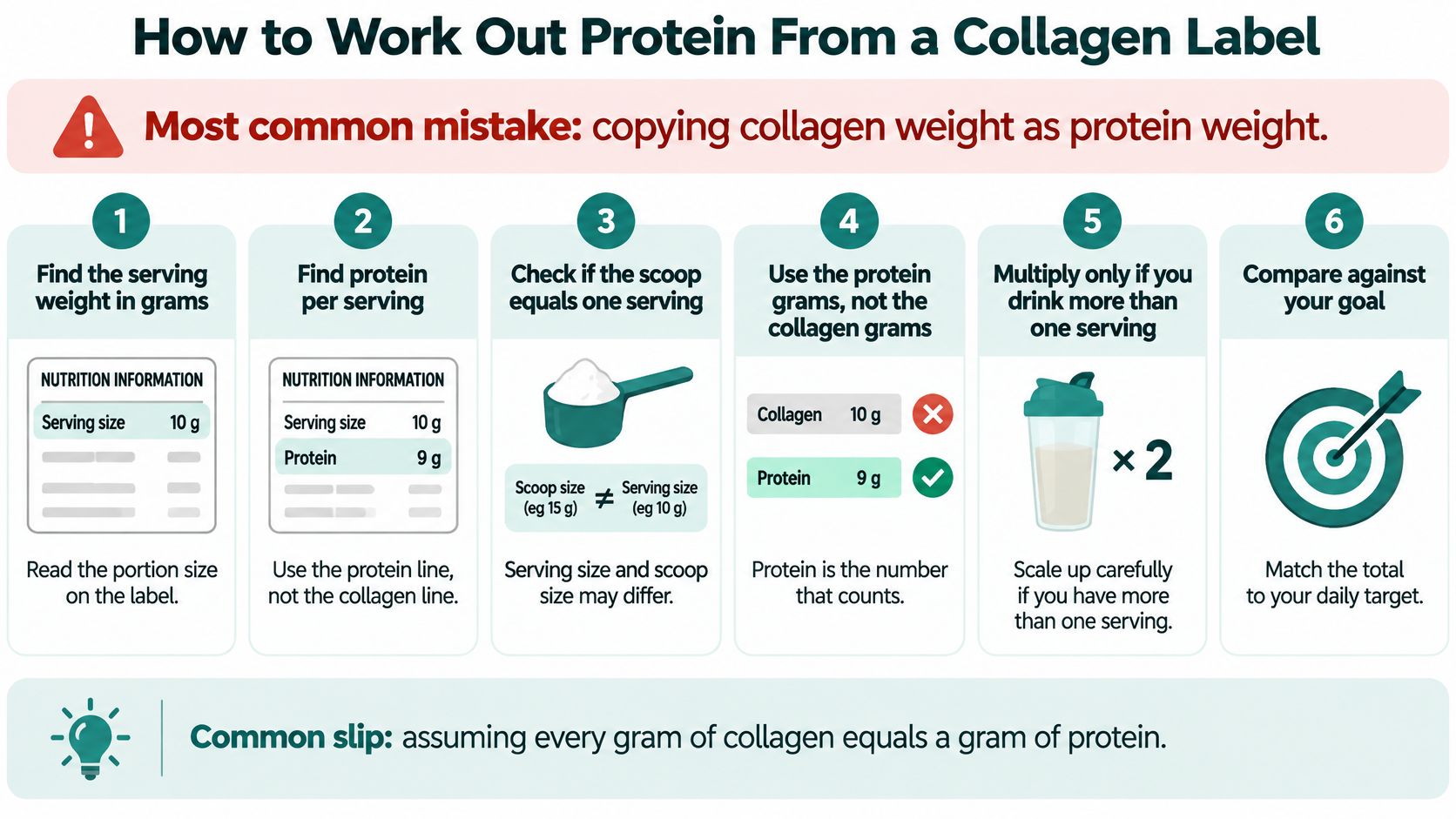
Six Steps on the Panel
- Find the serving weight in grams on the Nutrition Information Panel. A 10 g, 15 g and 20 g serve cannot be compared until you know which weight you are holding. The scoop in the tub is not automatically one labelled serve.
- Read the protein line, not the collagen line. The DSLD label record for a New Zealand collagen product lists a 15 g serving containing 15 g collagen but 14 g protein, alongside 50 calories and 13 mg sodium. Copy the 15 g and the protein figure is already 1 g too high.
- Convert to a density figure by dividing protein per serve by serve weight, then multiplying by 100. 14 divided by 15, multiplied by 100, gives about 93.3 g per 100 g, subject to the label's own rounding. Density is what lets you compare brands when the scoops differ. Two powders can post similar grams per serve and still separate once both are expressed per 100 g.
- Check a stated per 100 g figure by working back. Multiply per 100 g protein by serve weight, then divide by 100. 90 multiplied by 15, divided by 100, gives 13.5 g. If that result does not match the per serve line, rounding or a different serve definition is usually why.
- Confirm the serve matches what you will use. A 20 g scoop is not automatically more protein than a 10 g scoop if its density is lower. Rank brands on protein per 100 g first, then on cost per 10 g of protein, so the price tracks protein rather than powder weight. A similar-looking serve can still lose on density, and collagen grams still do not stand in for a full essential amino acid set.
- Record three details for every product: serving weight, protein per serve, and protein per 100 g. Side by side, the weaker density shows without guessing from the front of the pack.
The nutrition information panel already places protein with energy, fat, carbohydrate and sodium. Use those lines for the maths.
If a number you need is missing, that tells you something about the label before you compare powders.
Combining Collagen With Whey or Plant Protein
Start with your daily total, not with a single scoop. The Australia and New Zealand Nutrient Reference Values analysis in Nutrients sets the Estimated Average Requirement for protein at 0.68 g per kilogram per day for adult males aged 19 to 70 and 0.60 g/kg/day for adult females in the same range. For an 80 kg man, that's an average requirement of about 54 g a day from all food and supplements combined.
Those values describe total protein, not a collagen dose. Collagen contributes to the total, but it doesn't add essential amino acids in the same proportion as whey or a complete blend. That distinction shapes how you stack them, because a day that hits your gram target mostly through collagen can still fall short on leucine and other essentials.
Daily Protein From Sample Mixes
| Daily mix | Powder protein | Collagen protein | Total |
|---|---|---|---|
| One whey isolate scoop only | about 25 g | 0 g | about 25 g |
| One whey isolate scoop plus one collagen serve | about 25 g | 9 g | about 34 g |
| One collagen serve only | 0 g | 9 g | about 9 g |
| One pea or rice blend scoop plus one collagen serve | about 21 to 24 g | 9 g | about 30 to 33 g |
The pattern that works is simple. Use whey or a plant blend as the core serve, then add collagen as an extra serve when total protein is running low or when it suits a drink or recipe, such as stirred into coffee or a smoothie where a flavoured shake doesn't fit. If dairy is an issue, whey protein isolate in NZ is worth checking first, since whey isolate has very little lactose and plant based protein has none.
A sample day to copy is two whey isolate serves, one collagen serve in a coffee or smoothie, and protein foods at each meal, with the panel figures added up and checked against your target.
Add your own label figures rather than estimating from a table like this one. Your whey might give 24 g, your collagen might give 14 g, and those differences add up across a week. The reference value also shifts with age, since the Estimated Average Requirement for older females rises to 0.75 g/kg/day, so the same body weight needs more daily protein for an older woman than for a woman in the 19 to 70 range. Run your own maths against your own target, then let collagen top up the gap.
Checking a Collagen Label Before You Buy
A large protein number on the front of a tub does not show how much collagen one serve contains, or whether the product suits your dietary needs. Check the serving details and ingredient panel before weighing claims such as “natural”, “premium” or “grass fed”. Those terms describe marketing or sourcing preferences, not the collagen dose or batch testing.
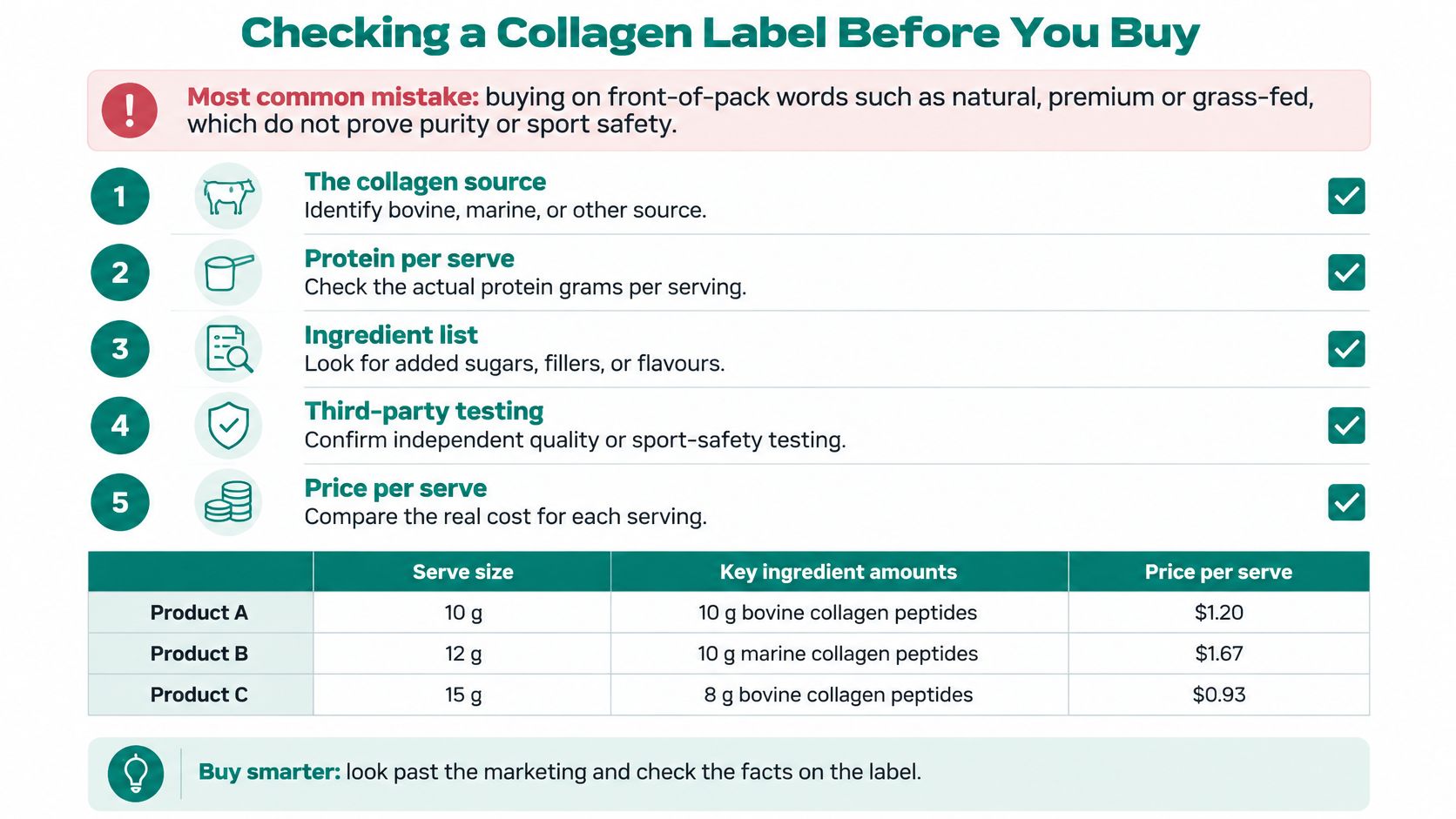
Five Checks in Order
- Collagen peptide dose per serve: Find the amount listed for collagen peptides. A total protein figure alone does not tell you how much of that protein is collagen.
- Animal source and allergens: Check whether the collagen is bovine, porcine or marine, then read the allergen statement. These details help you assess dietary suitability and potential allergens.
- Responsible business named on the label: Check that the manufacturer or sponsor is identifiable, so you know whom to contact with questions about the product.
- Batch certificate or independent testing: Drug-tested athletes can use testing information to assess contamination risk. Supplements are not approved by WADA, and contamination can occur during manufacturing.
- Batch code matched to the certificate: Compare the code on the pack with the code on any certificate. A certificate for another batch does not cover the product in your hand.
The Nutrition Information Panel gives you a consistent basis for comparing protein. New Zealand's Ministry for Primary Industries labelling guidance says the panel must show protein, energy, fat, saturated fat, carbohydrate, sugars and sodium, with values per serving and per 100 g. MPI also says a panel is required when nutrition or health claims are made. For a plain-language overview of terms used on collagen labels, see understanding collagen supplement labels.
Keep dose and testing separate. The panel shows the amount of protein and collagen; batch information addresses product testing. A high protein figure cannot, by itself, establish whether a batch has been tested.
Which Protein Fits Your Goal and What to Buy
A 5 g collagen serve and a whey serve can look close on a scoop and still do different jobs. Collagen adds a small protein contribution and lacks essential amino acids, so protein per 100 g, not headline scoop size, decides whether it belongs in the daily total. Choose the core protein first if you train for muscle, compete under anti-doping rules, or avoid dairy. Collagen stays an add-on.
The illustration below shows the range of people who use these products, which is exactly why one recommendation does not fit everyone.
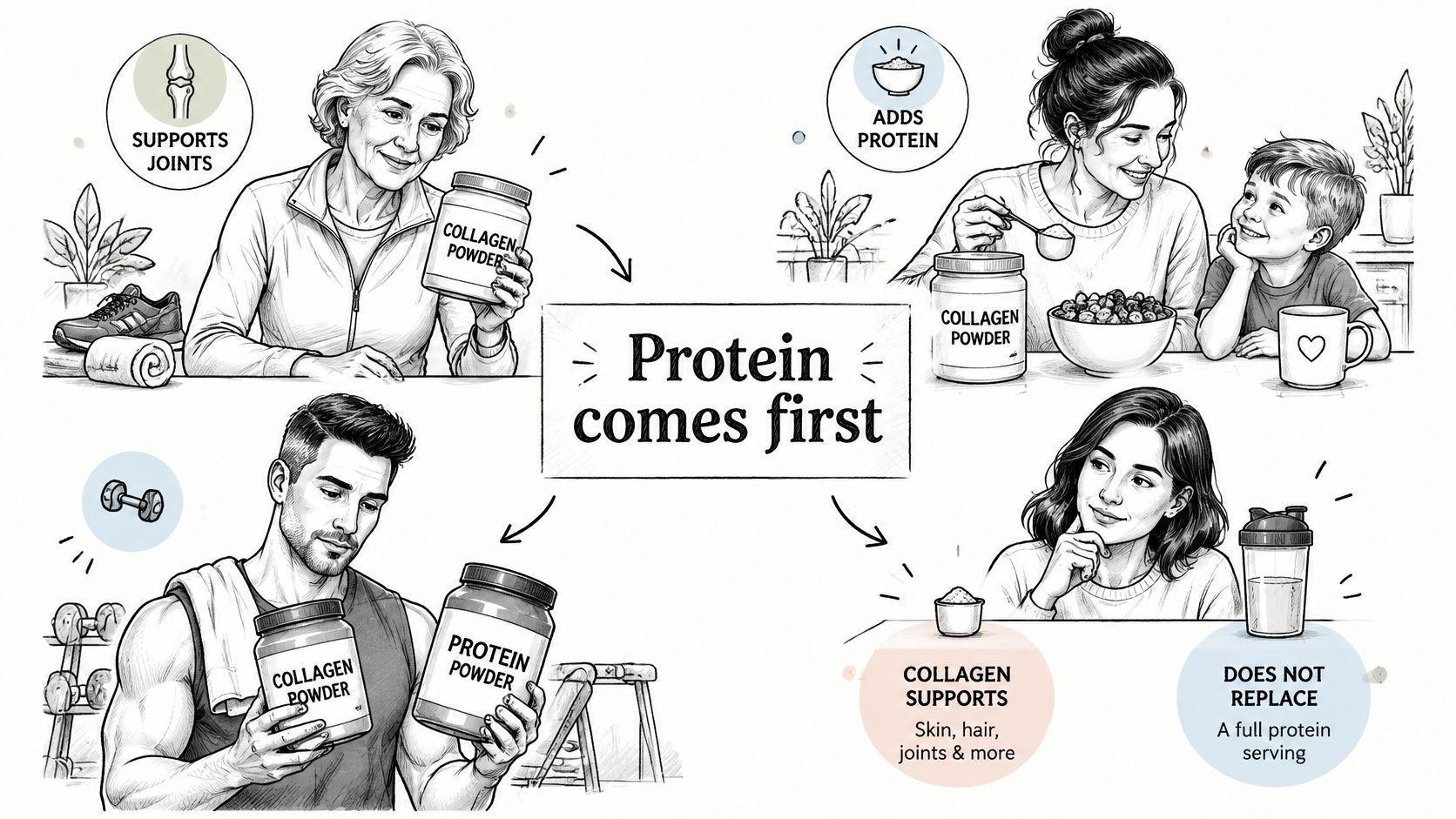
Four Shoppers, Four Different Answers
A gym goer chasing muscle gain should build around whey isolate or a complete plant blend, with collagen optional. A Massey University double-blind, placebo-controlled study compared collagen hydrolysate, dairy protein and an isoenergetic placebo after 30 minutes of downhill running, with products consumed for three days. Neither sped acute recovery indicators more than the calorie-matched placebo in recreationally active males. Recovery claims should not drive this purchase. Muscle still needs a complete protein with the essential amino acids collagen does not supply.
A drug-tested athlete should start with a product that carries a certificate for that exact batch, then compare protein per serve. Protein quality is the second question. If the certificate does not match the tub, a strong panel does not fix it.
Someone with tendon or joint interest who already meets a protein target can treat collagen as an add-on judged on its label. The Massey result does not show a recovery benefit, so buy the collagen dose and the protein contribution the panel states, not an outcome that trial did not demonstrate.
A dairy-free shopper should use a pea and rice blend as the core, and collagen only if animal sourcing suits. Collagen itself is animal-derived, so read the source line before it goes in the cart. The comparison of whether plant protein is better than whey walks through that core choice in more depth. Two serves can list similar grams and still differ once you check essential amino acids and protein per 100 g.
The short video below runs through how these powders differ in practice, which is handy before you commit to a tub.
What to Buy First
Buy in this order. Read the panel, calculate protein per serve, choose the core protein, then add collagen.
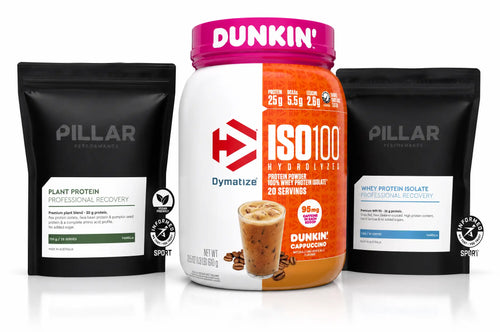
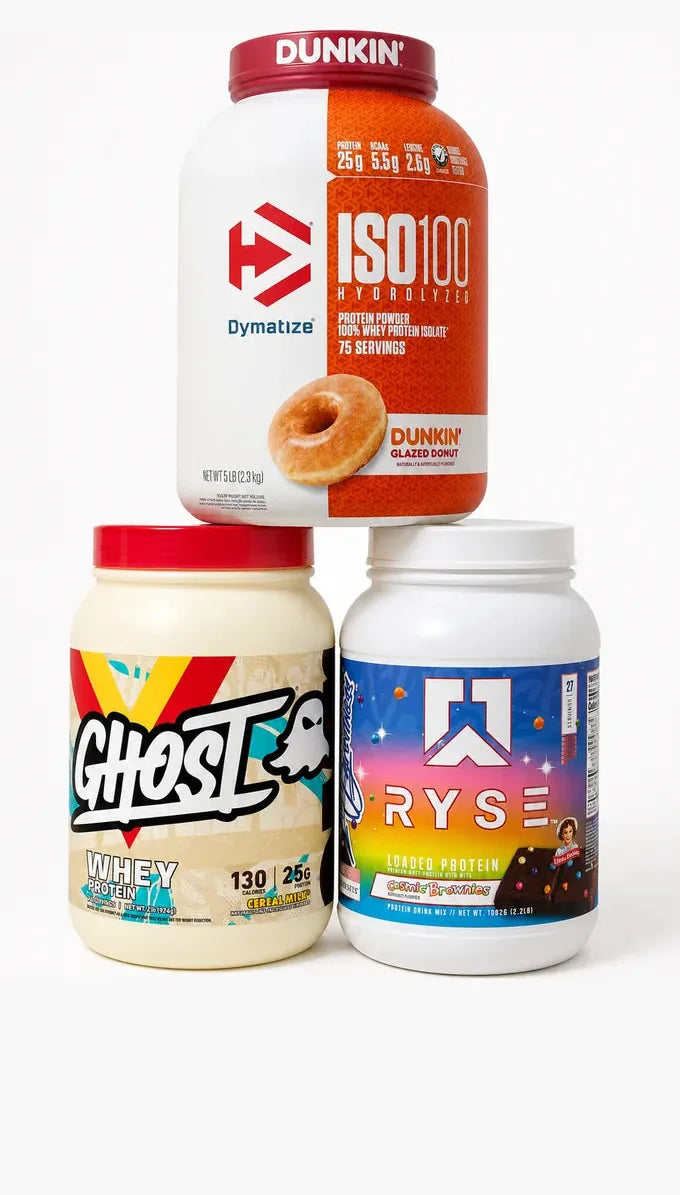
For the core, start with whey protein isolate if dairy suits, or a plant powder if it does not. NZ Supps carries plant-based protein made from sources such as pea or rice. If you want some of that protein from food-format snacks alongside shakes, the roundup of high-protein bars for weight management shows how bars compare as another top-up.
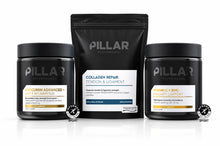
For the collagen add-on, Pillar Performance Collagen Repair Tendon & Ligament, Unflavoured comes in 510 g and provides 100 serves, at $0.90 per serve. Each serve provides 5 g of TENDOFORTE collagen peptides (bovine) and 18 kcal. Put that 5 g serve through the same density maths as a 10 g or 15 g collagen serve: protein grams and cost per serve, not tub size, show how little it moves a daily total. Check the product page for current stock and the panel on the day you order. Orders over $99 ship free.
Compare collagen, whey isolate and plant blends side by side at NZ Supps, where full ingredient disclosures and per-serve pricing let you run the density maths before you buy. Stock is held in New Zealand and dispatched nationwide, and orders over $99 ship free. Pick the core protein first, then the collagen serve that fits the daily total.