SHOP NOW, PAY LATER










 Informed Sport
 Informed Choice
 NSF Certified for Sport
 HASTA Certified

You don't need to add anything to safe tap water for everyday hydration, despite the popularity of electrolyte powders. For long, hot or heavily sweaty exercise, a properly formulated drink containing sodium, and sometimes carbohydrate, can be useful. If you're browsing electrolytes NZ, start with the activity you're doing and the fluid you're losing, not the promise on the front of a tub.
Table of Contents
- When Plain Water Is Enough and When It Is Not
- Athletes Versus Everyday Use
- When Illness or Heavy Fluid Loss Changes the Answer
- What to Add Per Litre and How to Mix It
- Confirm Your Choice Before Your Next Session
When Plain Water Is Enough and When It Is Not
Plain water is the default, not an inferior option. Food usually supplies the electrolytes you need for ordinary daily activity, so adding salt to every bottle isn't necessary. A squeeze of lemon or some mint can make water more appealing, but flavour and electrolyte replacement are different jobs.
The Ministry of Health's adult eating and activity guidelines list adequate daily fluid intakes from drinks of 2.6 litres for men and 2.1 litres for women, with total water intakes of 3.4 litres and 2.8 litres, respectively, once food is counted. These are population adequacy figures, not amounts everyone must force themselves to drink.
Body size, temperature, activity and diet all affect your needs. Milk counts towards fluid intake, and water-rich foods contribute too, so your drinking bottle doesn't have to supply the entire total.
What to drink by situation
| Situation | What to drink | Notes |
|---|---|---|
| Normal day, desk work or commuting | Plain tap water | Drink to thirst; food supplies most sodium |
| Gym session under about an hour | Plain water | Drink to thirst before and after |
| Training approaching an hour and a half, or hot conditions | Water, with electrolytes if sweating is heavy | Check for salt residue on clothing |
| Longer sessions or heavy sweating | Commercially formulated electrolyte drink | Follow the label dilution exactly |
| Vomiting or diarrhoea | Oral rehydration solution as directed | Seek medical advice if symptoms persist |
The distinction between an electrolyte supplement and a sports drink matters. Some products mainly supply minerals; others also provide carbohydrate for exercise. Our guide to electrolytes versus sports drinks explains what to look for when those labels sound interchangeable.
Town-supplied tap water is generally suitable for drinking in New Zealand, subject to local notices. If you use a private supply, check its safety with your council or public health service.
Practical check: White salt marks on training clothes are a reason to consider sodium replacement during demanding sessions. They aren't a measurement of exactly how much sodium you need.
Athletes Versus Everyday Use
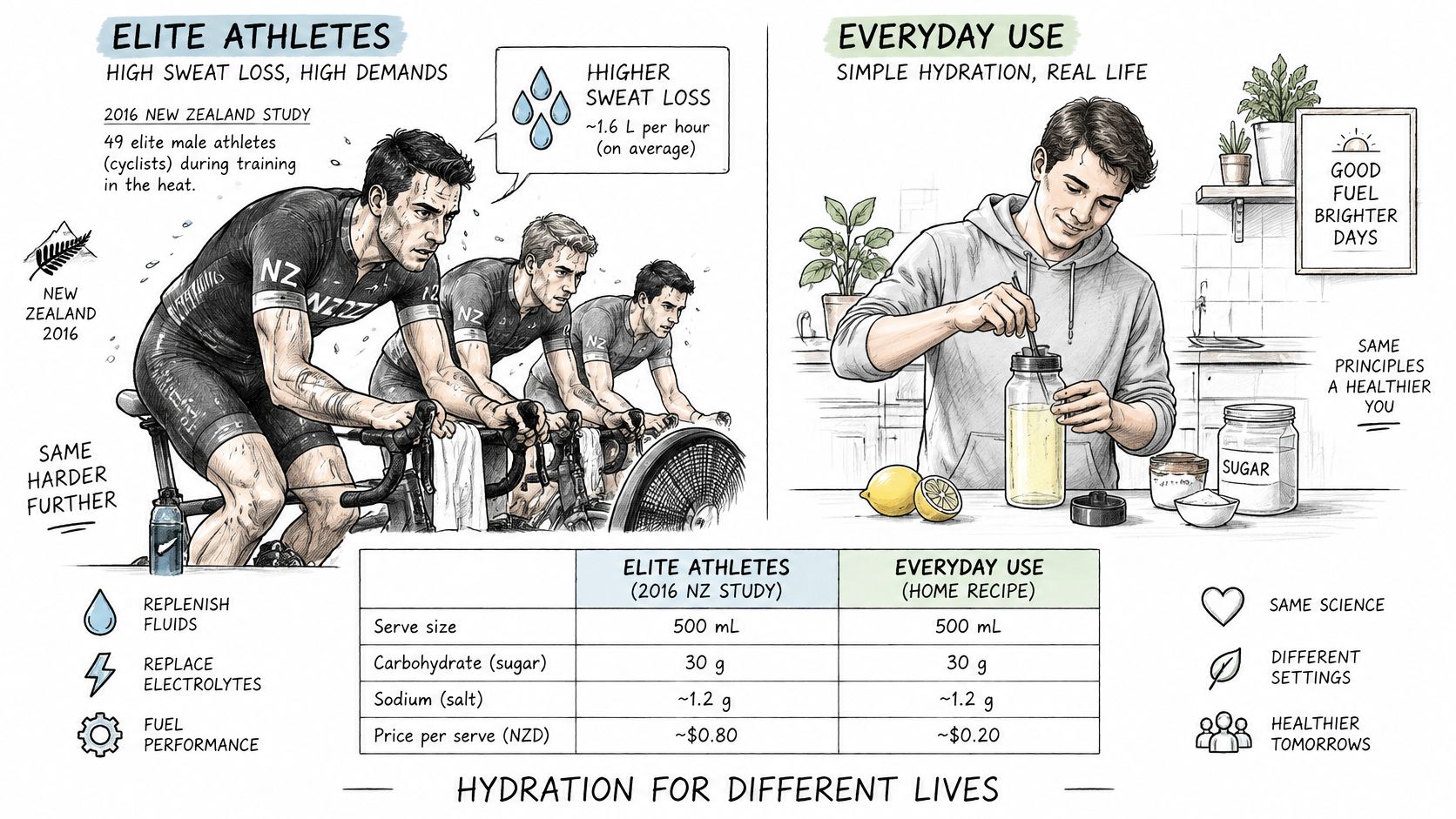
An elite athlete's bottle doesn't automatically belong on an office desk. Training intensity, clothing, weather and drinking opportunities can make athletes' fluid losses very different from those of someone going about a normal day.
This visual separates the situations rather than treating every drink as an upgrade.
What New Zealand athlete measurements show
A New Zealand observational study published in 2016 examined 49 elite male athletes during an hour of stationary cycling: mean sweat rates were 0.93 litres per hour for Māori/Pacific Island athletes and 0.89 litres per hour for New Zealand European athletes, while mean sweat sodium concentrations were 73.4 and 55.5 mmol/L, respectively.
Those group averages don't prescribe anyone's drink. The spread between individuals was substantial, and a cycling session under study conditions isn't a direct forecast of your next run, lifting session or match.
A useful practical approach is to compare body mass before and after a representative session, while recording what you drink and any toilet stops. Use dry clothing and consistent weighing conditions. Our guide to measuring sweat rate explains how to avoid mistaking a simple change on the scales for a complete sweat-loss measurement.
Match the bottle to the work
- Everyday activity: Water and regular meals are usually sufficient.
- Short gym sessions: You generally don't need to copy an endurance athlete's carbohydrate and sodium intake.
- Endurance and team sport: Heat, prolonged effort and limited drink breaks can justify a more deliberate plan.
For surfers combining water time with gym work, Blitz Surf Shop's cross-training advice for New Zealand surfers provides useful training context. Choose your drink for the actual land-based session rather than assuming every workout creates the same losses.
For drug-tested athletes, read the full ingredient list and check batch-testing certification. A performance formula, an electrolyte product and medical oral rehydration salts serve different purposes, and none of those names alone establishes suitability for sport.
Use the following video as supporting context, not as a substitute for your own label and session checks.
When Illness or Heavy Fluid Loss Changes the Answer
What caused the fluid loss? That question matters more than which powder tastes best. A sweaty training session and vomiting or diarrhoea shouldn't lead you to the same mixing instructions.
The RNZ explanation of when electrolyte drinks are necessary distinguishes ordinary hydration from substantial fluid loss and highlights Healthify's advice on oral rehydration salts. These are specifically formulated for dehydration associated with gastroenteritis, rather than being another version of a gym drink.
Keep medical rehydration separate
Mix oral rehydration salts only with water, using the exact volume stated on the packet. Don't add juice, sugar, salt, sports powder or another supplement. Changing the mixture changes the concentration it was designed to provide.
A homemade exercise drink isn't a substitute during vomiting or diarrhoea. Nor should you assume that a brightly coloured sports drink has the same formulation as an oral rehydration solution.
When you're unwell, the priority is an appropriate rehydration plan, not making your usual training drink stronger.
People with hypertension, kidney disease, heart failure or fluid restrictions need individual clinical advice before deliberately adding sodium. A generic recipe can't account for prescribed restrictions, medicines or the reason someone has been told to limit fluid.
Know when to get help
Seek medical help for:
- Fainting or confusion: Don't try to manage these symptoms by changing drinks.
- Very little urine: Especially when this accompanies ongoing illness or difficulty drinking.
- Inability to keep fluids down: You may need advice beyond a packet's mixing directions.
- Symptoms that don't ease: Persistent vomiting or diarrhoea warrants clinical guidance.
For families planning outdoor activities, Water Filter Advisor's summer heat precautions for families offers related preparation advice. Shade, rest and changing the activity are important parts of managing hot conditions; a drink isn't permission to keep exercising when someone feels unwell.
After ordinary training, you can generally return to drinking water and eating normally. Illness-related fluid loss deserves its own decision, rather than an improvised version of an athletic hydration plan.
What to Add Per Litre and How to Mix It
For prolonged exercise, check the amounts in the finished drink, not just the powder in a scoop. The final sodium and carbohydrate concentrations depend on how much water you mix with the ingredients.
The Ministry of Health's food and nutrition guidelines for children and young people give a reference for exercise drinks during activity lasting 90 minutes or more: approximately 0.5 to 0.7 g sodium per litre and 4 to 8% carbohydrate, equivalent to 40 to 80 g carbohydrate per litre. These ranges come from children and young people's guidelines. They are not a prescription for every adult workout.
Per-litre targets and homemade equivalents
| Target | Per litre for prolonged activity | Homemade equivalent | Note |
|---|---|---|---|
| Sodium | Approximately 0.5 to 0.7 g | Approximately 1.3 to 1.8 g fine table salt | Compare the sodium in a commercial drink with the finished-drink range |
| Salt equivalent | Approximately 1.3 to 1.8 g table salt | Weigh fine table salt on an accurate scale | Table salt is roughly 39% sodium, so salt and sodium weights differ |
| Carbohydrate | 40 to 80 g, giving 4 to 8% | 40 to 80 g sugar | For honey or maple syrup, use the carbohydrate amount on the label |
| Flavour only | No electrolyte-replacement target | A squeeze of lemon juice | Treat it as flavour, not a measured electrolyte source |
A commercial drink gives you a defined serving and dilution to follow. Homemade mixtures need accurate measurements: spoon sizes and salt crystals vary, and the weight of honey or maple syrup is not all carbohydrate.
Salt and sodium are different quantities. Table salt is about 39% sodium, which is why the salt weight in the table is higher than the sodium target. For more on reading sodium amounts for hydration, see this guide to sodium in hydration.
A careful mixing method
- Measure the water. Use a marked jug and safe drinking water. For a commercial powder, follow the water volume on the packet rather than guessing based on bottle size.
- Weigh sodium-containing ingredients. For a homemade exercise drink, use the salt amount in the table and an accurate scale. Stir until the grains dissolve. A pinch is too imprecise.
- Add the carbohydrate. Weigh sugar rather than using heaped tablespoons. For honey or maple syrup, calculate the amount from the carbohydrate declaration on its label.
- Add flavour last. Lemon juice can make a drink more pleasant, but it does not replace measured ingredients. A weak flavour is not a reason to add more salt.
- Check the mixture. A markedly salty or syrupy taste is a reason to stop and recheck your measurements. Taste cannot confirm the concentration; remake an uncertain mixture instead of correcting it by guesswork.
- Keep commercial and homemade recipes separate. Use a commercial product's stated serving and dilution. Don't add a homemade salt dose to an electrolyte drink that already contains sodium.
- Store it sensibly. Use a clean, covered bottle and refrigerate the drink until needed. Follow the product's storage instructions, make it fresh for the session, and discard leftovers rather than topping up an old mixture.
- Drink according to the session. Sip when opportunities arise and respond to thirst and measured losses. Finishing the bottle is not a goal in itself.
For a smaller bottle, scale every ingredient and the water together. Reducing only the water makes the drink stronger; reducing only the ingredients makes it weaker. A bottle's printed capacity does not guarantee that you have measured the water accurately.
Mixing safeguard: More powder does not mean better hydration. Follow the intended concentration before adjusting for flavour or convenience.
Why drinking behaviour still matters
A study of elite New Zealand rugby players during preseason training found that more than 80% began sessions hypohydrated. During resistance training, players replaced 196 ± 130% of sweat loss, compared with 56 ± 17% during aerobic training, a statistically significant difference (p = 0.002). The study detected no cases of hyponatraemia, but both underdrinking and overdrinking occurred.
Choosing an electrolyte drink does not, by itself, ensure appropriate hydration. You can still drink too little or substantially more than you lose, whatever is in the bottle.
Over-concentrated drinks can slow stomach emptying and worsen gastrointestinal discomfort. Excessive plain-water intake can also dilute blood sodium, so neither a powder nor plain water makes forced drinking sensible.
Common mixing errors include heaped spoons, undissolved ingredients, doubled scoops and too little water. A common drinking error is trying to catch up by gulping a large volume at once. For long, hot sessions without a commercial option, a carefully measured homemade drink may be practical. Anyone with a medical sodium or fluid restriction should not improvise.
Confirm Your Choice Before Your Next Session
Choose what goes in your bottle based on the session, not habit. For everyday use, plain water is generally enough; longer or sweatier exercise may call for a drink with electrolytes. Illness-related fluid loss is a separate situation, so use an appropriate oral rehydration solution rather than treating a sports drink as a substitute.
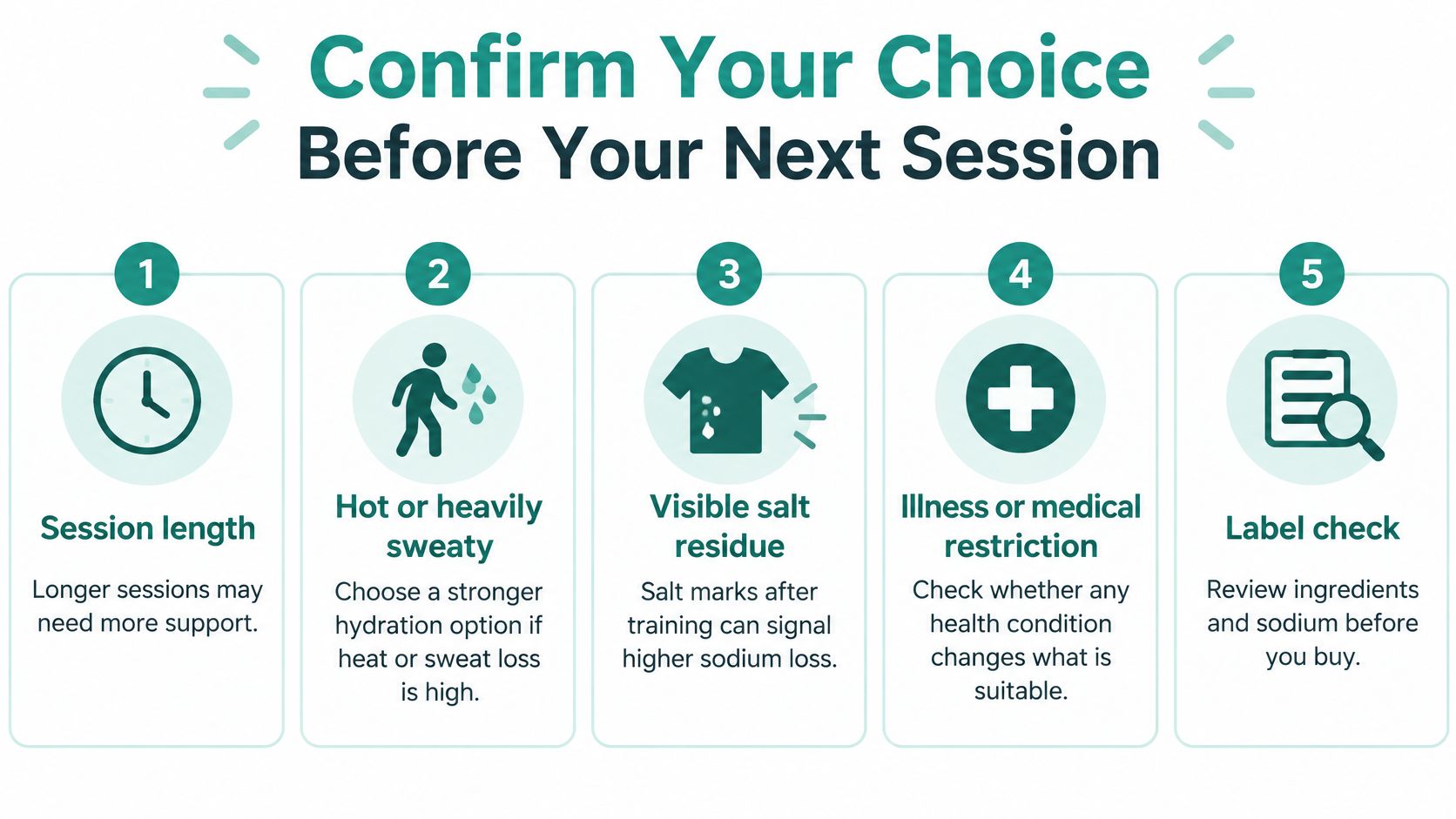
Five checks before filling your bottle
- Session length: Is this routine training or prolonged continuous effort?
- Heat and sweat: Will the temperature, clothing or intensity increase fluid losses?
- Salt residue: Do similar sessions often leave white marks on your kit?
- Illness or restrictions: Is this a medical rehydration question, or do you have a fluid or sodium restriction?
- Label details: How much sodium and carbohydrate will the prepared drink contain?
Hydration options compared
| Option | Serve size | Key ingredient amounts | Price per serve |
|---|---|---|---|
| Plain tap water | Drink to thirst | No added sodium or sugar | Local water charges apply |
| Homemade salt and sugar mix | A measured bottle | Sodium and carbohydrate depend on the measured recipe and final volume | Calculate from your ingredient costs |
| Commercial electrolyte sachet | Per label serve | Check sodium and carbohydrate at the stated dilution | Divide pack price by labelled serves |
| EAA product with electrolytes | Per label serve | Check declared sodium and other ingredients | Divide pack price by labelled serves |
Many EAA formulas sold by NZ Supps add electrolytes for intra-workout use. Check the product label and mixing instructions before adding another sachet, so you can account for the drink's total sodium.
For parents preparing a young player for training or a match, a soccer safety guide for parents offers broader preparation context. A suitable drink is one part of supporting a player alongside appropriate training, rest and attention to how they feel.
NZ Supps offers electrolyte powders and sachets, with ingredient information to help you match a drink to your session. Visit NZ Supps to compare labels before buying; orders over $99 ship free. Shop all electrolytes in NZ.