SHOP NOW, PAY LATER













 Informed Sport
 Informed Choice
 NSF Certified for Sport
 HASTA Certified


Why choose a pre workout snack before deciding whether your session needs one? Most gym-goers don't need an extra snack for every workout; when food would help, choose it by time since your last meal, training demands and digestive comfort.
A banana, toast or porridge can do the job. Portable options such as protein bars NZ can also fit, but a protein-heavy bar isn't interchangeable with quick carbohydrate before a hard session. Start with the workout, not the wrapper.
Table of Contents
- How Long Before Training to Eat and How Much
- Carbohydrate and Protein Targets for Your Body Weight
- Everyday Foods That Work Before Training
- Packaged Protein Bars Compared Per Serve
- Fibre, Caffeine and Digestion Pitfalls
- Snack Choices for Your Goal and Diet
- Test Your Pre-Workout Snack Before a Key Session
How Long Before Training to Eat and How Much
Skip the snack if you've eaten normally and feel ready to train. For a moderate session lasting under an hour after a normal meal two to three hours earlier, an extra eating occasion usually isn't necessary. Eat your next meal on time instead.
A snack becomes more useful when there's a long gap between meals, you're training soon after waking, or the session will be long or demanding. Tufts' pre-exercise snack guidance identifies a gap of at least two to three hours since eating as a useful reason to consider one, with suggested portions of 200 to 300 kcal earlier beforehand and 100 to 200 kcal around an hour before exercise.
Snack size and format by time before training
| Time before training | Snack size | Best format | Example |
|---|---|---|---|
| 2 to 3 hours or more | 200 to 300 kcal, approximately 840 to 1,260 kJ | Mixed snack with carbohydrate and some protein | Oats with milk and a banana |
| About 1 hour | 100 to 200 kcal, approximately 420 to 840 kJ | Lighter, carbohydrate-led | Toast with honey or a fruit pouch |
| Within 30 minutes | Small | Quickly digested carbohydrate, low fibre | A banana or a few rice cakes |
| 30 to 60 minutes | 30 to 60 g carbohydrate | Low fat, low protein, low fibre | White toast, rice cakes or pretzels |
The kilojoule figures are rounded conversions of the calorie ranges. Examples describe food combinations, not guaranteed portions: a large bowl of oats and a small bowl won't provide the same energy.
For exercise starting in 30 to 60 minutes, the US Anti-Doping Agency nutrition guide recommends 30 to 60 g of easily digested carbohydrate, keeping fat and protein minimal. Treat that as a fuelling option for a session that needs it, not an obligation for every gym visit.
Match the portion to the job
The overlapping windows aren't contradictory. One describes general snack size; the other prioritises carbohydrate for exercise demands. For broader planning around different sports, Optimal Native's sport-specific nutrition plans offer a useful starting point.
Practical rule: If you consistently arrive hungry and flat, trial a snack. If you feel comfortable and train well without one, don't add food just because you're going to the gym.
Carbohydrate and Protein Targets for Your Body Weight
Body-weight calculations help most when you're preparing for demanding exercise. They're less useful when they turn a straightforward gym session into a forced feeding exercise.
The Human Performance Resource Center's nutrient-timing guidance gives a planning range of 1 to 4 g carbohydrate per kilogram of body mass in the 1 to 4 hours before exercise. It also notes that up to 30 g protein before exercise may benefit strength or power training.
Carbohydrate grams by body weight at three intake levels
| Body mass | 1 g per kg | 2 g per kg | 4 g per kg |
|---|---|---|---|
| 60 kg | 60 g | 120 g | 240 g |
| 75 kg | 75 g | 150 g | 300 g |
| 90 kg | 90 g | 180 g | 360 g |
These are calculated amounts, not compulsory snack sizes. The higher columns describe substantial pre-event eating, with time available for digestion.
Use the calculation selectively
- Know your body mass. Use it to calculate carbohydrate rather than assuming a packaged serve meets your needs.
- Choose your eating window. Allow more digestion time for a larger amount.
- Multiply by the appropriate target. For example, a 75 kg endurance athlete choosing 1 g/kg would plan about 75 g carbohydrate; 4 g/kg would mean 300 g.
- Build the portion from familiar food. Check carbohydrate on labels and combine foods rather than guessing from bowl size.
That upper amount belongs in prolonged endurance preparation, not an ordinary weights-session snack. More carbohydrate doesn't automatically produce more repetitions.
An AUT randomised resistance-training study found that a liquid meal providing 1.2 g/kg carbohydrate two hours beforehand didn't improve upper-body training volume compared with 0.3 g/kg or placebo, and suggested acute intake may matter less when daily carbohydrate already reaches at least 3 g/kg.
Protein also changes how a snack sits, so don't chase a pre-training number independently of the rest of your day. Our protein timing guide helps put that eating occasion into context. Check your daily carbohydrate intake before upgrading your snack.
Everyday Foods That Work Before Training
Would a full snack help, or would it just sit heavily? Choose familiar supermarket foods according to how soon you'll train and how long it has been since your last meal. Oats, bananas, honey, raisins, rice, potatoes and lentils can all contribute to training-day eating. White toast and rice cakes are simpler options when you want a smaller snack.
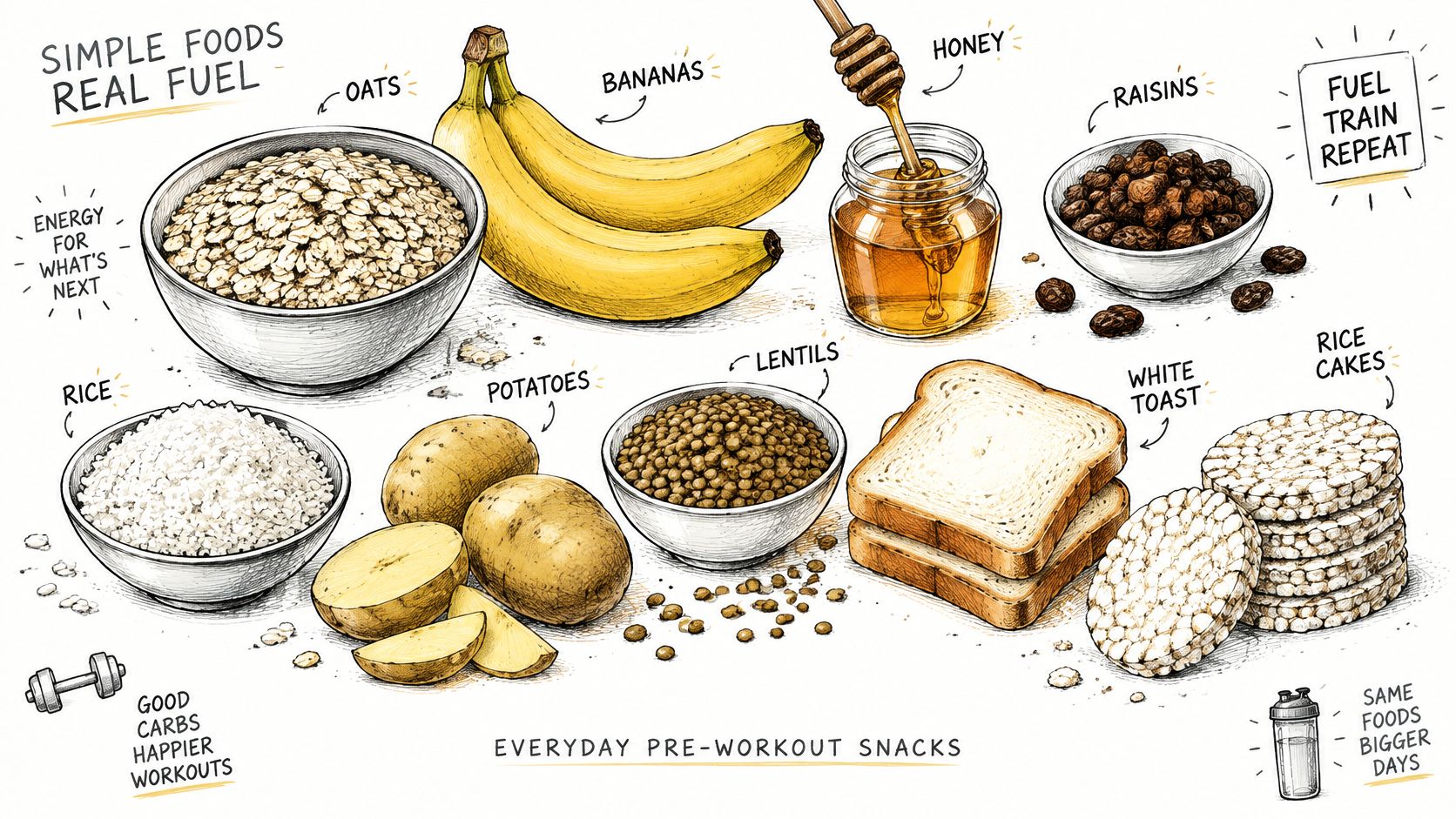
Choose foods by how soon you'll train
- Close to training: Try white toast with honey or banana, rice cakes with jam, or familiar fruit. Keep toppings modest; a thick layer of nut butter may make a small snack feel heavy.
- With more digestion time: Porridge made with milk, rice with a little honey, or a banana with milk can make a more substantial snack. For an earlier eating window, use this protein oats recipe and adjust the portion to suit your appetite.
- Earlier in the day: Lentils and bulky potato servings may leave you feeling full, so have them well before training if that happens to you.
A Massey University review of endurance fuelling discusses everyday carbohydrate foods and notes that large quantities, including potatoes, can cause gastrointestinal discomfort. If your last meal was recent and you feel comfortable, another snack may be unnecessary. Skip it rather than eating by the clock.
For a prepared option, homemade matcha energy bites are one recipe to consider. Check the ingredients and account for caffeine; a homemade snack may still be too rich or stimulating close to training.
Use the video alongside a practical trial of food and portion size.
Plan the day, not just the snack
In a New Zealand provincial rugby academy study, sports nutritionist support increased pre-gym carbohydrate intake significantly (p = 0.030) within a high-volume training pattern organised around seven eating occasions. That schedule reflects the study's training context, not a requirement for every athlete.
Try the exact food and portion during training before using them at competition. Compare the cost of the portion you'll eat, too. Fruit is not automatically cheaper than a bar; check shelf prices and pack sizes.
Packaged Protein Bars Compared Per Serve
| Bar (60 g, one serve) | Protein | Energy | Carbohydrate | Fibre | Price per serve |
|---|---|---|---|---|---|
| Choc Brownie | 20 g | 180 kcal, approximately 753 kJ | 23 g | 17 g | Not listed |
| Caramel Choc Chunk | 20 g | Not listed | 21 to 24 g | 14 g | $5.94 |
| S'Mores | 21 g | 190 kcal, approximately 795 kJ | 22 g | 14 g | $5.94 |
| Cookies N Cream | 21 g | 200 kcal, approximately 837 kJ | 21 g | 15 g | $5.94 |
| Choc Chip Cookie Dough | 21 g | 200 kcal, approximately 837 kJ | 21 g | 14 g | $5.94 |
Quest protein bars per serve, one 60 g bar. Each provides 20 to 21 g protein. The listed bars range from 21 to 24 g carbohydrate and 14 to 17 g fibre. Price is $5.94 per bar for Caramel Choc Chunk, S'Mores, Cookies N Cream and Choc Chip Cookie Dough.
For pre-training, the timing and size of your last meal matter more than the flavour. If you ate a meal recently and feel fuelled, skip the bar. If you need a snack, these bars are more suited to an earlier eating window than to a quick bite just before exercise.
Read the differences before choosing a flavour
Choc Brownie has the highest listed fibre, at 17 g, and the lowest listed energy, at 180 kcal. Caramel Choc Chunk lists 21 to 24 g carbohydrate; treat that as a range, not a precise target. S'Mores has 190 kcal, while Cookies N Cream and Choc Chip Cookie Dough each have 200 kcal.
The four bars priced at $5.94 cost the same per serve. Their fibre differs by up to 1 g, while the listed protein ranges from 20 to 21 g.
A 60 g bar with 14 to 17 g fibre may sit heavily close to training. Choose one only if it fits your schedule and digestion, and leave enough time before exercise to assess your comfort.
Fibre, Caffeine and Digestion Pitfalls
The most common mistake is eating a bulky, high-fibre snack too close to training. Read the fibre line, then check the clock: save a substantial mixed snack for earlier, and choose a simpler carbohydrate option when you're about to exercise.
Protein-heavy food can also feel uncomfortable near a session. That doesn't make protein a poor choice overall; it means the timing and portion need to suit your stomach.
Use this checklist to separate everyday nutrition from immediate pre-training comfort.
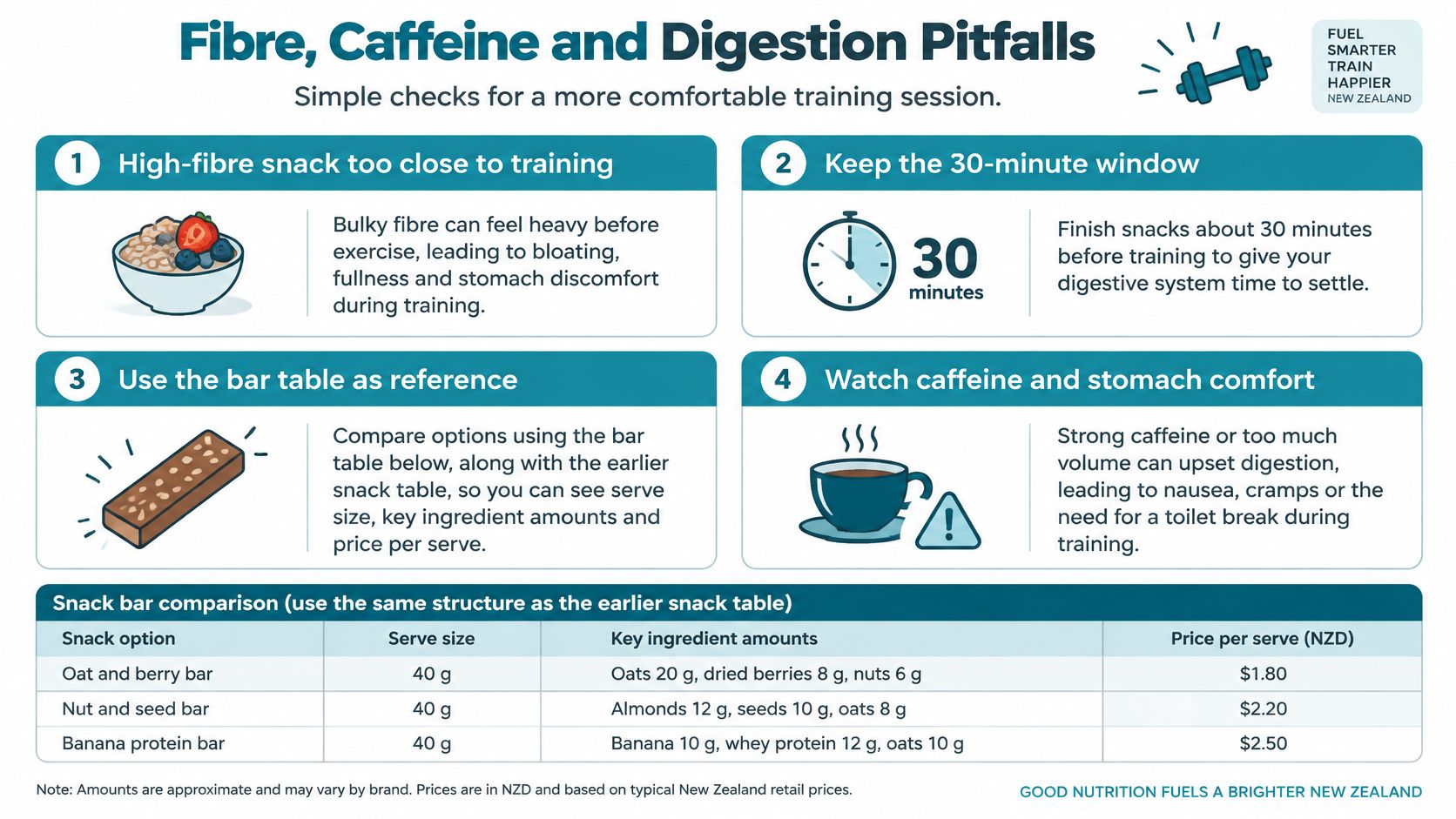
Count caffeine across the whole day
Healthify's caffeine guidance recommends no more than 400 mg daily from all food and drink sources and describes an approximate six-hour half-life. That's a ceiling to be aware of, not a performance target or a suitable allowance for everyone.
Caffeine can come from ingredients such as cacao and guarana in snack, muesli and sports bars. Coffee, an energy drink, a caffeinated bar and a pre-workout formula can therefore overlap without you deliberately planning a large intake. Late-day use also deserves attention when you're trying to protect sleep.
Check the wrapper before the session
- Fibre and portion: Assess the whole snack, including toppings and drinks, rather than the headline protein number.
- Caffeine total: Add the declared milligrams from each product. If the amount isn't clear, don't assume it's negligible.
- Other ingredients: If bars leave you uncomfortable, inspect the sweetener list. Our guide to sugar alcohols in protein bars explains what to look for.
- Sport certification: Drug-tested athletes should check independent certification, such as Informed Sport or NSF Certified for Sport, for the exact supplement and batch where applicable.
Test unfamiliar snacks in an ordinary training session. Don't introduce a new bar, drink and pre-workout formula together, because you won't know which change affected your comfort.
Snack Choices for Your Goal and Diet
Strength and power training: Choose a mixed snack earlier if it fills a genuine gap in your eating day. Greek yoghurt with a banana is practical because you can adjust the yoghurt portion for protein and the fruit portion for carbohydrate.
Michigan State University's nutrient-timing guidance gives a pre-activity protein range of 10 to 40 g, while cautioning that protein can slow carbohydrate absorption and cause indigestion for some people. More isn't automatically better immediately before lifting.
Match the food to your training
Endurance: Build a carbohydrate-led snack or meal around the session's demands. Rice with honey or porridge with milk is easier to scale than assuming a single packaged snack covers a long workout.
Use body mass as a planning tool when the session warrants it. Then check whether you can comfortably eat the calculated amount within the available time.
A short, fed gym session: You may need nothing extra. Don't turn a convenient snack into a compulsory purchase when your normal meals already leave you ready to train.
A useful snack solves a specific problem: hunger, a long meal gap, limited time or demanding exercise. It doesn't need to solve all of them at once.
Adjust for dietary requirements
- Plant-based: Try soy milk with oats and berries, or hummus with rice crackers when you have time to digest. Check protein per serve rather than assuming all plant-based milks and yoghurts are equivalent.
- Dairy-free: Fruit, rice cakes with honey or soy yoghurt offer straightforward alternatives. Check the full ingredient and allergen information on packaged foods.
- Gluten-free: Bananas, rice cakes and small potato portions can fit. For packaged options, look for a gluten-free label rather than relying on the food's name.
Avoid solving one dietary requirement by creating another timing problem. A large bowl of oats may meet your ingredient preferences but still feel too heavy before running; a smaller familiar option may work better.
People with a medical condition or allergies should check with a doctor or dietitian before changing their eating pattern.
Test Your Pre-Workout Snack Before a Key Session
A useful pre workout snack is one you can repeat comfortably. Test the food, portion and timing together rather than judging a snack from its protein number or how energetic its packaging looks.
Use an ordinary session for the trial. Keep the rest of your routine familiar so you can make a sensible adjustment afterwards.
A practical testing plan
- Record the starting point. Note when you last ate, what the meal contained, and the planned session's length and intensity. Include hunger before warming up.
- Choose an eating window. Work backwards from the actual start of exercise, not when you leave home. Include travel and changing time.
- Calculate only what's relevant. Use a body-mass carbohydrate target for demanding endurance preparation. Don't impose a large pre-event meal on a routine gym visit.
- Choose familiar food. Check fibre and caffeine on packaged options. Keep the portion measurable, such as the same bowl, bread slices or packaged serve.
- Run the trial. Eat that exact snack before a normal session and note fullness, stomach comfort, hunger and whether you could complete the planned work.
- Change one thing. Move the food earlier or reduce the portion if it sits heavily. If you remain hungry, adjust the amount rather than replacing everything at once.
Make convenience work for you
A grab-and-go option helps when cooking or refrigeration isn't practical. Choose it for the eating window and your tolerance, not because a product labelled for sport must outperform ordinary food.
Keep a brief note on your phone so you can repeat what worked. Once you've found a comfortable approach, there's no need to keep changing it before every workout.
Our site also offers a supplement-finding quiz, including a pre-workout quiz. Use it for product selection after you've decided whether you need food, a supplement, or neither.
NZ Supps offers packaged protein snacks and label information to help you compare portions for your training schedule. Visit NZ Supps to check the available options, then choose around your next session rather than buying a snack by habit. Shop all protein bars in NZ.