SHOP NOW, PAY LATER











 Informed Sport
 Informed Choice
 NSF Certified for Sport
 HASTA Certified

Zero sugar is one narrow line on a protein powder label, not a verdict on the whole tub. The sugars figure has to come out at zero for the stated serve, and the wording on the front has to match that figure. It does not mean zero carbohydrate, zero kilojoules, or a powder with nothing sweetening it.
A tub can taste sweeter than one built on sugar and still make an accurate claim. Sweetness lives in the ingredient list. The sugars column is a separate reading. On the protein powder NZ shelves, two tubs can both print zero sugars and still part ways on the rest of the panel, the sweetener list and any sports testing marks.
New Zealand's labelling rules pin the sugars wording to the panel. They do not tell you whether the powder suits your training, your gut or a testing obligation. Those questions get answered on the same label, if you score the full panel rather than stopping at one line.
Table of Contents
- What Zero Sugar Means on a Protein Powder Label
- How to Check a Zero Sugar Label in Five Steps
- Sweeteners and Sugar Alcohols Compared
- Taste and Texture Trade-offs in Sugar-Free Powders
- Weight Management and Blood Sugar Without the Hype
- Choosing the Right Zero Sugar Powder for Your Situation
What Zero Sugar Means on a Protein Powder Label
A front-of-tub "zero sugar" line is a legal nutrition content claim, and it covers exactly one figure. In New Zealand that claim sits under Standard 1.2.7 of the Australia New Zealand Food Standards Code. The Ministry for Primary Industries nutrition claims guidance states that nutrition content claims must meet the requirements in Part 3 of Schedule 4. The panel has to support the wording. The same rule covers advertising, not only the print on the tub.
A zero sugar claim is judged by the sugars figure on the Nutrition Information Panel, not by how sweet the powder tastes. A vanilla that hits like dessert can still show zero sugars when the sweetness comes from other ingredients. Taste is a flavour decision. The sugars cell is the claim.
The rest of the row is a separate score. Energy, protein, total fat, saturated fat, carbohydrate and sodium sit beside sugars for the same serve. Zero in the sugars cell leaves those six numbers untouched. Fibre, cocoa, thickeners and flavour components can still add grams to carbohydrate while sugars stays at zero, and the protein figure can be thin for the scoop you mix.
Sweeteners live one list over. Erythritol, xylitol and maltitol are sugar alcohols. Sucralose, acesulfame potassium, stevia and monk fruit are high-intensity sweeteners. They belong on the ingredient list, and they do not appear as sugars. A clean sugars line says nothing about which of them the manufacturer used.
Sports testing marks are a third score, not a bonus on the sugar claim. A testing mark, or the lack of one, speaks to banned-substance screening for athletes who compete under a testing programme. It does not change the sugars figure, and a zero sugar panel does not stand in for that mark.
Reading rule: score the tub three ways, the full nutrition row, the sweetener list, and any sports testing mark. The sugars figure only settles the first cell of the first score.
How to Check a Zero Sugar Label in Five Steps
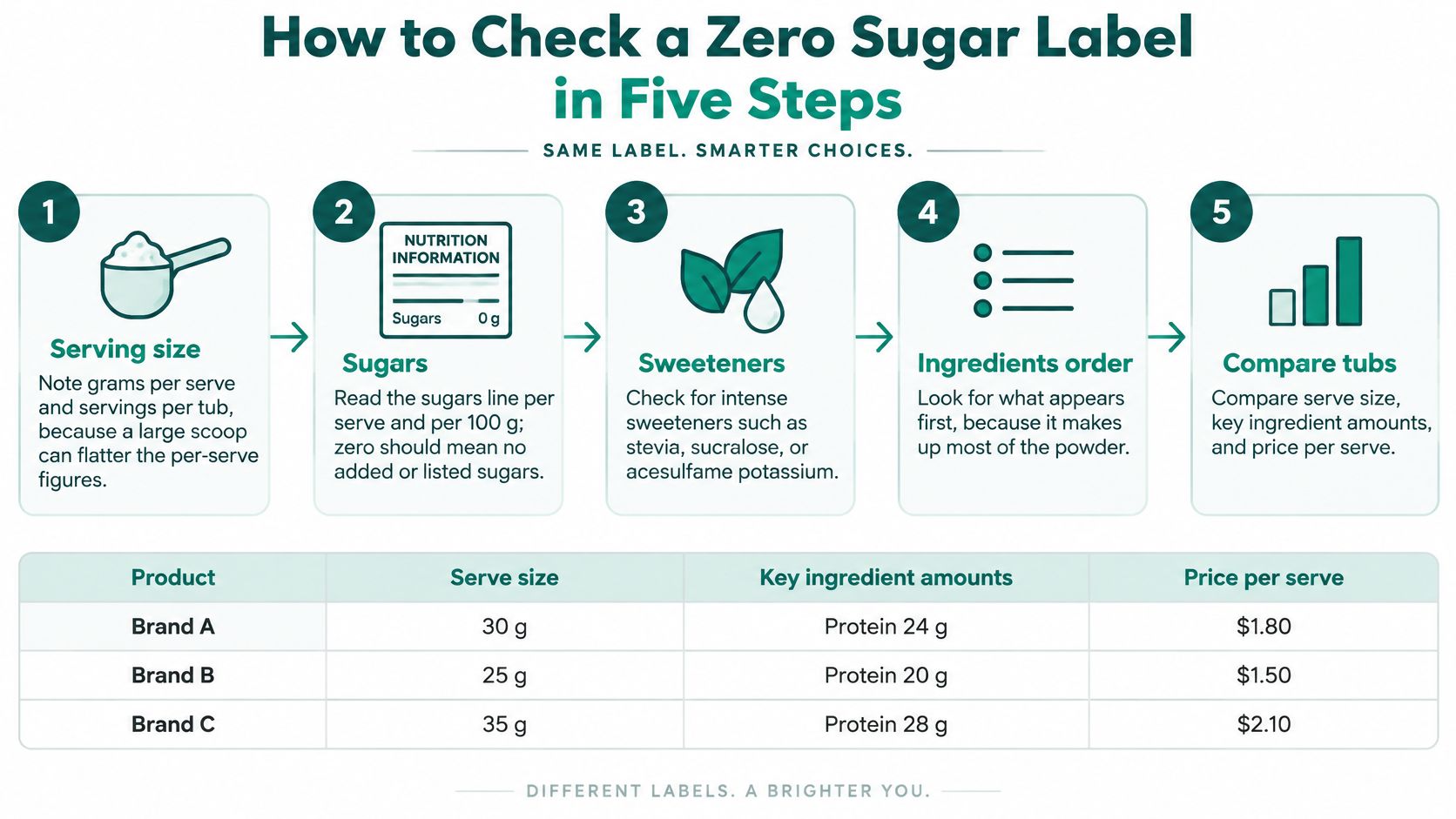
A $75 tub can look cheap on the shelf and costly once you price the protein inside it. The MPI retail labelling guidance confirms that most packaged foods sold at retail must display a panel showing energy, protein, total fat, saturated fat, carbohydrate, sugars and sodium, and that the values must be given both per stated serving and per 100 g. Zero sugars fills one cell on that row. The rest of the panel, the sweetener list and any sports testing mark are separate scores, and a zero in the sugars cell does not settle them.
Per serve is the scoop in the tub. Per 100 g is the same weight for every brand, so a bigger scoop cannot make a thinner powder look stronger.
- Start with the serving size. Note the grams per serve and the servings per tub. A large scoop lifts every per-serve number, because the serve is the amount the manufacturer chose to print.
- Read the sugars line twice. Zero per serve is the test of the front-of-pack claim. Zero per 100 g lets you line two tubs up at the same weight. A zero in only one column leaves the comparison half done.
- Check carbohydrate beside sugars. They are different figures on the same row. Sugars can read 0 g while carbohydrate still shows grams from fibre, sugar alcohols, cocoa or flavour components. Fibre is printed only where the manufacturer declares it. A blank fibre line means that optional item was left off, so you cannot treat the gap as zero or as a hidden amount.
- Price 25 g of protein, not the tub. Divide the tub price by the number of serves. Divide that result by the grams of protein in one serve. Multiply by 25. You now have dollars per 25 g of protein. A low shelf price with less protein per scoop can lose this sum.
- Finish with the ingredient list and the marks. Sweeteners, sugar alcohols, flavourings and milk-derived ingredients are listed here, not on the front. A plant powder has no milk ingredients to declare. A sports testing mark, where the brand prints one, is another line to score. It does not change the carbohydrate maths, and a missing mark does not rewrite the sugars figure.
A worked example on cost
Say a tub costs $75 for 30 serves, each serve 30 g, supplying 24 g of protein and 0 g of sugars. Divide 75 by 30 and you get $2.50 per serve. Divide 2.50 by 24, then multiply by 25: about $2.60 per 25 g of protein. A sugar-containing tub at the same price with 22 g of protein per serve is also $2.50 a scoop. Divide 2.50 by 22 and multiply by 25 and you get roughly $2.84 per 25 g of protein. Same shelf price. Protein per scoop is what moved the cost.
Two example tubs compared per serve
| Tub | Serve size | Protein per serve | Sugars per serve | Sweeteners listed |
|---|---|---|---|---|
| Example tub A, zero sugar | 30 g | 24 g | 0 g | Sucralose, acesulfame potassium |
| Example tub B, sugar-containing | 30 g | 22 g | 4 g | None listed |
What a clean read looks like: a scoop size you recognise, sugars at 0 g per serve and 0 g per 100 g, a carbohydrate figure you can account for from the ingredient list, protein stated per serve, and sweeteners you can name out loud. Fibre, when it is printed, is an extra column rather than a pass or fail. A testing mark is a separate tick. If the sugars cell is the only figure you checked, the front label did the deciding.
If you also read American tubs, the percentage column on those panels needs its own key, and the guide to understand supplement Daily Value percentages explains how those reference figures are set. For a wider walkthrough of New Zealand panels, our breakdown of how supplement labels are set out covers the rest of the back panel.
Sweeteners and Sugar Alcohols Compared
Once you know a powder is zero sugars, the next question is what's making it taste like something. Here's the shortlist you'll meet in New Zealand tubs, and what each one does to the label.
| Sweetener | Type | Energy per gram | Label note |
|---|---|---|---|
| Sucralose | Intense sweetener | Negligible | Often blended with acesulfame potassium to balance taste |
| Acesulfame potassium | Intense sweetener | Negligible | Frequently paired with sucralose or stevia |
| Stevia (steviol glycosides) | Plant-derived intense sweetener | Negligible | Can leave a liquorice-like aftertaste at higher levels |
| Monk fruit (luo han guo) | Plant-derived intense sweetener | Negligible | Often blended with erythritol for bulk |
| Erythritol | Sugar alcohol | Very low | Usually counted in carbohydrate; cooling aftertaste |
| Xylitol | Sugar alcohol | About 10 kJ | Can cause digestive upset at higher intakes |
| Maltitol | Sugar alcohol | About 10 kJ | Common in chocolate-flavoured powders; more likely to cause digestive effects |
| Sorbitol | Sugar alcohol | About 10 kJ | Digestive effects more likely at higher intakes |
Why the carbohydrate line keeps coming back
MPI's guidance records a compliance requirement for sugars and other carbohydrate claims, and it draws a line that matters here: a powder can declare zero sugars while still showing carbohydrate from other ingredients, including fibre, sugar alcohols or other carbohydrate sources. Food label information must be clear and accurate, and misleading label information is illegal, so the carbohydrate figure isn't padding. It's a real count of what's in the scoop.
That's why the reading order in the five steps puts carbohydrate straight after sugars. A sugar alcohol blend that adds 8 g of carbohydrate per serve has to show it there, even with 0 g of sugars and a zero sugar claim that's entirely accurate.
Digestion, in plain terms
Larger amounts of maltitol, sorbitol and xylitol can cause bloating or loose stools in some people, particularly in the first week or two of use. Erythritol is generally better tolerated but has a cooling aftertaste that some people notice at the back of the mouth. Intense sweeteners contribute negligible energy and don't affect the carbohydrate line at all.
Gut rule: if you're sensitive and the ingredient list stacks two or three sugar alcohols, buy the smallest tub you can find before committing to a kilogram.
None of this is a quality score. A tub sweetened with sucralose isn't better or worse than one sweetened with stevia, and a stevia blend isn't automatically "cleaner". The list tells you what to expect in the glass. If you want the taste comparison between the two most common plant and synthetic options, our piece on sucralose vs stevia goes through the sensory differences properly.
Taste and Texture Trade-offs in Sugar-Free Powders
Sugar does two jobs in a shake. It sweetens, and it gives the liquid body, the way a squeeze of sweetness rounds out the sharpness of a glass of grapefruit juice. Take it out and you're left with a thinner, sharper drink, and whatever is left in the ingredient list has to cover both jobs at once.
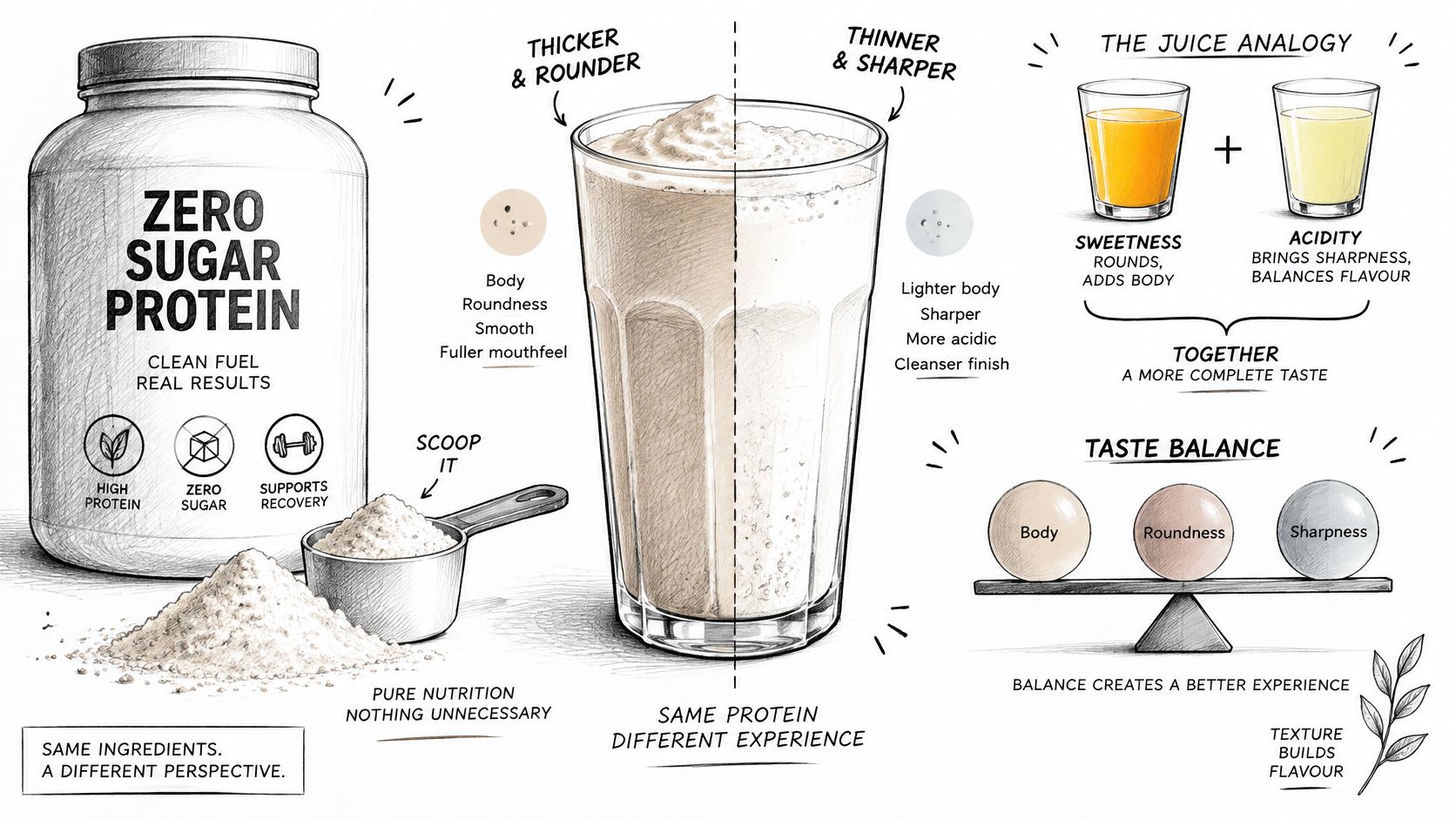
Sucralose and acesulfame potassium are the workhorses of the category. They're strong, cheap to use and stable in water, and they can leave a lingering sweetness that sits on the tongue after you swallow. Stevia can turn bitter at higher doses, which is why so many formulas blend it with something else rather than using it alone. Erythritol adds bulk and a cooling sensation, and blends built on it often feel slightly chalky or fuller in the glass depending on the liquid you use.
Three tests worth doing before you buy a kilo
Buy small first. A single serve or a 500 g tub costs more per gram and saves you from three months of a flavour you can't finish.
Mix it two ways. Cold water shows you the bare formula. Milk rounds the edges and hides sweetener aftertaste. Many drinkers choose one or the other, so test the one you'll use every day.
Start with chocolate or dessert flavours. Cocoa, vanilla and salt mask sweetener aftertaste far better than unflavoured or fruit-forward options, which have nowhere to hide.
The rule of thumb that saves the most money: if a shake tastes thin, or sweet at the back of your mouth, the sweetener blend is the likely cause rather than the protein. A whey isolate and a pea protein can both be zero sugar and taste completely different, and the panel won't tell you which one you'll prefer.
Weight Management and Blood Sugar Without the Hype
A zero sugar powder does not carry less energy than the same powder with sugar. Remove the sugars and the kilojoules from protein, and from any carbohydrate still in the scoop, stay right where they were. On its own, a zero sugar shake doesn't change your weight or your blood sugar. What it replaces in your day might.
The context is worth knowing. The 2008/09 New Zealand Adult Nutrition Survey reported median usual daily total-sugar intake of 120 g for males and 96 g for females, alongside median protein intakes of 102 g and 71 g, with inadequate protein intake estimated at just 2.0% overall (Ministry of Health, A Focus on Nutrition). It's more than a decade old and should be read as a historical national baseline, not a current estimate. But it frames the honest case for a zero sugar shake: concentrated protein without extra sugar, not a fix for a deficiency that barely exists.
The replacement question
Here's the test that decides things. A 30 g shake with 0 g of sugars standing in for a muffin at morning tea lowers the day's total energy. The same shake added on top of three full meals raises it. Identical tub, opposite result, and the panel looks the same both times.
Practical rule: judge a serve by what it replaces, not by what it contains in isolation.
For anyone managing carbohydrate intake, or living with diabetes, the carbohydrate per serve matters more than the sugars line alone, because sugar alcohols and fibre still count towards the total. Any change to meals, snacks or medication timing belongs with your healthcare team, not with a label.
So ask the plain question: does this serve fit today's energy and carbohydrate plan better than the food it's replacing? If the answer is yes, the tub is doing its job. If you're weighing up a shake against a meal and want the fuller comparison, our guide to choosing a protein powder for weight management works through the trade-offs.
Choosing the Right Zero Sugar Powder for Your Situation
Saturday morning decides the tub more than the sugars line does. A drug-tested sprinter, a vegan who wants no dairy, and someone using a shake in place of a snack can all hold a zero sugar powder and still need different answers from the rest of the panel.
| Shopper case | Main concern | What to check on the label |
|---|---|---|
| Drug-tested athlete | Banned substances and batch consistency | Certification mark (Informed Sport, Informed Choice, NSF Certified for Sport or HASTA) and batch testing |
| Dairy-avoiding shopper | Lactose and milk-derived ingredients | Plant protein from pea or rice has none; whey isolate has very little, so check the ingredients |
| Vegan shopper | Dairy and animal-derived ingredients | Plant protein source and the full ingredients list |
| Endurance or team-sport athlete cutting added sugar | Enough carbohydrate for longer sessions | Total carbohydrate per serve and its source |
| Meal replacement or weight management | Energy and fullness per serve | Kilojoules, protein and fibre per serve |
The sports integrity question
A sugars figure of 0 g is one cell on the nutrition panel. It does not describe banned substances, how the batch was made, or whether anyone tested that batch. Drug-tested athletes need an independent certification mark on the tub, and they need to check that the mark covers the flavour and batch in their hand. Look for Informed Sport, Informed Choice, NSF Certified for Sport or HASTA. A logo that is not one of those four leaves the tub unverified for a testing programme.
Testing rule: if you compete under a testing programme, buy the certified version of the flavour you want. Certification is product-specific, not brand-wide.
A certification mark works like a batch ticket stapled to one tub. The brand name on the range does not prove this flavour, in this batch, was the one that was checked.
Whey isolate against plant protein
Whey isolate is filtered further than whey concentrate, so it has more protein per serve with less carbohydrate, fat and lactose. Shoppers who tolerate dairy often pay for more protein in the scoop, because less of it is lactose, fat and leftover carbohydrate. That is an efficiency reading on the panel, not a promise about health.
Plant protein covers the other lane. Pea and rice proteins contain no lactose at all, which suits dairy-avoiding shoppers and anyone who finds whey sits badly. NZ Supps carries plant-based protein made from sources such as pea or rice when that is the match. A vegan shopper still reads the full ingredient list rather than the front of the tub. Flavourings, vitamins and processing aids can come from animal sources even when the protein itself is a plant.
The three-step buying routine
- Pick your case from the table. Athlete, dairy-avoider, vegan, endurance, or meal replacement. One case, not four.
- Compare two tubs on four numbers. Sugars per serve and per 100 g, total carbohydrate and fibre, kilojoules, and cost per 25 g of protein. Write them down; the shelf does not line them up for you.
- Confirm the sweetener list and, if you test, the certification mark. These are the two things that disqualify a tub after the numbers look fine.
Run that routine on any two tubs before you choose a size. Stock is sealed by the brand and dispatched from Palmerston North, and orders over $99 ship free.
Start with the sugars line, then keep going through carbohydrate, fibre, kilojoules, the sweetener list and, if you are tested, the certification mark. Zero sugar answers one narrow question. The rest of the panel decides whether that tub belongs in the kitchen.
The panel you compare online is the panel that leaves the Palmerston North warehouse a couple of days later. If you want the sugars, carbohydrate and cost per 25 g of protein set beside each other, send the two labels to the team at NZ Supps. Check the sugars line yourself before you commit to a size.