SHOP NOW, PAY LATER










 Informed Sport
 Informed Choice
 NSF Certified for Sport
 HASTA Certified

Neither is universally better. Whey has higher leucine density and digestibility, while plant protein wins for dairy-free tolerance, ethics and, for many NZ shoppers, price, so the right choice depends on your training goal, diet and budget.
You're standing in front of the protein shelf, comparing a whey isolate with a pea and rice blend. Both tubs promise an easy scoop, but the useful question isn't which one wins every category. It's which protein suits this meal, this training block and your tolerance.
For most gym-goers, whey is the efficient pick when you want more muscle-building amino acids from a smaller serve. Plant protein is the practical choice if you avoid dairy, prefer a vegan diet or feel better using it. A blend can sit between the two.
This guide puts the trade-offs into NZ context, using local protein-quality data and the label details shoppers can check. It covers amino acids, digestion, value, testing, environmental considerations and the products worth considering.
Table of Contents
- The Quick Answer for NZ Shoppers
- Protein Quality and Muscle Building
- Digestion, Satiety and Gut Tolerance
- Price Per Serve and Value for Money
- When to Choose Plant, Whey or a Blend
- Contamination, Heavy Metals and Banned-Substance Risk
- Environmental and Ethical Considerations
- Which Protein Should You Actually Buy
The Quick Answer for NZ Shoppers
You are choosing between whey and a pea-and-rice blend after training, before work or alongside breakfast. The better buy depends on the job. Whey gives you more muscle-building amino acids from a smaller serve. Plant protein suits dairy-free, vegan and better-tolerated routines, while a blend offers a practical middle ground.
A 2025 New Zealand protein-quality analysis placed plant-sourced protein below reference patterns for leucine and lysine. The practical result is simple: a plant scoop may need to be larger or blended to match the amino-acid density of a whey scoop. Leucine matters because it helps trigger muscle protein synthesis.
Plant protein still belongs in ordinary NZ eating. New Zealand government data from the 2008–2009 Adult Nutrition Survey found plant-based proteins contributed at least 40% of adults' average daily protein intake (MBIE plant-based foods paper). It is not a niche replacement.
My shop-floor rule: choose whey when protein efficiency, amino-acid density and easy mixing lead the decision. Choose plant when dairy, ethics or day-to-day tolerance matters more.
Match the powder to the meal. Whey works well in a quick post-training shake or low-preparation breakfast. A plant blend fits smoothies, afternoon snacks and meals where extra thickness and fibre are useful. Choose a blend if you want less dairy without depending on one plant source.
Use this buying order:
- Training goal: Do you need efficient muscle-building protein, or an easier way to raise daily intake?
- Tolerance: Does whey sit comfortably, or does plant protein cause fewer problems?
- Diet pattern: Vegan, flexitarian and dairy-free shoppers have a clear starting point.
- Budget: Compare protein per serve and price per gram, not tub size.
- Testing: Drug-tested athletes should check certification before choosing flavour or price.
For recreational lifters, whey isolate or a quality pea-and-rice blend are sensible choices. Vegans should favour a blended plant powder over a single source. Competitors under drug-testing rules should start with a batch-tested product.
Protein Quality and Muscle Building
A protein tub earns its place through more than the headline protein number. Check the protein delivered per serve, the amino acids behind that number and how much powder you need to use for a practical meal.
The NZ analysis puts a clear figure on one plant-protein trade-off. Plant-sourced protein provided 52.9 mg of leucine per gram and 35.7 mg of lysine per gram, compared with reference patterns of 59 mg/g and 45 mg/g respectively (MPI protein-quality report). The leucine result is roughly 10 percent below the reference, while the lysine result is further behind. A plant scoop can still support muscle building, but a pea and rice blend or a slightly larger serve closes that gap more effectively than relying on a single source.
Whey remains the efficient choice for amino-acid density and digestibility. Plant proteins need more label scrutiny. Pea contributes useful lysine, rice helps balance the profile in a blend, and hemp offers a different amino-acid mix. For plant shoppers, combining sources makes more sense than treating every powder as interchangeable.
Read the label before judging the scoop
DIAAS and PDCAAS can help compare protein quality, although brands do not always print either score on the tub. Whey concentrate and isolate are commonly placed near the top of these comparisons. Single-source plant proteins may score lower, depending on the source and processing. Apply the score to the actual formula, testing method and serving size rather than assuming one number describes every product.
Use this practical label check:
- Confirm the protein grams per serve.
- Choose a pea and rice combination if you want a broader plant profile.
- Check whether fibre, carbohydrate and flavouring ingredients occupy a meaningful part of the serve.
- Compare the declared amino-acid profile when the brand provides one.
| Metric | Whey Concentrate | Pea Protein | Rice Protein | Pea + Rice Blend |
|---|---|---|---|---|
| Main strength | High amino-acid density | Useful plant base | Complements pea | More balanced plant profile |
| Leucine position | Generally higher | Lower than whey per gram | Often lower than whey | Improved through formulation |
| Lysine position | Strong | Useful | Can be more limited | Better balanced than one source |
| Digestibility | Generally high | Product-dependent | Product-dependent | Product-dependent |
| Best label check | Protein and lactose | Protein and ingredients | Protein and testing | Protein, blend and testing |
NZ's dairy-focused protein manufacturing also helps explain why whey is the local benchmark. Government material describes strong production in dairy proteins such as casein and whey, while plant protein is presented as a growing food-manufacturing opportunity (MBIE plant-based foods paper).
For muscle gain, consistent total protein intake matters more than winning an argument about one powder. Choose whey for maximum protein efficiency per scoop. Choose a quality plant blend when dairy does not suit your diet or routine. For a closer look at how pea and soy differ, use this guide to pea versus soy protein.
Digestion, Satiety and Gut Tolerance
Whey and plant powders feel different in the shaker and often different after you drink them. Whey usually mixes thinner and moves through a meal more quickly. Plant powders tend to be thicker, and some retain more fibre or carbohydrate from the source material.
That doesn't make one universally easier to digest. The best protein is the one you can use repeatedly without gut complaints.
Whey concentrate can contain more lactose than isolate. If a whey shake leaves you bloated, the problem may be the lactose or the overall formula rather than whey protein itself. Switching to isolate, reducing the serving or choosing a plant blend are sensible experiments. Don't keep forcing a product that makes your routine unpleasant.
Plant powders have their own trade-offs
Plant blends can feel more filling because they're often thicker and may contain more fibre. That suits a breakfast smoothie or afternoon snack better than a very fast post-training drink. The same fibre and bean-derived ingredients can cause gas or loose stools for some shoppers, especially if their usual diet is low in fibre.
FODMAP content also deserves attention if particular foods already upset your digestion. Protein powder labels don't always make the relevant carbohydrate sources obvious, so check the ingredients for pea, bean, inulin, sugar alcohols and added fibres. Start with a smaller serve and assess your response rather than jumping straight to a double scoop.
Practical test: use one powder consistently for several days, keep the serving sensible and change only one variable at a time. That tells you more than switching between three flavours in one week.
Whey isolate is the obvious first trial for someone who likes dairy but dislikes the heaviness of concentrate. A pea and rice blend is the cleaner first trial for someone avoiding dairy or noticing that whey doesn't suit them. Neither choice needs a medical label attached to it. You're just matching the formula to your own response.
Price Per Serve and Value for Money
Protein value can look very different once you stop comparing tub prices. A large tub may have a lower cost per serve, while a smaller product may deliver more actual protein in each scoop. The only fair comparison uses the recommended serving, declared protein and current shelf price.
I can't give a truthful NZD price-per-serve table without the current product prices and serving details from the relevant NZ Supps product pages. Those figures change with flavour, promotions, tub size and stock status, and the verified information supplied here doesn't include them. It would be poor advice to invent a price and present it as a live comparison.
Use this table as the calculation template:
| Product Type | Typical Serve Size | Protein Per Serve | Approx. Price Per Serve (NZD) | Price Per Gram of Protein |
|---|---|---|---|---|
| Whey concentrate | Check product label | Check product label | Current listed price ÷ serves | Price per serve ÷ protein grams |
| Whey isolate | Check product label | Check product label | Current listed price ÷ serves | Price per serve ÷ protein grams |
| Pea protein | Check product label | Check product label | Current listed price ÷ serves | Price per serve ÷ protein grams |
| Pea and rice blend | Check product label | Check product label | Current listed price ÷ serves | Price per serve ÷ protein grams |
The calculation takes less than a minute
Divide the tub price by the number of labelled serves. Then divide that result by the grams of protein per serve. If the label gives a 30 gram scoop with 22 grams of protein, use 22 grams, not 30 grams, in the final calculation.
Also check whether the serving size is realistic. A brand can make a product look inexpensive by defining a large number of small serves, while another uses a larger scoop that better reflects how people drink it.
For many shoppers, bulk whey concentrate or a bulk plant isolate will be the value leaders. Premium isolate may be worth paying for when you want a thinner shake, a lower dairy load or a higher protein concentration. A pea and rice blend may cost more per scoop, but its balanced formulation can be worth it if it's the only powder you'll use consistently.
The blunt rule is this: compare price per gram of protein, then decide whether the texture and tolerance justify any premium.
When to Choose Plant, Whey or a Blend
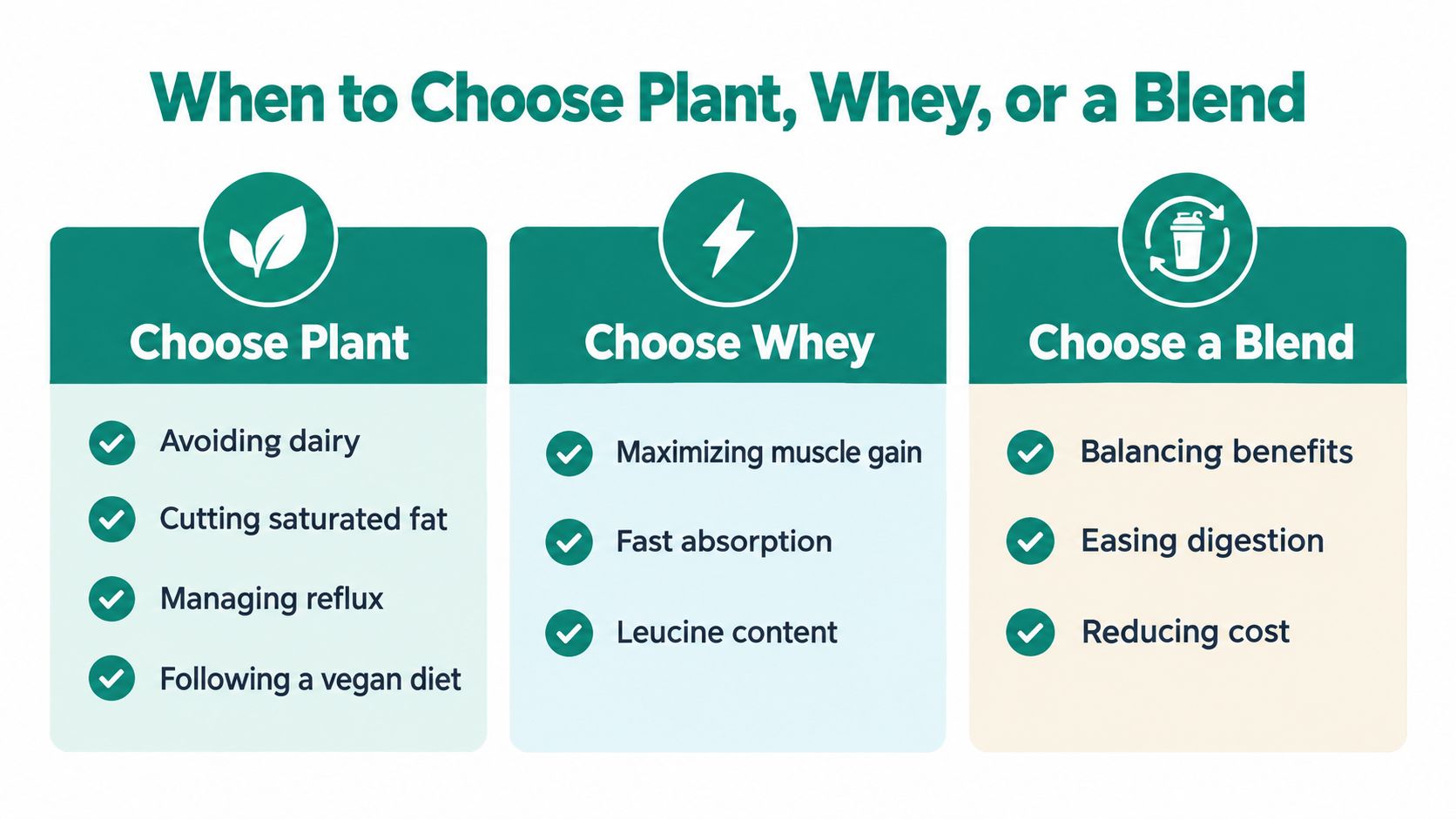
The right powder depends on the shopper and the meal, not on a universal winner. Choose plant protein if you avoid dairy, eat vegan, or follow a flexitarian diet and want one powder that fits your existing meals without creating a separate exception.
Choose a pea and rice blend when you want one plant powder to cover the different strengths of both sources. That is more practical than stacking two single-source tubs, especially if you plan to use the same powder every day. As covered in the protein quality section, combining sources offsets the limitations of relying on one plant protein alone.
Whey is my pick for lifters who want a simple, efficient scoop. It mixes easily, has a strong amino-acid profile and suits a post-training shake that needs little preparation. Choose whey isolate when you want a higher protein concentration or less lactose than a concentrate, but read the label rather than relying on the product name. DoseRoutine's whey isolate library offers useful background on isolate formats and label differences.
A blend suits shoppers who want to reduce dairy without going fully plant-based, or athletes who prefer different proteins across the day. Use hemp for variety in a plant routine. Use pea and rice when you want the main balancing work done in one formula.
Match the powder to the meal
- After a hard session: Choose whey if you tolerate dairy and want a quick, easy shake.
- At breakfast: Use a plant blend with oats, fruit or yoghurt-style alternatives, particularly if you prefer a thicker drink.
- During a dairy-free week: Use pea and rice consistently instead of patching a single-source powder with random additions.
- For a mixed routine: Use whey for convenience and plant protein with meals where you want less dairy.
For drug-tested athletes, certification can matter more than the protein source. A tested blend may be a better choice than an untested whey or plant powder. The product formulation also affects how a powder mixes and behaves in recipes.
A Riddet Institute study found that heating hemp protein with whey isolate at 95°C for 20 minutes produced particles of about 3.8 μm, compared with about 27.5 μm for hemp alone. Whey also formed irreversible disulfide-linked binding to hemp particles (Riddet Institute study). That is a processing result, not a guarantee for every product, but it supports checking the blend's texture and intended use before buying.
Contamination, Heavy Metals and Banned-Substance Risk
For competitive athletes, testing matters more than the plant-versus-whey argument. A clean ingredient panel doesn't prove that a finished product has been screened for banned substances, and “natural” doesn't automatically mean tested.
Whey and plant powders have different potential contamination concerns. Dairy processing raises questions about residues and supply-chain control, while crops can reflect the soil and processing environment. Rice and hemp deserve particular scrutiny from shoppers concerned about heavy metals, and pea products still need proper batch control. I'm not assigning unverified risk rankings to every category because the answer depends on the individual product and its testing.
What drug-tested athletes should check
Look for a recognised certification and a batch or certificate reference that can be verified. The certification should apply to the finished product, not merely to one raw ingredient. If a brand makes a testing claim but can't explain the batch, standard or certificate, treat the claim as incomplete.
NZ Supps' Tested for Sport collection groups products carrying standards such as Informed Sport, Informed Choice, NSF Certified for Sport and HASTA. That makes certification a useful filter before you compare flavours. The practical steps are set out in this guide to checking supplement testing in NZ.
For tested athletes: certification comes before flavour, price and whether the powder is plant or whey.
New Zealand's supplement rules also give shoppers a label-based starting point. Dietary supplements are regulated under the Dietary Supplements Regulations 1985 within the Food Act 2014 framework, and packaging must include ingredient information and other consumer details (Medsafe dietary supplement regulation). Read the actual panel, check the serving size and keep the batch information from the tub.
Environmental and Ethical Considerations
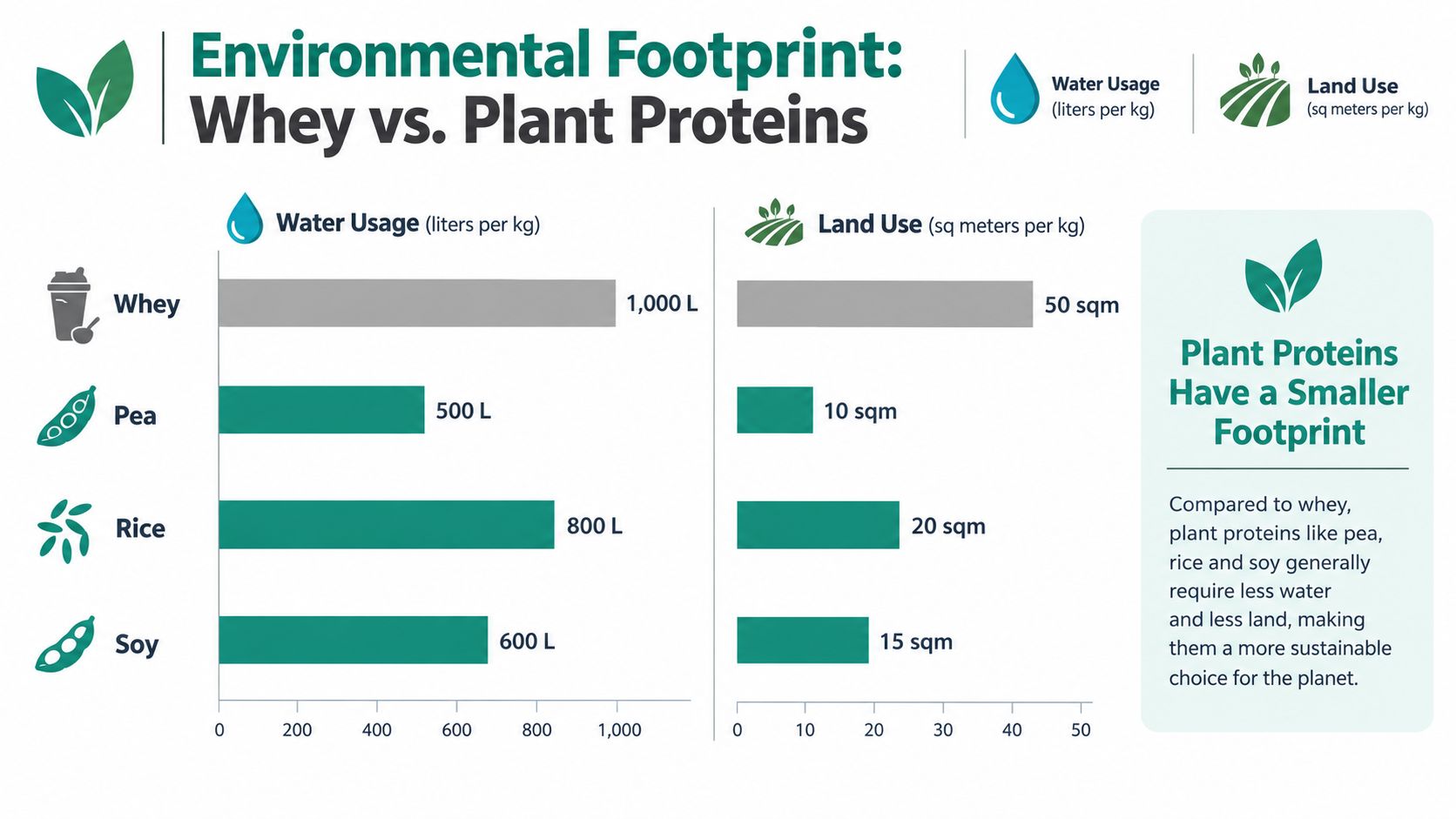
Plant protein generally has the stronger environmental and animal-welfare argument. Growing peas, rice or soy doesn't require dairy production, and plant proteins usually use less land and water than animal-derived protein systems.
The supplied comparison visual presents approximate footprints of 1,000 litres of water and 50 square metres of land per kilogram for whey, compared with approximately 500 litres and 10 square metres for pea, 800 litres and 20 square metres for rice, and 600 litres and 15 square metres for soy. Those figures are illustrative rather than a verified source in the information provided, so I won't present them as established NZ measurements or use them to rank specific products.
The NZ context complicates the simple slogan that plant is always greener. Locally produced whey can have a different transport profile from imported whey, and the impact of a product depends on farming, processing, packaging, freight and how long the tub stays in your cupboard.
Buy according to your actual priorities
If animal welfare is your deciding factor, plant protein is the clearer fit. If you're concerned about imported crops, ask where the ingredients were grown and processed. Soy and corn may also raise questions about GMO status, while fair-trade sourcing can matter for imported ingredients. Those details aren't guaranteed by the word “plant” on the front label.
A well-made NZ whey product can still be a defensible choice for someone who tolerates dairy, buys in bulk, recycles the tub and wants a local supply chain. The environmental decision isn't a purity test. It's a balance between diet, sourcing, packaging, transport and how reliably you use the product.
Which Protein Should You Actually Buy
Here's the direct recommendation.
Drug-tested athletes should start with the Tested for Sport collection, then choose whey or plant according to tolerance. A certification standard and batch information are more important than whether the powder is dairy-based.
Recreational gym-goers can choose whey isolate if they want a simple, efficient shake. Choose a pea and rice blend if dairy doesn't suit you, or if a plant-based routine fits your meals better.
Vegans and dairy-avoiding shoppers should buy a blended plant powder rather than relying on one source. Pea and rice are the sensible base combination, with hemp as an optional addition.
Budget shoppers should compare the current price per gram of declared protein. Bulk whey concentrate often deserves the first look, while bulk pea protein can be competitive when the serving and tub size work in its favour.
For shoppers who want a neutral ingredient approach, shop unflavoured protein powder and compare its label against the same measures below. The product still needs to suit your diet and testing requirements.
| Product Type | Protein per Serve | Leucine per Serve | Price per g Protein (NZD) | Best For | Key Certification |
|---|---|---|---|---|---|
| Whey isolate | Check current label | Check current label | Calculate from listed price | Efficient post-training protein | Check product certification |
| Pea and rice blend | Check current label | Check current label | Calculate from listed price | Vegan and dairy-free routines | Check product certification |
| Whey concentrate | Check current label | Check current label | Calculate from listed price | Budget-focused shoppers | Check product certification |
My buying order
- Check the protein grams per serve. Don't compare scoop weight alone.
- Check the ingredients. Look for the plant sources, sweeteners, fibre and dairy content.
- Check tolerance. A powder you enjoy using beats a theoretically perfect powder left in the cupboard.
- Check certification. This is essential for athletes subject to drug testing.
- Check current price per gram. Promotions and tub sizes change the answer.
You can also read this NZ guide to vegan protein powder before choosing between a single plant source and a blend. For a wider comparison of whey, isolate and plant options, compare protein powders in NZ by serving size, ingredients and certification rather than front-of-pack promises.
NZ Supps offers whey, whey isolate, plant powders and Tested for Sport options with label and per-serve details available for comparison. Visit NZ Supps now, choose the protein that matches your diet and training, and check the current serving cost before you order.