SHOP NOW, PAY LATER












 Informed Sport
 Informed Choice
 NSF Certified for Sport
 HASTA Certified

Most advice on micronized creatine gets the main point wrong. It treats micronized like a stronger version of creatine, when it's really a handling upgrade on the same old ingredient.
That matters in New Zealand because creatine doesn't sit in some fringe supplement corner anymore. A Food Standards survey found 9.3% of people aged 15+ in New Zealand had consumed supplementary foods in the previous four weeks, and that was statistically similar to Australia's 10.2%, which tells you the category is broad enough to matter well beyond hardcore bodybuilders (Food Standards survey). If you sell or use sports nutrition here, you're dealing with a mainstream buying habit.
Creatine has also been around NZ sport long enough that nobody should still be falling for shiny-label nonsense. It was already part of mainstream rugby talk back in the Super 12 era, discussed as a legal option used by New Zealand players for bulk and strength. What's changed since then isn't the core ingredient. It's the packaging, the convenience, and the marketing.
So here's the straight answer. If you're choosing a micronized creatine product, stop asking whether it's “better” in some magical performance sense. Ask three things instead: How much creatine monohydrate do I get per serve? Can I take it every day without hating the texture? And if I'm drug tested, is the supply chain clean?
Table of Contents
- What Micronized Creatine Actually Is
- How Creatine Works in the Body
- Micronized Creatine vs Regular Creatine Monohydrate
- How to Dose Micronized Creatine Properly
- Where Micronized Creatine Fits for Real NZ Athletes
- Side Effects, Myths, and Drug-Tested Safety in NZ
- Buying and Storing Micronized Creatine in NZ
- The Bottom Line on Micronized Creatine
What Micronized Creatine Actually Is
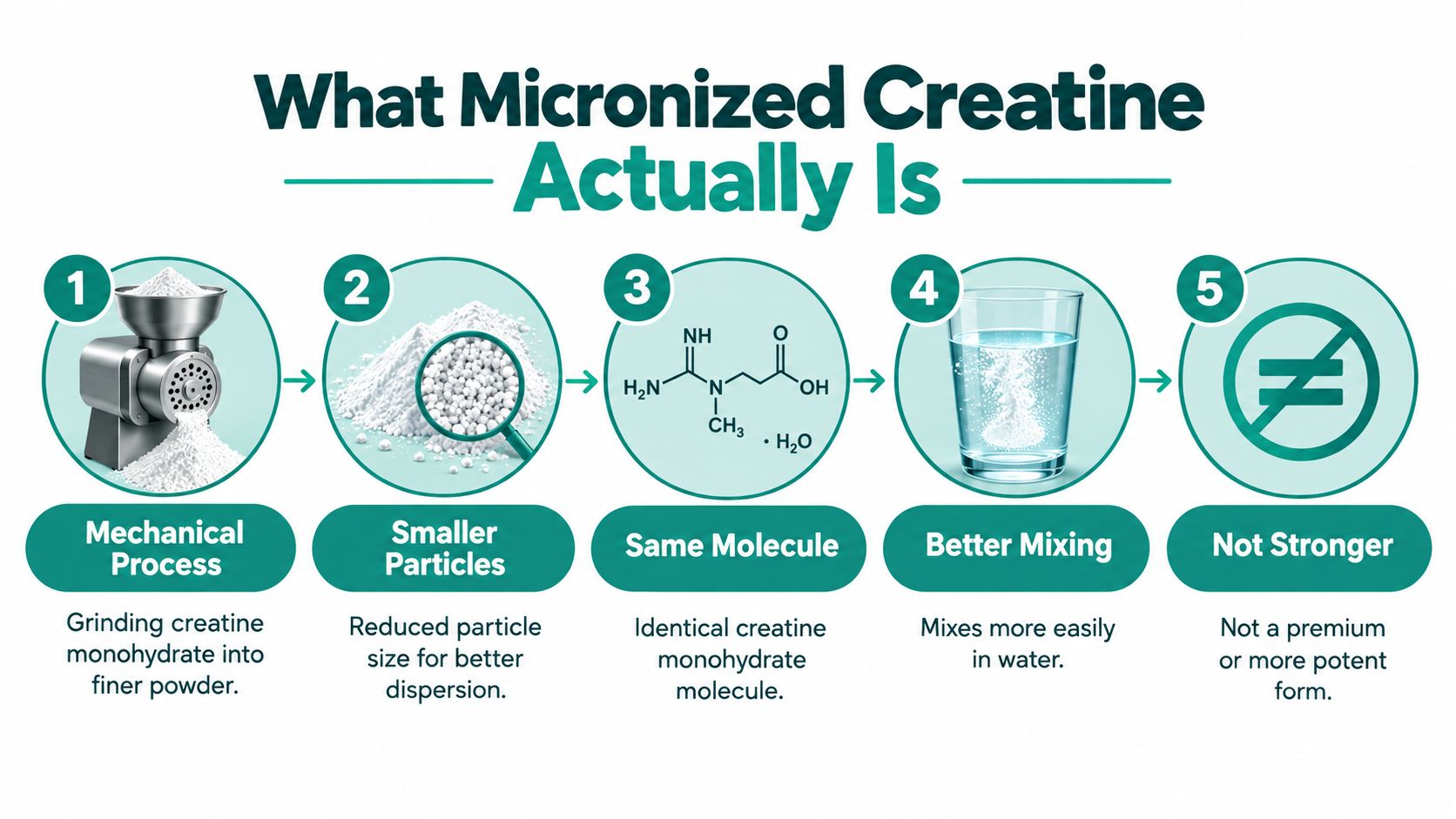
Micronized creatine isn't a new form of creatine. It isn't a premium molecule. It isn't a secret upgrade.
It's creatine monohydrate ground into smaller particles.
That's the bit the label usually glosses over. Brands love to imply that “micronized” means more advanced, more potent, or somehow more effective in the gym. It doesn't. The active ingredient is still creatine monohydrate. The practical difference is physical, not biochemical.
The part that changes
When the powder is milled finer, it disperses more easily in water. You get less grit at the bottom of the shaker, less clumping in the tub, and a smoother drink. That's useful. If you've ever necked a half-mixed creatine sludge and copped a mouthful of chalk, you already know why some people prefer micronized powder.
A simple way to think about it is this. Standard powder can feel sandy. Micronized powder feels closer to a finer flour. Same ingredient. Different texture. Some descriptions of micronized products use a concrete example of particle size dropping from roughly 200 microns to under 20, which helps make the scale real, but the buying takeaway is still the same. You're paying for better handling.
The part that doesn't
Micronizing does not change the actual creatine molecule. It doesn't turn monohydrate into a stronger ingredient. It doesn't create a new mechanism. It doesn't suddenly make timing matter more.
NZ retail guidance around creatine already points people back to the fundamentals. Micronized creatine monohydrate is still creatine monohydrate chemically, with common daily guidance around 5 g/day and the standard daily intake commonly cited as 3 to 5 g/day across training and rest days alike (NZ retail creatine guidance).
Practical rule: Judge micronized creatine on mixability and ease of use. Judge creatine itself on the actual grams of monohydrate you take consistently.
If a brand sells “micronized” as if it's a performance breakthrough, that's fluff. If it sells it as a smoother, less clumpy way to take ordinary creatine monohydrate, that's fair.
How Creatine Works in the Body
Creatine helps with short, hard efforts. Heavy squats. Repeated sprints. Explosive sets where your body needs energy fast and doesn't have time to muck around.
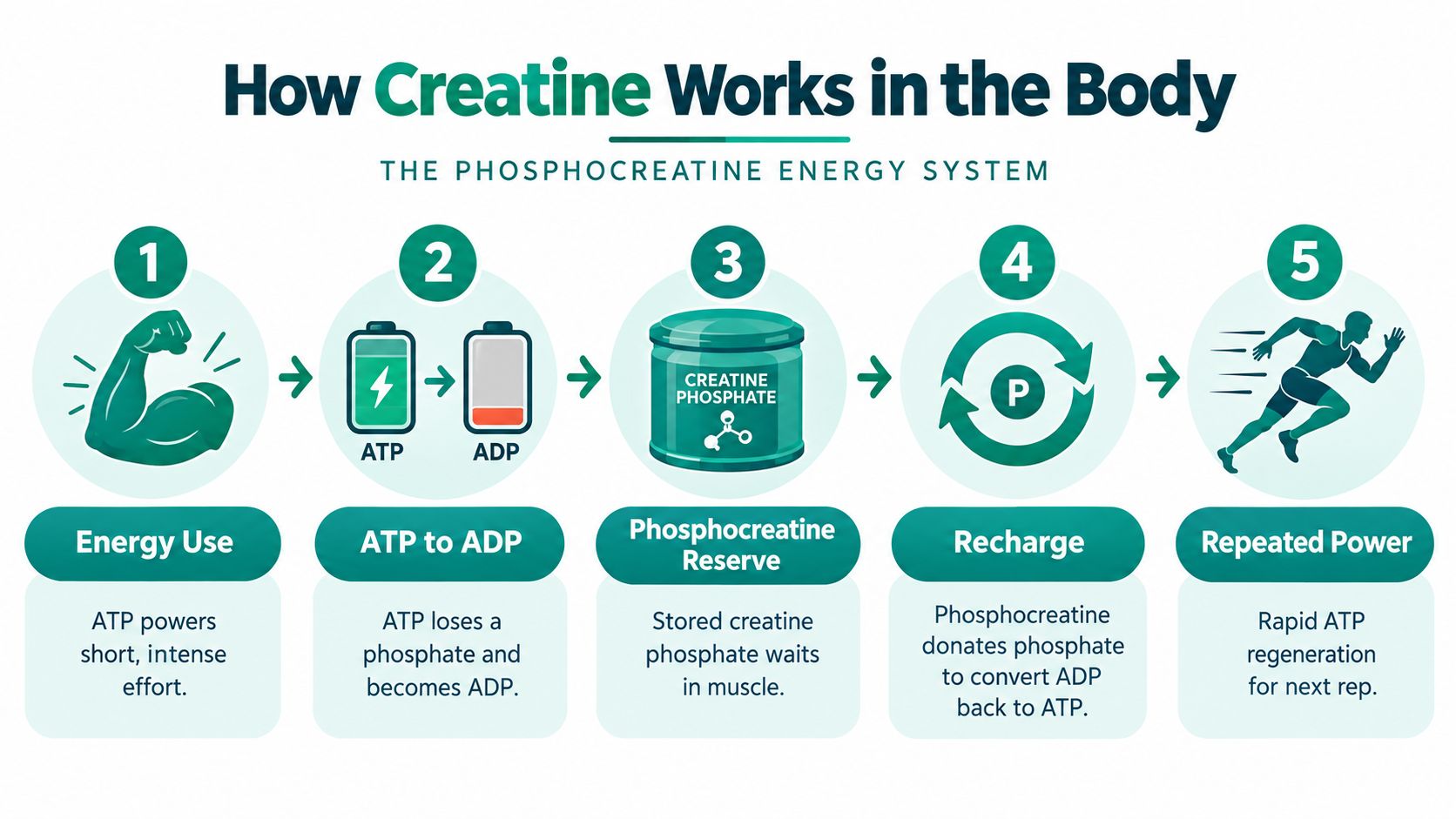
The key system here is the phosphocreatine energy system. Your muscles use ATP for immediate energy. Once ATP gives up a phosphate to fuel movement, it becomes ADP. Creatine stored in muscle helps rebuild ATP quickly, which is why it matters for repeated high-intensity work.
The simple version
Think of ATP as your phone battery while the screen brightness is maxed out and every app is running. It drains fast when demand is high. Phosphocreatine acts like the quick-charge backup that helps top it up so you can keep pushing.
That's why creatine is useful for efforts where seconds matter and repeat output matters. It's not a stimulant. You don't “feel” it like caffeine. It works by helping your body maintain rapid energy turnover during intense work.
To make that easier to picture, this process flow helps.
Saturation is the whole game
The point of taking creatine daily is muscle saturation. Once muscle stores are topped up, that's where most of the benefit comes from. If you're inconsistent, you're making life harder for no good reason.
This is also why timing gets oversold. Morning, post-training, with lunch, before bed. It matters far less than whether you take it every day.
If you want a practical breakdown of that day-to-day effect on training outcomes, how creatine really affects your gains is worth reading alongside the label in your hand.
Why the training context matters
Creatine isn't a shortcut for weak programming. The New Zealand Journal of Sports Medicine noted that creatine showed no meaningful benefit in several rehabilitation settings where loading was low, including post-ACL reconstruction and post-knee replacement, and the conclusion was blunt: the exercise stimulus was too small to express the expected hypertrophic effect (NZ Journal of Sports Medicine discussion).
That's the bit Instagram skips. Creatine supports output when training gives it something to support.
Micronized Creatine vs Regular Creatine Monohydrate
This comparison is a lot simpler than supplement companies want it to be. If both tubs give you the same grams of creatine monohydrate, you're not choosing between two different performance ingredients. You're choosing between two powder behaviours.
What actually matters
For most buyers, the useful differences come down to four things:
- Mixability: Micronized powder usually disperses better in cold water.
- Texture: It tends to feel less gritty.
- Clumping: Finer powders can behave better in a shaker, though storage still matters.
- Value: You still need to compare cost against actual creatine monohydrate delivered.
What doesn't belong on the list is “more powerful” or “more anabolic”. That's label theatre.
Micronized vs Regular Creatine Monohydrate
| Attribute | Micronized Creatine Monohydrate | Regular Creatine Monohydrate |
|---|---|---|
| Active ingredient | Creatine monohydrate | Creatine monohydrate |
| Performance mechanism | Same as regular monohydrate | Same as micronized |
| Mixability | Usually better in water, especially cold drinks | More likely to leave grit or sediment |
| Texture | Finer mouthfeel | Often rougher or sandier |
| Scoop handling | Easier to level and split if you want smaller serves | Usually fine, but less tidy in some tubs |
| Label meaning | Particle-size spec | Standard powder form |
| Best reason to buy | Convenience and smoother use | Simplicity and value |
“Micronized” tells you about the powder. It doesn't tell you about purity, certification, or superiority.
If you're also weighing up other creatine variants, creatine HCL vs monohydrate is the comparison that changes the buying conversation. Micronized versus regular monohydrate usually doesn't.
Who should pay extra for micronized
I'd say micronized earns its keep for three groups.
First, lifters who always mix creatine into cold drinks. Second, anyone who's sick of swallowing gritty sludge. Third, people stacking it into a single shaker with aminos or electrolytes, where cleaner dispersion just makes life easier.
If none of that sounds like you, regular monohydrate is usually enough. Don't pay a premium for a smoother powder if you'd happily knock back the basic one anyway.
How to Dose Micronized Creatine Properly
Overcomplicating creatine dosing is easy because “faster saturation” is often mistaken for “better results.” Those aren't the same thing.
For day-to-day use, the common guidance in NZ retail practice is straightforward: 3 to 5 g/day of creatine monohydrate, every day, including rest days. A common standard presentation is 5 g per scoop, and one NZ-listed example shows 60 servings in a 300 g container, which is the sort of simple format buyers should look for when comparing tubs (300 g creatine example with 60 servings).
Two dosing strategies that matter
| Protocol | Daily Amount | Duration | Best For | Drawbacks |
|---|---|---|---|---|
| Maintenance only | 3 to 5 g | Ongoing daily use | Most lifters, team-sport athletes, general gym users | Takes longer to fully saturate muscle stores |
| Loading then maintenance | Higher daily intake split across multiple serves, then 3 to 5 g daily | Short initial loading phase, then ongoing | Athletes who want saturation sooner before a block or event | More hassle, more chance of stomach discomfort if done badly |
When loading makes sense
Loading is fine if you've got a reason to speed things up. Short comp prep. A near-term training block. An athlete who's impatient and sticks to the plan.
If you're not in a rush, skip it. Daily maintenance works. The big mistake is not failing to load. It's taking creatine randomly, forgetting rest days, and then blaming the product.
How to read the label without getting fooled
A lot of confusion starts with the scoop. Some brands make the scoop sound impressive while under-delivering actual creatine per serve.
Check these points:
- Look for the exact ingredient name. You want creatine monohydrate, not a proprietary blend with mystery extras.
- Find grams per serve. Ignore hype words and find the actual amount of creatine monohydrate.
- Check how many serves the tub gives. That tells you whether the value stacks up.
- Use the fine powder properly. If you want a smaller serve, micronized powder is easier to split more neatly than rough granular powder.
A simple routine works best. Keep the tub where you'll see it, mix it with a meal or post-training shake, and take it at the same time every day. You don't need to cycle on and off. You need to stop missing days.
Where Micronized Creatine Fits for Real NZ Athletes
The theory is easy. Real use is messier. Different athletes care about different trade-offs, but the winner is usually still the same: dose, consistency, clean supply.
The rugby forward
He wants size, repeat effort, and something he'll take through a long season. For that athlete, a plain daily serve with a training meal does the job. Micronized powder helps because it mixes better into a quick sideline shake, and that means fewer missed doses from pure annoyance.
This is also where the broader NZ context matters. Supplement use is common enough to be a normal part of serious sport and gym culture here, not some fringe behaviour. Creatine has been embedded in local sport talk for decades, so the practical question now isn't whether athletes use it. It's whether they're buying smart.
The CrossFit competitor
This athlete often wants everything now. If there's an Open, a qualifier, or a hard block coming up, a short loading approach can make sense. Not because micronized creatine is special, but because using a finer powder several times a day is easier when you're mixing in a gym bag shaker and don't want clumps.
The buying lesson is boring but useful. If you're taking multiple serves in a day for a short period, smoother texture becomes more valuable than it is during low-friction maintenance.
The drug-tested sprinter
This is the athlete I'm least interested in hearing supplement hype from. For a tested sprinter, “micronized” is not the key word. Certified supply chain is.
New Zealand anti-doping rules make accidental ingestion of prohibited substances a genuine sanction risk, and Sport Integrity NZ's rules make it clear that the contamination problem sits with supplements broadly, not with creatine itself (Sport Integrity NZ anti-doping rules).
So the recommendation changes. Same molecule. Same use case. Different purchase standard. This athlete should care more about batch-tested, certified-for-sport products than particle size.
Side Effects, Myths, and Drug-Tested Safety in NZ
Let's deal with the rubbish first. Micronized creatine isn't dangerous because it's powdered more finely. It's still creatine monohydrate. The safety conversation should be about how you use it and where it came from.
What people actually notice
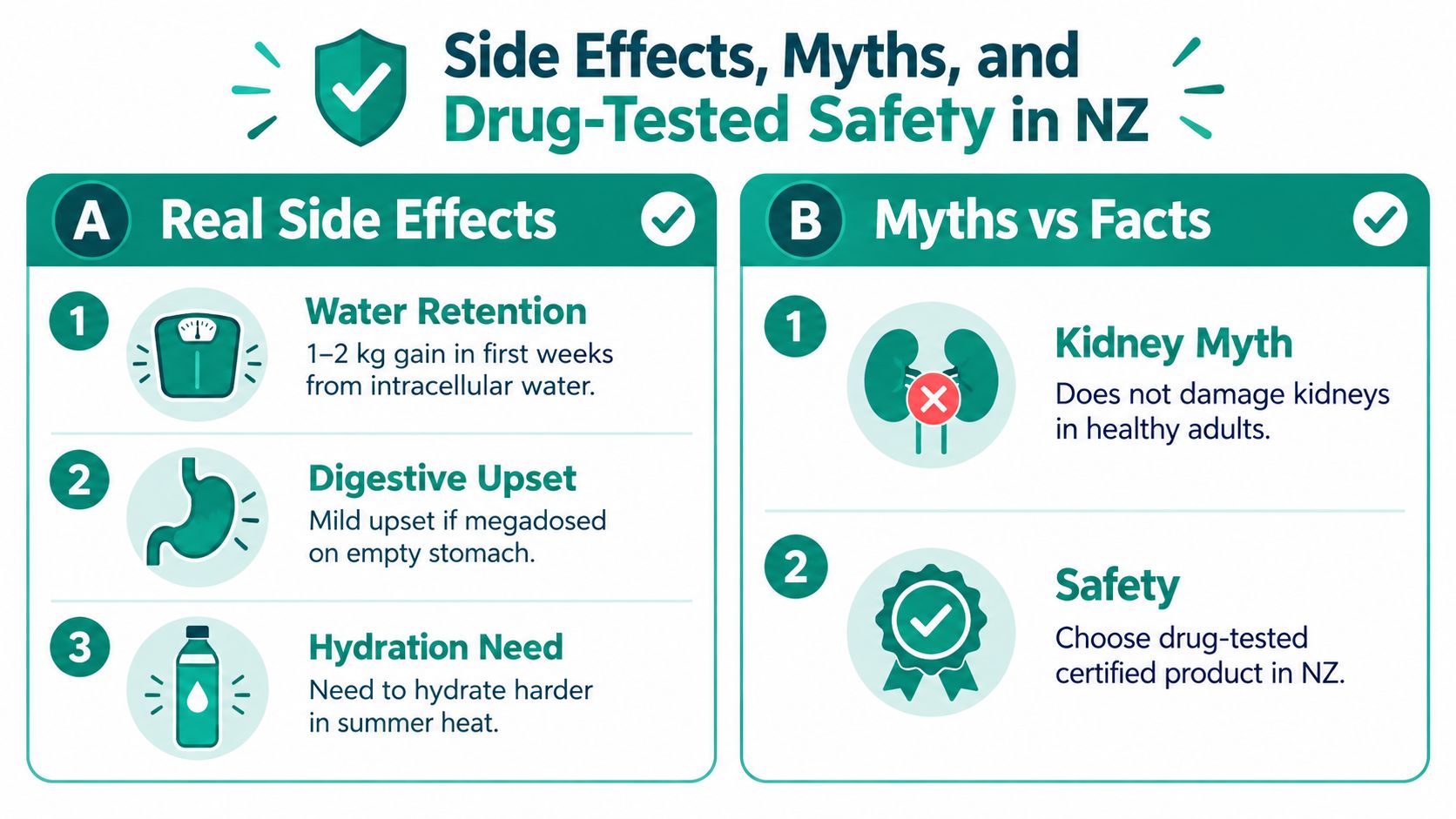
Some users report a bit of early water retention. Some get mild stomach upset if they throw down large serves on an empty stomach. Summer training also tends to punish sloppy hydration habits.
None of that means creatine is a bad supplement. It means athletes still need to use basic common sense.
The myths worth binning
The kidney panic gets repeated far more often than it gets explained properly. The same goes for the hair-loss scare. A lot of creatine content online keeps dragging these claims around because fear sells.
My view is simple. Healthy athletes shouldn't let internet folklore drive the decision. What should drive it is whether the product gives you a clear monohydrate dose, whether you tolerate it well, and whether the source is trustworthy.
Buy creatine for what it reliably does. Don't reject it because someone on TikTok confuses gossip with evidence.
The NZ issue that actually matters
For tested athletes, the bigger risk isn't creatine. It's contamination.
That's why I'd push a sprinter, rugby sevens player, weightlifter, or anyone under a testing regime toward certified products and proper retailer filtering. If you need a practical breakdown of what that looks like, batch-tested creatine in NZ is the right place to start.
Certification doesn't make creatine work better. It helps reduce supply-chain risk. That's a very different claim, and it's the honest one.
Buying and Storing Micronized Creatine in NZ
Spending more time reading Instagram comments than reading the label is backwards.
Buying micronized creatine in NZ should come down to a short checklist. If a tub fails it, leave it on the shelf.
Four checks before you buy
-
Confirm the ingredient
You want 100% creatine monohydrate unless you've got a clear reason to buy a blend. Added sugars, random stimulants, and proprietary fluff usually just muddy the waters.
-
Check actual grams per serve
Ignore oversized scoop talk. Look at what each serve gives you in real creatine monohydrate.
-
Look for sport certification if relevant
If you're tested, this isn't optional. “Micronized” is not a purity badge.
-
Compare value per usable serve
Two tubs can look similar and deliver very different value once you compare serves and actual ingredient dose.
Common tricks that should put you off
Some brands lean hard on presentation because the formula won't sell itself.
Watch for:
- Undersized serves dressed up as premium. Fine print matters more than the front label.
- Blends that hide the amount of monohydrate. If you can't see the actual dose, move on.
- Decanted plain bags. Sealed original manufacturer tubs are safer than mystery powder in unbranded pouches.
If you want a local example of a retailer setup that surfaces ingredient details, per-serve comparisons, and tested-for-sport filtering, NZ Supps does that as part of its product and category tools. That's useful because it lets buyers compare like for like instead of guessing from front-label hype.
Storage matters more with fine powder
Micronized powder can be fussier in the cupboard because finer particles tend to grab moisture more easily.
Do this instead:
- Keep the lid tight. Don't leave it half-open in a humid kitchen.
- Store it somewhere dry. Not the bathroom. Not beside the jug.
- Leave the moisture control in. If there's a silica sachet, don't throw it out.
- Use your nose and eyes. If it smells off or sets like concrete, bin it.
Clumping doesn't automatically mean the tub is ruined, but badly stored powder is one of the dumbest avoidable mistakes in supplements.
The Bottom Line on Micronized Creatine
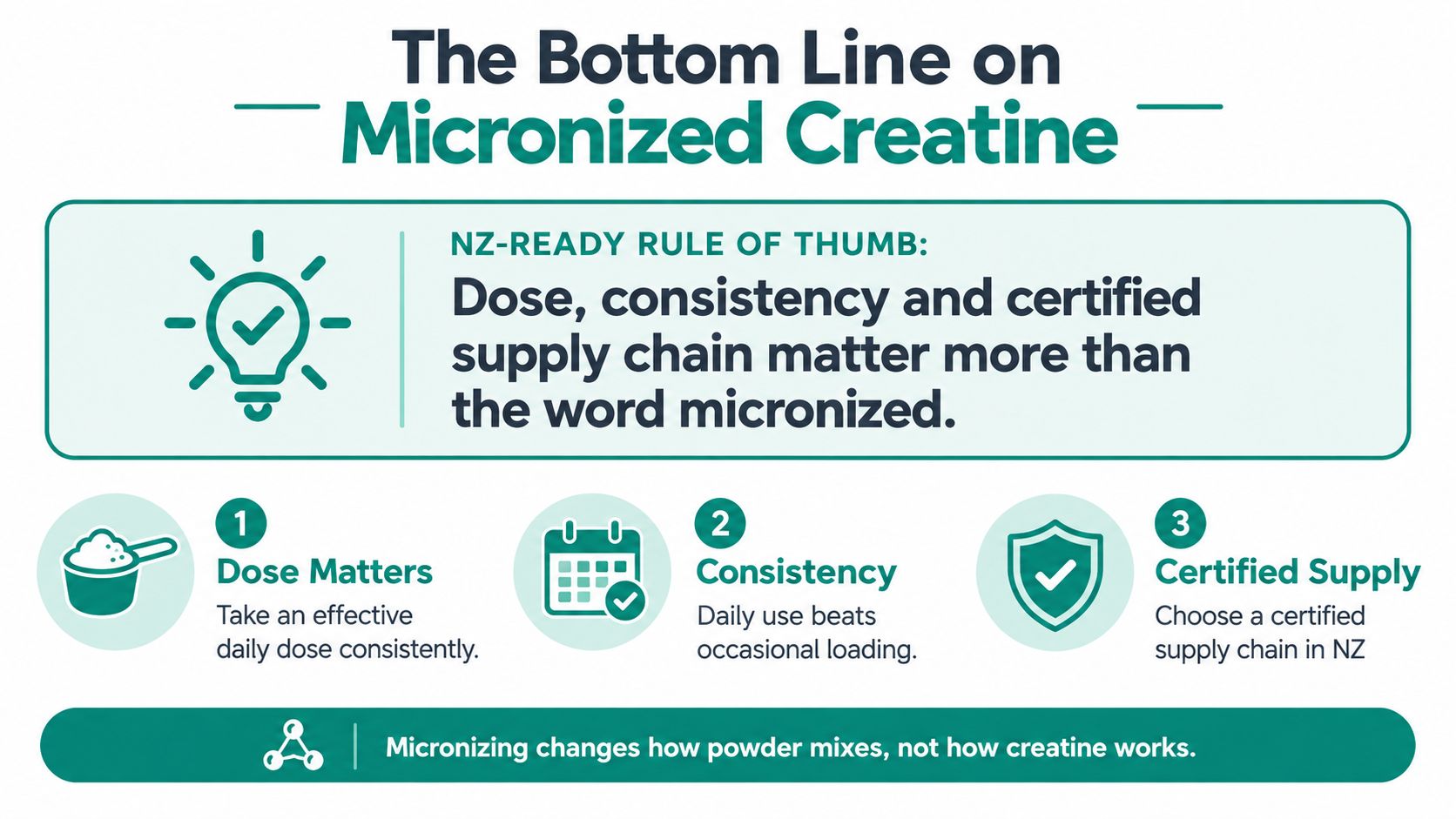
Here's the rule of thumb that matters in NZ. Dose, consistency, and certified supply chain matter more than the word micronized on the label.
Micronizing changes how the powder behaves in the shaker. It doesn't change what creatine does inside muscle. So if you're buying micronized creatine because you think it's a stronger form, you're buying the wrong story.
What I'd tell most athletes
Take creatine monohydrate daily, hit the dose your label clearly states, and stop obsessing over perfect timing. If the finer powder helps you stick to the habit because it mixes better and feels smoother, good. That's a practical win.
If it doesn't improve compliance for you, don't treat it like an upgrade you must have.
Three actions worth taking
- Pick a plain monohydrate product first. The cleaner and clearer the label, the better.
- Commit to the daily habit. Rest days count.
- If you're tested, prioritise certification. That matters more than any powder spec.
There's also an education gap here in NZ that's worth noting. A New Zealand-led study is looking at whether creatine monohydrate can improve cognition in older adults, which shows research interest is stretching beyond gym use (Massey University COG trial information). That's interesting. But it still doesn't change the buying advice for lifters and athletes today.
Buy the form you'll take. Use it every day. Ignore marketing fluff.
If you want sealed-by-brand creatine options, clear per-serve comparisons, and a Tested for Sport collection that helps cut through contamination risk, have a look at NZ Supps. It's a practical place to compare micronized creatine against standard monohydrate without getting distracted by front-label nonsense.