SHOP NOW, PAY LATER











 Informed Sport
 Informed Choice
 NSF Certified for Sport
 HASTA Certified

A protein bar without sugar in NZ is best judged by sugars per 100 g and per serve on the Nutrition Information Panel, plus the sweetener system on the ingredients list, because the front-of-pack phrase and actual composition aren't the same thing. If the sugar has gone, what has replaced it, and does that replacement suit the way you'll use the bar?
That's the gap in most sugar-free bar recommendations. A low sugar number matters, but it doesn't tell you how much protein you're buying, how much energy the bar supplies, or whether its ingredients agree with you during training.
Start with the wrapper, not a flavour ranking. The useful choice is the bar whose composition fits your snack, dietary preferences and training schedule, without asking you to overlook missing information.
Table of Contents
- What Protein Bars Without Sugar Actually Mean in NZ
- Why Sugar Free Does Not Always Mean Lower Calorie
- Reading the Ingredients List Like a Label
- Protein, Fibre and Calories on a Fair Basis
- Sugar Free Bars Available at NZ Supps Compared
- Matching a Bar to Your Goal in NZ
- Tested for Sport, Tolerability and a Final Checklist
What Protein Bars Without Sugar Actually Mean in NZ
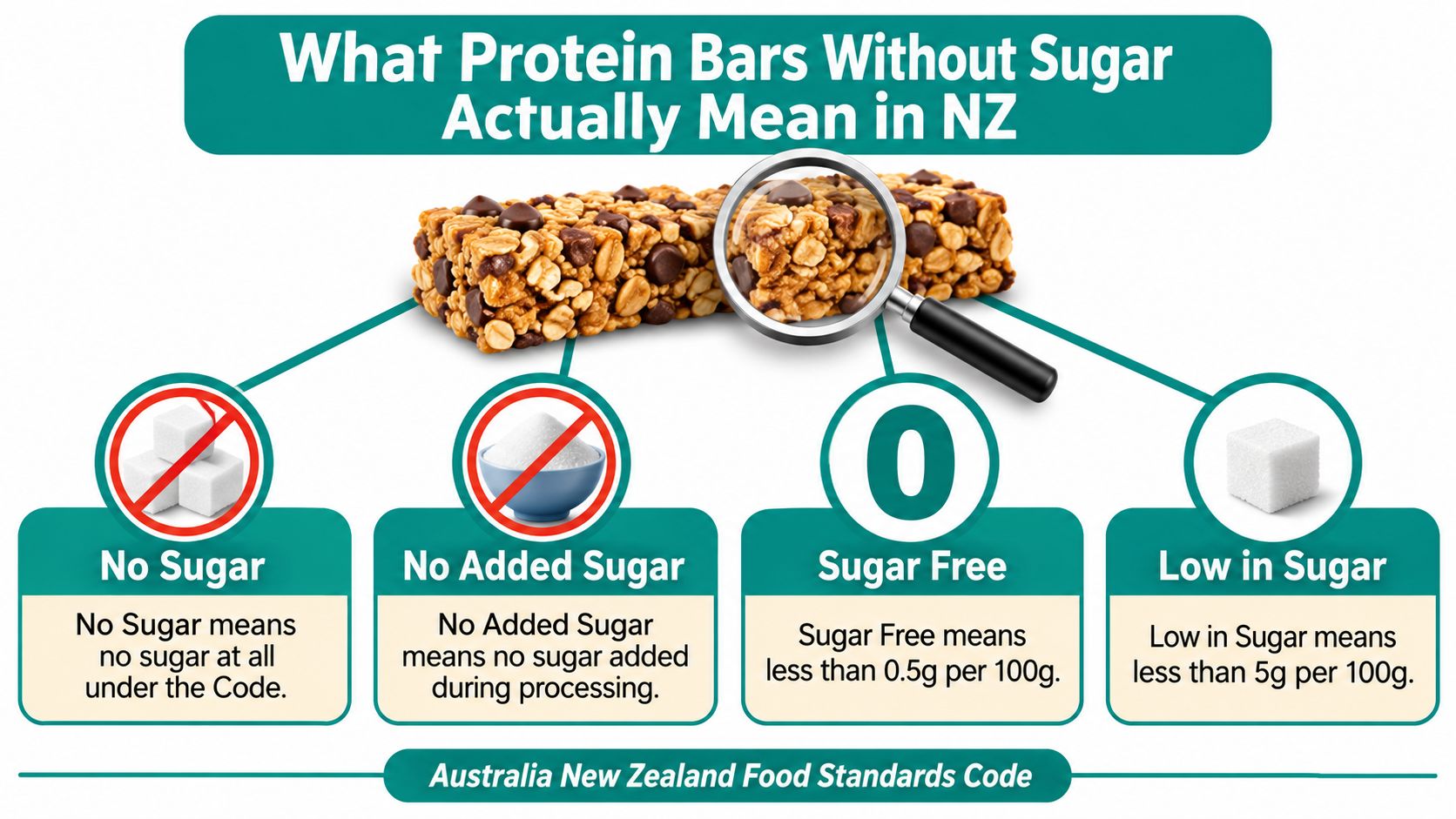
Without sugar, no added sugar, sugar free and low in sugar aren't interchangeable statements. Treat them as different claims to investigate, rather than different ways of saying the same thing.
MPI identifies low in sugar as a regulated nutrition content claim. Businesses must meet the relevant Australia New Zealand Food Standards Code criteria, substantiate their claims and include the relevant nutrition information, as explained in MPI's guidance on nutrition content claim regulations.
Start with the Nutrition Information Panel
Most retail food labels must show energy, protein, fat, saturated fat, carbohydrate, sugars and sodium, both per serving and per 100 g, according to MPI's retail food labelling guidance. That gives you a common basis for comparing bars of different weights, followed by the amount you'll eat.
Read the sugars row before interpreting the claim. Then check the declared serving against the actual bar weight. A packet and a serving aren't something to assume are identical.
Claim vs label reality for NZ protein bars
| Front-of-pack phrase | What it actually means | What to check on the label |
|---|---|---|
| Without sugar or no sugar | Wording that needs checking against the product's composition and applicable claim rules | Quantified sugars, ingredients and the exact claim |
| No added sugar | A statement about added sugars, not necessarily an absence of naturally occurring sugars | Milk ingredients, fruit ingredients and total sugars |
| Sugar free | A claim that shouldn't be interpreted from the product name alone | The sugars row and applicable Code requirements |
| Low in sugar | A regulated nutrition content claim | Sugars on a common weight basis, plus the actual serving |
The visual below distinguishes the headline phrases. Its numerical thresholds and simplified definitions shouldn't replace checking the current Code requirements.
Keep dietary guidance separate from product claims
New Zealand's adult eating guidance recommends foods and drinks with little or no added sugar and cites the WHO recommendation that free sugars provide less than 10 percent of total energy, with a further suggested reduction to less than 5 percent to help prevent tooth decay, in the Ministry of Health's adult eating and activity guidelines.
Those are population-level dietary references. They aren't a qualification test for an individual bar, or grounds for making therapeutic claims about it.
Practical rule: A sugar claim is a prompt to turn the wrapper over, not a reason to stop reading.
Why Sugar Free Does Not Always Mean Lower Calorie
Removing sugar doesn't automatically remove energy. A manufacturer still needs to make a bar that holds together, tastes sweet and has a texture people want to eat.
Replacing sucrose with polyols, concentrated protein or added fats doesn't guarantee fewer kilojoules. Approved sweeteners can help reduce sugar and may lower energy, but that outcome depends on the complete formulation, not merely the presence of a sweetener.
The illustration below shows the intended trade-off. Its figures are illustrative, not verified labels for products sold in New Zealand.
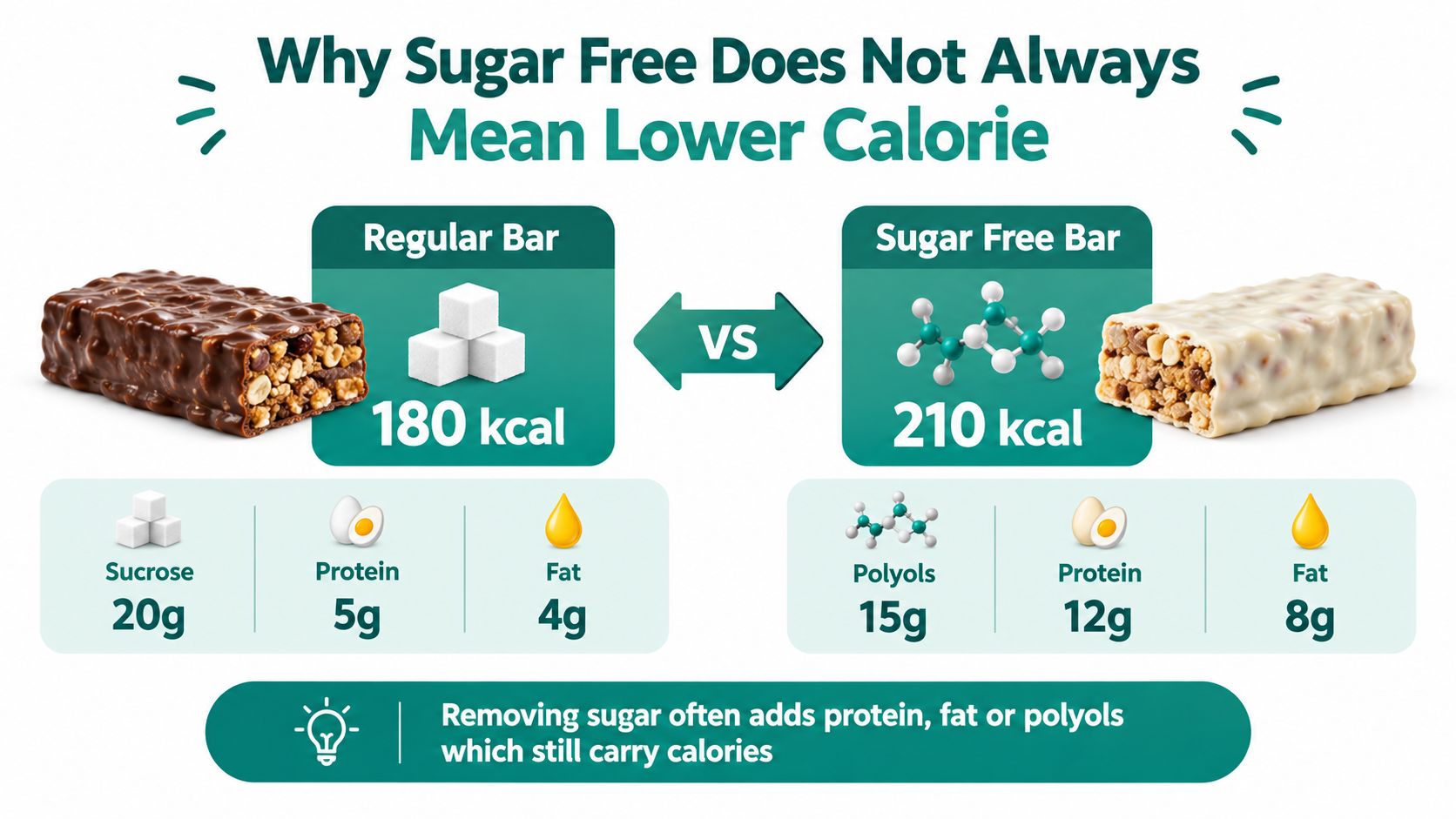
Follow the energy row, not the slogan
Consider a formulation containing maltitol and cocoa butter. The maltitol helps explain how the bar can taste sweet with less declared sugar. The cocoa butter helps explain why the energy figure still deserves attention.
That's formulation logic, not a claim that every bar containing those ingredients has the same nutritional profile. You can't calculate the finished bar's energy accurately by spotting ingredient names alone.
- Compare energy density: Use the common-weight column to judge how concentrated the bar is.
- Check the portion you'll eat: Use the serving column to understand the whole snack.
- Keep saturated fat visible: Don't let a low sugar figure distract you from the rest of the panel.
- Avoid automatic rankings: Lower sugar and lower energy are separate objectives.
Decide what you're buying the bar for
For an everyday snack, taste, convenience and protein may justify a more energy-dense option. For someone managing their overall food intake, the same bar needs to fit that day's eating plan. Neither decision follows automatically from a sugar-free badge.
A bar can be lower in sugar without being lower in energy. Those are different comparisons.
This video provides another format for considering the sugar-free bar question.
The useful habit is to keep the energy row beside the protein row while shopping. Don't compare one bar's sugar claim with another bar's calorie claim and call that a fair assessment.
Reading the Ingredients List Like a Label
The Nutrition Information Panel tells you the quantities. The ingredients list helps explain how the manufacturer achieved them.
Sugar-free doesn't mean carbohydrate-free. Starches, polyols, fibre syrups and naturally occurring sugars can still be part of the formulation. That makes the ingredient check particularly useful when you're avoiding a specific sweetener or trying to identify why a bar doesn't sit comfortably.
Identify the sweetener system
MPI explains that sweeteners must be declared using their class name and name or international code, giving sweetener (951) as an example, in its guidance on sweeteners in food. MPI also states that food additives, including sweeteners, must be safety-assessed by Food Standards Australia New Zealand.
An unfamiliar code isn't, by itself, evidence that an ingredient is unsafe. It is a reason to identify the ingredient if it matters to your preferences or restrictions.
Ingredient list red flags
| Ingredient on label | What it really is | Why it matters |
|---|---|---|
| Maltitol, erythritol, xylitol or sorbitol | Sugar alcohols, also called polyols | Identify the particular system when assessing personal tolerance |
| Polydextrose, inulin or chicory root fibre | Added fibre ingredients | Check the declared fibre and whether the formulation suits you |
| Glucose syrup, rice syrup or honey | Ingredients to investigate when assessing sweetness and added sugars | A familiar or natural-sounding name doesn't remove the need to read the panel |
| Fruit juice concentrate or date paste | Fruit-derived ingredients that can contribute sweetness | Fruit-based doesn't automatically mean low in sugars |
| Maltodextrin | A carbohydrate ingredient to examine separately from the sugars row | Don't equate low sugars with an absence of carbohydrate |
| Sweetener followed by a name or code | A declared sweetening additive | Useful when avoiding a specific ingredient |
“Red flag” here means check it, not “reject it”. A bar containing added fibre or an approved sweetener isn't automatically a poor choice.
Don't turn the ingredient list into a purity test
Look through the opening ingredients, then read the full list, including any coating or filling. Don't assume a chocolate coating uses the same sweetener system as the centre.
Avoid treating every syrup, fruit ingredient and carbohydrate ingredient as legally identical. In particular, spotting maltodextrin doesn't justify calling it sugar or deciding that a claim breaches the Code without checking the applicable requirements.
For a closer look at the names you'll encounter, read sugar alcohols in protein bars. The practical outcome should be a shortlist of ingredients you're comfortable eating, not a blanket ban on anything you don't recognise.
Protein, Fibre and Calories on a Fair Basis
Protein density means how much protein a bar supplies on a common weight basis. It answers a different question from protein per serving: how protein-focused is the formulation, rather than how much protein comes in that particular portion?
New Zealand's food-composition infrastructure supports consistent nutrient comparisons. The database covers more than 3,400 foods and ingredients, while its FOODfiles 2024 standard version reports 87 nutrient components across 2,857 foods, according to the New Zealand Food Composition Database's frequently asked questions.
That database is a foundation for comparison, not a substitute for the current label of a particular flavour.
Compare profiles without inventing product numbers
The chart below illustrates contrasting profiles. Its values aren't verified retail product data and shouldn't be used to select a stocked bar.
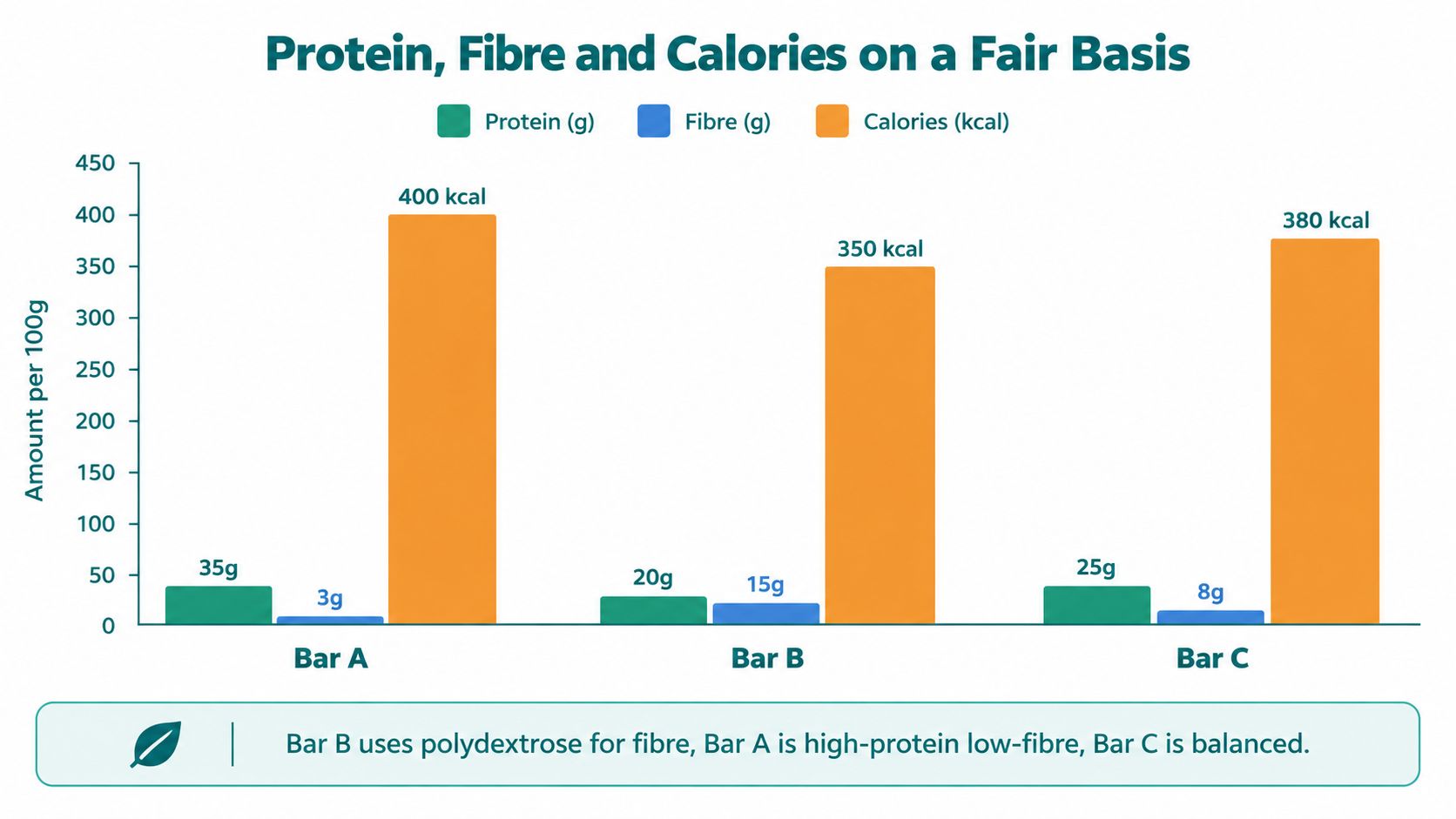
A higher-protein, lower-fibre profile may interest someone who wants a protein-focused gym snack. The deciding questions are the actual protein portion, energy and dietary suitability, not whether the wrapper looks sporty.
A moderate-protein, higher-fibre profile using polydextrose asks you to weigh fibre against protein and personal tolerance. More fibre isn't automatically the right choice immediately before demanding exercise.
A very-low-sugar profile using erythritol may suit a shopper prioritising the sugars row. It still needs enough protein for the intended use and an acceptable overall energy figure.
Make the maths useful
Use the declared common-weight values wherever they're available. If you need to calculate a nutrient density, divide the nutrient amount per serving by the serving weight, then scale to the common comparison weight. Keep units consistent and don't manufacture fibre values when none are declared.
- Protein first for a protein snack: Rank by protein density, then confirm the actual portion.
- Fibre with context: Consider both the quantity and the ingredient supplying it.
- Energy alongside both: A stronger protein or fibre figure doesn't cancel out the rest of the composition.
If convenience is the main reason you're choosing a bar, protein powder versus protein bars helps frame the format decision. A bar doesn't need to win every nutritional comparison to be useful, but its advantages should be specific.
Sugar Free Bars Available at NZ Supps Compared
Which bar fits your needs: one with fewer sugars per 100 g, more protein per serve, or a sweetener system you tolerate? A useful NZ Supps comparison needs the exact flavour's Nutrition Information Panel, serving size and current price. Product names alone cannot confirm sugars, fibre, sweeteners or value.
Quest Bar Choc Brownie, Quest Overload varieties and Grenade protein bars are options to check in the catalogue. Treat each flavour as a separate product: recipes and panel values can differ within a brand. Don't apply one flavour's figures across a whole range.
Compare the exact bar, not the brand
The table sets out what to record for each candidate. Verify the current product page and pack before relying on a figure, since labels and prices can change.
Sugar-free protein bars stocked at NZ Supps
| Product | Serve size | Protein per serve | Sugars per 100 g | Fibre per serve | Sweetener system | Price per serve |
|---|---|---|---|---|---|---|
| Quest Bar Choc Brownie | Check current pack | Check current pack | Check current pack | Check current pack | Check current ingredients | Check current price |
| Quest Overload Bar varieties | Check exact variety | Check exact variety | Check exact variety | Check exact variety | Check exact ingredients | Check current price |
| Grenade protein bars | Check exact flavour | Check exact flavour | Check exact flavour | Check exact flavour | Check exact ingredients | Check current price |
Record sugars per serve as well as sugars per 100 g. The first helps you judge the portion you'll eat; the second makes differently sized bars easier to compare. Add energy and saturated fat, and note the sweetener and fibre ingredients. If the panel doesn't state an ingredient amount, leave it unknown rather than estimating.
Use the panel to make the call
Browse the protein bars available in New Zealand, then open the exact flavour's product page and check its full label. For a multipack, divide the pack price by the number of bars. Confirm the pack's serving size too, since a whole bar may not equal one declared serve.
A bar's best use depends on its label and your reason for buying it:
- Protein-focused snack: Compare protein per serve with energy and price.
- Higher-fibre option: Check the declared fibre amount and source, then consider whether that formulation suits you.
- Lower-sugar preference: Compare the measured sugars values, not the prominence of a front-of-pack claim.
Keep the comparison grounded in the current panel. That makes the trade-offs visible without assigning a product a ranking based on its name or reputation.
Matching a Bar to Your Goal in NZ
The same protein bar won't suit every shopper. A strength trainee looking for a convenient protein snack and a runner planning pre-event fuel are solving different problems.
New Zealand's national dietary-survey framework explicitly distinguished meal replacements and protein supplements, including powders and bars, from other snack-bar categories, as recorded in the Ministry of Health's national nutrition survey methodology. That's a useful reminder not to treat every wrapped snack as nutritionally equivalent.
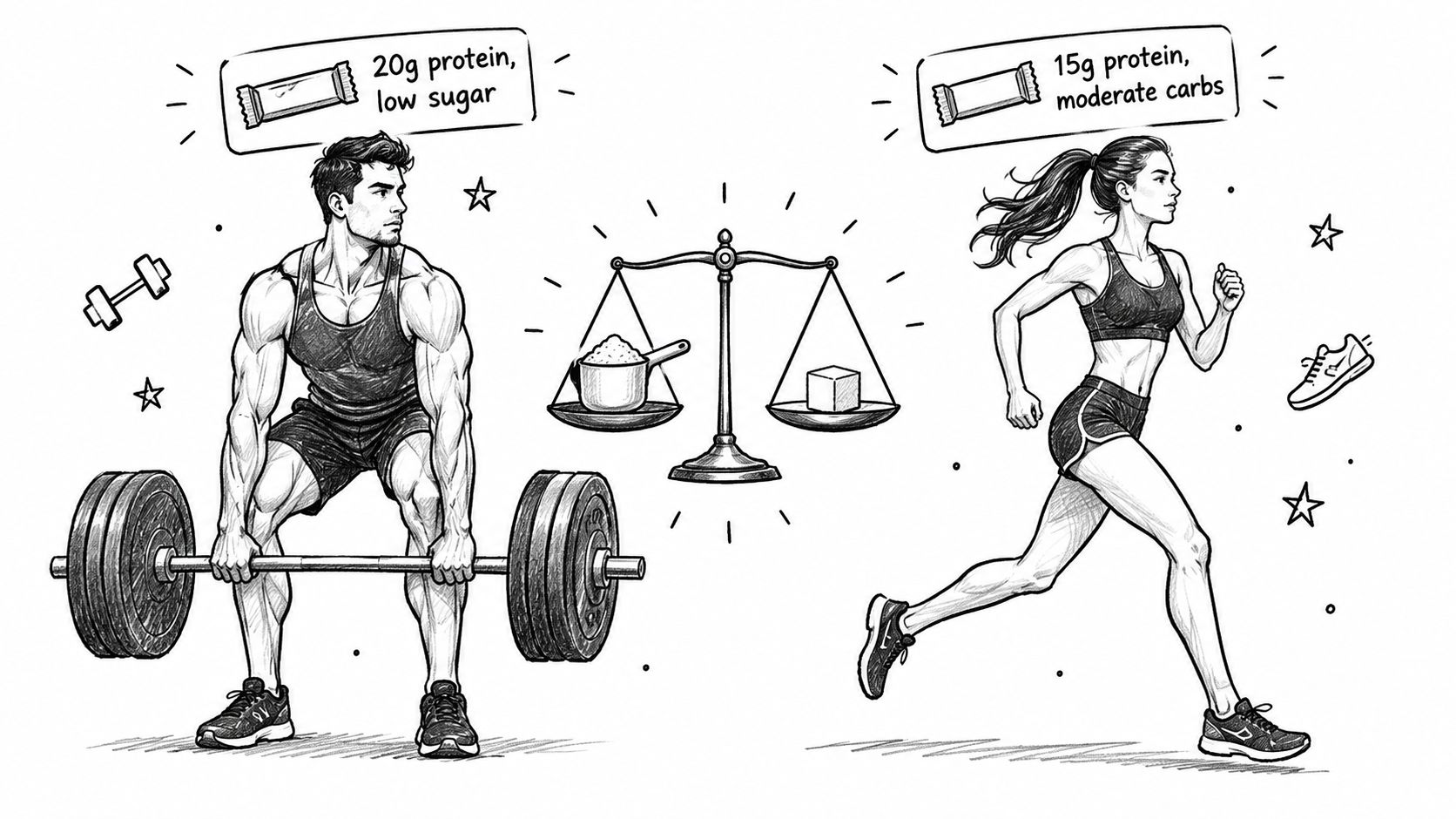
Gym training and everyday eating
For strength training, prioritise the actual protein per serving and whether that portion fits your normal eating routine. There isn't a universal protein-bar threshold that makes a product suitable for everyone.
For everyday snacking, include enjoyment and practicality. A bar that meets your preferred label profile but tastes unpleasant isn't a useful repeat purchase.
For weight-management shopping, keep the discussion on composition and portion size. Compare protein, fibre and energy together without assuming that sugar-free wording produces a weight-loss result.
Buying insight: Choose the bar for the job you'll actually give it, not for every possible benefit on the wrapper.
Endurance, team sport and dietary preferences
A low-sugar protein snack isn't automatically pre-event fuel. For endurance sessions, rapidly available carbohydrate can matter in a way that a high-protein, low-sugar formulation may not address.
Keep an everyday desk snack separate from your competition fuelling plan. If timing is the main question, use guidance on eating a protein bar before a workout to assess the occasion as well as the ingredients.
- Vegan shoppers: Inspect the complete protein blend and coating rather than assuming a low-sugar bar is plant-based.
- Dairy-avoiding shoppers: Check the protein source and allergen information independently of the sugar claim.
- Polyol-sensitive shoppers: Avoid formulations you've previously found uncomfortable, even when their nutrient panel otherwise looks suitable.
- Competition-day users: Don't introduce an unfamiliar, heavily sweetened or fibre-rich bar immediately before an important event.
Dietary suitability is a separate pass-or-fail check. A strong nutritional comparison can't make an unsuitable ingredient acceptable.
Tested for Sport, Tolerability and a Final Checklist
Drug-tested athletes need another layer of checking beyond nutrition. Tested-for-sport status and sugar content answer different questions.
Informed Sport, Informed Choice, NSF Certified for Sport and HASTA are certification names you may encounter when narrowing a supplement shortlist. They shouldn't be treated as interchangeable promises that every batch has undergone the same testing process.
Verify the exact product and batch
Use the certification standard as a starting filter, then confirm what applies to the specific product you're considering. Don't assume a badge elsewhere in a brand's range covers every bar, flavour or batch.
NZ Supps provides Tested for Sport filtering by certification standard. That's useful for narrowing options, but the athlete still needs to verify the relevant certification and batch information rather than infer it from a brand name.
- Match the product: Check the exact name and flavour.
- Check the scope: Establish what the certification programme verifies.
- Confirm batch information: Look for applicable batch-specific records where relevant.
- Keep nutrition separate: Certification doesn't establish that a bar is sugar-free.
Test tolerance before relying on the bar
Ingredients that replace sugar can affect how comfortable a bar feels during training. Polyols and concentrated added fibres deserve particular attention if you've had digestive discomfort with similar formulations.
MPI's sports-food survey included protein bars and identified nutrition-claim compliance problems, including a no-added-sugar claim, in its official review of sports foods and their claims. That supports a cautious approach to marketing, alongside the formulation-dependent tolerance concerns.
Trial an unfamiliar bar away from competition. Note the portion, timing and formulation rather than concluding that all sugar-free bars suit you, or that none do.
Your final product-page checklist
- Sugars: Record both the common-weight value and the amount in the portion you'll eat.
- Protein: Confirm the serving amount and protein source.
- Sweetener system: Identify the named ingredients or codes.
- Fibre: Check the declared amount and source, without guessing missing values.
- Energy and saturated fat: Keep both visible when making the final comparison.
- Value: Calculate price for the actual serving or whole bar consistently.
- Sport status: Verify certification scope and applicable batch details if relevant.
- Personal fit: Choose a formulation you can tolerate and realistically use.
The strongest buying decision isn't the bar with the loudest claim. It's the one you can explain using its current label, verified status and intended place in your day.
NZ Supps offers protein bars, ingredient disclosures and comparison tools to help you assess composition and per-serve value. Visit NZ Supps, shortlist the exact flavours you're considering and check their current panels before choosing your next everyday or training snack.