SHOP NOW, PAY LATER

















 Informed Sport
 Informed Choice
 NSF Certified for Sport
 HASTA Certified


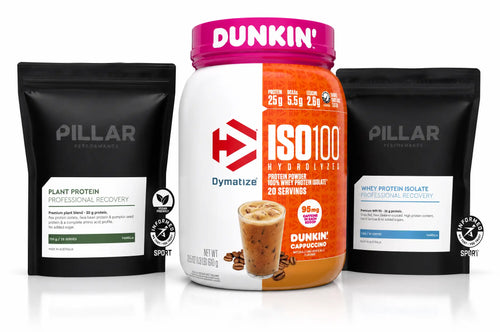
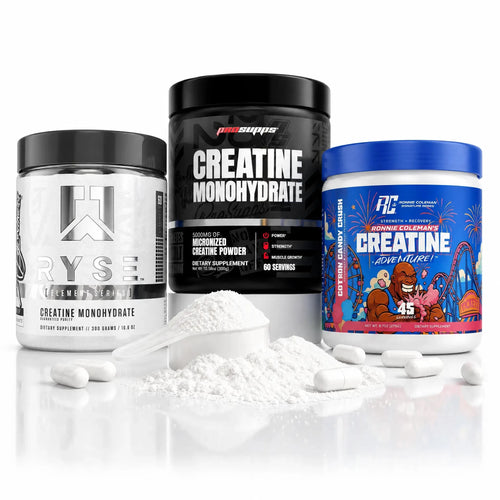
NZ Supps accepts Afterpay at checkout, and Afterpay Pay in 4 splits an eligible order into four instalments over six weeks, with the first payment, about 25% of the total, taken when you place the order. That answers how one basket works, but it leaves the question most Afterpay supplements NZ guides skip. What happens when you reorder protein or creatine before the first order has cleared? If you're browsing protein powder NZ options, creatine or pre-workout, the overlap between orders is where a tidy payment plan can turn into several debits landing in the same week.
Table of Contents
- Does Afterpay Work for Supplements in NZ?
- How the Four Afterpay Payments Are Spread Out
- How to Pay with Afterpay at NZ Supps Checkout
- Eligibility, Credit Checks and Spending Limits
- Late Payments and Faulty Goods
- Pros, Cons and the Repeat-Purchase Trap
- Choose How to Pay Before You Confirm the Order
Does Afterpay Work for Supplements in NZ?
Yes, you can select Afterpay at NZ Supps checkout for an eligible order. You're not getting a discount. You're entering a credit arrangement that changes when you pay, not what the product costs.
That's the condition that matters. The price on the product page is the amount you'll pay across the four instalments, before any late fee if a payment is missed. Consumer Protection NZ explains on its buy now pay later guidance page that BNPL providers must provide contract and default fee information and conduct credit checks intended to assess whether repayments are affordable without substantial hardship.
Think of the likely users in practical terms:
- Planned stack buyers: Someone ordering protein, creatine and pre-workout together who wants to spread one planned cost.
- Tight fortnight buyers: Someone whose usual order lands before payday, but who can cover each scheduled date.
- Top-up buyers: Someone replacing one item who's deciding whether splitting a smaller basket is worth the extra commitment.
Orders over $70 ship free, so the basket total and shipping threshold are worth checking before you choose a payment method.
The rest of this guide follows the order you'd meet the decisions. It starts with how the four payments are spread out, then the checkout steps, eligibility and limits, late payments and faulty goods, the repeat purchase test, and finally how to choose between payment methods.
How the Four Afterpay Payments Are Spread Out
One payment leaves your account at checkout, then three more follow roughly every two weeks until the order clears at about week six.
Say your example basket contains protein powder and creatine and totals $120. Treat it as a worked example rather than a live product price. The pattern looks like this:
Afterpay Pay in 4 schedule for a $120 order
| Payment | When it is taken | Amount |
|---|---|---|
| Payment 1 | At checkout | $30 |
| Payment 2 | About 2 weeks after checkout | $30 |
| Payment 3 | About 4 weeks after checkout | $30 |
| Payment 4 | About 6 weeks after checkout | $30 |
| Total | Six weeks | $120 |
Afterpay explains on its how it works page that Pay in 4 splits an eligible purchase into four instalments over six weeks, the first generally taken when the order is placed and the initial payment approximately 25% of the purchase total. That word approximately matters. Your first charge can differ slightly from a neat quarter, so budget from your own schedule rather than the rounded example.
Read the exact amounts and due dates in your payment schedule, not the rounded example on a product page.
You can check that schedule in the Afterpay app or web portal, and you can pay an instalment early if you would rather clear it ahead of the automatic debit.
Afterpay's schedule is also a different thing from instalments a store arranges itself. Merchants can set up payment plans on Shopify through their own checkout, while Afterpay runs its plan through your Afterpay account and nominated card.
Paid by card, the same $120 basket is one charge at checkout. With Afterpay the price stays the same and only the timing changes, and timing is where reordering gets tricky. Place a second $120 order four weeks after the first and the two schedules overlap: weeks four and six each carry two $30 payments, so $60 leaves your account in one fortnight, while the second order keeps running to about week ten after the first has cleared. A steady reorder habit means two schedules regularly run side by side.
Before you confirm, line the four dates up against payday, rent, power and any order you already have open. If the next reorder would land while this one is still running, you are no longer looking at $30 a fortnight.
How to Pay with Afterpay at NZ Supps Checkout
A supplement order is rarely a one-off. Protein, creatine and electrolytes run out at different speeds, so the key question at checkout is often whether this new payment plan will still be active when the next basket is due.
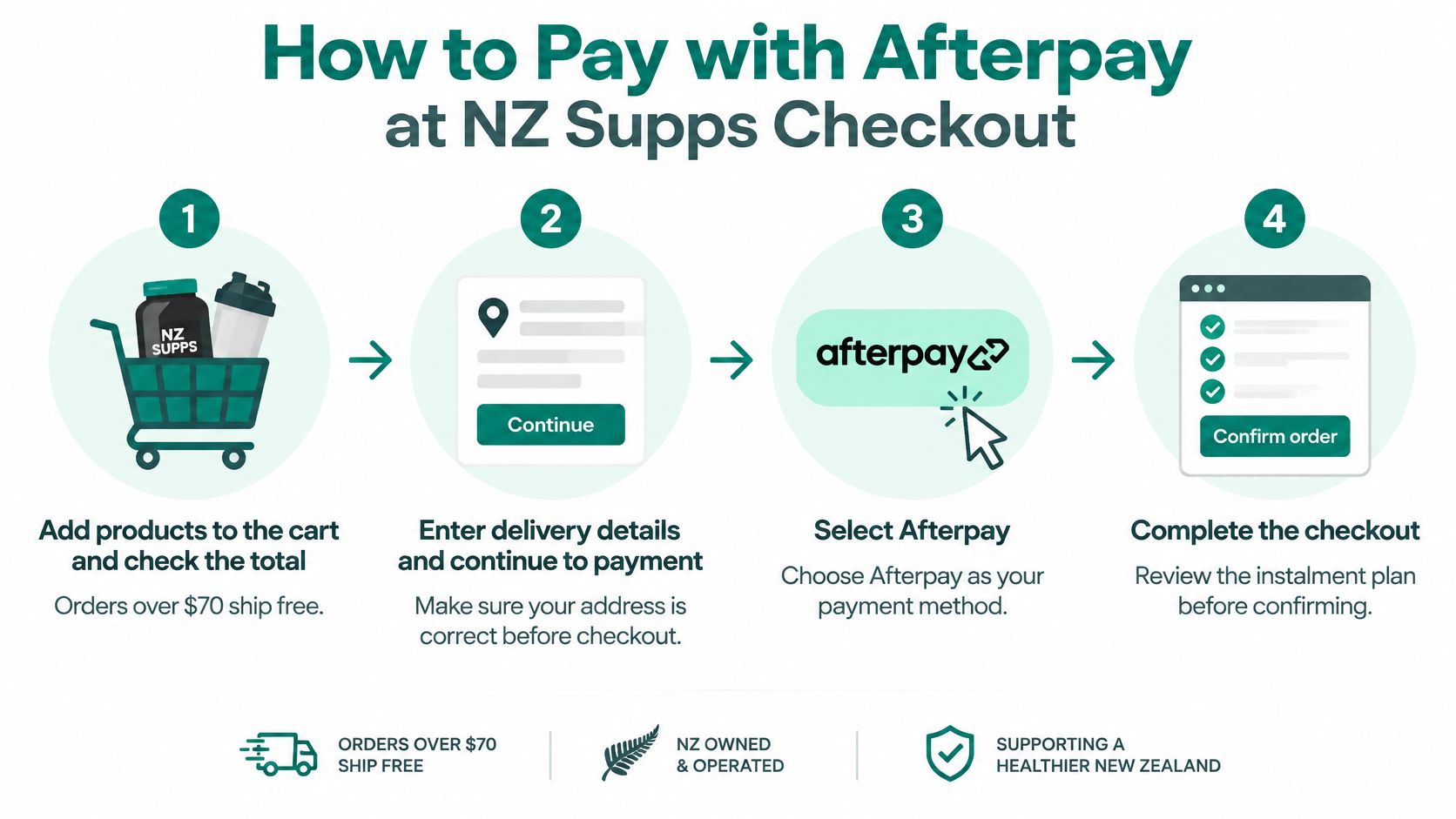
Work through it slowly the first time. Each screen gives you information you'll need later, especially the schedule screen.
Checkout steps
- Add products and check the cart total. Confirm the full amount you're committing to, and check the cart total against NZ Supps's current free-delivery threshold before you continue.
- Enter your delivery details. Check the address carefully before you move to payment, since changing it after dispatch is harder.
- Select Afterpay at the payment stage. You'll leave the standard card fields and move into the Afterpay sign in or sign up flow.
- Sign in or create your Afterpay account. Complete the details Afterpay asks for so it can assess the application.
- Accept the credit check. This is part of signing up, not an optional extra you can skip.
- Link a debit or credit card. Afterpay uses this nominated card for the scheduled automatic payments.
- Read the approval decision and payment schedule. Don't confirm until you've seen each amount and date and checked them against your budget, including any Afterpay order already running and the reorder you expect next.
- Place the order. NZ Supps dispatches it in the usual way, and the Afterpay app shows each instalment with reminders before it's due.
Afterpay states in its merchant help guide for customers that New Zealand customers may be subject to a credit check when signing up, a linked debit or credit card is required, instalments are automatically deducted, and reminders are sent before a payment is due.
If you want a visual walkthrough before you start, this short video covers the general checkout idea.
If approval is declined
A decline doesn't complete your purchase. Your cart still needs a payment method, so you can pay by another option shown at checkout, reduce the basket, or leave the order for another day.
Don't keep retrying with a larger basket to test the system. If the order is approved, treat the app schedule and reminders as your record from that point on. Screenshots of the product page won't show your personal due dates, but the schedule will. Keep that schedule in view when a staple runs low, because a fresh order can add a new set of debits while the earlier one is still collecting.
Eligibility, Credit Checks and Spending Limits
Three conditions decide whether Afterpay is available to you for a particular order. Each one can stop the purchase on its own.
First, the credit check. Afterpay runs this when you sign up. It's assessing you as a borrower, because the instalments are a credit commitment even though the term is short.
Second, the linked card. You need a debit or credit card connected to the account for scheduled payments. If that card expires, is replaced, or doesn't have enough available funds on a due date, the automatic payment can fail.
Third, the approval decision at checkout. Approval isn't guaranteed, and it can differ between customers and between orders. A decline says nothing about the product in your cart. It means Afterpay won't fund that purchase on those terms at that time.
Your personal spending limit
Afterpay sets a spending limit for each customer, and that limit can change. Check your own limit in the app rather than assuming a figure you've seen elsewhere. A multi-product stack is more likely to test a limit than a single tub, so splitting a large order or paying part by card may be more realistic than forcing the whole basket through one method.
If an instalment becomes overdue, your account can be restricted from new Afterpay purchases until it's brought up to date. That restriction is a useful warning sign, not a problem to work around with another short term credit product. If you're comparing short term options generally, reading about how cash advance apps work can help you see how different products charge, assess and collect, but it doesn't make an unaffordable basket affordable.
Before you apply, run this short checklist:
- Card ready: Your nominated card is current and in good standing.
- Schedule visible: You can see the instalments and know where to find them again.
- Dates covered: Each due date fits your budget alongside essentials and existing commitments.
Late Payments and Faulty Goods
One missed $30 instalment can cost more than $30. That's the part shoppers most often underestimate, because the checkout screen focuses on the instalment amount rather than the cost of missing it.
Afterpay late payment charges for NZ orders
| Charge | Amount | When it applies |
|---|---|---|
| Initial late fee | $10 | An unpaid instalment on an order of $40 or more |
| Further late fee | Up to $7 | The instalment is still unpaid seven days after its due date |
| Maximum late fees per order | 25% of the order price, never more than $68 | All Pay in 4 late fees on one order combined |
Afterpay states in its guide to how Afterpay works for customers that for orders of $40 or more an initial $10 late fee may apply, followed by a further fee of up to $7 if payment remains unpaid seven days after its due date, with total late fees capped at 25% of the order price and never more than $68 per order.
Those charges sit on top of the product price. A $120 order paid on time costs $120. The same order with late fees costs more, even though the supplements in the box are identical.
What to do before a due date
Keep enough money available on the nominated card before each payment is taken. Check the card still matches the one in your account if your bank has issued a replacement.
If a date is going to be tight, contact Afterpay before the payment is missed, not after several have failed. If illness, injury or job loss has changed your situation, raise financial difficulty early and ask what hardship help is available. Readers who are worried about how missed BNPL payments may affect their credit record can also read background on Afterpay credit reporting issues to understand the questions worth asking. For store specific questions, start with the NZ Supps frequently asked questions page and then contact support if your order needs individual help.
Practical rule: If you need the next payday to cover an instalment that's already due, contact Afterpay before the debit fails.
Faulty goods are a separate issue
Paying by instalments doesn't remove your consumer rights. Consumer Protection NZ explains in its Consumer Guarantees Act guidance that the Act applies to goods bought from businesses operating in New Zealand, including online sellers, and a covered problem must be remedied at no charge within a reasonable time by repair, replacement or refund depending on the circumstances.
If the problem is substantial, or it isn't remedied within a reasonable time, you may be entitled to reject the product and request a refund or replacement. Make the faulty goods claim through NZ Supps, since the product issue sits with the seller. Ask the support team how a refund on an Afterpay order is processed, because the payment timing sits with that instalment arrangement and isn't set out here.
Pros, Cons and the Repeat-Purchase Trap
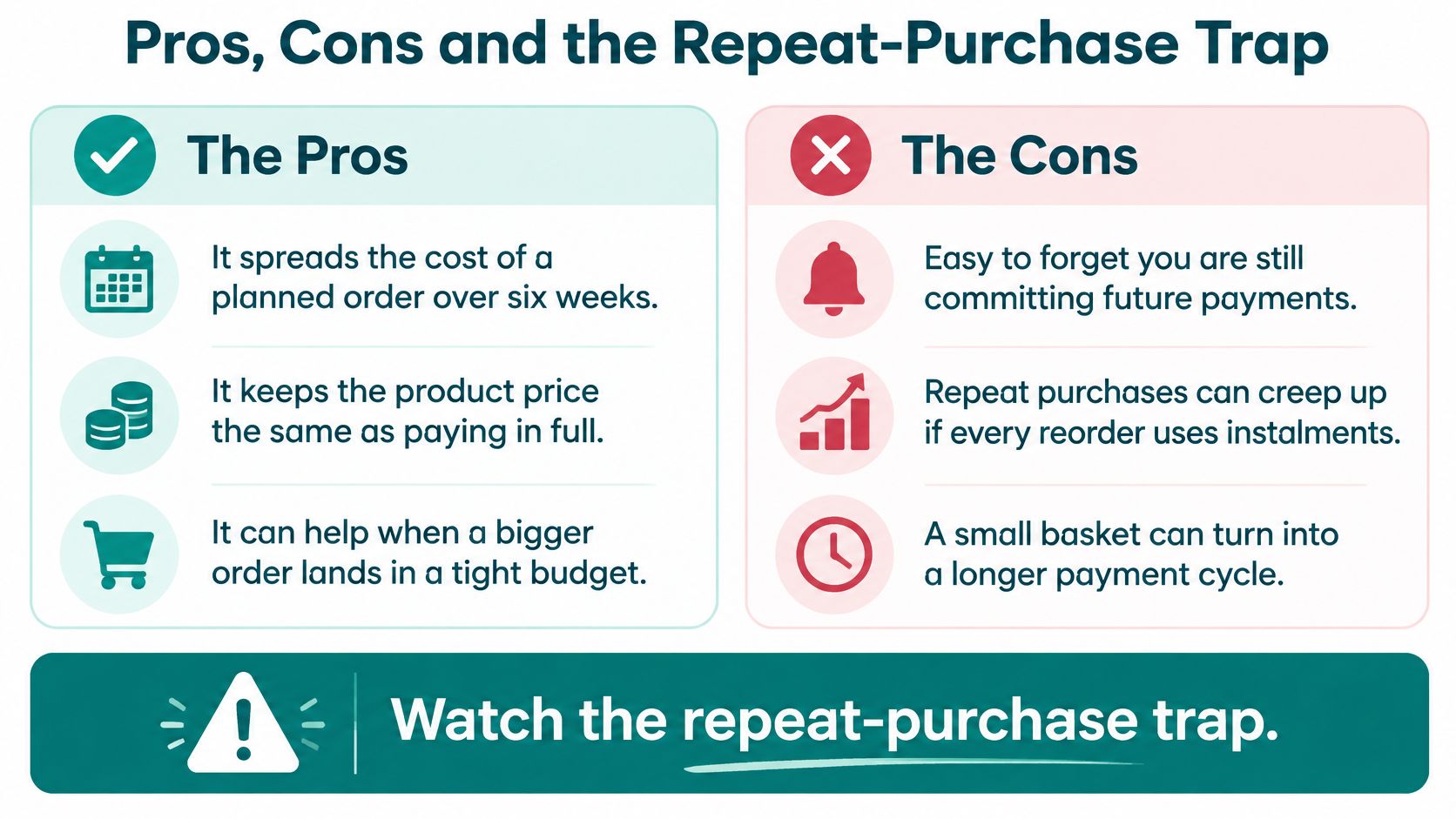
For a single planned order, the case for Afterpay is straightforward. The problems start when supplements run out on a cycle that's shorter than the payment term.
Pros
- Spreads one planned cost: A larger basket is divided across six weeks instead of leaving in one payment.
- Same product price when paid on time: Splitting the payment doesn't add to the shelf price by itself.
- Helps timing: It can bridge a tight fortnight when the full order is already budgeted.
Cons
- Late fees: A missed debit adds cost that paying in full wouldn't have created.
- Approval risk: You may plan around Afterpay and still be declined at checkout.
- Overlap risk: A reorder can land while earlier instalments are still due.
The overlap, worked through
Take the $120 example and place the same order again two weeks later. On that day, payment two from the first order is due at $30. Payment one from the second order is also taken at checkout at $30. That's $60 leaving on one day, not $30.
Order again two weeks after that and the pattern tightens further. Three schedules can be running at once, each with its own dates. Nothing has gone wrong with any single order. The trap is the stacking.
Consumer NZ reporting on its buy now pay later fees investigation, based on a nationally representative survey of 2,000 New Zealand adults, underlines that repayment stacking and late fee exposure are central risks, and recurring purchases can overlap with earlier instalments to create multiple simultaneous obligations.
Afterpay also doesn't change the per serve cost on the label comparison. A tub that's poor value per serve stays poor value per serve when it's split into four. The payment question is purely about cash flow.
Before reordering, list every open instalment and subscription, add the first payment of the next planned order, then check each date. Our guide on when to reorder supplements can help you time the product side, but the payment side needs that separate date check. If the full basket isn't already in your budget, waiting is the cheaper option.
Choose How to Pay Before You Confirm the Order
Use Afterpay when the whole order already fits your budget, every due date is covered, and your next planned order won't land on top of an open instalment. Otherwise, pay in full or wait.
Ways to pay for an NZ Supps order
| Option | When you pay | Extra cost | Best for |
|---|---|---|---|
| Afterpay Pay in 4 | 25% at checkout, then about every two weeks | Late fees if a payment is missed | Planned orders you can cover on every due date |
| Debit or credit card | Full amount at checkout | Set by your card issuer under your card terms | Orders you want cleared at once |
| Wallet payment, if shown at checkout | Full amount at checkout from your linked card or wallet | Set by your wallet or linked card provider | Fast checkout on a phone |
Afterpay suits a planned stack that costs more than you'd normally spend in one shop, provided the overlap test passes. Afterpay's own extra cost is late fees only, so paying on time is the whole game.
A card suits a top-up order you want finished straight away, with no dates to track afterwards. There's no schedule to remember because there's nothing left owing on that purchase once the card payment is made, though your card's own terms still apply.
A wallet suits a fast phone checkout when your details are already saved and you want the full amount settled immediately. Speed is the benefit there, not extra time to pay.
Whichever route you choose, do the boring checks first. If you're comparing larger tubs while browsing protein powder NZ options, our explainer on whey protein 5 lb sizing can help you judge how long a bag may last before a reorder is likely. Then check the schedule, confirm the nominated card is in good standing, and only then place the order. Shop all protein powder in NZ.
When you're ready to order, NZ Supps stocks protein, creatine, pre-workout and hydration products with clear label information and per serve pricing to help you compare before you commit. Check your basket total, choose the payment method that fits every due date, and place your order only when the full cost already sits comfortably in your budget.