SHOP NOW, PAY LATER










 Informed Sport
 Informed Choice
 NSF Certified for Sport
 HASTA Certified
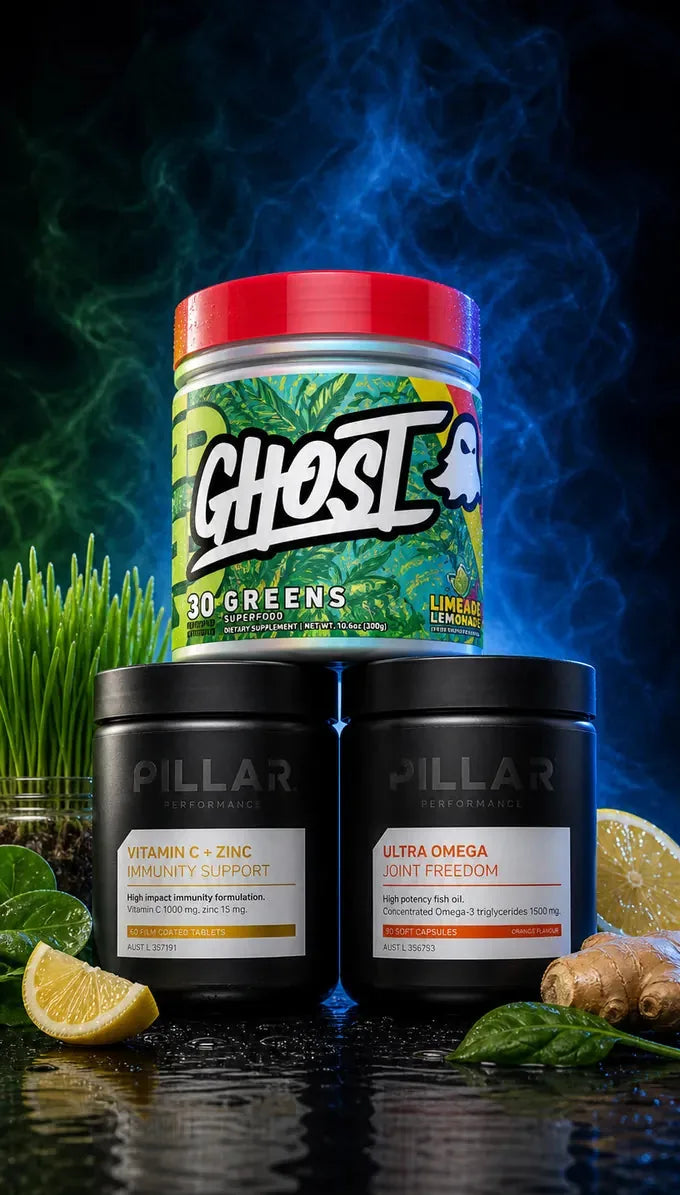

Buying the strongest-sounding blend isn't a useful way to choose inner strength supplements. Inner strength is a marketing phrase, not a scientific ingredient category, and creatine monohydrate has the clearest support here for repeated high-intensity resistance training, while broad promises about calm, focus and resilience need much closer scrutiny.
Table of Contents
- What Inner Strength Means on a Supplement Label
- Check Your Diet and Training Before Buying Anything
- Ingredients Ranked by Evidence and Typical Serve
- Why Creatine Is the Best-Supported Strength Ingredient
- Gut, Stress and Sleep Nutrients Explained
- Safety Checks for Drug-Tested Athletes
- Build a Low-Risk Routine You Can Actually Keep
What Inner Strength Means on a Supplement Label
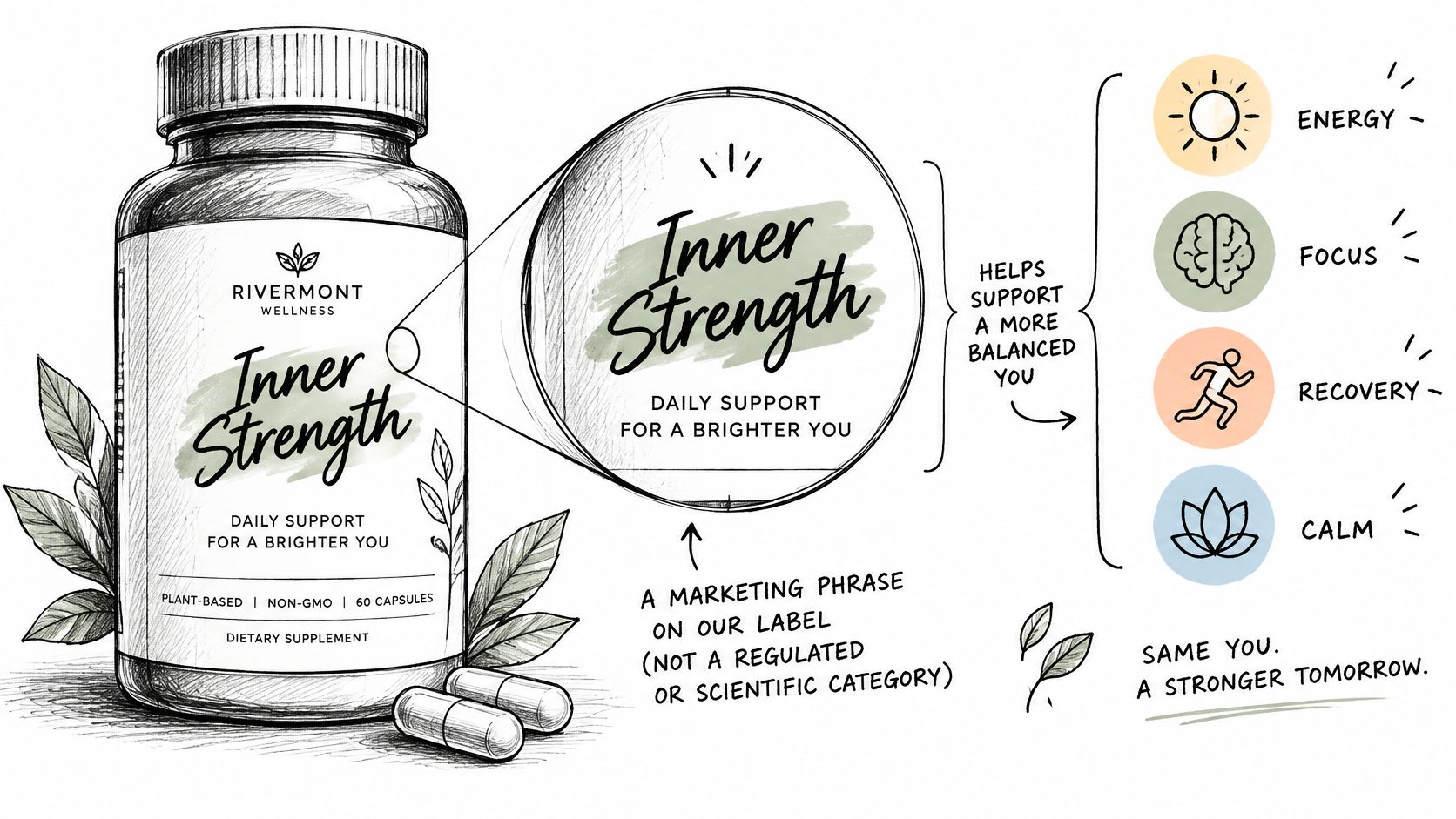
An inner strength label is like a car badge. It tells you how the manufacturer wants you to feel about the product, but it doesn't tell you what's under the bonnet. Even when browsing a focused category such as creatine NZ, the useful information is the ingredient panel, not the product's personality.
Brands commonly group several different ambitions under the same phrase:
- Energy and focus: Feeling more alert isn't the same outcome as completing more work in the gym.
- Recovery: This needs a defined measure, rather than a general promise to feel restored.
- Training resilience: Strength output, completed training volume and perceived exertion are practical things to record.
- Calm and confidence: Sleep duration can be tracked, but mental toughness and inner calm need clearer definitions before they become useful product claims.
The illustration shows how easily a bottle can combine unrelated outcomes into one message.
Read the engine specification
A label that names creatine monohydrate and its quantity per serve gives you something you can evaluate. A proprietary strength blend that lists only a combined weight doesn't tell you how much of each active ingredient you're buying. Use this guide to supplement labels to distinguish serving information from promotional language.
Label test: Could you describe what's in the serving without using any words from the front-of-pack slogan?
Personal strengths deserve a separate conversation. For that distinction, strengths-focused insights from reVIBE Mental Health offer a resource about a strengths-based approach, rather than a reason to buy capsules.
The buying decision should rest on ingredient identity, a disclosed amount, evidence relevant to your goal and an acceptable safety profile. A persuasive name can't substitute for any of those.
Check Your Diet and Training Before Buying Anything
Start with the gap you're trying to fill, not the tub you're considering. Write down what you normally eat, what your training involves and where your routine becomes difficult. A supplement should have a job you can explain in an ordinary sentence.
HealthEd's guidance on high-protein supplements says most physically active people can meet their protein needs through ordinary food, and consuming more than required doesn't provide additional strength or recovery benefits. It also identifies potential downsides of unnecessary intake, including extra dietary energy, calcium losses and kidney workload.
Make the purchase earn its place
- Estimate your food intake. Record meals, snacks and drinks, using their labels where available. Include products you already take, rather than treating each powder or bar as a separate decision.
- Put training in context. Note whether you're following a repeatable programme or fitting in occasional sessions. The Ministry of Health's activity interpretation guide describes its adult activity measure as at least 30 minutes of moderate activity, in bouts of at least 10 minutes, on at least five days each week.
- Identify practical restrictions. Lactose intolerance, vegan eating, limited food access and low-appetite days can change which option is convenient.
- Name the actual gap. Decide whether you need more food, a different meal pattern or a portable option. Convenience is a valid reason to buy something, but it isn't proof of a nutritional shortfall.
Say a lifter calculates a hypothetical 20 g breakfast protein gap from their food diary. They could check whether a larger breakfast containing eggs or yoghurt closes it before buying a powder. The relevant comparison is the complete meal against the person's needs, not a scoop against an empty plate.
A smaller serving, a better breakfast or no purchase at all can be the most sensible supplement decision.
For broader meal-and-training context, Venus Health Co. on building muscle provides another discussion to consider alongside your own food record.
Seek individual advice before adding high-protein products if you have kidney disease, are pregnant, are considering adolescent use or already combine several protein supplements. Don't interpret a general intake discussion as a personal prescription.
Ingredients Ranked by Evidence and Typical Serve
“Inner strength” is a marketing label, not an evidence rating. A useful comparison looks at the named ingredient, its amount, the intended outcome and the quality of support for that use. Strong claims on a tub do not make a blend better supported.
Common inner strength ingredients
| Ingredient | Typical serve on label | What it may support | Evidence level |
|---|---|---|---|
| Creatine monohydrate | A stated daily amount of creatine monohydrate | Repeated high-intensity effort during resistance training | Strongest support among these strength-focused options |
| Caffeine | A stated amount of caffeine per serving; add caffeine from all ingredients | Alertness and short-term performance are common reasons for inclusion | Evidence depends on dose, timing and the outcome being considered |
| Omega-3, EPA and DHA | A stated combined amount of EPA and DHA per serving | General heart and brain health are common reasons for use | Strength claims are not established by those uses |
| Vitamin D | A stated amount per daily serving | Nutrient intake when an individual shortfall is identified | More relevant to correcting low intake than to a general strength claim |
| Magnesium glycinate | A stated amount of elemental magnesium per serving | Marketed for sleep quality and cramps | Evidence for sleep or cramp benefits is mixed and context-dependent |
| Probiotics | Named strain or strains and colony-forming units per serving | Digestive comfort, depending on the strain and intended use | A generic blend name alone does not establish effectiveness |
| Collagen peptides | A stated amount of collagen peptides per serving | Joint comfort is a separate question from strength performance | Evidence for joint comfort varies by use and formulation |
| Ashwagandha | Named extract, amount per serving and directions | Commonly marketed for self-rated stress | Evidence does not support a general recommendation for everyone |
Compare quantities before claims
Read the active amounts, not just the front-of-pack claims. A blend total cannot show how much creatine, caffeine or botanical extract a serving contains if the individual quantities are hidden.
Evidence strength is separate from price. A premium product can still have an unclear formulation, and a long ingredient list does not show that its ingredients work together.
For a practical comparison, record the same details for each product:
- Serve size: Note the powder weight or number of capsules in one labelled serving.
- Key ingredient amounts: Copy each active quantity, not only the blend weight.
- Price per serve: Divide the purchase price by the number of servings in the container.
- Evidence fit: Match the ingredient's supported use to your reason for buying.
A clear label makes those comparisons possible. If it lists only a proprietary blend total, you cannot tell whether the serving provides a meaningful amount of any individual ingredient.
Why Creatine Is the Best-Supported Strength Ingredient
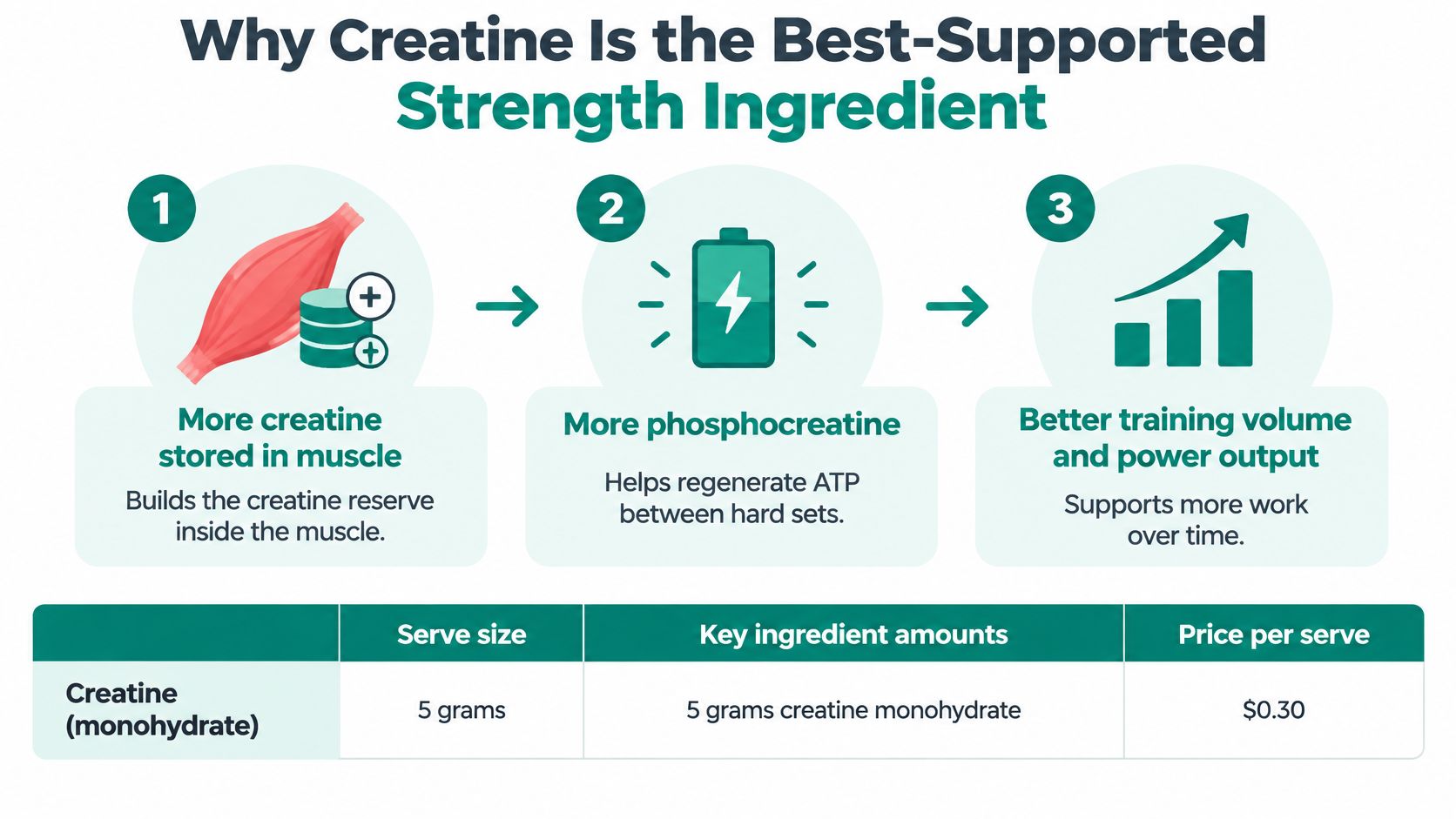
“Inner strength” is a marketing label, not a measure of evidence. Creatine monohydrate has a clearer link to resistance-training performance than an undefined resilience blend because it supports the energy demands of repeated hard efforts.
Follow the mechanism, then check the outcome
Muscle creatine contributes to phosphocreatine reserves, which help regenerate ATP, the energy source for muscular contractions. That process can support power or training volume across repeated hard efforts when training is appropriate.
A New Zealand-focused summary of creatine's benefits and who may use it reports approximately twice the muscle-mass gain of placebo over one to three months in controlled trials combining creatine with heavy weight training. It identifies 3 to 5 g daily as a practical benchmark for creatine monohydrate. The result is not a promise of doubled gains for every person. Response can vary with baseline intake, muscle-fibre profile, training quality and adherence.
Daily consistency matters more than precise timing, and loading is not necessary. A lifter who takes the labelled serving consistently through a training block follows a more dependable routine than one who remembers it only when packing a gym bag. The point is regular intake, not whether the serving is taken immediately before or after exercise.
Buy the ingredient, not the tub size
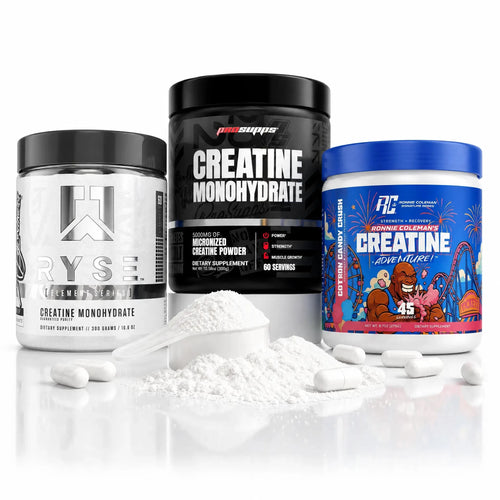
For plain creatine monohydrate, compare the cost per gram of creatine. A larger tub is not automatically better value if flavouring or other ingredients reduce the proportion of active material. For a multi-ingredient product, calculate the creatine amount only when the label discloses it. Total powder weight does not tell you how much creatine a serving contains.
| Serve size | Creatine monohydrate per serve | Price per serve |
|---|---|---|
| 3 to 5 g | 3 to 5 g | Product price divided by the number of servings |
A low price per serving is useful only if the serving provides a disclosed amount of creatine monohydrate. For more practical context, read about creatine benefits and who it's actually for.
This video offers another format for considering creatine use.
People with diagnosed kidney disease or relevant medicines should obtain clinical advice before using creatine. General safety statements about healthy adults do not establish whether it is appropriate for someone with an individual medical condition.
Gut, Stress and Sleep Nutrients Explained
A product can place gut comfort, stress and sleep on the same label without establishing a connection between its formulation and all those outcomes. Shared packaging isn't shared evidence. Evaluate each proposed use separately.
Gut products need an identifiable formulation
For a probiotic, look for the organism's full identification, including its strain, and the stated colony-forming units. Record storage instructions and whether the label explains when the stated count applies. Without those details, meaningful comparison is difficult.
A gut-related claim also shouldn't become a mood or training claim by implication. Readers who want broader context can explore the gut and mental health connection through Integrative Psychiatry of America, while keeping that topic separate from proof that a particular capsule improves performance.
Botanical names aren't complete specifications
For ashwagandha or rhodiola, the plant name alone doesn't fully identify the product. Check the plant part, extract description, amount and any declared standardisation. Don't assume that different extracts are interchangeable because the front labels use the same botanical name.
Claims about self-rated stress or fatigue need more than a reference to an ingredient. Without a trial tied to the relevant extract, population and outcome, a shopper can't establish how well the claim applies. People taking medicines or managing medical conditions should obtain professional advice before adding botanical products.
Magnesium requires the right number
For magnesium glycinate, compare elemental magnesium, rather than the total weight of the compound. Also check multivitamins, electrolyte products and evening blends for overlapping ingredients. A form name doesn't tell you the total daily amount you're already taking.
The cited material doesn't establish a reliable sleep benefit or a universal dose for this use. Don't treat glycinate on the label as proof that the product will improve your sleep.
Medsafe's product categorisation guidance explains that dietary supplements must not be intended for a therapeutic purpose, and that disease-related or body-change claims can change a product's categorisation. Useful descriptions therefore focus on ingredients, quantities and directions, not treatment or transformation promises.
If a formula promises calm, focus and recovery but hides the active amounts, you have a marketing message, not a usable dosing specification.
Safety Checks for Drug-Tested Athletes
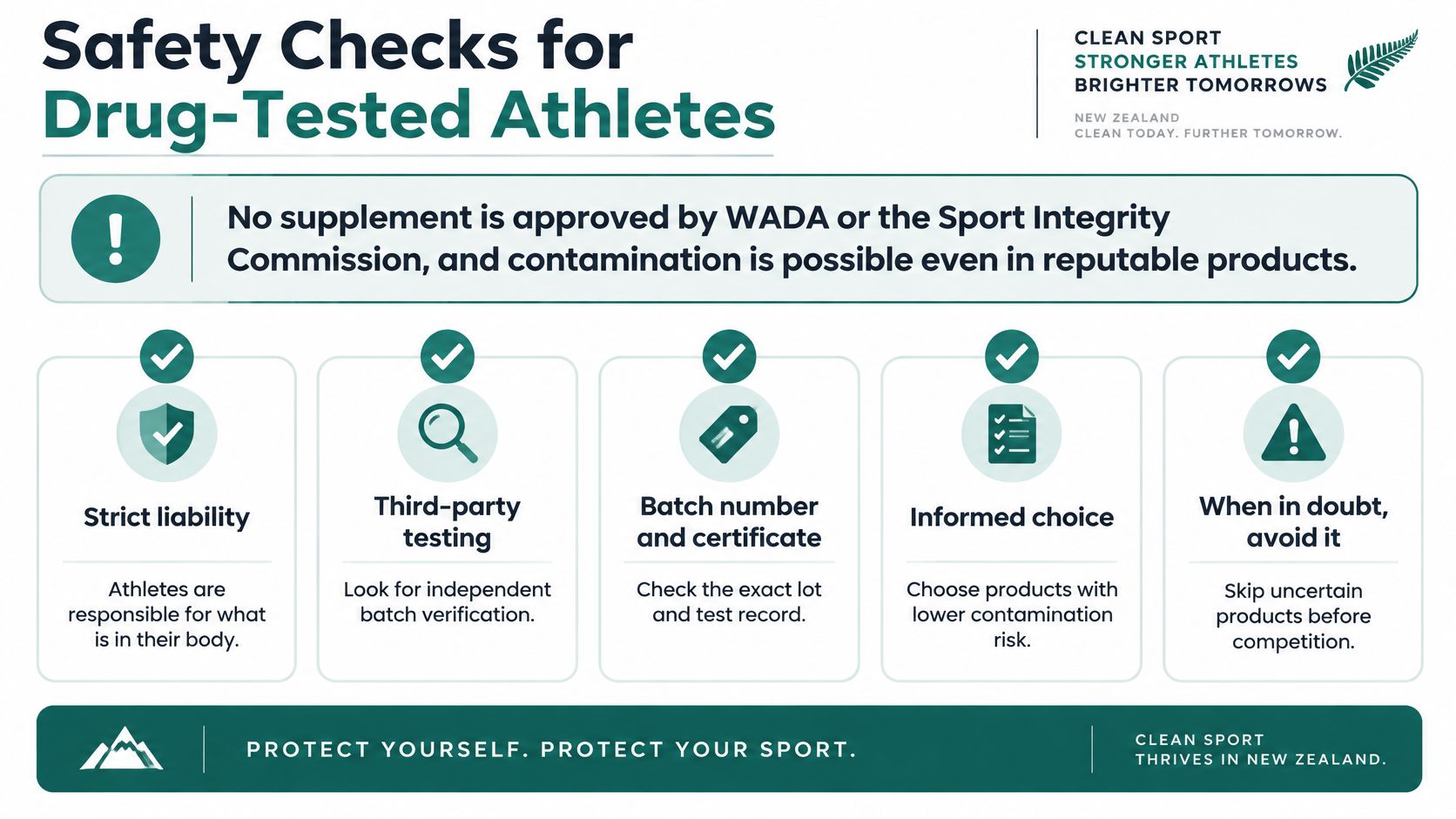
No supplement is approved by WADA or the Sport Integrity Commission, and contamination remains possible, according to High Performance Sport New Zealand's supplement guidance. The same guidance reports that Consumer NZ found illegal drugs in six supplement products in 2022.
Under strict liability, athletes are responsible for substances found in their samples, even when contamination is accidental. That makes product selection a sports-integrity decision as well as a nutrition decision.
Use the checklist as a prompt for a documented decision, not as a guarantee.
Product types and the safety checks each one needs
These are practical screening priorities, not measured contamination probabilities. Lower concern doesn't mean risk-free, and independent testing still matters for a simple formula.
| Product type | Risk level | Checks before use | Action if a check fails |
|---|---|---|---|
| Creatine monohydrate | Lower concern | Full quantity disclosure and independently verifiable batch certification | Don't use the unverified lot; assess an alternative |
| Protein powder | Lower concern | Labelled quantities and certification where available | Avoid products that hide active ingredients |
| Collagen peptides | Lower concern | Full disclosure and batch records | Retain packaging and review uncertainties with a dietitian |
| Multi-ingredient strength formulas | Higher concern | Every active ingredient named with an amount | Pause use and check the sport's rules |
| High-stimulant pre-workouts | Higher concern | Total caffeine, all stimulant identities and independent batch testing | Don't use until the formulation and batch are verified |
| Stimulant and test-support products | Highest concern | Banned substances, unclear ingredients and aggressive body-change claims | Avoid uncertain products and consult a sports doctor |
You can't identify an undeclared stimulant by reading the ingredient panel. That's why disclosure and independent testing answer different questions.
Verify the batch, not just the logo
Certification can reduce uncertainty, but only within the programme's scope. Check whether the certification applies to the exact product and batch, which substances were screened and whether the record is current. A logo isn't a guarantee covering every possible substance or future batch.
Medsafe's dietary supplement regulation guidance describes restrictions on medicinal and controlled ingredients. Legal sale and anti-doping suitability are separate questions.
Before opening a new product:
- Record identifiers: Photograph the label, batch or lot number and expiry information.
- Keep purchase evidence: Save the receipt or order confirmation alongside the photographs.
- Check active ingredients: Use the current anti-doping rules relevant to your sport, with qualified support where needed.
- Retain packaging: Keep it through the season as a practical record, and ask your team adviser whether longer retention is appropriate.
This explanation of how supplements are tested for banned substances can help you assess what a testing claim covers.
Involve a sports doctor or registered dietitian before combining substances, using an uncertain formulation or making decisions for a young athlete. If you suspect an adverse reaction, stop using the product, retain the packaging and seek medical advice. Seek urgent care for severe symptoms.
Build a Low-Risk Routine You Can Actually Keep
A useful supplement routine should make your decisions easier to audit. You should be able to identify why each product is there, what you're taking and what would make you stop.
- Establish a repeatable base. Organise meals that cover your needs, a realistic training programme and a regular sleep routine. Fix the part you repeatedly miss before adding another product.
- Choose a single clear purpose. If you select creatine monohydrate for resistance training, use the disclosed daily directions consistently. Don't add a separate focus, calm and recovery formula just because they share a theme.
- Document every new purchase. Treat a replacement tub as a new batch to verify. Keep its label photographs, purchase record and certification details together.
- Review against a planned outcome. Use your training log and notes on sleep, energy and unwanted effects. Decide whether the product is useful enough to continue, needs professional review or should be stopped.
Adding several limited-evidence products together makes it harder to identify what helped or caused a problem. A simpler routine won't establish causation, but it gives you a clearer basis for a sensible decision.
When comparing creatine NZ, prioritise disclosed monohydrate amounts, usable-serving value and the verification appropriate to your sport. Check the live label and stock status before choosing a product.
NZ Supps offers sports nutrition products, ingredient comparison tools and certification filters to help you assess a purchase beyond its marketing name. Visit NZ Supps to compare current labels and availability against your training needs. Shop all creatine in NZ.