SHOP NOW, PAY LATER










 Informed Sport
 Informed Choice
 NSF Certified for Sport
 HASTA Certified

An amino acid energy drink is a caffeinated beverage, typically containing 36 to 80 mg of caffeine per 250 mL serve under FSANZ Standard 2.6.4, alongside amino acids such as BCAAs or EAAs. The amino acids aren't what create the energy feeling, the caffeine does.
The popular advice is to choose the drink with the longest amino-acid panel. That's the wrong first filter. For New Zealand shoppers, the useful question is how much caffeine this drink adds to the whole day, measured against body weight, then whether the disclosed amino acids, electrolytes and serving format justify buying it.
Table of Contents
- What an Amino Acid Energy Drink Actually Is
- Amino Acids, Stimulants and Electrolytes on the Label
- The Caffeine Maths Across Your Whole Day
- When to Use Them and When to Skip Them
- Products NZ Supps Stocks at a Glance
- Drug-Tested Athletes and Batch-Tested Stock
- Buying Checklist and Common Questions
What an Amino Acid Energy Drink Actually Is
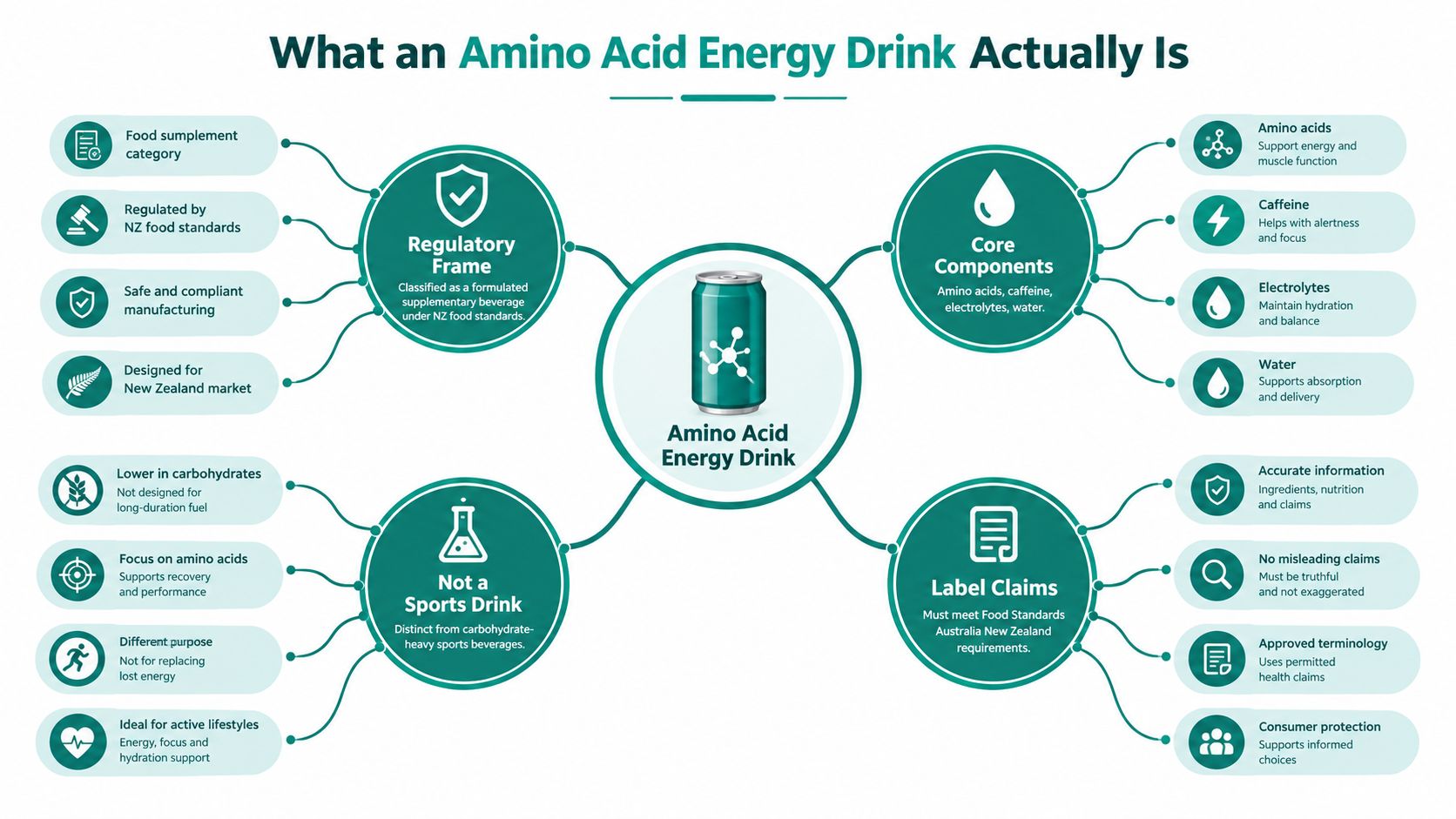
An amino acid energy drink is generally a formulated caffeinated beverage containing caffeine plus ingredients such as taurine, BCAAs, EAAs or electrolytes. It isn't a stimulant-free hydrator, a meal replacement or a clinical supplement. The can may look like a sports drink, but the label needs to be read more like a caffeine product.
Under Food Standards Australia New Zealand Standard 2.6.4, formulated caffeinated beverages must contain 145 to 320 mg of caffeine per litre. That works out to approximately 36 to 80 mg in a 250 mL serve. A 600 mL can could contain up to approximately 192 mg, depending on its stated concentration and serving information.
That upper 250 mL serving level is comparable with the approximately 66 mg of caffeine in a 250 mL cup of plunger coffee, according to New Zealand consumer guidance. So the can's amino-acid branding doesn't make it a low-stimulant product. The caffeine number remains the meaningful starting point.
The label information that matters
New Zealand labels must state the average caffeine quantity per serving and per 100 mL. They must also carry warnings that the product contains caffeine and isn't suitable for children, pregnant or breastfeeding women, or people sensitive to caffeine. Those warnings matter even when the product's front label highlights BCAAs, flavour or electrolytes.
| Element | What it means | NZ reference point |
|---|---|---|
| Caffeine | The stimulant component | 145 to 320 mg per litre under Standard 2.6.4 |
| 250 mL serve | A common reference size | Approximately 36 to 80 mg caffeine |
| 600 mL can | A larger retail format | Up to approximately 192 mg, depending on concentration |
| Taurine and amino acids | Added formula ingredients | Their presence doesn't remove the caffeine calculation |
| Mandatory label details | Information shoppers should see | Caffeine per serve, caffeine per 100 mL and required warnings |
The practical conclusion is simple. Treat the drink as caffeine plus added amino acids, not as an amino-acid product that happens to contain a little energy.
Amino Acids, Stimulants and Electrolytes on the Label
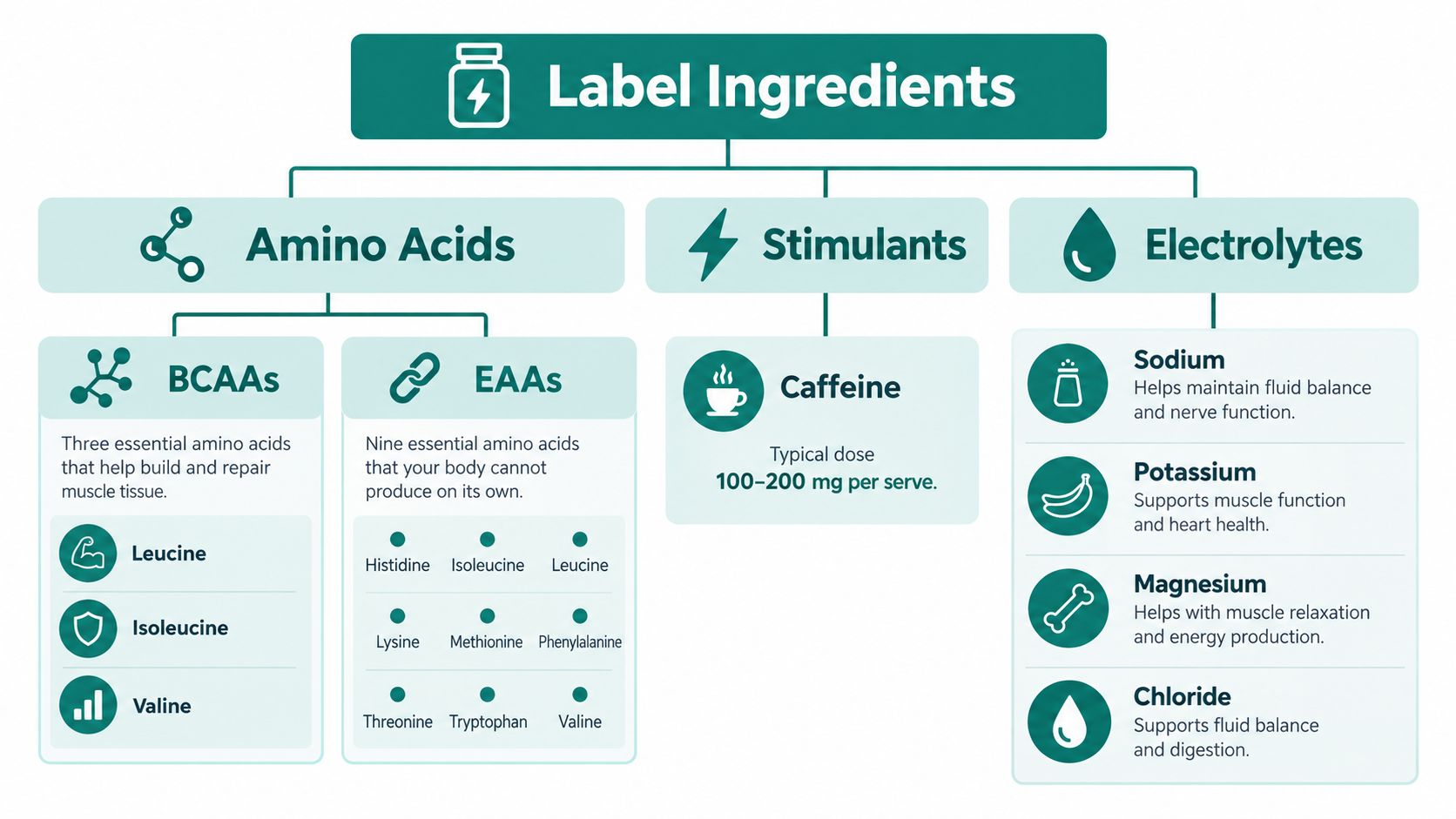
BCAAs and EAAs aren't interchangeable labels. BCAAs are leucine, isoleucine and valine, three of the nine essential amino acids. EAAs include all nine essential amino acids, which the body must obtain from food or supplementation.
On a label, BCAAs are like selecting three players from a nine-person team. An EAA blend lists the full essential group, although the usefulness of either format depends on the broader diet and what the manufacturer has disclosed. Neither label changes the fact that the drink's noticeable energy effect comes primarily from caffeine.
Caffeine is the central nervous system stimulant in the formula. Guarana can also contribute caffeine, so a transparent label should identify it rather than leaving shoppers to guess whether the botanical is relevant to their daily total. Taurine is an amino acid-like ingredient commonly found in this category, while electrolytes such as sodium, potassium and magnesium are minerals used in fluid and mineral formulations.
Think of each ingredient as a different tool
- BCAAs: Three named essential amino acids, usually presented for people who want a targeted amino formula.
- EAAs: The full essential amino-acid group, giving a broader amino profile than BCAAs alone.
- Caffeine: The alertness ingredient and the number that belongs in your daily caffeine calculation.
- Guarana: A botanical caffeine source that can be easy to miss if you only scan for the word “caffeine”.
- Taurine: An added amino-acid ingredient, not a substitute for checking the stimulant load.
- Electrolytes: Minerals such as sodium, potassium and magnesium, relevant to the product's hydration-oriented formulation.
- B vitamins: Micronutrients included in some energy formulas, but not a reason to ignore the caffeine panel.
An intra-workout amino drink and an energy drink can overlap, but they aren't the same purchase. One may focus on amino acids and minerals with no stimulant, while the other adds caffeine for alertness. If the amino side is what you want, compare amino and BCAA products in NZ separately rather than paying for a stimulant you don't need.
For a plain-language explanation of the mineral side, see why your body actually needs electrolytes. The key label scan is BCAA or EAA quantities, caffeine from every source, taurine, guarana, electrolyte amounts and the stated serving size.
The Caffeine Maths Across Your Whole Day
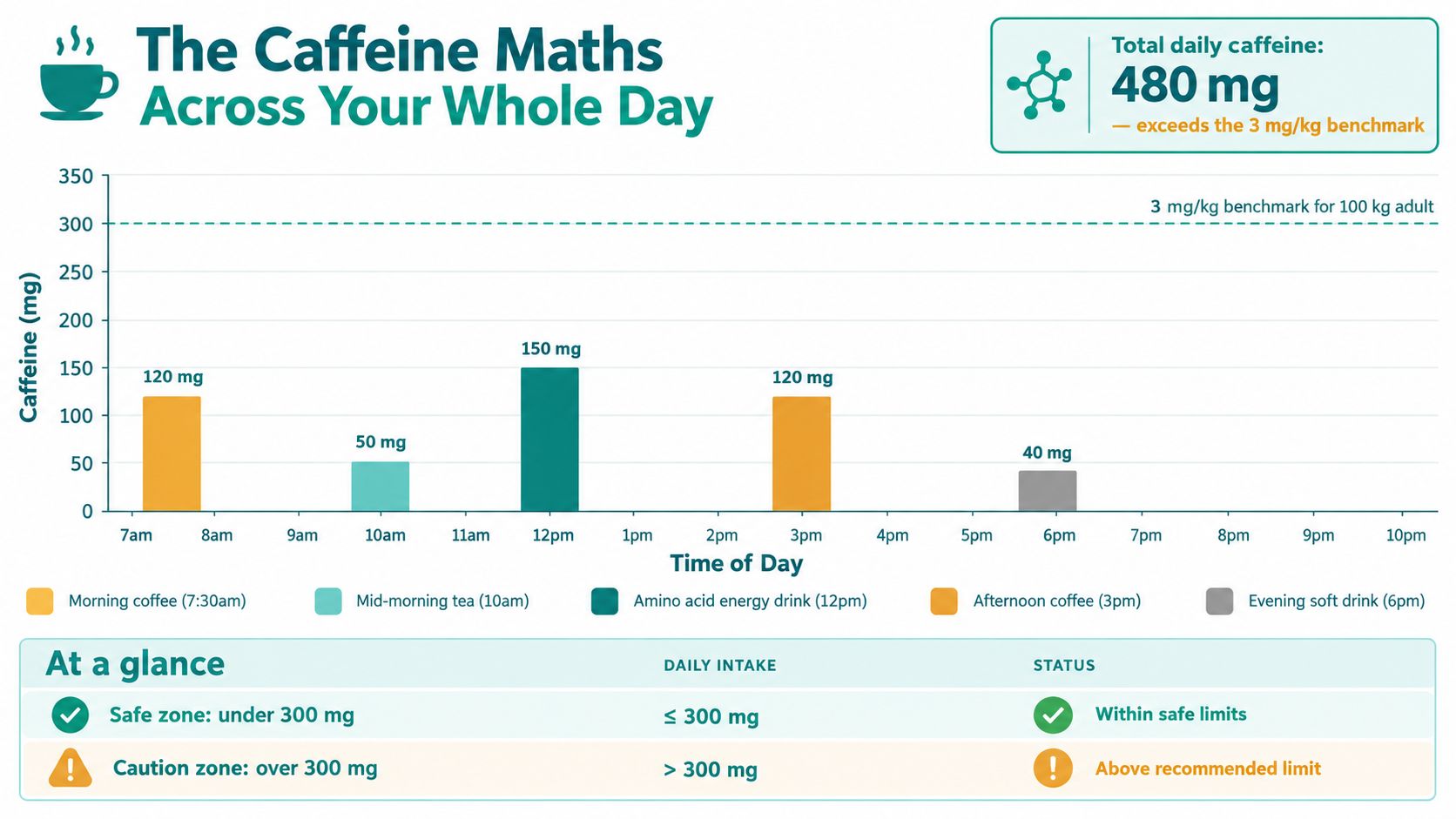
The decision variable isn't the number of amino acids printed on the front. It's total caffeine divided by body weight. New Zealand research uses 3 mg per kilogram of body weight per day as a level associated with increased adverse effects in the cited studies, so the same can represents a different proportion of the daily benchmark for different people. (Massey University research)
| Body weight | 3 mg/kg benchmark | One 250 mL drink at 80 mg | One 600 mL can at 160 mg |
|---|---|---|---|
| 60 kg | 180 mg/day | 80 mg | 160 mg |
| 70 kg | 210 mg/day | 80 mg | 160 mg |
| 80 kg | 240 mg/day | 80 mg | 160 mg |
These are comparison calculations, not permission to treat a benchmark as a personal target. A 60 kg person reaches the cited benchmark at 180 mg, while an 80 kg person reaches it at 240 mg. The can's caffeine doesn't change with the customer's body weight, but its share of the benchmark does.
New Zealand research found that 34.4% of 317 tertiary students aged 16 years and older consumed caffeine above 3 mg/kg/day. Energy drinks were consumed by 40.4% of the participants overall, including 45.3% of males and 36.1% of females. A separate study of secondary-school students found 21.2% above the same caffeine benchmark, and energy-drink consumers were 2.44 times more likely than non-consumers to exceed it. These findings concern caffeine exposure, not amino acids.
Build the stack before you buy the can
Take a 70 kg adult using an example stack of an amino acid energy drink with 80 mg caffeine, a pre-workout scoop with 200 mg, and two long blacks contributing 240 mg. The total is 520 mg, which is more than 7 mg/kg for that body weight. The important point isn't the particular coffee estimate. It's that each product can look ordinary on its own while the day's total becomes substantial.
Pregnancy has a separate New Zealand Ministry of Health guideline. The recommendation is to keep caffeine below 200 mg per day and avoid energy drinks and energy shots because they contain high caffeine levels and other substances whose risks for pregnant women haven't been assessed. A drink containing 160 mg would leave only 40 mg for coffee, tea, cola, chocolate, kombucha and other caffeine sources that day. (New Zealand adult eating and activity guidance)
For another way to think about matcha or coffee for daily focus, compare the actual caffeine on the label or menu rather than assuming one format is automatically lighter. A caffeine bands explained guide can also help when you're comparing lower and higher-stimulant products.
When to Use Them and When to Skip Them
Timing should follow the formula, not the front-of-can promise. A caffeinated amino drink may make sense before training when you want the stimulant component for alertness and the label's amino or electrolyte blend fits your plan. That doesn't make it a complete training meal or a replacement for ordinary food and fluids.
During training, the decision depends on session length, heat, sweat conditions and the product's actual mineral panel. A drink with electrolytes may fit a different use case from a caffeine-heavy can with minimal mineral disclosure. For longer endurance sessions, find enduro fueling options rather than assuming an amino acid energy drink covers every fuelling requirement.
Match the format to the job
- Before training: Check the caffeine per serve and add it to coffee, tea, pre-workout and other sources already consumed.
- During training: Look at the electrolyte quantities and serving size, particularly for hot conditions or longer sessions.
- After training: A stimulant-free amino product may be more suitable if you're finished with caffeine for the day.
- Late shifts or evening sessions: Choose a lower-stimulant or stimulant-free option if caffeine could interfere with your preferred routine.
Skip the drink if you're already stacking a high-caffeine pre-workout, if you're treating it as a meal replacement, or if you want a quiet evening option. Shoppers who want to compare the drink format with a traditional scoop can compare pre-workouts in NZ. Those seeking hydration without the stimulant calculation can browse electrolytes for hydration-focused use.
Serving size creates a common trap. If the label defines 250 mL as one serve and you drink 500 mL, you've consumed two serves, so the caffeine and disclosed electrolyte amounts are doubled. Read the per-serve line against the volume you'll finish.
Products NZ Supps Stocks at a Glance
Product comparison only works when the label and price are visible. NZ Supps stocks products across ready-to-drink and amino formats, but the product page should remain the final check for current flavour, pack size, ingredients and price.
| Product | Serve size | Caffeine per serve | Key amino or electrolyte amounts | Price per serve NZD |
|---|---|---|---|---|
| Cellucor C4 Energy + Amino | Label-dependent | 100 mg natural caffeine | 5 g BCAA and EAA amino acids, electrolytes | Check current product page |
| Cellucor C4 Carbonated RTD | Label-dependent | Check current label | Key amino or electrolyte quantities depend on the listed formula | Check current product page |
| Alani Nu RTD | Label-dependent | Check current label | Check current label for disclosed amino or electrolyte amounts | Check current product page |
| Bucked Up RTD | Label-dependent | Check current label | Check current label for disclosed amino or electrolyte amounts | Check current product page |
The Cellucor C4 Energy + Amino entry is the clearest amino-focused comparison here because its listed formula combines 5 g of BCAA and EAA amino acids, 100 mg of natural caffeine and electrolytes per serving. That 100 mg belongs in the same daily calculation as coffee and pre-workout, even though the product's front-of-pack emphasis is amino support.
The other RTD options should be judged by what their current labels disclose, not by assuming that all energy drinks contain the same amino or electrolyte profile. If a quantity isn't listed, leave it unknown. Don't convert a marketing phrase into a gram amount.
Price per serve is more useful than the can or tub sticker price. Divide the current pack price by the number of labelled serves, then compare that figure with the caffeine and disclosed ingredients you'll use. A cheaper pack can cost more per useful serving if you discard part of the format or regularly choose a lower dose.
Drug-Tested Athletes and Batch-Tested Stock
Drug-tested athletes have an extra filter: what's in the batch may matter as much as what's printed on the label. The New Zealand Sports Integrity Commission lists BCAA products and energy or rehydration drinks among supplement categories that can carry contamination or labelling risks. It also reports that Consumer NZ found illegal drugs in six separate supplement products in 2022. (Sports Integrity Commission supplement guidance)
Batch testing increases confidence in a particular batch, but it can't provide absolute certainty. A certificate for one batch doesn't assure a different batch, so the athlete needs to match the batch number and expiry date on the product with the certificate.
The practical checks
- Certification filter: Look for Informed Sport, Informed Choice, NSF Certified for Sport or HASTA where relevant to the product.
- Batch match: Check that the certificate describes the exact batch you received.
- Packaging check: Keep the seal intact and inspect the packaging before use.
- Record keeping: Record the product on doping-control documentation when required.
- Claims check: Don't treat “WADA-approved” as official approval. WADA doesn't test or approve supplements.
The meaningful safeguard is a sealed product with a matching batch record, not a broad badge detached from the item in your hand. How supplements are tested for banned substances explains the practical distinction between certification language and batch-level checking.
NZ Supps stocks genuine, sealed-by-brand products and dispatches from Palmerston North, which avoids the grey-market import question when batch identity matters.
Buying Checklist and Common Questions
Use this checklist before checkout:
- Read caffeine per serve: Record the milligrams, then multiply by the number of serves you'll drink.
- Calculate the day: Add coffee, tea, pre-workout, cola, chocolate, gels, bars, medicines and other products that may contain caffeine.
- Choose the purpose: Decide whether you want amino acids, caffeine, electrolytes or a combination.
- Check the format: Match the can or powder serving size with the amount you'll realistically consume.
- Review sport status: Drug-tested athletes should check certification and batch details.
- Compare per-serve cost: Pack price alone doesn't tell you what each usable serving costs.
Are there stimulant-free alternatives?
Yes. Choose an amino product without caffeine when you want the amino side without the stimulant calculation, or use an electrolyte product when hydration is the actual job. You can compare amino and BCAA products in NZ and review electrolyte options by their disclosed mineral quantities.
Are amino acid energy drinks suitable during pregnancy?
The New Zealand Ministry of Health recommends keeping caffeine below 200 mg per day during pregnancy and advises against energy drinks and energy shots. That guidance applies to the complete daily caffeine total, not just the amino-acid ingredients in one can.
How do they compare with a traditional pre-workout?
An RTD drink is convenient and already portioned, while a powder may offer more control over serving size and ingredient disclosure. The comparison should focus on caffeine per actual serving, the product's upper caffeine concentration, amino and electrolyte quantities, and price per use. A pre-workout scoop can also join the same daily stack, so switching formats doesn't remove the calculation.
Do the amino acids actually do anything?
The label confirms only what the manufacturer has chosen to disclose. Evidence for isolated amino-acid products is mixed and context-dependent, so don't assume a longer BCAA or EAA list automatically makes the drink more useful. Compare the stated amounts with your overall protein intake and decide whether you're buying amino acids, caffeine, electrolytes or convenience.
For a category-level comparison, compare aminos and BCAA products in NZ using the same rule throughout: calculate total daily caffeine in mg per kg of body weight before judging the amino-acid panel.
NZ Supps offers amino, RTD, pre-workout and electrolyte products with ingredient details and per-serve comparisons to help you build a label-led stack. Visit NZ Supps to check current products, serving information and Tested for Sport options before choosing your next drink.