SHOP NOW, PAY LATER











 Informed Sport
 Informed Choice
 NSF Certified for Sport
 HASTA Certified

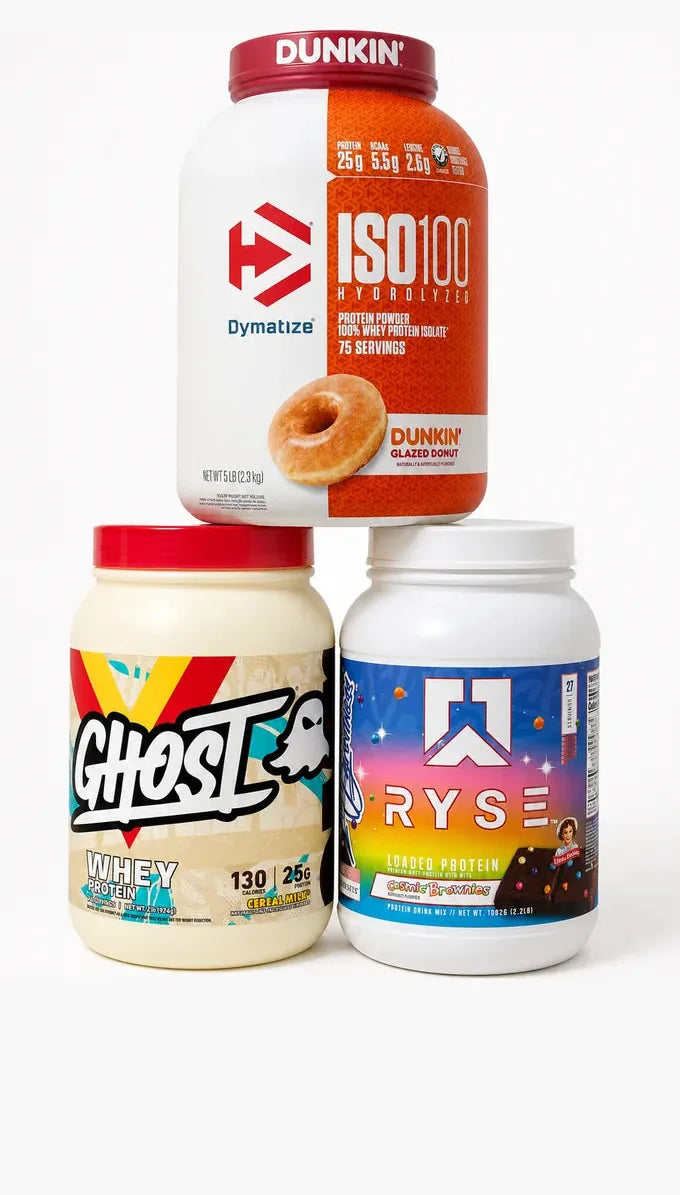
98% of people met the recommended average protein requirement in the Ministry of Health national nutrition report, with median usual daily protein intakes of 102 g for males and 71 g for females. That figure reframes the search for the best amino acids for muscle recovery, because most shoppers aren't starting from an empty tank. They're adding a product on top of food that already supplies amino acids every day.
For most gym-goers who already eat enough protein, amino acids are a small add-on rather than the main recovery tool. The right format depends on your daily protein, what you eat around training, whether you eat plant-based, and whether you're drug-tested.
Table of Contents
- Which Amino Acid Format Suits Your Recovery
- What Each Amino Acid Format Actually Contains
- What the Recovery Research Shows for Amino Acids
- When Amino Acids Add Value Beyond Protein
- Dosing and Timing Around Training
- Tested for Sport and Safe Use for Drug-Tested Athletes
- Confirm the Product and Dose Before You Buy
Which Amino Acid Format Suits Your Recovery
If your meals and shakes already cover protein, an extra tub rarely changes much. Browse amino acids NZ only after you've checked that total, because the label on a BCAA product can't tell you whether yesterday's food was short. Health New Zealand protein guidance puts food first, noting that a varied diet with lean meat, fish, seafood, milk, eggs, nuts, seeds and legumes can provide all the amino acids the body needs. It also ties building muscle to a well-designed resistance-training programme with enough total food energy and protein, not to a powder alone.
| Your situation | Best-fit format | Why it fits | Check on the label |
|---|---|---|---|
| Daily protein already met from meals and a shake | No extra amino acid product needed | Total protein already supplies essential amino acids | Protein grams and serve size |
| Plant-based diet with a short protein total | Complete plant protein or EAA blend | Plant proteins can be lower in one or more indispensable amino acids | Disclosed EAA grams and leucine per serve |
| Training fasted or a long gap before eating | EAA or intra-workout blend | Essential amino acids are available around the session without a full meal | Serve size, sugar, electrolytes and any caffeine |
| Low appetite or hard to eat enough protein | EAA blend or complete protein shake | Delivers amino acids in a small, easy serve | Protein grams and total EAA grams per serve |
| Drug-tested athlete | Any format with a Tested for Sport certification | Independent batch testing lowers contamination risk | Informed Sport, Informed Choice, NSF Certified for Sport or HASTA mark |
| Considering leucine or a single amino acid alone | Usually not the best use of money | Leucine alone doesn't supply the full set of essential amino acids | Leucine grams per serve and whether other essentials are listed |
Recovery also doesn't start in your shaker, which is why it's worth reading about why athletic recovery starts with sleep alongside any supplement decision. A short night will blunt next-day training more reliably than a missing scoop will help it.
Practical rule: Read the protein grams per serve before you read any amino acid claim. If a product supplies little protein or few total essential amino acids, a large leucine number on the front is answering the wrong question.
What Each Amino Acid Format Actually Contains
There are nine essential amino acids your body can't make. They are leucine, isoleucine, valine, lysine, histidine, methionine, phenylalanine, threonine and tryptophan. You must get them from food or supplements, and building new muscle protein needs the full set, not just the famous ones.
The formats in plain terms
An EAA blend supplies all nine essentials in one serve. A BCAA powder supplies only leucine, isoleucine and valine, often in a 2:1:1 ratio, so it leaves out the other six. A single amino acid product delivers one compound at a time, such as leucine or glutamine, and glutamine is conditionally essential, meaning your body usually makes it but demand can rise. An intra-workout blend is an EAA or BCAA powder with added carbohydrate, electrolytes and sometimes caffeine or sweeteners, which changes both the cost per serve and the stimulant load. A complete protein with added leucine is whey, isolate or a plant protein carrying extra leucine on top of its normal protein dose.
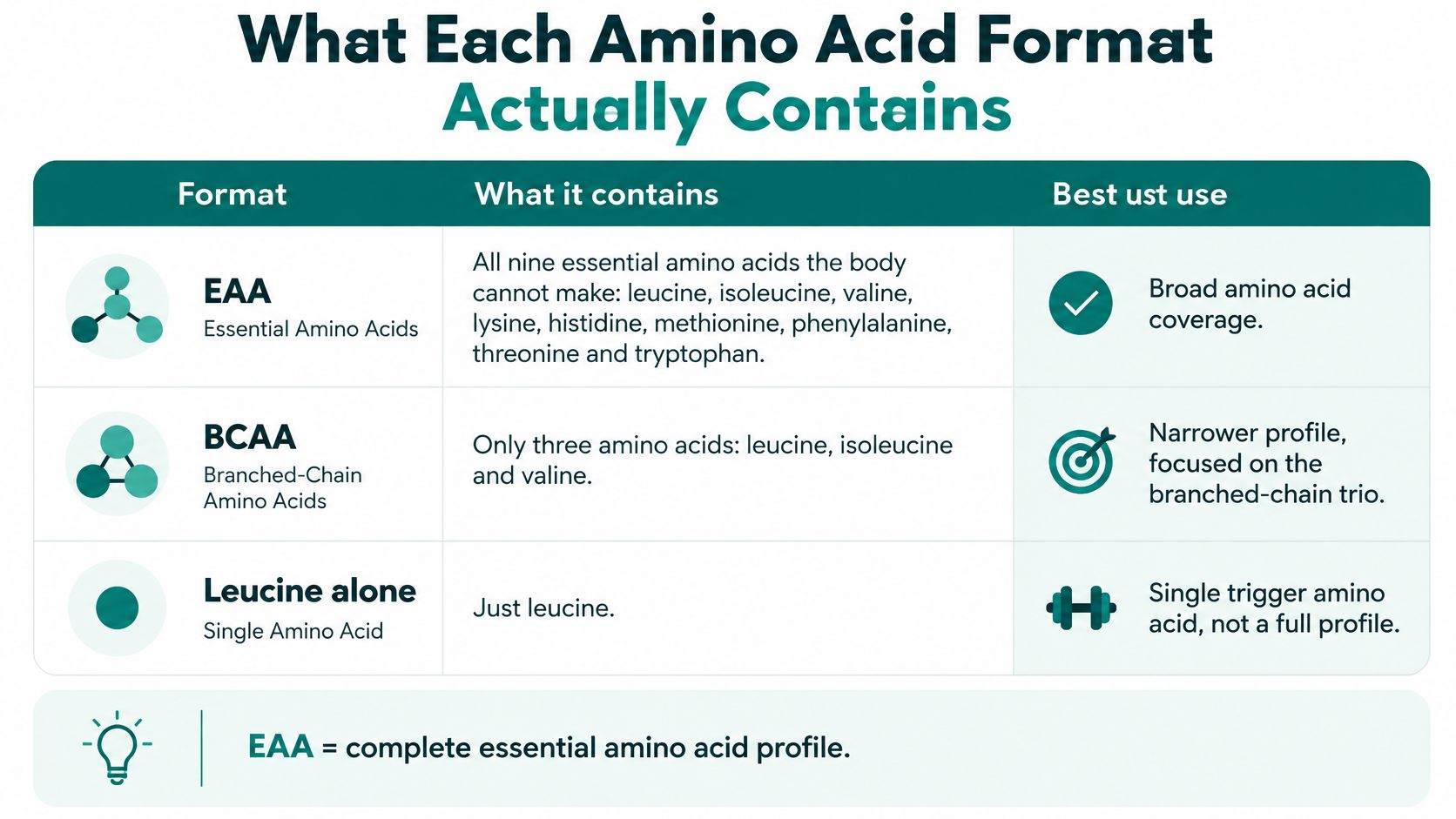
| Format | What it contains | What the label should show | Best use |
|---|---|---|---|
| EAA blend | All nine essential amino acids, including leucine, isoleucine and valine | Total EAA grams and leucine grams per serve | Full essential coverage without a meal |
| BCAA powder | Leucine, isoleucine and valine, often in a 2:1:1 ratio | Leucine grams per serve and the full ratio | Narrow coverage, doesn't supply all essentials |
| Single amino acid | One compound, such as leucine or glutamine | Grams per serve | Targeted gap only, rarely a full recovery tool |
| Intra-workout blend | EAAs or BCAAs with carbohydrate, electrolytes and sometimes caffeine or sweeteners | Total serve, sugar, electrolytes and caffeine | Long or fasted sessions, check the stimulant total |
| Complete protein with added leucine | Whey, isolate or plant protein with extra leucine | Protein grams and leucine grams per serve | Everyday recovery with a clear protein dose |
A label showing a large leucine number and no total EAA figure tells you less than it seems, because leucine starts a signal that the other essentials have to finish. Our EAA versus BCAA comparison works through that distinction in full. Before you buy any format, run three checks.
- Total EAA grams per serve: This is the actual payload, so a tiny scoop with a bold headline ratio may deliver very little.
- Leucine grams per serve: Look for the number itself, not a ratio that hides a small total.
- Every essential listed by name: If only three amino acids appear, you're buying a BCAA product whatever the front of the tub implies.
What the Recovery Research Shows for Amino Acids
Start with the least comfortable finding for leucine marketing. A 2025 systematic review of 14 randomised controlled trials found that 13 reported no significant improvement in muscle mass, strength, or recovery from leucine supplementation in healthy, trained young adults. Leucine activates muscle protein synthesis signalling, yet that biochemical step didn't reliably turn into outcomes a lifter can measure. That pattern runs across the whole category, and it should shape what you're willing to pay.
BCAAs and soreness
A Massey University review of BCAA evidence reports that branched-chain amino acids have only moderate evidence for reducing exercise-induced muscle damage and soreness. The same review cites a 2022 randomised study in which BCAA supplementation did not improve perceived soreness or neuromuscular performance after repeated change-of-direction sprinting. That second result matters most for field and court sport athletes, because repeated direction changes resemble their training far more than a single leg extension protocol. A BCAA product sold to those athletes as a guaranteed fix is oversold.
Marker-level results are murkier still. A separate Massey University review of BCAA research describes a 2017 review reporting significantly lower creatine kinase at follow-up points below 24 hours and at 24 hours, but no significant reduction in muscle soreness at any follow-up. Other studies in that review found no meaningful recovery effect, or effects that depended on amino acid type, dose and timing. The same product class can shift a blood marker while leaving soreness and next-session performance untouched.
The complete protein comparison
University of Waikato research in masters female runners found that a larger whey protein isolate dose after muscle-damaging exercise gave a small benefit to muscle function recovery, measured by maximal voluntary contraction and countermovement jump performance, within a day. Those are functional measures, which makes the result more useful than a soreness score alone. It's still one small study in a specific group, so it doesn't set a universal dose for a 25 year old powerlifter or a teenage swimmer. What it supports is narrower and more practical: a complete, leucine-containing protein serve after a damaging session, rather than assuming a BCAA-only or single amino acid product delivers the same thing.
A result that moves a blood marker is not the same as a result that improves your next session.
Read every claim through that lens. Creatine kinase and signalling pathways are biochemical markers, while next-session performance, strength recovery and soreness are the outcomes you train around. When a study reports only the first group, treat the product as unproven for the second. For a shopper weighing an amino acid tub against a protein powder, the evidence ranking is fairly clear: complete protein carries the cleaner trial results, isolated amino acids carry the louder packaging, and the protein total you already reach each day decides whether either product earns a place at all.
When Amino Acids Add Value Beyond Protein
The first question is whether your daily protein total is short, because many people already obtain substantial amino acid quantities from ordinary food. Our guide to protein timing covers how to spread that total, but the total itself comes first. If it isn't short, an amino acid product is mostly duplicating what your meals supplied.
Plant-based eaters are the clearest exception. A 2025 study of New Zealand vegans found mean protein intakes of 0.98 g/kg/day for males and 0.80 g/kg/day for females, yet only 55.6% of participants who met the protein requirement achieved adequacy for all digestibility-adjusted indispensable amino acids. Total grams therefore didn't guarantee full coverage. That gap is what a plant blend disclosing every essential amino acid in grams, or an EAA product, is built to close.
The University of Waikato study in masters female runners points to a separate lesson about dose after damaging exercise: 40 g of whey-protein isolate produced a small beneficial effect on muscle-function recovery within 24 hours compared with 20 g or an isocaloric placebo. Neither finding argues for an isolated amino acid over food. Both push the decision back to totals, coverage and dose, which is what this three step test checks before you spend anything.
- Total daily protein from food and shakes, written down for two or three normal days.
- Amino acid coverage of the serve, including whether every essential amino acid is listed with grams.
- Cost per gram of protein, so you can judge whether the price is reasonable against a shake.
Dosing and Timing Around Training
Timing only matters once the day's protein is sorted. Amino acids earn their place when total protein for the day is already adequate and the session is long, or the gap between meals stretches out. Taken beside a full protein meal, an extra serve adds little beyond the meal itself.
What complete protein does after exercise
Massey University research on amino acid availability reports that raising blood amino-acid availability has been shown to increase muscle-protein-synthesis rates both at rest and after exercise. In trained cyclists, adding whey protein to a carbohydrate-containing drink produced enhanced recovery compared with carbohydrate intake alone. Note the comparison, because it's complete protein against carbohydrate, not BCAAs against protein. That evidence supports eating or drinking a complete protein source after training. It doesn't show that isolated BCAAs improve every measure of recovery, and it shouldn't be borrowed to sell them.
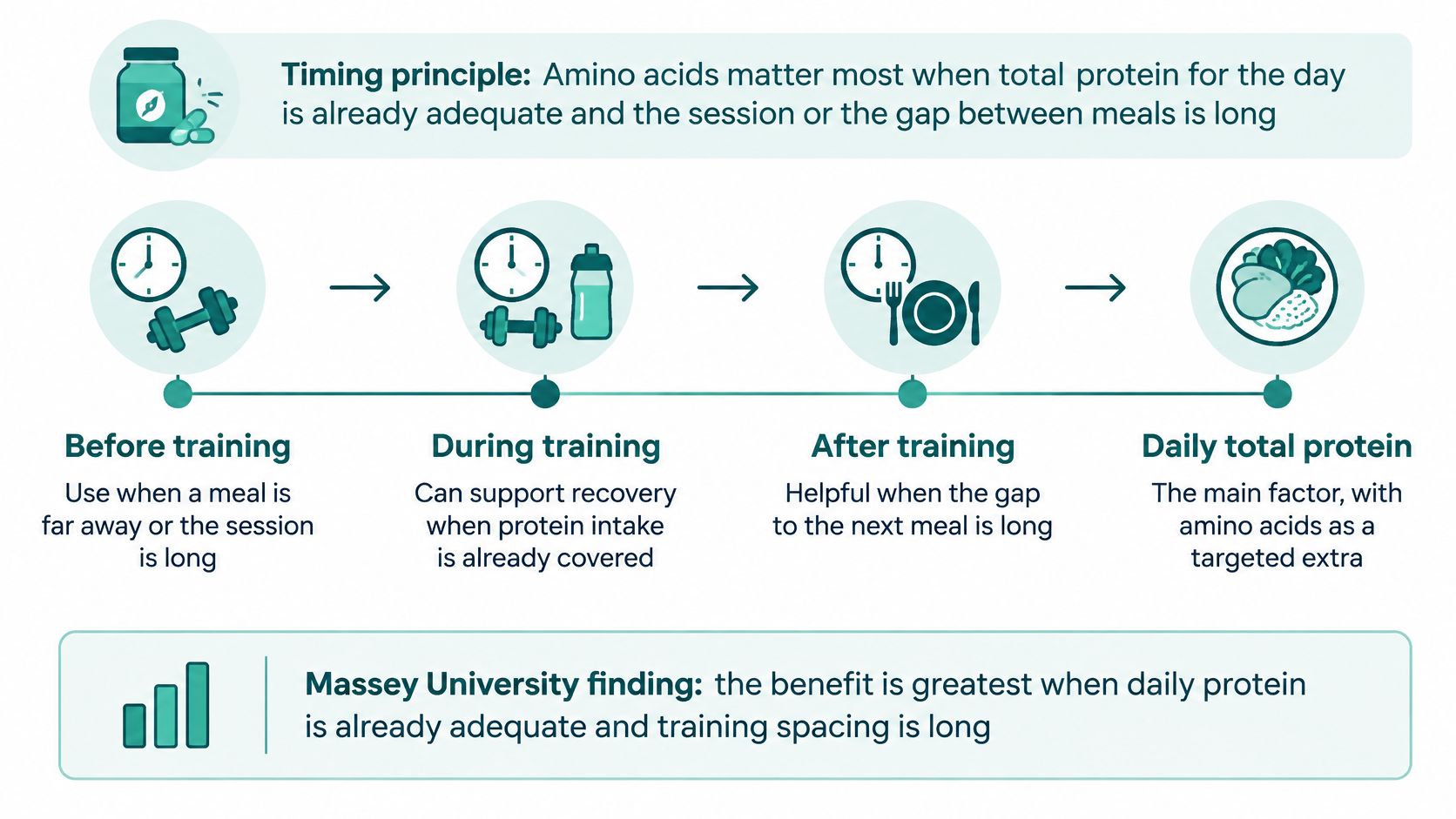
Use roughly 2 to 3 g leucine per serve alongside the other essential amino acids as your working benchmark when you compare labels. Many labels only show leucine, which is convenient for the brand and unhelpful for you, so treat a missing total EAA figure as a reason to look at another product. A controlled study in trained men used far larger test doses than any retail scoop, which is another reminder that a research dose and a shop serve are different things.
| Timing | Practical format | Target per serve | Label check |
|---|---|---|---|
| Post-session, within a few hours | Whey, isolate or complete protein shake | Roughly 20 to 40 g protein with about 2 to 3 g leucine | Protein grams and leucine grams |
| Before or during a long or fasted session | EAA or intra-workout blend | Serve size from the label, with total EAA grams checked | Sugar, electrolytes and caffeine |
| Whole day | Food first, then a shake to fill a gap | Protein spread across meals, with a shake only where the total falls short | Total daily protein from food and shakes |
| Plant-based athlete after training | Complete plant blend with disclosed amino acids | Roughly 30 to 40 g protein with about 2.5 to 3 g leucine | Protein per serve and amino acid profile |
A dose check routine
Read the serve size in grams, then convert it into grams of EAA or protein using the panel, then decide whether one serve is enough for the session you've just done. If the maths needs two scoops to reach the leucine benchmark, your real price per serve has just doubled, so recalculate before you judge value. For intra-workout use, reserve it for sessions longer than an hour or fasted training, and check the serve for sugar, electrolytes and caffeine first. Caffeine late in the day is a poor trade for a modest amino acid dose, since it can cost you the sleep that recovery depends on.
Older trainees should lean toward the top of these ranges rather than the bottom. Appetite and the response to a given protein dose both tend to fall with age, so a bigger, leucine-dense serve is the practical adjustment. Younger trainees eating three protein-rich meals usually sit at the other end, where a shake after training covers the same ground for less money.
Tested for Sport and Safe Use for Drug-Tested Athletes
A Tested for Sport mark counts when it covers the exact product and batch in your hand. A certified protein from one brand says nothing about an uncertified intra-workout from that same brand. Four schemes are used for this job: Informed Sport, Informed Choice, NSF Certified for Sport and HASTA. Each involves independent batch testing of the finished product against banned-substance lists, which is beyond what a label can prove, since a label only states what the maker intended to include.
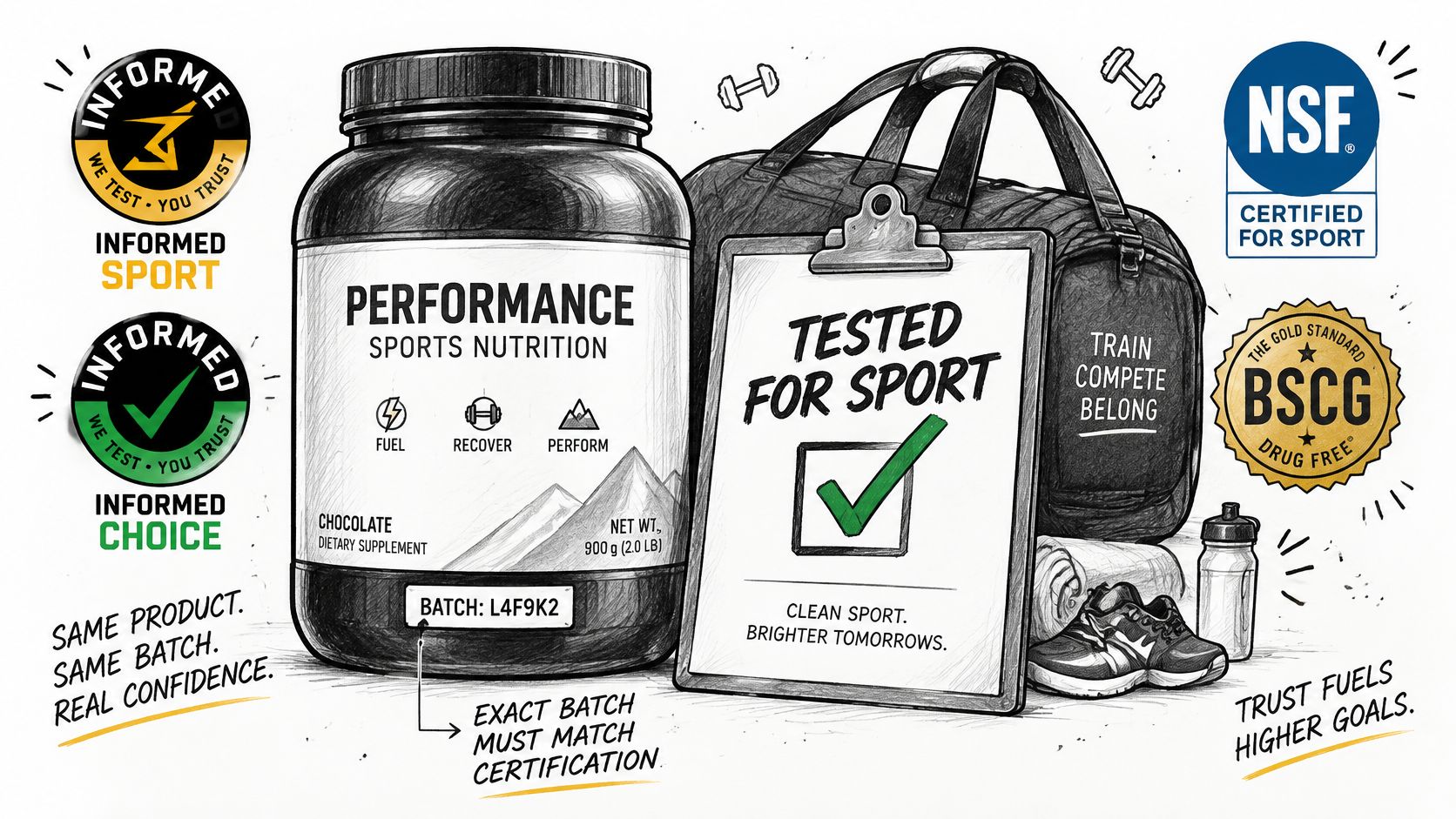
Dietary supplements sold in New Zealand are generally not checked before sale, so quality and compliance need to be confirmed by the buyer rather than assumed from the category or the branding. Certification settles contamination risk for one batch; it still leaves the bigger recovery question, whether the serve delivers enough total EAA or protein, to the panel and your daily target. The NZ Supps explainer on Informed Sport certified supplements in NZ sets out how the schemes differ. Work through these checks in order.
- Confirm the certification covers this exact product and batch, matching the certificate to the tub.
- Check the label for a full amino acid breakdown rather than a proprietary blend.
- Add up stimulant sources, such as caffeine, across intra-workout and pre-workout products.
- Avoid unsealed or grey-market stock, where storage and origin cannot be verified.
- Check your sport's prohibited list before you start.
A certificate is evidence about one batch. You remain responsible for what enters your body.
Confirm the Product and Dose Before You Buy
By the time you reach checkout, the amino acid decision has usually narrowed to a protein decision. The tub worth buying is the one that closes a measured gap in your daily protein total at the lowest cost per gram, so the final step is arithmetic rather than advertising. Run the checks in this order.
- Read the serve size in grams, including how many scoops make one serve.
- Read total EAA or protein grams and leucine grams per serve, using the three label checks from earlier.
- Divide the tub price by the number of serves to get price per serve.
- Compare cost per gram of protein, not the headline leucine figure.
- Match any Tested for Sport mark to the batch certificate before ordering if you're drug-tested.
NZ Supps lists per-serve pricing and ingredient disclosures on its product pages, which makes steps three and four a two-minute job. Apply the same maths to any tub you're weighing up, because a bigger container with a small serve size can look cheaper while costing more per gram.
The worked example below uses hypothetical tubs to show the calculation:
| Product type | Serve size | Key ingredient amounts | Price per serve |
|---|---|---|---|
| EAA blend | 12g, one scoop | 9g total EAA, 2.5g leucine | $69 tub ÷ 30 serves = $2.30 |
| Intra-workout blend | 21g, one scoop | 7g BCAA, 14g carbohydrate, 300mg sodium | $75 tub ÷ 25 serves = $3.00 |
| Whey isolate with added leucine | 30g, one scoop | 25g protein, 2.7g leucine | $89 tub ÷ 30 serves = $2.97 |
The isolate carries the highest sticker price yet delivers 25g of protein for under $3, while the EAA tub delivers 9g for $2.30. Per gram of amino acid, the isolate works out roughly twice as cheap, which is exactly why cost per gram beats the leucine figure on the front label.
Fill the same cells from the live label on the day you buy rather than a screenshot or an old review, since brands reformulate and resize tubs without much notice. If a product page doesn't disclose total EAA grams, that answers the transparency question on its own. Shipping changes the maths too: delivery is free over $99, so consolidating a protein and an amino acid product into one order usually beats paying freight twice.
Get your daily protein total right first, then use per-serve pricing and full label disclosure to pick an amino acid format that fills a real gap in your training week. Visit NZ Supps to compare EAA blends, intra-workout formulas and complete proteins side by side, with batch-tested options filtered for drug-tested athletes.