SHOP NOW, PAY LATER









 Informed Sport
 Informed Choice
 NSF Certified for Sport
 HASTA Certified

“No sugar” is not a hydration specification. It's a marketing claim.
A sugar-free powder can deliver a useful sodium load for a sweaty training session, or it can be little more than flavoured water with a token amount of mineral salts. The label decides which one you're buying. Sodium density and osmolality matter more than the words zero sugar on the front of the packet.
New Zealand's electrolyte category has also changed considerably. In the 2012 Nutritrack data reviewed by Nutrition Edge, electrolyte drinks averaged 39.5 g of sugar per serve, approximately eight teaspoons, while no artificially sweetened or low-energy electrolyte options were recorded at the time. That makes today's sugar-free electrolyte powder more than a cosmetic variation. It represents a shift away from the traditional sugar-heavy sports drink model. (Nutrition Edge's NZ hydration review)
| What to assess | Weak formula | Functional formula |
|---|---|---|
| Sugar | Zero sugar, but little sodium | Zero sugar with clearly disclosed sodium |
| Sodium | Token amount designed for flavour | Meaningful concentration matched to sweat loss |
| Mixing instructions | Vague or inconsistent | Exact dilution and serving information |
| Tonicity claims | “Isotonic” with no supporting data | Claim supported by osmolality information |
| Sweetener system | Heavy or gut-irritating blend | Palatable, tolerable, transparent ingredients |
Sugar can support fluid absorption in some performance situations because carbohydrate and sodium use linked transport pathways in the gut. Removing it can be useful when you don't need energy from the drink, but it also means the product must earn its place through mineral delivery rather than sweetness or calories.
That distinction matters in New Zealand, where electrolyte consumption has historically been niche. In the 2008–09 nutrition survey, only 1% of people aged 15 years and over reported consuming electrolyte drinks on one or both survey days. The reported consumers averaged 768 g per day, and the 90th percentile reached 1,524 g per day, showing that a small user group accounted for concentrated intake rather than the general population. (NZ Supps electrolyte collection)
For a short gym workout, a no-sugar drink may be a sensible way to avoid unnecessary carbohydrate. For a long, hot endurance session, it may be incomplete if you also need fuel. The right question isn't “Is sugar bad?” It's “What does this session require from the drink?”
Table of Contents
- The Zero Sugar Hydration Reality Check
- Core Salts and Ingredients That Actually Matter
- Decoding Labels and Regulatory Tonicity Claims
- Sweetener Profiles and Gut Comfort During Training
- When to Choose Zero Sugar Over Carbohydrate Formulas
- Criteria for Comparing Sugar Free Electrolyte Products
- Situational Recommendations for NZ Athletes
The Zero Sugar Hydration Reality Check
“Zero sugar” is a useful filter, not proof that a powder will hydrate you well. Sugar may be unnecessary for everyday sipping or a brief lifting session, but zero sugar does not automatically create an effective sports hydration formula. During a heavy sweat session, sodium density and the drink's concentration after mixing matter more than the front-of-pack claim.
Traditional electrolyte drinks in New Zealand were built around substantial sugar content. Modern no-sugar powders remove that carbohydrate load, which can suit athletes who already eat enough, people managing weight, or anyone who does not want liquid calories between meals. The trade-off is functional rather than moral. A product that replaces sweetness with only a token amount of sodium may taste like an electrolyte drink without supplying much useful electrolyte.
Check the actual calculation. If one serve provides 300 mg of sodium and is mixed into 750 mL of water, the drink delivers 400 mg of sodium per litre. That may be adequate for a lighter hydration need, but it is a modest sodium density for a heavy sweat session. The number on the label is only meaningful alongside the prepared volume.
Practical rule: Treat “zero sugar” as a filter, not a verdict. Check sodium per prepared litre, then consider whether the drink's concentration suits the session.
Why the NZ category needs better labels
New Zealand's earlier regulatory framework helps explain why shoppers can find the category confusing. The relevant material describes traditional electrolyte drinks as containing 50–100 g/L of sugar, while products that appeared to be no-sugar electrolyte drinks could instead fall under formulated beverage rules, with different requirements around sugar and added vitamins or minerals. (Food Standards Australia New Zealand proposal material)
A sugar-free powder may therefore be marketed as an alternative to a sports drink without matching its intended use. Some formulas are built for light hydration and palatability. Others provide a more concentrated sodium dose for athletes who sweat heavily. The mixing instruction determines the final concentration, so comparing sachet amounts alone can mislead.
The category is not automatically necessary for every bottle of water. People who train lightly, sweat modestly, and eat regular meals may not need a specialised electrolyte product for every session. Athletes training in heat, wearing restrictive equipment, or producing visibly salty sweat have stronger reasons to inspect sodium rather than buy on the sweetener claim.
The better decision
A no-sugar formula is usually strongest when carbohydrate is not the training priority. That includes short sessions, low-carbohydrate routines, office or travel hydration, and situations where you want minerals without turning hydration into a snack.
It becomes less complete when the session is long, demanding, and energy limited. You may then need two separate tools, a sugar-free electrolyte mix for sodium and fluid, plus food or a carbohydrate drink for fuel. Do not force one product to do both jobs if its label was not designed for both.
For a practical explanation of electrolyte requirements, the electrolyte explainer from NZ Supps provides useful context. The central lesson is straightforward: the absence of sugar is valuable only when the mineral formula and prepared concentration match the session.
Core Salts and Ingredients That Actually Matter
A useful label starts with the mineral panel, not the flavour name. Electrolytes carry an electrical charge in body fluids and support fluid balance, nerve signalling, and muscle contraction. In a sugar-free formula, sodium is the primary performance mineral, while potassium, magnesium, calcium, and chloride provide supporting roles.
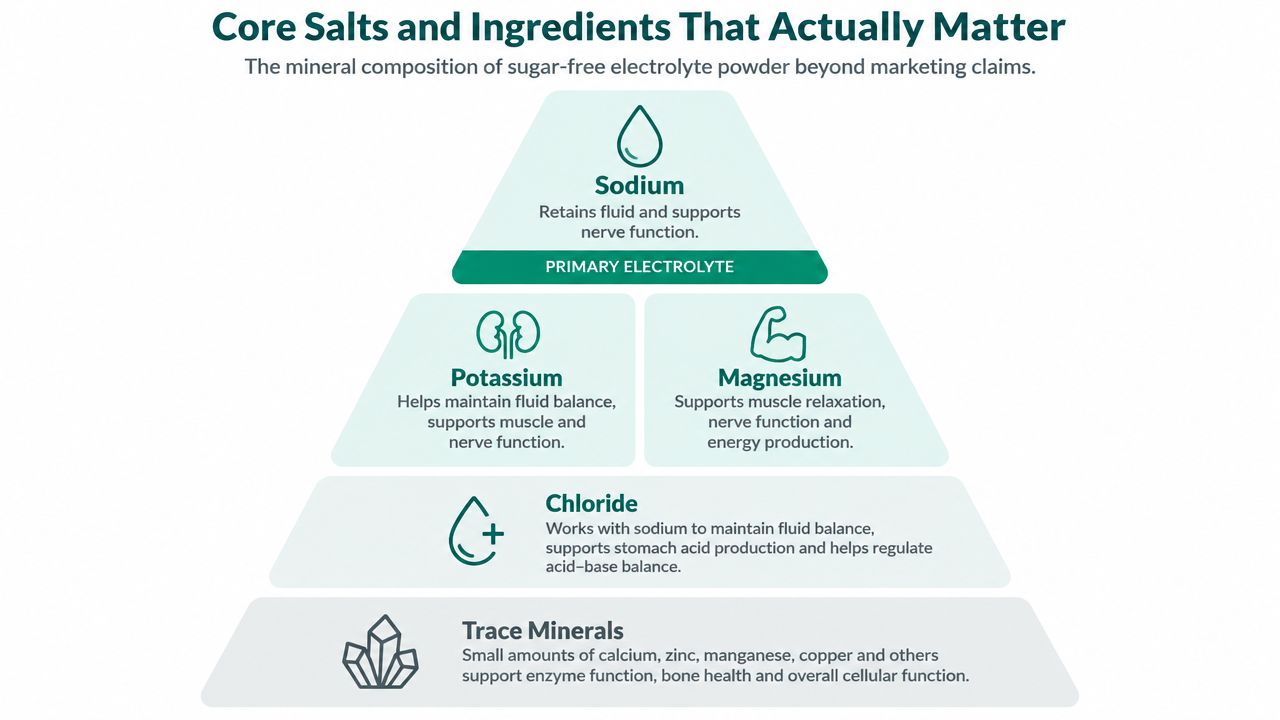
Sodium deserves first position
Sweat contains water and dissolved minerals, and sodium is the electrolyte most directly associated with maintaining fluid outside cells. It also contributes to nerve impulses and muscle contractions. For athletes, the useful number is elemental sodium per prepared drink, not the total weight of a salt compound.
Sodium chloride is familiar table salt and supplies both sodium and chloride. Sodium citrate can taste less aggressively salty and may be easier for some people to tolerate, though the compound name alone doesn't tell you whether the finished drink contains enough sodium. Always find the elemental amount in the nutrition or supplement panel.
Potassium supports normal cellular fluid balance, nerve transmission, and muscle function. It matters, but it shouldn't distract you from a weak sodium dose. A product can advertise a long list of minerals while still failing to provide the sodium concentration a heavy sweater needs.
Supporting minerals and chemical forms
Magnesium participates in energy-related reactions and neuromuscular function. It's often included because muscle and nerve activity rely on it, but magnesium is usually a supporting electrolyte rather than the main driver of rapid rehydration. Compare the elemental magnesium amount and note the form, such as citrate, glycinate, bisglycinate, or oxide, because different forms can vary in taste, solubility, and individual gut tolerance.
Calcium supports muscle contraction, nerve function, and bone health. Chloride works with sodium in fluid balance and is commonly supplied through sodium chloride or other mineral salts. Trace minerals can add breadth to a formula, but they shouldn't compensate for missing core information.
Use this checklist when comparing powders:
- Sodium first: Find the elemental sodium amount per serving and per prepared volume.
- Potassium next: Check whether the formula provides a meaningful supporting amount.
- Magnesium form: Look for elemental magnesium and assess whether the form suits your digestion.
- Chloride and calcium: Treat these as useful supporting details, not the main purchasing trigger.
- Transparent serving size: Confirm how many scoops produce the stated mineral quantities.
Buying insight: A premium ingredient list can still produce a poor hydration drink if the formula hides a low sodium dose behind potassium, magnesium, flavouring, or trace-mineral language.
The ingredient list also needs context. Acids, flavour systems, colours, anti-caking agents, and sweeteners may make a powder easier to drink, but they don't replace electrolyte density. When a product promotes taurine, vitamins, botanical extracts, or exotic mineral sources, check the sodium amount before assigning performance value to the extras.
Decoding Labels and Regulatory Tonicity Claims
Sugar-free status, electrolyte content, and tonicity describe different parts of a drink. A powder can contain no sugar yet deliver too little sodium for a heavy sweat session, or become overly concentrated when mixed with too little water. The useful question is how much sodium reaches the athlete at the stated dilution, and whether the drink's dissolved load supports its tonicity claim.
FSANZ rules applied in New Zealand require an electrolyte drink or electrolyte drink base to contain at least 10 mmol/L of sodium. Isotonic claims are permitted only within an osmolality range of 250–340 mOsmol/kg, and products making isotonic, hypotonic, or hypertonic claims must disclose osmolality on the label. (FSANZ regulatory notice) These are regulatory reference points, not a guarantee that the product matches an individual athlete's sweat losses.
Read the label in this order
Begin with sodium per prepared volume. A serving can appear substantial until you check how much water the manufacturer expects you to add. Convert the listed sodium amount into the final drink volume, because one scoop in a small bottle creates a different sodium density from the same scoop diluted into a large bottle.
Check the mmol figure when it is provided. Milligrams show sodium mass, while millimoles describe the amount of substance and relate directly to the regulatory threshold. A listed salt ingredient does not prove that the finished drink reaches the electrolyte-drink benchmark.
Then examine osmolality information. A label using “isotonic” or “hypotonic” should show a specific osmolality value. A sugar-free formula can still become highly concentrated if its mineral load or other dissolved ingredients are mixed into too little water.
Why product examples expose the gap
Powerade Zero lists 51 mg sodium per serve, equivalent to 2.2 mmol, while the NZ-made Athletech Precision Hydration powder lists 329 mg sodium per 3 g scoop and reaches 987 mg sodium at 9 g. At its highest listed concentration, it provides 132 mg sodium per 100 mL, with zero sugar.
Those figures do not make one product universally better. They show how widely “zero sugar” products can differ as hydration tools. Powerade Zero may suit someone seeking a lightly salted flavoured drink without sugar. Athletech's powder can provide a more concentrated sodium delivery system when prepared according to its instructions.
How to judge an isotonic claim
Treat the preparation instructions as part of the claim. Confirm the final water volume, then check whether the disclosed osmolality matches the stated isotonic or hypotonic description. Finally, compare the resulting sodium density with the session's sweat demands. Regulatory compliance establishes a label standard, not a personal hydration prescription.
For competitive athletes, batch testing and manufacturing transparency add another layer of label confidence. The NZ Supps guide to batch-tested electrolytes explains why those details deserve attention alongside the mineral panel.
Sweetener Profiles and Gut Comfort During Training
Sugar-free powders need a flavour system that can cover saltiness without adding sugar. The choice affects more than taste. During hard exercise, the gut is already under stress, so a product that tastes excellent at the desk can become unpleasant once breathing, movement, and heat rise.
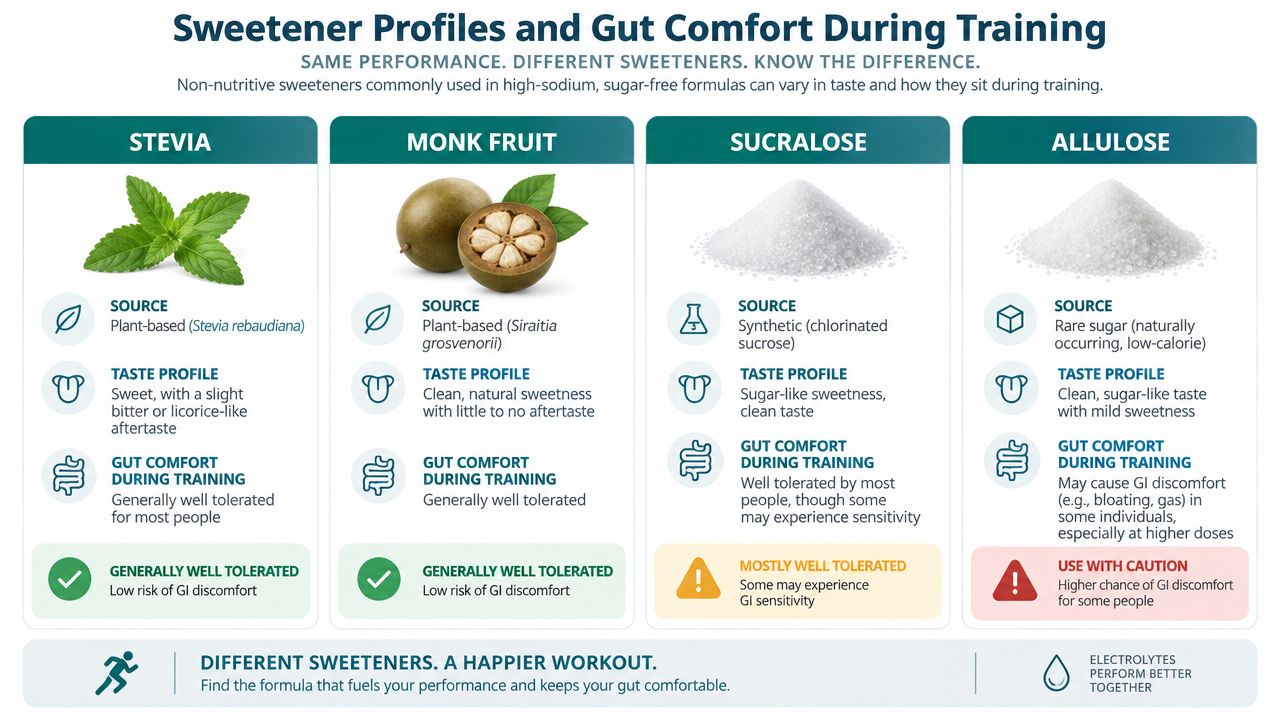
Stevia and monk fruit
Stevia provides strong sweetness with a plant-derived profile, but some people notice a lingering herbal or bitter note. In practice, that aftertaste can become more obvious when a formula contains a high mineral load. It's often a reasonable option for athletes who prefer to avoid artificial sweeteners, provided the finished flavour is drinkable at the required sodium concentration.
Monk fruit is another plant-derived option. It can taste rounded and less herbal than stevia in some blends, although the overall profile depends on the acids, flavours, and bulking ingredients used with it. Neither ingredient proves that a formula will suit your stomach. Personal tolerance still matters.
Sucralose and sugar alcohols
Sucralose can create a clean, familiar sweetness at a low inclusion level. Some athletes tolerate it without issue, while others dislike the aftertaste or prefer to avoid it for personal reasons. The useful approach is not to label every artificial sweetener as harmful, but to test whether the specific product agrees with you during training.
Sugar alcohols deserve more caution when gut comfort is the priority. Ingredients such as sorbitol, erythritol, and maltitol can behave differently from one another, and larger amounts may cause bloating, cramping, or loose stools in sensitive users. A powder that relies heavily on these ingredients may be a poor choice immediately before running or intense intervals.
Allulose and the full formula
Allulose is not a conventional sugar alcohol, but it can still affect people differently. The product's total carbohydrate and calorie lines matter, particularly for athletes who define “no sugar” strictly or are managing intake closely.
Before using a new powder in competition, test it on an ordinary training day:
- Mix it as directed: Don't create an unusually dilute drink just to mask a strong flavour.
- Assess the whole session: Note taste, thirst, stomach pressure, burping, cramping, and bowel urgency.
- Change one variable: If the formula causes trouble, don't simultaneously change gels, caffeine, or meal timing.
- Keep the first trial low-risk: A hard local session is a better testing ground than race morning.
No sweetener is automatically superior for every athlete. The best formula is the one you can drink at the required concentration without flavour fatigue or gastrointestinal disruption. If you need a high sodium dose, flavour engineering becomes part of the performance equation.
When to Choose Zero Sugar Over Carbohydrate Formulas
The best use for an electrolyte powder with no sugar is a session where hydration and mineral replacement matter more than liquid energy. That often includes strength training, short high-intensity workouts, team training where meals provide the fuel, and routine hydration during warm days.
A zero-sugar formula also fits weight-management phases when you don't want every bottle to contribute carbohydrate. It can be practical at work or while travelling, especially when the alternative is a traditional sports drink chosen for convenience rather than need.
Match the drink to the work
Short and intense: A sugar-free electrolyte powder can provide sodium and flavour without adding a carbohydrate drink to a session that doesn't demand it. You'll still need ordinary food and water across the day.
Long and fuel-limited: Cutting sugar may leave you with a drink that replaces minerals but not energy. For multi-hour endurance work, carbohydrate from drinks, gels, bars, or meals may be necessary to maintain output. A separate fuel plan is often more effective than expecting a no-sugar electrolyte powder to supply energy it intentionally doesn't contain.
Hot and sweaty: Heat increases the importance of fluid and sodium planning, but it doesn't create a universal requirement for sugar. Choose based on sweat loss, session duration, and whether you can eat carbohydrate separately.
Everyday use: If you're not sweating heavily, plain water and normal meals may cover your needs. Electrolytes shouldn't become a reflexive substitute for a balanced diet.
A sugar-free electrolyte drink can solve the mineral problem while leaving the energy problem untouched. Decide whether your session has one problem or both.
Glucose has a specific role
Glucose isn't an unwanted ingredient in sports nutrition. Carbohydrate can support sustained exercise and may help the gut move fluid when the drink's overall composition is appropriate. A useful explanation of the exercise situations in which the body targets glucose can help clarify why carbohydrate still belongs in some performance plans.
The practical decision matrix is therefore simple:
| Training situation | Better starting point |
|---|---|
| Brief gym or strength session | Zero-sugar electrolyte powder if sweating warrants it |
| Moderate session with normal meals | Water or a light electrolyte formula |
| Long endurance session | Electrolytes plus a deliberate carbohydrate source |
| Hot-weather training | Sodium and fluid plan matched to sweat loss |
| Weight-management phase | Zero-sugar option, provided sodium density is adequate |
| Race day with limited food access | Carbohydrate and electrolytes together, if tolerated |
Don't turn that table into a rigid rule. A heavy sweater may need more sodium during a shorter session than a light sweater needs during a longer one. Session length sets the fuel question, while sweat rate drives the electrolyte question.
Criteria for Comparing Sugar Free Electrolyte Products
Shopping becomes easier when you compare finished drinks rather than tubs, scoops, or front-label claims. A formula that appears cheap per serving may require multiple scoops to produce its stated sodium concentration. The meaningful comparison is the amount of sodium and the total drink characteristics you receive at the mixing instruction you'll use.
| Evaluation Criteria | What to Look For | Why It Matters |
|---|---|---|
| Sodium per serve | Clearly stated elemental sodium | Shows whether the product can support meaningful replacement |
| Sodium density | Sodium related to final drink volume | Prevents a large serving of water from hiding a light dose |
| Osmolality | Disclosure when isotonic or hypotonic claims are made | Helps verify the product's tonicity positioning |
| Sugar and calories | Complete nutrition panel, not only front-pack claims | Confirms whether “no sugar” also fits your energy goals |
| Sweetener system | Named sweeteners and supporting ingredients | Helps predict taste and individual gut tolerance |
| Testing status | Independent batch-testing details | Matters for drug-tested competitors concerned about contamination |
| Serving economics | Cost per effective serving, not cost per scoop | Exposes formulas that need several scoops for practical use |
Compare the prepared formula
Write down four label details before buying: sodium per serving, water volume, number of scoops, and price per container. Then compare products at the concentration you need. If one powder lists a strong sodium amount only when you use several scoops, its real serving cost and taste burden may be less attractive than the tub suggests.
Osmolality deserves special attention because it describes the concentration of dissolved particles in the prepared drink. A product can be sugar-free and still be highly concentrated. Conversely, it can be refreshing and easy to drink while delivering very little sodium. Neither outcome can be judged from sugar content alone.
The comparison of top electrolyte drinks for hydration can provide broader context, but your own decision should still come back to the label. Rankings are useful for discovering options. They aren't a substitute for checking the actual sodium dose and mixing instructions.
Don't pay for decorative complexity
Vitamins, amino acids, botanicals, and trace minerals may have a place, but they shouldn't obscure the core hydration data. If the product doesn't clearly state elemental sodium, potassium, magnesium, serving volume, and sugar content, move on.
Third-party batch testing is a separate quality question from performance suitability. A tested product may reduce concern about prohibited-substance contamination, but it can still be under-dosed for a heavy sweat session. Use both filters, mineral adequacy and manufacturing confidence.
For a New Zealand-focused way to compare hydration formats, see the NZ Supps hydration powder guide. The useful habit is to compare like with like, prepared drink against prepared drink, rather than powder against powder.
Situational Recommendations for NZ Athletes
Different athletes need different electrolyte strategies, even when they all search for the same phrase. Start with the session, then inspect sodium density, then consider taste and certification. The best no-sugar powder is the one that solves your actual sweat problem without creating a fuel or gut problem.
Drug-tested competitive athletes
Choose transparency over clever branding. Look for independent batch testing, including recognised programmes such as Informed Sport, Informed Choice, NSF Certified for Sport, or HASTA, and verify the certification applies to the specific product and batch where that information is available.
Batch testing doesn't tell you whether the sodium dose suits you. It addresses a different risk, contamination and competition compliance. Keep the product label, batch details, and purchase record, particularly when preparing for an event where supplement scrutiny matters.
Heavy sweaters and hot-weather trainers
Put sodium at the top of the shortlist. Compare the prepared sodium concentration, not merely the number of minerals listed. A high-sodium powder may suit long outdoor rides, field sessions, or hot training better than a lightly salted drink, but concentration must still follow the manufacturer's mixing instructions.
Avoid copying another athlete's dose without assessing your own sweat pattern. Salt residue on clothing, noticeable thirst after training, and repeated heavy sweating can justify a closer label review, but they don't replace medical advice where health conditions or medication affect sodium and potassium handling.
Gym-goers and strength trainees
A lighter formula may be adequate for a normal session, particularly when meals and fluids are consistent. Zero sugar is useful here when you want flavour and electrolytes without adding carbohydrate to a workout that isn't energy limited.
Prioritise a clean ingredient list and good taste. If you have to force down an aggressively salty drink, you won't use it consistently. A moderate product that you reliably drink can be more practical than a concentrated formula reserved for conditions you rarely encounter.
Weight-management consumers
Check more than the sugar line. Confirm total calories, carbohydrate, serving size, and sweetener type. “Sugar-free” can still mean the product contains other ingredients that affect your dietary tracking, so use the full nutrition panel.
A no-sugar electrolyte powder also shouldn't become a replacement for meals or ordinary fluids. Use it when sweating, heat, travel, or training creates a clear reason for electrolyte support, and keep your overall intake organised around food quality and hydration habits.
For broader planning around fluid, sodium, and training conditions, this hydration guide for athletes offers useful context. The buying sequence remains the same: identify the session, check sodium density, verify tonicity claims, then choose the sweetener and testing profile you can live with.
NZ Supps makes it easier to compare transparent hydration labels, per-serve value, and tested sports products in one NZ-owned catalogue. Visit NZ Supps to filter electrolyte options by your training needs, check batch-tested ranges, and choose a no-sugar formula based on sodium rather than front-label marketing.