SHOP NOW, PAY LATER
















 Informed Sport
 Informed Choice
 NSF Certified for Sport
 HASTA Certified

Krill oil suits people chasing antioxidant support and a slightly different absorption profile, while fish oil remains the better pick for most people who want the most EPA and DHA per dollar and the deepest pool of clinical evidence behind it. That’s the short version. The longer version comes down to a handful of trade-offs: how each oil gets absorbed (phospholipid versus triglyceride form), how much EPA and DHA actually lands in a serving, whether krill’s astaxanthin content matters clinically, and which oil has the stronger track record in heart-focused trials.
Neither oil is a clear universal winner. Fish oil dominates on cost and dose density. Krill oil has a genuine, if narrow, edge in a few absorption studies and brings along an antioxidant that fish oil doesn’t have.
- Lowering triglycerides on a budget: fish oil, concentrated triglyceride or ethyl ester form, dosed to your doctor’s target.
- Curious about antioxidants and smaller capsules: krill oil, phospholipid form, at a dose that still hits a meaningful EPA+DHA total.
- Shellfish allergy: fish oil only. Krill is a crustacean and carries real allergy risk.
Pro Tip: Don’t compare capsules to capsules. Compare milligrams of EPA+DHA to milligrams of EPA+DHA. A “1000 mg” krill softgel and a “1000 mg” fish oil softgel are not delivering the same active dose, not even close.
Key Takeaways
Fish oil delivers more EPA and DHA per dollar and carries the stronger evidence base for heart health, while krill oil offers a phospholipid form and astaxanthin content that appeal to a narrower set of goals.
| Point | Details |
|---|---|
| Absorption edge is real but narrow | A 30-day crossover trial found 35.6% higher plasma EPA relAUC with krill oil, but in only 11 participants. |
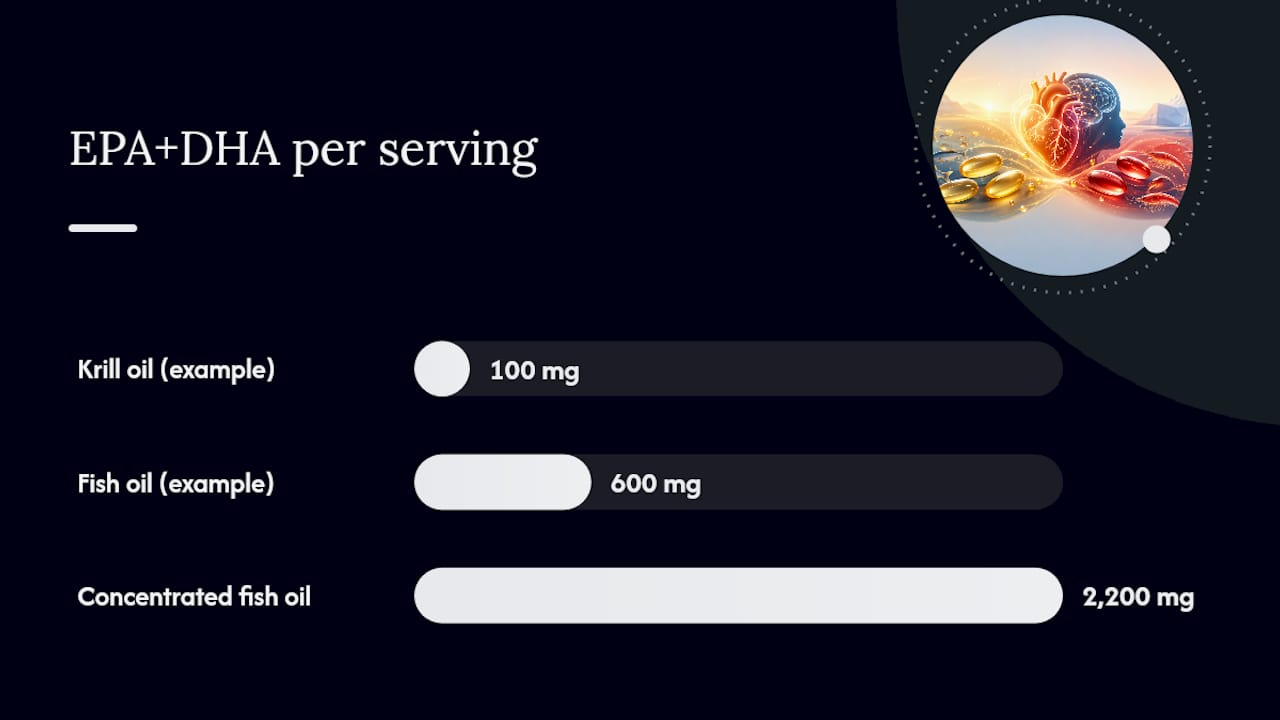
| Dose density favors fish oil | Fish oil delivers up to 2,200 mg EPA+DHA per serving versus krill oil’s typical less than 300 mg per softgel. |
| Shellfish allergy rules out krill oil | Krill are crustaceans, so anyone with a shellfish allergy should avoid krill oil entirely. |
| Cost per milligram favors fish oil | Krill oil’s harvesting and processing costs typically make it more expensive per milligram of EPA+DHA. |
| Check labels before choosing either | Nzsupps curates supplements with disclosed ingredient panels, useful for comparing EPA+DHA totals directly on the shelf. |
Table of Contents
- Fish Oil vs Krill Oil Absorption: What the Science Says
- What Do Clinical Trials Actually Show?
- How to Compare EPA and DHA Doses Across Brands
- Does Astaxanthin in Krill Oil Make a Real Difference?
- Which Oil Has Stronger Evidence for Heart Health?
- What Do Trials Say About Brain and Cognitive Effects?
- Side Effects, Allergies, and Drug Interactions to Know
- Comparing the Real Cost Per Milligram of Omega-3
- Sustainability and Sourcing: What to Check Before You Buy
- A Goal-Based Checklist for Choosing Between Fish Oil and Krill Oil
- How to Take Your Supplement Without the Fishy Aftertaste
- The Bottom Line on Fish Oil vs Krill Oil
- A Note on How This Comparison Was Built
- Where NZ Supps Fits Into Your Omega-3 Decision
- Frequently Asked Questions
- Sources
Fish Oil vs Krill Oil Absorption: What the Science Says
Fish oil carries its omega-3s as triglycerides (or, in concentrated pharmaceutical products, as ethyl esters). Krill oil carries most of its omega-3s bound to phospholipids, the same molecular backbone your cell membranes are built from. That structural difference is the entire basis of the “krill absorbs better” marketing claim, and it’s not a made-up idea. Phospholipids are more water-soluble than triglycerides, so in theory they mix into the gut more easily and get shuttled into cells through slightly different pathways.
Theory and lab chemistry are one thing. Human blood is another. Trial results comparing plasma EPA and DHA uptake between the two oils have been inconsistent, and it depends heavily on dose, formulation, and how long the study ran.
The most cited data point in this debate comes from a small 30-day randomized crossover trial in 11 healthy women. Participants took krill oil (1.27 g of long-chain omega-3s daily) and fish oil (1.44 g daily) in separate phases, with blood drawn along the way.
Krill oil produced a significantly higher plasma EPA relAUC at both day 15 and day 30, compared with fish oil (p = 0.045). The two oils also drove different changes across 43 distinct plasma lipid molecular species, meaning they don’t just raise the same numbers by different amounts. They actually remodel your blood lipid profile in different ways.
That sounds like a decisive win for krill oil, and headlines have treated it that way. But it’s a trial with 11 participants over one month. Other comparisons, including a broader review summarized by University of Washington nutrition researchers, have found total absorption comes out roughly similar once doses are properly matched. The honest read: krill oil’s phospholipid form may give it a modest, dose-dependent edge in some contexts, but “krill oil absorbs 300% better” style claims you see on supplement packaging are not supported by the full body of research.
- Small trials (10 to 30 people) can show real but fragile effects that don’t always replicate at scale.
- Absorption differences don’t automatically translate into better health outcomes. Getting more EPA into plasma is not the same as fewer heart attacks.
- Dose matching matters. If a krill product delivers less total EPA+DHA than a fish oil product, better absorption per milligram may not close that gap.
Pro Tip: When a label claims “superior absorption,” ask “compared to what dose?” A 500 mg krill softgel absorbing better than a 500 mg fish oil softgel still might deliver less total omega-3 than a 1200 mg fish oil softgel absorbing at a normal rate.
What Do Clinical Trials Actually Show?
The evidence base breaks into three tiers: randomized controlled trials, smaller crossover studies, and meta-analyses pooling multiple trials together. Fish oil has the deeper bench here simply because it’s been studied far longer and in far larger cardiovascular outcome trials. Krill oil research is newer, smaller in scale, and concentrated more on lipid markers and absorption than on hard outcomes like heart attacks or strokes.
The standout krill-specific study remains the 30-day lipidomic crossover trial referenced above, run on healthy adult women and showing a significantly higher plasma EPA relAUC with krill oil than fish oil. It’s rigorous for its size, but its size is also its limit: 11 participants is enough to detect a signal, not enough to settle the question.
One trial found a substantial difference in plasma EPA relAUC between krill and fish oil after 30 days, but that finding comes from just 11 participants.
| Study | Design | Sample | Key endpoint | Main result |
|---|---|---|---|---|
| Krill vs. fish oil lipidomics trial | Randomized crossover | 11 healthy women | Plasma EPA relAUC, lipid species | KO showed significantly higher EPA relAUC at day 30 (p = 0.045) |
| Krill oil formulation reviews | Systematic review / network meta-analysis | Multiple pooled trials | Triglyceride change | KO phospholipid/FFA forms at 2,000 to 2,900 mg reduced triglycerides in some formulations |
| Broader omega-3 cardiovascular reviews | Meta-analyses of RCTs | Thousands (pooled) | CV events, lipid markers | Consistent triglyceride lowering; mixed results on hard cardiovascular outcomes |
- Randomized crossover trials are strong for isolating absorption differences within the same people.
- Meta-analyses give a wider view but often mix formulations and doses, muddying head-to-head comparisons.
- Evidence for krill oil’s bioavailability advantages remains formulation and dose dependent, not universal.
How to Compare EPA and DHA Doses Across Brands
Here’s the part most shoppers skip, and it’s the one that actually determines whether a supplement does anything: the total EPA plus DHA per serving, not the oil source, not the capsule size, not the marketing copy on the front of the bottle. A supplement built around whole fish flesh or krill meal that’s mostly filler and low in actual omega-3s isn’t doing much no matter how it’s absorbed.

This is where the practical gap between fish oil and krill oil gets stark. According to Healthline’s product comparisons, fish oil supplements typically supply somewhere between 300 mg and 2,200 mg of combined EPA+DHA per serving, depending on concentration. Krill oil products commonly provide noticeably less EPA+DHA per soft gel compared with concentrated fish oil products.
That means matching doses with krill oil often requires taking several capsules where one or two fish oil softgels would do the job.
| Oil type | Typical EPA+DHA per serving |
|---|---|
| Standard fish oil | 300 mg |
| Concentrated fish oil | Up to 2,200 mg |
| Krill oil | less than 300 mg per softgel |
If you want a general maintenance dose, 250 to 500 mg combined EPA+DHA daily is a common baseline. Reaching that with krill oil might mean two to four capsules; a single concentrated fish oil softgel can cover it in one.
- General maintenance: 250 to 500 mg EPA+DHA daily, achievable with either oil if dosed correctly.
- Triglyceride reduction: doses often climb toward 2 to 4 grams daily, territory where prescription-strength fish oil (ethyl ester or triglyceride form) is far easier to hit than krill oil without swallowing a handful of capsules.
- Prescription-level use: always physician-supervised. Don’t self-dose at pharmaceutical thresholds using over-the-counter softgels of either type.
Because krill capsules run lower in EPA+DHA per unit, check the supplement facts panel for the actual milligram total, not just the overall oil weight listed on the front label.
Does Astaxanthin in Krill Oil Make a Real Difference?
Astaxanthin is a carotenoid pigment, the same class of compound that gives salmon and flamingos their color, and it’s a genuine antioxidant. Krill oil naturally contains it. Most standard fish oil does not, unless it’s specifically fortified. That’s the entire basis for the “krill oil fights oxidative stress better” claim you’ll see repeated across supplement marketing.
The antioxidant argument is real in principle. Astaxanthin has documented antioxidant activity in lab and some clinical settings, and its presence may also help protect the oil itself from oxidizing on the shelf. What’s thinner is direct clinical proof that the astaxanthin dose delivered by a standard krill oil softgel produces a measurable health outcome on its own, separate from the omega-3 content. Cleveland Clinic’s comparison notes krill oil’s astaxanthin content as a genuine point of difference, while still cautioning that consumers need transparent sourcing and third-party testing to trust label claims about how much is actually in the bottle.
- Consumer claim: “Astaxanthin in krill oil reduces oxidative stress and inflammation more than fish oil.”
- What trials show: astaxanthin has antioxidant properties in isolated research, but dedicated outcome trials tying krill oil’s specific astaxanthin dose to clinical benefits (not just lab markers) are limited.
- What matters more in practice: whether the brand discloses actual astaxanthin content per serving and backs it with batch testing.
A typical krill oil softgel contains a small, often unlisted amount of astaxanthin, frequently in the low single-digit milligram range or less per serving, well under the doses used in most standalone astaxanthin research.
If antioxidant support is your main goal, a dedicated astaxanthin supplement dosed and tested for that purpose may make more sense than relying on the incidental amount in a krill oil softgel. For guidance on evaluating supplement claims and transparency, see Kava vs Kratom article.
Which Oil Has Stronger Evidence for Heart Health?
Fish oil has the far longer and larger clinical track record for cardiovascular outcomes. Krill oil has some promising lipid-marker data, but nowhere near the scale of trials behind fish oil’s reputation as a heart-health supplement.
Large pooled analyses of omega-3 trials consistently show triglyceride reductions with fish oil, and that effect is one of the more reliable findings in the entire omega-3 literature according to reviews of cardiovascular pathways and outcomes. Where the evidence gets murkier is on harder endpoints: does taking a fish oil supplement actually reduce heart attacks, strokes, or cardiovascular death? Large outcome trials have produced mixed results, with effects that vary by dose, by formulation, and by whether the person already has elevated triglycerides to begin with.
The honest position from cardiovascular researchers is that eating oily fish remains the preferred route to omega-3 benefits, and whether supplements replicate that benefit for reducing cardiovascular events remains genuinely unsettled, even after decades of trials.
Formulation matters as much as source. Fish oil comes in three common forms: natural triglyceride, concentrated ethyl ester, and re-esterified triglyceride, each with different absorption and cost profiles. Krill oil is almost always sold in its natural phospholipid form. Some krill oil phospholipid and free fatty acid formulations at doses of 2,000 to 2,900 mg have shown triglyceride reductions in trials, but that’s a specific formulation at a specific dose range, not a blanket claim that applies to every krill product on a shelf.
Meta-analyses pooling omega-3 trials show consistent triglyceride lowering as one of the most reproducible cardiovascular benefits across both oil types.
- What the evidence reliably supports: triglyceride reduction with adequate dosing of either oil, particularly at 2 grams or more of combined EPA+DHA daily.
- What’s mixed or unresolved: whether supplementation meaningfully reduces heart attacks, strokes, or cardiovascular death in the general population, independent of baseline triglyceride levels.
- Where krill needs more data: large-scale, long-duration outcome trials comparable in size to the fish oil cardiovascular trials run over the past three decades.
If lowering triglycerides is your primary goal and you want the deepest evidence base behind your choice, fish oil at a clinically relevant dose remains the better-supported option today.
What Do Trials Say About Brain and Cognitive Effects?
Most cognitive research on omega-3s has used fish oil, not krill oil, which means the krill-specific data on brain health is thin by comparison. That’s worth knowing upfront, because krill oil marketing sometimes borrows fish oil’s cognitive research and applies it loosely to krill products that were never actually tested.
For healthy adults without existing cognitive impairment, the evidence that omega-3 supplements meaningfully improve memory, focus, or mood is limited and inconsistent across trials. Some studies show modest benefits in specific subgroups, such as older adults with mild cognitive decline or people with low baseline omega-3 status, but broad claims about omega-3s sharpening cognition in the general population outrun what the data supports.
Systematic reviews of omega-3 and cognition trials generally find effects, when present, tend to be strongest in populations that started with a measurable deficiency or age-related decline, not in cognitively healthy adults.
- Memory: modest evidence for benefit in older adults with early decline; little consistent evidence in healthy younger adults.
- Mood: some trials suggest omega-3s may help as an adjunct for depressive symptoms, though results vary by dose and existing treatment.
- Age-related decline: the most consistent (though still not definitive) area of benefit, largely studied using fish oil formulations rather than krill oil.
Krill oil’s phospholipid structure has led to speculation that it might cross into brain tissue more efficiently, since phospholipids are a core building block of neuronal membranes. That’s a reasonable hypothesis, but it remains largely untested in dedicated human cognition trials at this point.
Pro Tip: If cognitive support is your main reason for supplementing, don’t expect dramatic results from either oil unless you’re addressing an actual deficiency. Omega-3 status testing (via a simple blood panel) tells you more about whether supplementation is likely to help than any label claim will.
Side Effects, Allergies, and Drug Interactions to Know
Both oils share a similar side effect profile at typical doses: mild gastrointestinal upset, a fishy aftertaste or burps, and occasional loose stools, especially when starting out or increasing dose quickly. Krill oil is often reported as slightly milder on the burp front, though this varies by brand, freshness, and individual tolerance.
The allergy issue is where the two oils genuinely diverge. Krill are crustaceans, closely related to shrimp, and krill oil carries a real risk for anyone with a shellfish allergy. Fish oil, derived from fish rather than shellfish, is generally safer for people with shellfish allergies specifically, though anyone with a fish allergy needs to avoid fish oil instead.
Anyone with a known shellfish allergy should treat krill oil as off-limits without an allergist’s clearance. Cross-reactivity risk is a genuine safety concern, not a theoretical one.
Drug interactions matter most for anyone on blood thinners. Omega-3s, from either source, can increase bleeding risk at higher doses, and this effect compounds when combined with anticoagulant or antiplatelet medications. Clinical guidance on omega-3 safety generally recommends caution and physician oversight at doses above 3 grams daily, particularly for people already on blood-thinning medication or scheduled for surgery.
- Stop or reduce omega-3 supplementation before scheduled surgery, on your surgeon’s guidance, due to bleeding risk.
- Talk to a doctor before combining high-dose fish oil or krill oil with warfarin, aspirin therapy, or other anticoagulants.
- Pregnant or nursing individuals should stick to food-based or supplement doses cleared by their obstetric provider rather than self-selecting high-dose products.
- Discontinue and consult a clinician if you notice unusual bruising, prolonged bleeding from small cuts, or blood in stool while supplementing.
Common questions worth flagging here, answered in more detail further down: is it safe to take fish oil and krill oil together, and does either oil interact with common medications beyond blood thinners? Both deserve a direct look before you commit to daily use.
Comparing the Real Cost Per Milligram of Omega-3
The sticker price on a bottle tells you almost nothing. What matters is cost per milligram of EPA+DHA actually delivered, and that’s where krill oil’s premium pricing becomes hard to justify for most budgets.
Here’s the math: take the bottle price, divide by the number of servings, then divide by the milligrams of EPA+DHA per serving. That gives you a true cost-per-milligram figure you can compare across brands and oil types. A fish oil product priced similarly to a krill oil product but delivering four to ten times the EPA+DHA per serving is, dollar for dollar, a dramatically better value, even before factoring in any absorption differences.
Market comparisons consistently show fish oil is cheaper per milligram of EPA+DHA than krill oil, sometimes by a wide margin, because krill harvesting, processing, and cold-chain handling cost more than standard fish oil extraction and refining.
- Harvesting cost: krill must be processed almost immediately after catch to prevent enzymatic breakdown, driving up production costs compared with fish oil’s more established supply chain.
- Concentration: fish oil is more commonly sold in concentrated forms (up to 2,200 mg EPA+DHA per serving), spreading processing costs over a bigger active dose.
- Marketing premium: krill oil is frequently marketed as a premium product, and pricing often reflects that positioning more than any proven superior outcome.
Pro Tip: Do the cost-per-milligram math before you buy, not after. A $40 bottle of krill oil delivering 100 mg EPA+DHA per capsule can cost several times more per milligram than a $20 bottle of fish oil delivering 600 mg per capsule, even though the krill bottle looks like the better deal at a glance.
Sustainability and Sourcing: What to Check Before You Buy
Krill sit low on the marine food chain, and their populations are large and fast-reproducing, which is a point in favor of krill harvesting compared to depleting larger predatory fish stocks. But krill are also a foundational food source for whales, seals, and penguins in the Southern Ocean, and harvesting pressure in concentrated fishing zones raises real ecological questions that go beyond simple population counts.
Fish oil sourcing carries its own set of concerns: bycatch of non-target species, pressure on wild fish stocks already stressed by broader fishing industry demand, and variability in how responsibly different fisheries are managed. Neither oil source is automatically the “clean” choice. Both require scrutiny of where and how the raw material was harvested.
Look for independent certifications rather than taking a brand’s own sustainability claims at face value. Marine Stewardship Council (MSC) certification, Friend of the Sea (FOS) certification, and clear public sourcing disclosures (species, catch location, harvesting method) are the kinds of signals worth checking on a label or company website before assuming a product is genuinely sustainably sourced.
| Sourcing factor | Fish oil | Krill oil |
|---|---|---|
| Population resilience | Varies by species, some stocks stressed | Generally large, fast-reproducing population |
| Ecosystem role | Bycatch risk affects non-target species | Krill are a key food source for whales and seabirds |
| Common certifications | MSC, FOS, IFOS | MSC, sourcing transparency reports |
- Ask whether the brand publishes catch location and species information, not just a vague “sustainably sourced” claim.
- Check for a named third-party certification logo rather than an in-house sustainability badge.
- Be skeptical of “eco-friendly” language with no certification body or verifiable sourcing data behind it.
A Goal-Based Checklist for Choosing Between Fish Oil and Krill Oil
Work through this in order. Each step narrows the decision based on what actually matters clinically, not what sounds impressive on packaging.
- Identify your primary goal first. Triglyceride reduction, general maintenance, and antioxidant interest each point toward different dosing strategies and, in some cases, different oils entirely.
- Check the actual EPA+DHA total per serving, not the total oil weight. This single number matters more than oil source, brand reputation, or capsule size.
- Confirm the formulation matches your dose target. If you need 2 or more grams of combined EPA+DHA daily, concentrated fish oil (triglyceride or ethyl ester form) will almost always be more practical than krill oil.
- Look for third-party testing or certification confirming the label’s EPA+DHA and, where claimed, astaxanthin content actually matches what’s inside the capsule.
- Screen for allergens. Anyone with a shellfish allergy should rule out krill oil immediately, no exceptions.
- Weigh sustainability certification if ecological sourcing factors into your buying decision, checking for MSC or FOS marks specifically.
- Calculate cost per milligram of EPA+DHA before comparing final prices across brands.
- Higher clinical dosing needs generally favor fish oil, for cost and capsule-count reasons.
- Interest in astaxanthin and a slightly different absorption curve leans toward krill oil.
- Shellfish allergy is an automatic disqualifier for krill oil, full stop.
Red flags to watch for: vague “proprietary blend” labeling that hides the actual EPA+DHA amount, no visible third-party testing certification, and sustainability claims with no named certifying body attached.
Pro Tip: If you’re genuinely unsure which oil fits your goal, a quick way to check your baseline is asking your doctor about an omega-3 index blood test before committing to a specific product or dose long term. It tells you where you’re starting from, which makes the rest of this checklist far more precise.
How to Take Your Supplement Without the Fishy Aftertaste
Getting the timing and storage right does more for your experience than switching oil types ever will.
- Take your softgel with a meal that includes some fat, which improves absorption and reduces the odds of a fishy repeat later in the day.
- Split doses across two meals if you’re taking a higher total amount, rather than swallowing everything at once.
- Try freezing the capsules if burps are a persistent problem. A frozen softgel dissolves slower in the stomach, cutting down on that lingering aftertaste.
- Consider an enteric-coated option if standard softgels consistently cause reflux or burps, since the coating delays breakdown until the capsule clears the stomach.
- Store the bottle in a cool, dark place, away from direct sunlight and kitchen heat sources, and refrigerate if the label recommends it, particularly for krill oil.
Oxidized fish or krill oil doesn’t just taste worse. It’s less effective and can produce more pronounced stomach upset. Check for a sharp, unpleasant, paint-like smell rather than a mild ocean scent. That’s your signal to discard the bottle rather than push through it.
Pro Tip: Snap a capsule open over a paper towel if you’re ever unsure about freshness. A clear or pale yellow oil with a mild smell is normal. Dark, cloudy, or sharply pungent oil means it has likely oxidized and should be thrown out.
The Bottom Line on Fish Oil vs Krill Oil
For most goals, fish oil remains the stronger default: cheaper per milligram of EPA+DHA, backed by a far larger body of cardiovascular research, and easier to dose at clinically meaningful levels without swallowing a handful of capsules daily.
- Best for budget: fish oil, concentrated form, for the lowest cost per milligram of EPA+DHA.
- Best for antioxidant curiosity: krill oil, for its natural astaxanthin content, understanding the clinical proof behind that specific benefit is still thin.
- Best for triglyceride reduction at matched doses: either oil works, but fish oil makes hitting the required 2+ gram daily dose far more practical.
- Best for shellfish allergy: fish oil, without question.
Fish oil wins on evidence, dose density, and cost for most people chasing heart health, while krill oil earns its place for a smaller group specifically drawn to its antioxidant content and phospholipid form.
A Note on How This Comparison Was Built
I approached this comparison the way I’d want someone to approach it for me: start with what the trials actually measured, not what the marketing implies. The krill oil absorption story is more nuanced than either camp likes to admit. It’s genuinely interesting science, but it’s built on small trials that haven’t yet scaled into the kind of outcome data fish oil has accumulated over decades.
Nzsupps sells supplements, including omega-3 products, and that context matters here. Nothing in this comparison changes because of that. The evidence for fish oil’s dosing efficiency and cost advantage stands regardless of who’s publishing it, and I’ve flagged krill oil’s genuine strengths (astaxanthin, some absorption signals) just as plainly as its limitations.
Where NZ Supps Fits Into Your Omega-3 Decision
Once you’ve decided which oil fits your goals, the next question is whether you can trust what’s actually in the bottle. That’s where sourcing transparency and batch testing separate a reliable supplement from a gamble, especially with a category like omega-3s, where oxidation and mislabeled concentrations are common problems.
Nzsupps curates its omega-3 and general health lineup from brands that disclose their ingredients clearly, rather than hiding EPA+DHA totals behind vague “fish oil blend” language. If you’ve landed on fish oil as your pick after reading through the dosing math above, checking a product’s actual EPA+DHA concentration per serving against your target dose is the single most useful thing you can do before adding it to your cart. For general performance and recovery support alongside your omega-3 routine, the Basic Supplements Isolate protein range is a solid place to start, with fully disclosed ingredient panels you can check the same way you’d check an omega-3 label. And before you commit to any supplement claiming third-party testing, it’s worth learning how to actually verify that testing rather than taking a badge on the label at face value. Browse the current lineup and start comparing labels for yourself.
Frequently Asked Questions
Is krill oil or fish oil better for heart health? Fish oil has the larger and longer clinical track record for cardiovascular outcomes and triglyceride reduction. Certain krill oil formulations at specific doses show triglyceride benefits too, but the overall evidence base is smaller and less consistent.
Which is better, krill or fish oil, for people on blood thinners? Both carry increased bleeding risk at higher doses when combined with anticoagulant medication. Anyone on blood thinners should consult a doctor before starting either supplement, particularly above 3 grams daily.
Can I take fish oil and krill oil together? There’s no established danger in combining them, but doing so mainly adds cost without a clear benefit over simply taking a properly dosed single product. Track your total combined EPA+DHA either way to avoid excessive intake.
Is krill oil safe if I have a shellfish allergy? No. Krill are crustaceans, closely related to shrimp, and cross-reactivity risk is real. Choose fish oil instead, and confirm with an allergist if you have any doubt.
Why does krill oil cost more than fish oil? Krill require rapid processing after harvest to prevent breakdown, and krill oil products typically deliver far less EPA+DHA per serving than concentrated fish oil, both of which push up the price per milligram of active omega-3.
This article is general information, not a substitute for advice from a qualified doctor. Consult a qualified healthcare professional about your own circumstances before acting on anything here.
Sources
- Krill oil has different effects on the plasma lipidome compared with fish oil following 30 days of supplementation in healthy women, Nutrients (Victoria University repository)
- Comparison of bioavailability of krill oil versus fish oil and health effect, PMC (review/meta-analysis listing)
- Krill oil vs fish oil, Cleveland Clinic
- Omega-3 fatty acids and the heart: new evidence, more questions, Harvard Health