SHOP NOW, PAY LATER












 Informed Sport
 Informed Choice
 NSF Certified for Sport
 HASTA Certified

Liposomal vitamin C is not the clear winner the marketing suggests, and regular vitamin C is not the loser either. For most healthy adults taking a standard 250 to 500 mg daily dose, regular ascorbic acid remains the better value, meeting the body’s needs at a fraction of the cost. Human trials show liposomal forms can raise plasma levels by a modest but variable amount over standard vitamin C in some formulations, but that bump rarely translates into proven differences in how you feel, heal, or fight off a cold.
Liposomal vitamin C earns a real look in a few specific situations:
- You take single high doses (3 to 4 grams or more) where the gut’s absorption capacity maxes out with plain ascorbic acid.
- Regular vitamin C consistently upsets your stomach or triggers diarrhea at doses you actually need.
- A clinician has recommended a high-dose protocol and you need better tolerated, higher-yield delivery per dose.
Outside those cases, a 2025 scoping review found liposomal formulations outperformed non-liposomal versions in bioavailability across most included studies, yet the same review flagged small sample sizes and wide variation between products as real limits on how confidently anyone should act on those numbers.
Key Takeaways
Liposomal vitamin C raises blood levels modestly in controlled trials, but that advantage rarely justifies its cost outside high-dose or gastrointestinal-sensitive situations.
| Point | Details |
|---|---|
| Absorption advantage is real but modest | Trials show liposomal vitamin C raising plasma AUC by about 1.8 times versus regular ascorbic acid at higher single doses. |
| Clinical outcomes remain unproven | Higher blood or leukocyte vitamin C levels have not been clearly linked to better cold recovery or immune outcomes in current trials. |
| Cost per absorbed mg favors regular vitamin C | Liposomal products cost roughly 25 to 50 times more per gram, which rarely pays off at routine 500 mg daily doses. |
| Reserve liposomal for specific cases | High single doses above 1 gram and persistent GI intolerance to ascorbic acid are the strongest reasons to pay the premium. |
| Nzsupps prioritizes transparent labeling | Nzsupps evaluates every vitamin C and supplement listing for disclosed ingredient sources and third-party testing before adding it to the catalog. |
This article is general information, not a substitute for advice from a qualified doctor. Consult a qualified healthcare professional about your own circumstances before acting on anything here.
Table of Contents
- Liposomal Vitamin C vs Regular Absorption: What the Trials Show
- How Liposomal Delivery Works Differently From Regular Vitamin C
- Cost Comparison: Liposomal Vitamin C vs Regular Value Per Dose
- Should You Choose Liposomal Vitamin C? A Decision Checklist
- Safety, Side Effects, and Smart Dosing Practices
- How Nzsupps Evaluates Vitamin C and Other Supplements
- What Actually Deserves Your Attention Here
- Where Nzsupps Fits Into Your Vitamin C Decision
- Sources
Liposomal Vitamin C vs Regular Absorption: What the Trials Show
The pharmacokinetic data is more interesting than most marketing pages let on, and also more modest. Randomized crossover trials, where the same people take both forms on different days so their own biology serves as the control, are the gold standard here, and a handful of them exist for vitamin C.
One frequently cited crossover study found a single 4 gram dose of liposomal vitamin C produced roughly 1.8 times the plasma AUC (area under the curve, a measure of total absorption over time) compared with the same dose of unencapsulated ascorbic acid. Other small trials working with lower doses, around 500 mg to 1 gram, found smaller but still measurable gains. A separate PK study on a moderate liposomal dose reported modestly higher plasma and leukocyte vitamin C compared with ascorbic acid than the ascorbic acid comparison, according to a systematic literature review that pooled 13 studies on alternative vitamin C delivery forms.
The evidence in brief: Across the best controlled human trials, liposomal vitamin C raises blood and leukocyte vitamin C by roughly 20% to 80% versus standard ascorbic acid, depending on dose and formulation. That is a real, measurable pharmacokinetic effect. It is not the tenfold or more improvement some product pages imply.
That gap between what gets measured and what gets marketed matters. A 2024 systematic review covering alternative vitamin C delivery methods, including liposomal and Ester-C formulations, reached a similar conclusion: several alternative forms raised plasma or leukocyte concentrations in at least some studies, but the researchers stressed that clinical outcome data, meaning things patients actually care about, remain thin.
That’s the real fork in the road. Plasma AUC and leukocyte concentration are surrogate markers. They tell you how much vitamin C shows up in blood or immune cells after a dose, not whether that translates into fewer colds, faster wound healing, or better immune function. The trials measuring plasma levels are plentiful enough to draw a modest, real conclusion. The trials measuring whether higher plasma levels change health outcomes are sparse.
A few evidence-quality issues are worth flagging before anyone acts on these numbers:
- Sample sizes in most liposomal PK trials run small, often a few dozen participants or fewer, which limits how confidently results generalize.
- Liposomal products vary widely in phospholipid composition, particle size, and manufacturing process, so results from one branded formulation do not automatically apply to another.
- Some of the underlying research has ties to supplement manufacturers, which does not invalidate the findings but is a reason to weight independent replication more heavily.
- Almost none of the trials followed participants long enough to measure disease outcomes rather than blood chemistry.
None of this means liposomal vitamin C is a scam. It means the honest claim is “higher blood levels in the short term for some formulations,” not “better health outcomes,” and the two are not the same thing.
How Liposomal Delivery Works Differently From Regular Vitamin C
The biology behind this comparison starts with a bottleneck in your gut. Vitamin C absorption in the small intestine depends on a transporter called SVCT1 (sodium-dependent vitamin C transporter 1), and like any transporter, it has a ceiling. At low to moderate doses, SVCT1 absorbs a large share of what you swallow. Push past roughly 1 gram in a single dose, and the transporter starts saturating, so the percentage absorbed drops and much of the excess simply passes through and gets excreted.

Liposomal vitamin C tries to route around that bottleneck entirely. Ascorbic acid gets encapsulated inside a liposome, a microscopic sphere built from a phospholipid bilayer, often using phosphatidylcholine as the primary lipid. Because that structure resembles a cell membrane, some of it may bypass standard gut absorption and get taken up through intestinal cells or lymphatic pathways instead of relying solely on SVCT1. That is the leading theory for why liposomal forms show higher plasma levels at doses where regular vitamin C would be hitting its transport ceiling.
There is a second wrinkle researchers are still working out. The phospholipid carrier itself, not just the vitamin C riding inside it, may carry its own antioxidant or anti-inflammatory activity. If that holds up under more rigorous trials, some of the reported benefits of liposomal products could come from the delivery vehicle rather than from ascorbic acid absorption alone, which would be a genuinely novel mechanism rather than just “better vitamin C.”
- SVCT1 saturation explains why megadosing regular vitamin C past 1 to 2 grams delivers rapidly diminishing returns.
- Liposome structure, not the vitamin C itself, is what changes the absorption pathway.
- Phospholipid carriers are a plausible independent contributor to benefit, still unconfirmed in large trials.
- Formulation quality, meaning liposome size and lipid ratio, varies enormously between brands and is rarely disclosed on labels.
Pro Tip: If you’re comparing liposomal products, look for one that lists the phospholipid source and particle size on the label or a linked certificate of analysis. A product that hides those details is asking you to trust a black box.
Cost Comparison: Liposomal Vitamin C vs Regular Value Per Dose
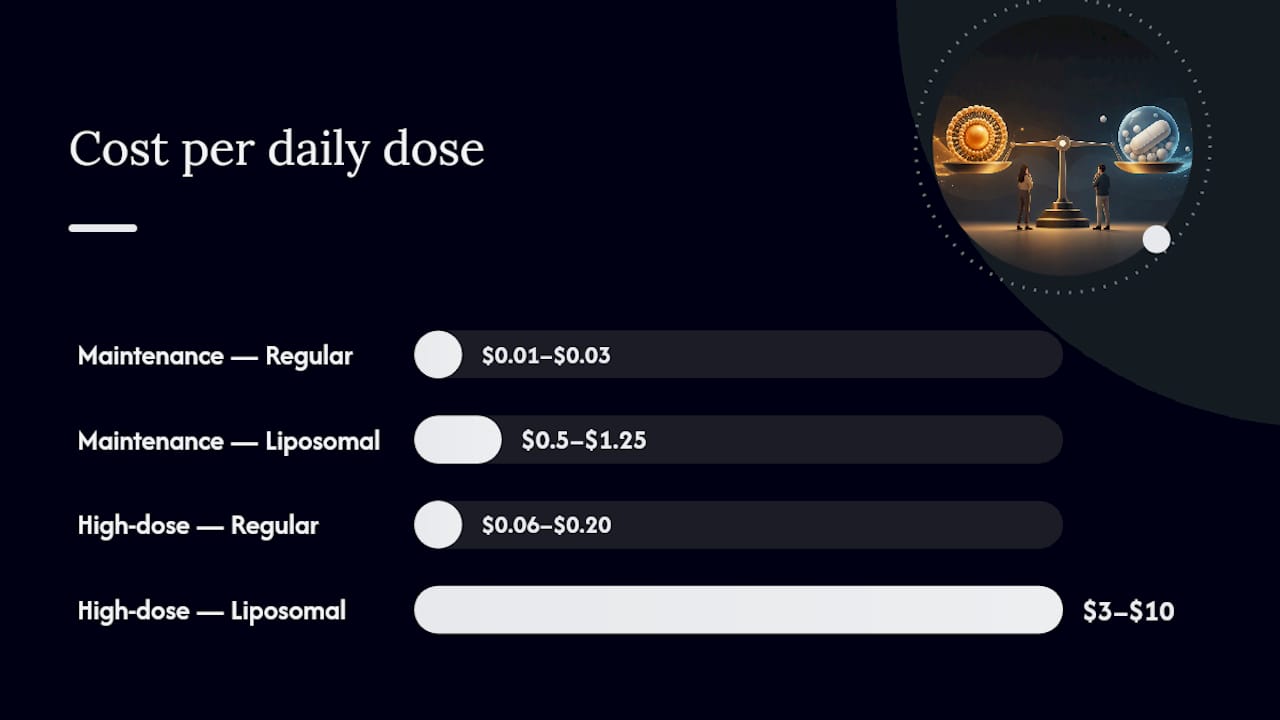
Here is where the decision usually gets made, because the price difference is not subtle. Bulk L-ascorbic acid typically costs somewhere in the range of $0.02 to $0.05 per gram, while liposomal vitamin C products run roughly $1.00 to $2.50 per gram, a premium that can land at 25 to 50 times the price for the raw vitamin C content alone.
Run that against the best-case absorption advantage, and the math gets interesting.
- Routine maintenance, 500 mg per day. Regular ascorbic acid costs roughly $0.01 to $0.025 daily. Even applying the most generous 1.8x absorption multiplier from the crossover trial data, liposomal vitamin C at the same dose costs somewhere near $0.50 to $1.25 daily, meaning you pay 20 to 50 times more for a fraction more absorbed vitamin C you likely did not need anyway, since your body clears excess ascorbate through urine at these levels.
- Acute high-dose protocol, 3 to 4 grams per day. This is the scenario where the math flips. Regular vitamin C at this dose runs into the SVCT1 ceiling, so a meaningful share never gets absorbed, and many people experience loose stools well before reaching 4 grams. Liposomal vitamin C at the same dose, benefiting from the roughly 1.8x AUC advantage seen in trial data, delivers more usable vitamin C per gram taken and is often better tolerated at the higher end, even though the sticker price for that day’s dose is dramatically higher.
The practical conclusion holds steady across most use cases: for everyday 250 to 500 mg maintenance dosing, regular vitamin C is the better value by a wide margin, since the extra absorption liposomal offers doesn’t matter much at doses your gut already handles efficiently. Liposomal only earns its premium at the high end, where its absorption advantage over saturated SVCT1 transport actually shows up in the numbers.
Should You Choose Liposomal Vitamin C? A Decision Checklist
The evidence points toward a narrow set of situations where paying more for liposomal actually makes sense, rather than a blanket recommendation either way.
Liposomal vitamin C is worth considering if:
- You’ve tried regular ascorbic acid at higher doses and reliably get GI upset or diarrhea before reaching your target dose.
- You’re following a clinician-directed high-dose protocol (multiple grams daily) where absorption efficiency at that dose range genuinely matters.
- You have a diagnosed malabsorption condition affecting nutrient uptake generally, not just vitamin C specifically, and your practitioner has suggested it as one option among several.
Regular vitamin C is almost certainly sufficient if:
- You’re taking a standard daily maintenance dose of 500 to 1,000 mg for general health or to support iron absorption from a plant-based meal. Our guide to iron and vitamin C timing covers how to pair them.
- You’re an athlete topping up around training days at typical doses in that same 500 to 1,000 mg range. Our guide to vitamin C and zinc covers what they can and can't do for hard training.
- Cost matters to you at all, since the price gap rarely closes even when liposomal’s absorption edge is real.
A few cheaper alternatives solve some of the same problems liposomal claims to address. Buffered mineral ascorbates (calcium or sodium ascorbate) are gentler on sensitive stomachs than plain ascorbic acid without the liposomal price tag. Splitting a large dose into two or three smaller doses across the day keeps you under the SVCT1 saturation point and improves total absorption almost for free. And if you’d rather skip supplements at doses beyond maintenance entirely, whole foods like citrus, bell peppers, and kiwifruit deliver vitamin C alongside flavonoids that may support its absorption, a pattern worth understanding the way you’d think about absorption differences between supplement forms more generally.
Safety, Side Effects, and Smart Dosing Practices
Higher blood vitamin C is not automatically better vitamin C, and both regular and liposomal forms carry the same underlying safety considerations once you push into high-dose territory.
- Gastrointestinal upset is the most common issue with regular ascorbic acid at high single doses, showing up as cramping, gas, or diarrhea once your gut’s absorption capacity is exceeded.
- Oxalate and kidney stone risk rises with sustained high-dose vitamin C intake, since some ascorbate metabolizes into oxalate; anyone with a history of kidney stones should talk to a doctor before megadosing either form.
- Hemochromatosis and iron-overload conditions are a specific contraindication, because vitamin C significantly boosts non-heme iron absorption, which is exactly backward for someone already storing excess iron.
- Drug interactions matter for certain chemotherapy regimens and a handful of other prescriptions, where high-dose antioxidant supplementation can interfere with treatment mechanisms.
For everyday use, splitting doses (say, 250 mg twice daily instead of 500 mg once) reduces GI symptoms and modestly improves total absorption for either form, since you’re working with your body’s transport capacity rather than against it. Pregnant women, people with kidney disease, and anyone on regular prescription medication should check with a clinician before starting a high-dose regimen of either regular or liposomal vitamin C, not because the vitamin is dangerous at normal doses, but because “higher absorption” is not the same claim as “better outcome,” and a doctor can tell you which one actually applies to your situation.
Pro Tip: If you’re prone to stomach sensitivity, try regular vitamin C split into two smaller daily doses before spending extra on liposomal. It solves the same tolerability problem for a lot of people at a fraction of the cost.
How Nzsupps Evaluates Vitamin C and Other Supplements
Nzsupps built its catalog around one standard: you should be able to see exactly what’s in a product before you buy it. That principle applies just as much to vitamin C as it does to protein or pre-workout formulas.
Transparent labeling and a preference for third-party tested products are the two filters we apply before anything earns a spot in our range, because absorption claims are only as trustworthy as the ingredient list behind them.
When evaluating any vitamin C product, whether regular or liposomal, we recommend applying the same criteria we use ourselves:
- Check whether the label discloses the exact ascorbic acid source and, for liposomal products, the phospholipid type and concentration.
- Favor brands that publish or reference third-party testing rather than relying on internal claims alone.
- Compare stated dose against the price per gram, since that number reveals the real cost-per-absorbed-mg math discussed above.
What Actually Deserves Your Attention Here
The conventional wisdom on liposomal vitamin C splits into two unhelpful camps: it’s either dismissed as a scam or treated as a strict upgrade over regular ascorbic acid. Neither holds up against the trial data. The honest read is narrower and more useful: liposomal delivery solves a real absorption ceiling problem at high single doses, and it does close to nothing extra for someone taking a standard daily maintenance dose.
What gets underestimated is how much dose matters to this whole debate. Most people asking whether liposomal is “better” are taking 500 mg to 1 gram a day, a range where SVCT1 transport isn’t remotely saturated and the liposomal advantage barely registers. The people who should actually care about the AUC and Cmax numbers are the small subset running high-dose protocols or fighting chronic GI intolerance to plain ascorbic acid.
Prioritize the dose question before the formulation question. Figure out how much vitamin C you actually need, then decide whether that number puts you anywhere near the transport ceiling where liposomal’s advantage becomes real rather than theoretical.
Blake
Where Nzsupps Fits Into Your Vitamin C Decision
Whichever way the math points for you, Nzsupps gives you a straightforward way to act on it. Every product on the site lists its ingredients and dosing plainly, so you’re not stuck guessing at what’s actually inside a bottle before you buy, whether you’re stocking up on straightforward daily-maintenance nutrients or dialing in a higher-dose recovery stack alongside your training. You can compare every option in our greens and vitamins collection.
If you’re leaning toward the high-dose or GI-sensitive end of this decision, that same transparency standard applies across our recovery and performance range, from creatine monohydrate to pre-workout formulas built for people training hard enough that absorption efficiency genuinely matters. Browse the current product range and pick based on the ingredient list and dose, not the marketing on the front of the label.
Browse the health and wellness range and read the ingredients for the product you are considering.
Sources
- Do Liposomal Vitamin C Formulations Have Improved Bioavailability? A Scoping Review Identifying Future Research Directions
- Vitamin C Bioavailability: Liposomal vs Standard Ascorbic Acid vs Whole-Food vs Ester-C
- Enhanced Vitamin C Delivery: A Systematic Literature Review Assessing the Efficacy and Safety of Alternative Supplement Forms in Healthy Adults
- Phospholipid carrier effects in liposomal formulations (mechanistic perspective)
- Vitamin C | Linus Pauling Institute | Oregon State University