SHOP NOW, PAY LATER















 Informed Sport
 Informed Choice
 NSF Certified for Sport
 HASTA Certified

ZMA works best as a correction, not a performance boost. If your zinc, magnesium, or B6 intake is genuinely low, ZMA benefits show up in better sleep and steadier recovery. If you already eat enough of these nutrients, the research says not to expect a testosterone spike, a strength jump, or a longer night’s sleep from the pill alone.
TL;DR:
- ZMA is only likely to provide benefits such as improved sleep or recovery if you are deficient in zinc, magnesium, or B6, rather than from taking it as a performance enhancer.
- Most commercial ZMA supplements contain amounts of nutrients that exceed daily requirements, but bioavailability varies depending on the mineral form used.
- Recent and higher-quality research shows little to no effect of ZMA on muscle strength, testosterone, or sleep in individuals without deficiencies.
- Excess zinc and B6 intake from long-term supplementation can cause serious side effects, including copper deficiency and nerve issues, especially if dosage exceeds recommended limits.
- The most effective way to benefit from ZMA involves confirming deficiencies through blood tests and choosing transparent products with labeled ingredient amounts.
Table of Contents
- What Zma Benefits Actually Depend On: The Formula Itself
- The Claimed Benefits Of Zma, One By One
- What The Clinical Trials On Zma Actually Show
- Zma Dosage, Safety, And What Can Go Wrong
- Who Is Likely To See Real Zma Benefits
- How To Read A Zma Label Like Someone Who Knows What They’re Doing
- The Bottom Line On Zma Benefits
- An Editorial Take On Zma’s Reputation
- Where To Find A Transparently Labeled Zma Or Mineral Supplement
- Sources
What Zma Benefits Actually Depend On: The Formula Itself
Every ZMA supplement is built from the same three ingredients, but the amounts and the chemical forms behind them vary more than most buyers realize. A typical commercial blend supplies about 30 mg of zinc, 450 mg of magnesium, and 10 to 11 mg of vitamin B6, often as zinc monomethionine aspartate and magnesium aspartate. Those numbers matter because they routinely exceed the RDI for all three nutrients, sometimes by a wide margin for B6.
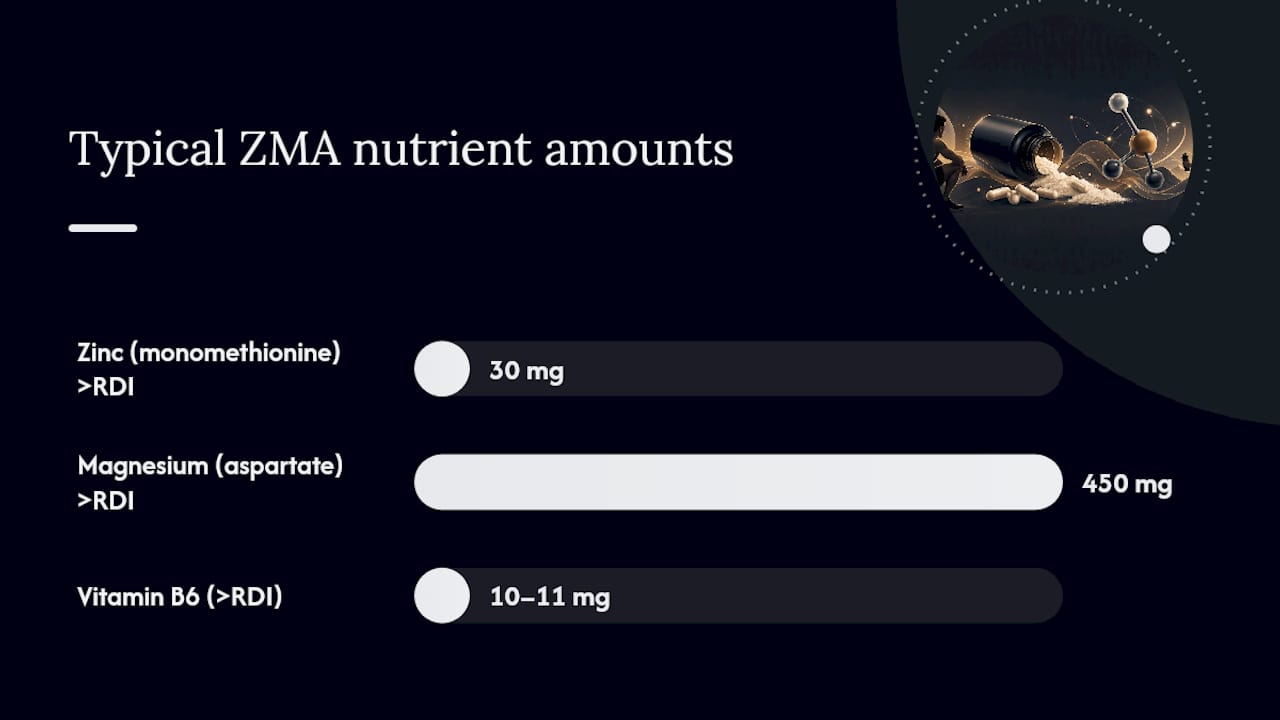
That excess is not automatically a problem, but it does change how you should think about the product. Zinc monomethionine and magnesium aspartate were chosen by the original formulators for absorption, not because they’re inherently superior to other forms. Magnesium glycinate and magnesium citrate, for instance, behave differently in the gut and carry their own absorption and tolerance profiles worth understanding before you assume “more magnesium” automatically means “better sleep.”
A few label details are worth checking before you buy:
- The specific amounts of each nutrient, rather than vague “high potency” claims.
- The mineral salt used (aspartate, glycinate, citrate, oxide), since bioavailability differs by form.
- The percent RDI listed for zinc, magnesium, and B6, to assess how the dose compares to daily needs.
- Hidden additions, particularly melatonin, which some sleep-focused ZMA blends quietly fold in without prominent labeling.
- Proprietary blend disclosures, which can obscure whether you’re getting a clinically studied ratio or a marketing approximation of one.
That melatonin issue deserves a second mention because it changes what you’re actually testing. If a ZMA product includes melatonin and you sleep better on it, the sleep benefit might be due to the melatonin rather than the zinc and magnesium. Read the full ingredient panel, not just the front label, before deciding whether a sleep improvement is really about ZMA.
The Claimed Benefits Of Zma, One By One
Marketing copy tends to lump ZMA’s benefits into one confident paragraph. The research doesn’t support that kind of blanket claim, so it’s worth taking each one separately.
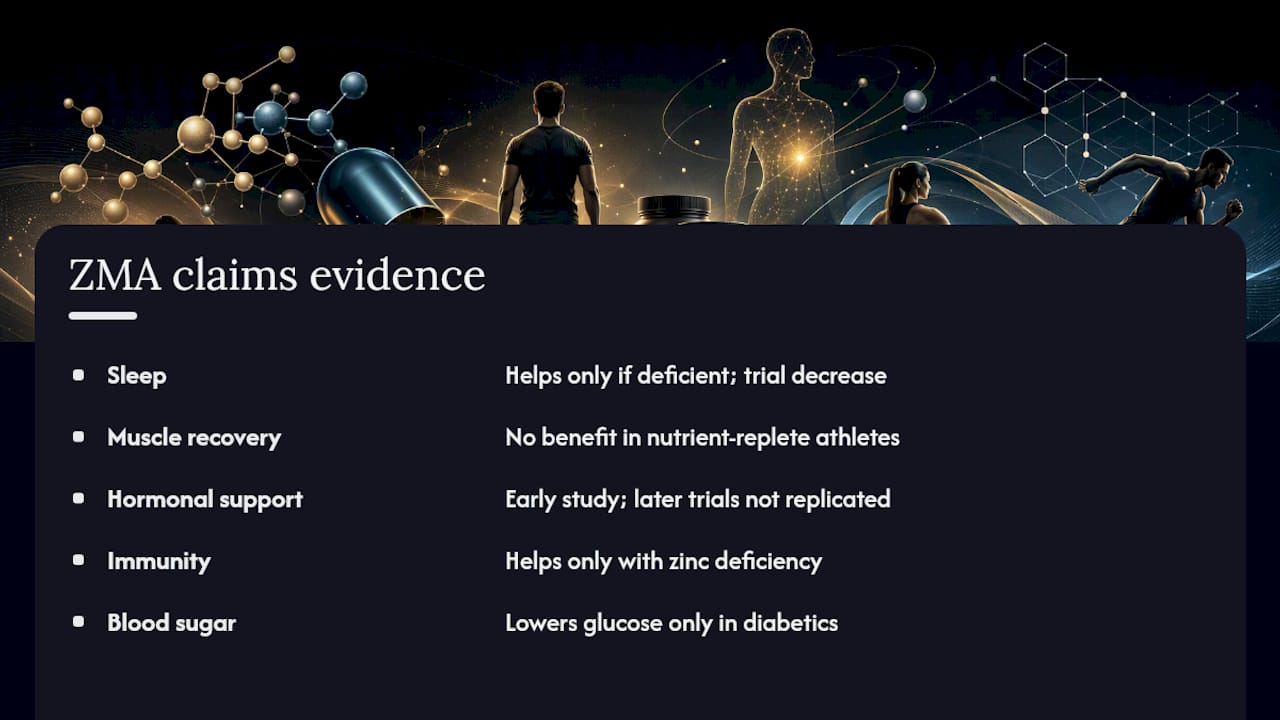
Sleep. The mechanism is plausible. Magnesium supports GABAergic signaling, the same pathway many sedatives target, and that’s the biological basis for magnesium’s proposed sleep benefits. The catch is that this evidence is stronger in older adults and people with confirmed low magnesium than it is in healthy young athletes. A 2024 randomized trial of trained males with adequate baseline nutrient status found something almost backwards: total sleep time actually decreased by roughly 0.46 to 0.94 hours under some conditions. If you’re not deficient, ZMA for sleep is not a safe bet.
Muscle recovery and performance. The biological story sounds reasonable. Zinc and magnesium both participate in protein synthesis and muscle contraction, so a shortfall could plausibly blunt recovery. But that same 2024 trial found no measurable improvement in muscle power, cognitive performance, or subjective recovery scores when ZMA was compared against a placebo in men who weren’t nutrient-deficient to begin with. The rationale for ZMA and muscle recovery is real biology applied to a population that mostly doesn’t need the correction.
Hormonal support. This is where ZMA’s reputation was built and where it’s weakest today. The claim traces back to a single, widely cited study.
A small 2004 trial reported increases in testosterone and IGF-1 among athletes taking ZMA, shaping a generation of product marketing. What gets left out of the pitch is that the study carried real methodological and sponsorship limitations, and later, better-controlled trials have not reproduced those hormonal gains.
Immunity. Zinc’s role in immune function is well established, but that’s a statement about zinc deficiency, not about topping up an already-sufficient diet. There’s a real signal here for people who are actually short on zinc, not a general immune boost for everyone else.
Blood sugar. Zinc supplementation can lower fasting glucose and HbA1c in people with diabetes, which sounds like a strong ZMA benefit until you notice the population studied. That result comes from people with impaired glucose regulation. Extending it to healthy, insulin-sensitive adults simply isn’t supported by the same data.
The pattern across every one of these claims is consistent: real physiology, real early enthusiasm, and a later body of research that only backs the benefit when a deficiency exists. Where no deficiency exists, what’s left is often the ritual of taking a pill before bed, a placebo effect that’s plausible but not the same thing as a pharmacological one.
What The Clinical Trials On Zma Actually Show
The credibility of any ZMA claim depends entirely on which study you’re pointing to, and the field has a wide range in quality.
The foundational trial came from Wilborn and colleagues in 2004, testing ZMA supplementation on training adaptations in college football players. It reported some favorable shifts in anabolic markers, and that result became the backbone of ZMA marketing for two decades. But the study had a small sample, and its funding and methodological limitations have kept it from being treated as definitive by researchers who’ve tried to build on it since.
More recent work tells a less flattering story. Several 2024 trials published in MDPI journals tested ZMA in trained males with no baseline nutrient deficiency and no sleep disturbances. The results were consistently unimpressive: no significant gains in strength, power, or cognitive measures, and in some groups, a reduction in total sleep time rather than an improvement.
A few recurring weaknesses show up across the ZMA literature as a whole:
- Small sample sizes, often a few dozen participants split across multiple conditions, which limits statistical power.
- No baseline nutrient testing, meaning many trials never confirmed whether participants were even zinc or magnesium deficient to begin with.
- Industry sponsorship in several of the earlier, more favorable studies, which raises legitimate questions about publication incentives.
- Short intervention windows, sometimes measuring acute, single-dose effects rather than sustained supplementation over weeks or months.
Put those pieces together and a clear hierarchy of confidence emerges. The evidence for zinc and magnesium correcting a genuine deficiency is solid and long-standing nutritional science. The evidence for ZMA specifically boosting testosterone, strength, or sleep in someone who isn’t deficient is thin, and the newest, better-designed trials are actively pushing back against it.
Zma Dosage, Safety, And What Can Go Wrong
Because ZMA doses often sit above the RDI for all three nutrients, it’s worth understanding where the safety ceiling actually is, not just the sales pitch.
Zinc has a tolerable upper intake level of 40 mg per day from supplements and food combined; some ZMA doses supply zinc amounts that approach this ceiling before food intake. Chronic excess zinc intake interferes with copper absorption, and that interaction can quietly cause a secondary copper deficiency over months of daily use. Vitamin B6 carries its own long-term risk: chronic high-dose intake has been linked to peripheral neuropathy, and some ZMA products deliver B6 well above what’s needed for a single day, day after day.
Common side effects at typical doses are usually mild: nausea, stomach upset, and headache if taken on an empty stomach. Rare but serious risks tend to appear only with prolonged, high-dose use, particularly tingling or numbness in the hands and feet, which can signal B6-related nerve involvement and warrants stopping the supplement and seeing a doctor.
A few practical steps reduce the risk without giving up on the supplement entirely:
- Separate ZMA from calcium-containing foods or supplements by a couple of hours, since calcium competes with both zinc and magnesium for absorption.
- Avoid stacking ZMA with other zinc or magnesium supplements, including many multivitamins, to prevent quietly doubling your intake.
- Flag it to your doctor if you’re on antibiotics, since zinc and magnesium can both reduce the absorption of certain antibiotic classes, including tetracyclines and fluoroquinolones.
- Watch for diuretic interactions, since some diuretics increase magnesium and zinc excretion, changing how much you actually retain.
- Get blood testing if you plan to use ZMA for more than a few months, so you can confirm you’re correcting a real shortfall rather than building toward an excess.
Pro Tip: Take ZMA on an empty stomach at bedtime, away from dairy or calcium supplements, and skip it entirely on days you’re also taking a multivitamin with meaningful zinc or magnesium content.
Who Is Likely To See Real Zma Benefits
The people most likely to feel a genuine difference from ZMA are the ones with an actual shortfall to correct, not the ones with the best training log.
Three groups stand out. People with a confirmed zinc or magnesium deficiency, diagnosed through bloodwork rather than assumed from symptoms, are the clearest case. Older adults, who absorb magnesium less efficiently and often eat less of it, form a second group where the sleep-related mechanism has more consistent backing. Heavy sweaters and athletes training at high volume are the third: sweat and urine losses can raise mineral requirements by roughly 10 to 20 percent, though it’s worth noting that dietary intake often keeps pace with those losses even in serious training blocks, so training hard doesn’t automatically mean you’re short.
The decision process is straightforward, even if it takes more effort than opening a bottle:
- Review your diet first. Zinc-rich foods include oysters, beef, and pumpkin seeds; magnesium is concentrated in leafy greens, almonds, and dark chocolate.
- Get a blood test if symptoms suggest a shortfall (poor sleep, fatigue, frequent illness, muscle cramps) rather than guessing.
- Try targeted supplementation only after a deficiency is confirmed, using a single-mineral product if you only need one of the three ZMA components, since a standalone magnesium supplement lets you dose it independently of zinc and B6.
- Reassess after a few months with follow-up testing rather than staying on a fixed dose indefinitely.
Food-first correction is not a slower version of the same result. It’s often the more precise one, since it lets you fix the actual mineral you’re short on instead of taking three at once because they happen to ship in the same capsule.
How To Read A Zma Label Like Someone Who Knows What They’re Doing
Understanding magnesium’s specific role in athletic performance helps separate genuine benefit from marketing noise, and that same evidence-first approach applies to reading any ZMA label.
A trustworthy product page states the exact milligram amount of zinc, magnesium, and B6 per serving, names the specific mineral form used, and discloses whether melatonin or any other active ingredient has been added. If a label just says “ZMA blend” without breaking out the individual amounts, treat that as a reason to look elsewhere. The same label-literacy habit applies to adjacent categories: claims about test boosters and citrulline malate deserve the same scrutiny before you trust the marketing over the ingredient panel.
The Bottom Line On Zma Benefits
| If your situation is… | What to expect from ZMA | What to do first |
|---|---|---|
| Confirmed zinc/magnesium deficiency | Meaningful improvement in sleep, recovery, or energy is plausible | Test, then supplement the specific mineral you’re short on |
| Well-nourished, training hard | Little to no measurable benefit in strength, sleep, or hormones | Save the money; focus on diet and sleep hygiene instead |
| Older adult with declining absorption | Sleep support has more consistent backing here | Discuss magnesium status with a doctor before dosing high |
| Any long-term daily use | Real risk of copper deficiency or B6-related nerve issues | Get periodic blood testing, don’t stack with other mineral supplements |
If you suspect a deficiency, testing beats guessing every time; a simple blood panel tells you more than any product review. If you’re already eating enough zinc and magnesium, don’t expect ZMA to outperform your current diet, and keep an eye on the upper limits if you decide to try it anyway.
An Editorial Take On Zma’s Reputation
The supplement industry built ZMA’s reputation on a study that never should have carried that much weight. A small, sponsored trial from 2004 became two decades of marketing copy, and most buyers never learn that later, cleaner research walked those claims back. That gap between origin story and current evidence is the real story here, more than ZMA itself.
None of that makes ZMA worthless. It makes it conditional. The honest position is that ZMA benefits people who need the correction and does very little for people who don’t, which is a less exciting pitch than “boost your testosterone,” but it’s the one the data actually supports.
Blake
Where To Find A Transparently Labeled Zma Or Mineral Supplement
If you’ve decided ZMA or a targeted mineral supplement fits your situation, the label is where trust gets earned or lost. Nzsupps lists exact ingredient quantities and mineral forms on every product page, so you’re never guessing whether “high potency” means 15 mg or 45 mg of zinc.
That same transparency extends across the recovery and performance range, including protein and pre-training products where dosing clarity matters just as much as it does for minerals. Before adding anything to your stack, check the Basic Supplements Isolate label as an example of how a full ingredient breakdown should look, then apply the same scrutiny to whatever mineral or recovery product you’re considering.
Pro Tip: Before buying any mineral supplement, screenshot the label’s “per serving” panel and compare it against the RDI for that nutrient. If a product won’t show you that number clearly, that’s your answer.
Sources
- ZMA Supplements: Benefits, Side Effects, and Dosage
- In Males with Adequate Dietary Needs Who Present No Sleep Disturbances, Is an Acute Intake of Zinc Magnesium Aspartate … Beneficial?
This article is general information, not a substitute for advice from a qualified doctor. Consult a qualified healthcare professional about your own circumstances before acting on anything here.