SHOP NOW, PAY LATER











 Informed Sport
 Informed Choice
 NSF Certified for Sport
 HASTA Certified

HMB reliably helps preserve muscle and speeds recovery in older adults, untrained beginners, and people recovering from injury or bed rest. Its effect on already well-trained athletes is real but modest. The typical clinical dose is about three grams a day, and current trial data show it’s safe for extended use up to at least one year.
TL;DR:
- HMB is most effective for older adults, untrained individuals, and clinical populations when combined with resistance training and sufficient protein intake.
- The typical dose is about three grams daily, usually split into two or three servings, with safety supported for up to at least one year of consistent use.
- Benefits include modest muscle mass and strength gains, faster recovery, and muscle preservation during disuse or illness.
- The evidence shows small but significant improvements, particularly in populations with more room for improvement, and effects become clearer after six to eight weeks.
- Reading supplement labels carefully to ensure proper dosing is essential, as the effectiveness depends on hitting the tested amounts precisely.
Table of Contents
- What Is HMB and How Does It Work?
- How Strong Is the Evidence Behind HMB Supplementation?
- What Specific Outcomes Does HMB Improve?
- Who Actually Benefits Most From HMB?
- How Much HMB Should You Take, and When?
- Is HMB Safe? Side Effects and Interactions to Know
- Building an HMB Routine Around Your Training
- Where Nzsupps Fits Into the HMB Picture
- Setting Realistic Expectations With HMB
- Try Gaspari HMB With Full Label Transparency
- Sources
What Is HMB and How Does It Work?
HMB, short for beta hydroxy beta methylbutyrate, is a metabolite your body already produces when it breaks down the amino acid leucine. Roughly 5% of dietary leucine converts to HMB naturally, which is why supplemental doses are needed to reach the concentrations tested in trials. You cannot get a meaningful dose from food alone.
The reason HMB gets attention isn’t leucine itself. It’s what HMB does once it’s circulating that leucine doesn’t do as directly. HMB appears to work through two separate pathways, which is part of why researchers describe it as having a “dual mechanism”:
- Stimulates muscle protein synthesis by activating the mTOR pathway, the same signaling cascade that resistance training and dietary protein trigger to build new muscle tissue.
- Suppresses muscle breakdown by inhibiting the ubiquitin proteasome system, the cellular machinery responsible for tagging and degrading muscle proteins during stress, illness, or disuse.
That second mechanism is the more distinctive one. Most anabolic strategies focus purely on building; HMB also puts a brake on the demolition side of the equation, which matters most when the body is under catabolic stress.
You’ll find HMB sold in two forms: HMB calcium (HMB-Ca), the older and more widely studied version, and HMB free acid (HMB-FA). HMB-FA raises blood HMB levels faster after ingestion, but the International Society of Sports Nutrition doesn’t currently have enough head-to-head clinical outcome data to call one form superior to the other. Faster absorption doesn’t automatically mean better long-term results.
How Strong Is the Evidence Behind HMB Supplementation?
An umbrella review of meta-analyses, essentially a study that pools the results of multiple meta-analyses to get the most reliable overall estimate, found statistically significant improvements across three outcomes.
By the numbers: HMB supplementation produced a small but statistically significant improvement in muscle mass, fat-free mass, and muscle strength index, according to the pooled analysis.
Effect sizes in that range (using Cohen’s d, where 0.2 is considered small and 0.5 is moderate) mean the benefit is real but not dramatic. This is not a supplement that turns a beginner into a bodybuilder in six weeks. It’s a supplement that nudges outcomes in a favorable direction, consistently enough across dozens of trials that the effect shows up in a pooled analysis rather than being a one-off finding.
The 2024 ISSN position stand formalized what much of the research community had already concluded: HMB is safe, has a defensible mechanism, and delivers its biggest wins when paired with structured training and adequate protein intake rather than used on its own.
Why do individual studies disagree so much on magnitude? A few factors drive that heterogeneity:
- Training status. Untrained or detrained participants show larger relative gains than athletes who are already close to their genetic ceiling.
- Study duration. Trials shorter than six weeks tend to miss the effect entirely; benefits become clearer past the six to eight week mark, per the umbrella review’s analysis.
- Study quality and dosing consistency. Trials with inconsistent adherence or underpowered sample sizes dilute the pooled effect size.
Read individually, some smaller trials show null results. Read together, the pattern holds up.
What Specific Outcomes Does HMB Improve?
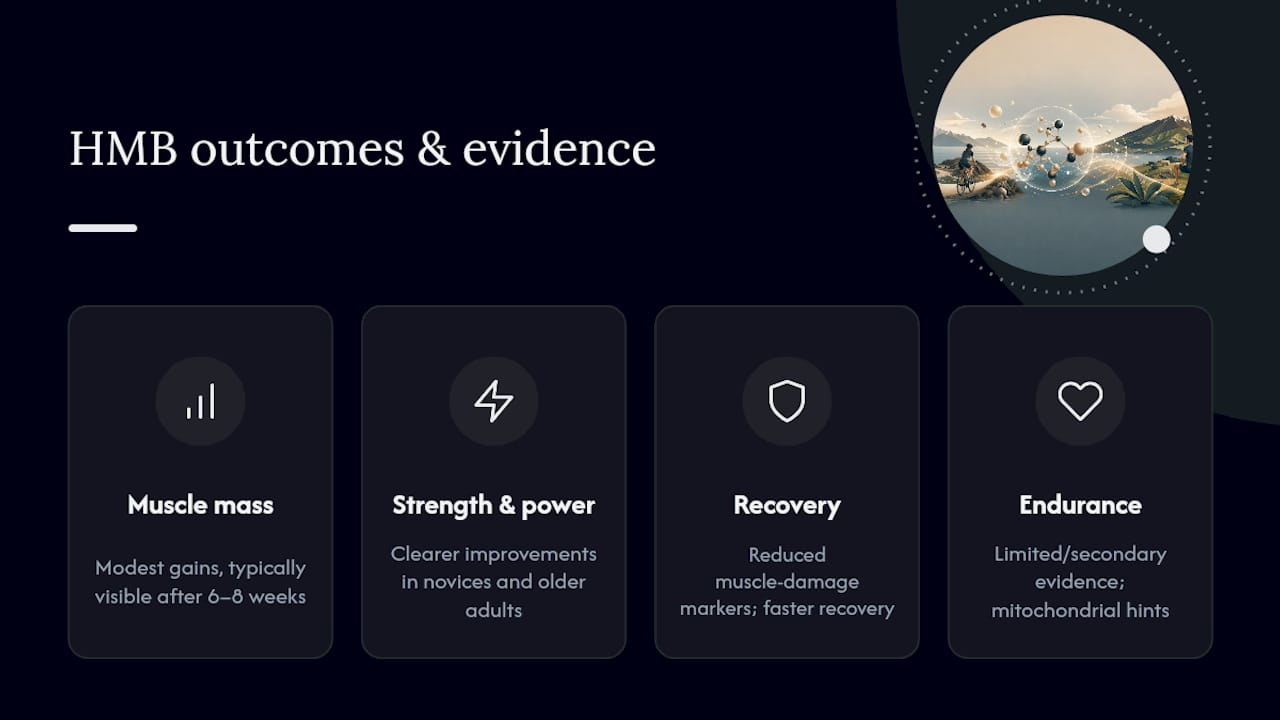
Muscle mass and fat-free mass gains from HMB are measurable but incremental. Based on the pooled effect sizes above, you’re looking at a modest edge over training and diet alone, typically visible after six to eight weeks of consistent use, not a dramatic transformation in a month.
Strength and power responses depend heavily on who’s taking it. Novice lifters and older adults tend to show clearer strength improvements than competitive athletes, because there’s simply more room for adaptation when someone is untrained. A powerlifter already benching double bodyweight isn’t going to see the same jump.
Recovery is where HMB has some of its more consistent support. Systematic reviews show reduced markers of muscle damage and faster recovery after exercise that causes real tissue stress, like eccentric-heavy training or a return to lifting after a layoff. Less soreness translates to more consistent training weeks, which compounds over months.
Endurance effects are less studied but not absent. Some research points to mitochondrial and oxidative benefits that could support aerobic capacity, though this remains a secondary finding rather than a headline benefit.
The preservation use case deserves its own mention. During disuse, illness, or bed rest, muscle breaks down fast, sometimes within days. HMB’s anti-catabolic mechanism is most valuable exactly here, which is why it shows up in clinical nutrition research far more than in bodybuilding forums.
Pro Tip: If you’re using HMB around a planned break from training, such as a surgery recovery period or a trip, start it a few days before the disuse begins rather than after. Early initiation appears to produce better preservation outcomes in smaller clinical trials than starting once muscle loss is already underway.
Who Actually Benefits Most From HMB?
Not everyone gets the same return from HMB, and being honest about that upfront saves you money and disappointment.
- Older adults and sarcopenic individuals show some of the clearest documented benefits, particularly when HMB is combined with physical exercise. The systematic review in older adults found HMB plus exercise improved lean mass and functional outcomes, like grip strength and mobility tests, more than exercise alone.
- Untrained or novice trainees respond better than seasoned lifters, simply because their baseline muscle protein turnover has more room to improve.
- Clinical and disuse contexts, including bed rest, ICU recovery, and cachexia associated with illness, are where HMB’s anti-catabolic mechanism carries the most clinical weight. This is a population where preserving what muscle you have matters more than building new tissue.
If you’re a competitive athlete already training hard with a solid diet, expect a smaller return. HMB isn’t a case where more training experience equals more benefit; it tends to run the other way.
How Much HMB Should You Take, and When?
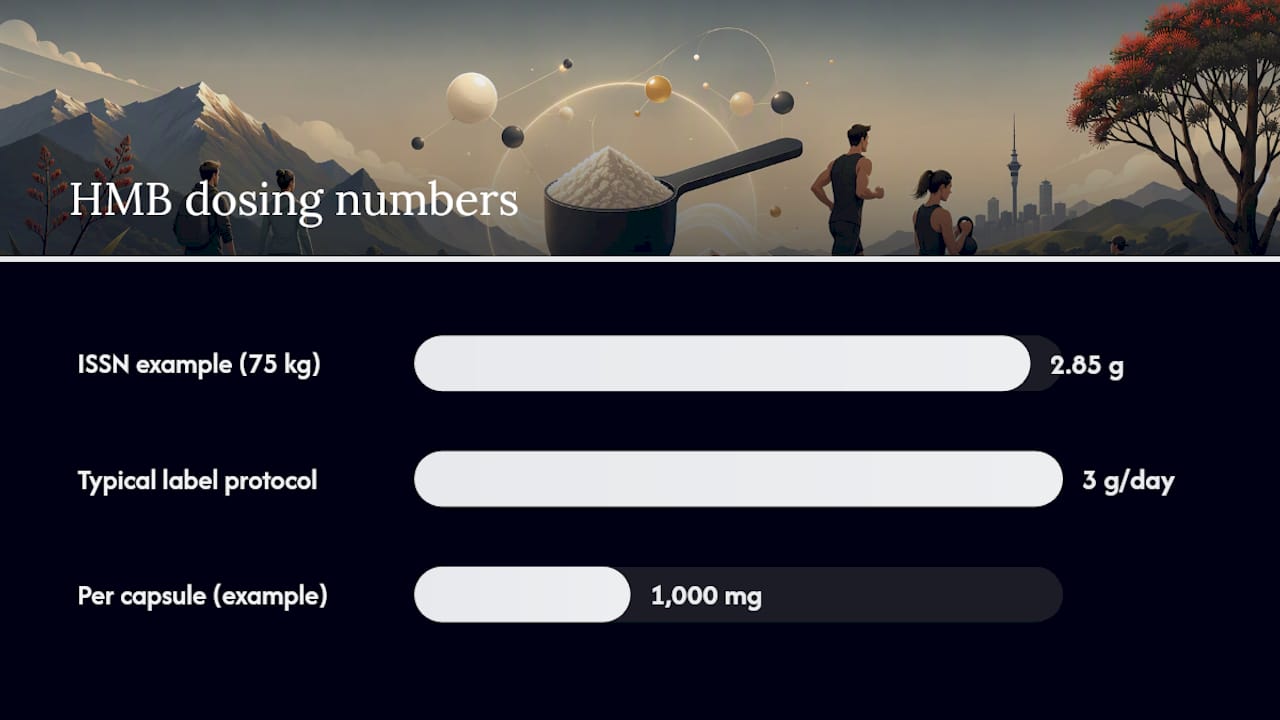
The ISSN position stand recommends 38 mg per kilogram of bodyweight daily as the evidence-based target. For most adults, that works out close to the commonly used 3 grams a day protocol you’ll see on product labels and in older trials.
Here’s how to apply that practically:
- Calculate your target dose. Multiply your bodyweight in kilograms by 38 mg. A 75 kg adult lands at roughly 2.85 grams, which is why most labeled servings round to 3 grams.
- Split the dose if your product allows it. Many HMB-Ca protocols divide the daily total into two or three servings rather than one large dose, based on the rationale that steadier blood levels may support the anti-catabolic effect more consistently.
- Time it around training, not obsessively. Chronic daily dosing, taken consistently regardless of workout timing, is what most of the supporting trials actually tested. HMB-FA’s faster absorption has led some protocols to explore a pre-exercise acute dose, but the chronic daily approach has the larger evidence base behind it.
- Read the label for capsule count. If a product delivers 1,000 mg per capsule, you’ll need three capsules to hit the standard 3 gram target, not one.
Key figure: ISSN’s own guidance sets a dose scaled to bodyweight as the recommended daily intake, typically about 3 grams per day for many adults, with safety data supporting use up to at least one year of continuous intake.
Consistency matters more than precision here. Missing the exact milligram target by a few hundred milligrams a day won’t meaningfully change your outcome. Skipping doses for half the week will.
Is HMB Safe? Side Effects and Interactions to Know
HMB has one of the cleaner safety profiles among performance supplements, largely because it’s a compound your body produces naturally in small amounts already.
- Long-term safety data looks solid. Trials extending up to one year report no consistent signal for liver toxicity, kidney strain, or adverse changes in blood glucose for either HMB-Ca or HMB-FA, based on the supporting evidence reviewed alongside the ISSN position stand.
- Reported side effects are minor and uncommon. Occasional mild digestive upset is the most frequently mentioned complaint, and it’s not common even at that.
- Interaction risk is largely theoretical. Because HMB works partly through the mTOR pathway, there’s a plausible but unproven theoretical interaction with mTOR inhibitor medications, a drug class used in some transplant and oncology settings. If you’re on any prescription medication or managing a serious chronic condition, talk to your clinician before adding HMB, not because there’s strong evidence of harm, but because that population wasn’t the focus of most trials.
Dietary supplements in general fall under a lighter regulatory framework than prescription drugs. In the FDA’s dietary supplement framework, for instance, manufacturers are responsible for safety before marketing, but products don’t go through the same premarket approval prescription drugs require. That’s a reasonable case for buying from brands that disclose full ingredient panels and batch testing rather than vague proprietary blends.
Pro Tip: If you’re pregnant, breastfeeding, or managing a diagnosed liver or kidney condition, skip self-directed HMB use and loop in your doctor first. Most safety trials excluded these groups, so the reassuring one-year data doesn’t directly cover them.
Building an HMB Routine Around Your Training
HMB doesn’t work in isolation. The ISSN position stand is explicit that benefits show up most reliably when HMB is paired with resistance training and adequate protein, not taken as a standalone fix.
- Weeks 1 to 2: Start at your calculated dose (roughly 3 g/day for most adults) taken consistently, and begin or continue a progressive resistance training program at least two to three sessions a week.
- Weeks 3 to 8: Hold the dose steady daily. This window is where most trials start detecting measurable strength and recovery changes, so don’t judge results before six weeks.
- Ongoing: Keep dietary protein in the range clinicians commonly recommend for older adults during active training, around 1.2 to 1.6 grams per kilogram of bodyweight, since HMB’s synthesis-boosting mechanism has more raw material to work with when protein intake is adequate. Protein timing around training sessions can add a further edge on top of total daily intake.
- Reassess at 8 weeks: Track something more concrete than the mirror. Grip strength, a timed up-and-go test for older adults, or a simple strength log (weight lifted for a given rep range) gives you an honest read on whether it’s working for you.
| What to track | Why it matters | When to check |
|---|---|---|
| Strength output (key lifts or grip strength) | Most sensitive marker in early weeks | Baseline, then every 4 weeks |
| Recovery/soreness after hard sessions | Reflects HMB’s anti-catabolic effect directly | Weekly, subjectively |
| Body composition (not just scale weight) | Fat-free mass changes are slow and easy to miss | Baseline, then at 8 weeks |
| Functional tests (older adults) | Catches real-world benefit beyond the gym | Baseline, then at 8 weeks |
Where Nzsupps Fits Into the HMB Picture
Nzsupps carries Gaspari HMB 1000mg Capsules as an in-market example worth using to practice reading a label properly. At 1,000 mg per capsule, hitting the standard 3 gram target means three capsules a day, a useful gut check when you’re comparing products against the ISSN’s 38 mg/kg guidance.
Reading labels carefully matters more with HMB than with flashier supplements, because the entire evidence base is built around specific dosing thresholds. A product with vague serving sizes or an unclear per-capsule breakdown makes it harder to know if you’re actually hitting the dose that trials tested.
- Nzsupps discloses full ingredient panels rather than proprietary blends, so you can see exactly what dose you’re getting per serving.
- Blake’s other supplement breakdowns, including a look at how beta-alanine supports muscular endurance, follow the same evidence-first approach applied here to HMB.
- Customer feedback on the site reflects real buying and usage patterns, alongside transparent labeling that lets you verify dosing claims yourself rather than taking marketing copy at face value.
Setting Realistic Expectations With HMB
HMB isn’t a supplement that rewards hype, and it’s not one that deserves dismissal either. The honest position sits in the middle: a compound with a real, mechanistically sound anti-catabolic effect that shows up most clearly in the people who need it most, older adults rebuilding lost strength, beginners adapting to new training stress, and anyone bridging a period of forced inactivity.
Where I’d push back on how HMB usually gets marketed is the framing aimed at already-advanced lifters chasing another few percent of gains. The effect sizes just don’t support that as the primary use case. Track a real marker, strength output or a functional test, not just how you feel, and give it the full eight weeks before deciding.
Blake
Try Gaspari HMB With Full Label Transparency
If you’ve read this far, you already know HMB’s value comes down to hitting a real dose consistently, not chasing a trendy label claim. Nzsupps stocks Gaspari HMB 1000mg Capsules with the per-capsule dose stated plainly, so you can calculate your 3 gram target without guesswork. For current prices and stock, see our BCAA and EAA NZ range.
Since HMB works best when stacked with adequate protein and progressive training, pairing it with a clean protein source like Basic Supplements Beef Isolate covers the dietary side the ISSN position stand points to as essential for results. Every product on the site lists its full ingredient panel upfront, so you know exactly what you’re taking before it ships. Head over to the Gaspari HMB product page to check current stock and place an order.
This article is general information, not a substitute for advice from a qualified doctor. Consult a qualified healthcare professional about your own circumstances before acting on anything here.
Sources
- International Society of Sports Nutrition position stand: β‑hydroxy‑β‑methylbutyrate (HMB)
- Health benefits of β‑Hydroxy‑β‑Methylbutyrate (HMB) supplementation in addition to physical exercise in older adults: A systematic review with meta‑analysis