SHOP NOW, PAY LATER














 Informed Sport
 Informed Choice
 NSF Certified for Sport
 HASTA Certified

Marine collagen is the sharper pick for skin because it consists almost entirely of Type I with smaller peptides that dermal tissue seems to use efficiently. Bovine collagen is the better all-rounder because its Type I and Type III blend supports skin, joints, and gut lining, and it costs less per gram. Both work when you commit to a hydrolyzed dose of between about 2.5 and 10 grams a day for at least eight to twelve weeks. If you can’t decide, start with bovine and add marine only if your main goal is visible skin change.
TL;DR:
- Marine collagen offers a higher concentration of Type I peptides, which are more efficiently absorbed and specifically benefit skin outcomes.
- A three-month trial showed a 35% reduction in wrinkles and improvements in hydration, radiance, and firmness, but that data is limited to one product and one demographic.
- Bovine collagen provides both Type I and Type III peptides, supporting skin, joints, tendons, and gut lining, with more extensive and established research backing its effectiveness.
- Cost per gram is generally lower for bovine collagen, making it a more economical choice for long-term use, especially for multiple joint and gut benefits.
- Fish allergy and alpha-gal syndrome are absolute contraindications, while sourcing, peptide dose, and third-party testing should guide quality-conscious buying decisions.
Table of Contents
- Marine Collagen: What It Does Well and Practical Trade-Offs
- Bovine Collagen: What It Does Well and Practical Trade-Offs
- Marine vs Bovine Collagen: Comparing the Decision Points That Matter
- How to Choose the Right Collagen Supplement for Your Goals
- Safety, Interactions, and Contraindications You Must Check First
- Dosing, Timing, and Practical Pairing for Better Results
- Author Note and Nzsupps’ Approach to Collagen
- Where Nzsupps Fits Into Your Collagen Decision
- Sources
Marine Collagen: What It Does Well and Practical Trade-Offs
Marine collagen’s biggest selling point is its Type I concentration paired with generally lower molecular weight peptides. Skin, tendons, and bone are Type I dominant tissue, so the mechanistic argument for marine collagen and skin outcomes holds up reasonably well on paper. A 2024 literature review confirms marine collagen is predominantly Type I with lower imino acid content and higher solubility in several preparations, which is the chemistry behind those bioavailability claims.
The human trial data backs this up, at least in a limited way. A randomized trial in women aged 45 to 60 found meaningful skin changes after three months on marine collagen.
Marine collagen trial results (women 45–60, 3 months): The same clinical trial reported a 35% reduction in wrinkles, 14% improvement in hydration, 22% improvement in radiance, and 25% improvement in firmness.
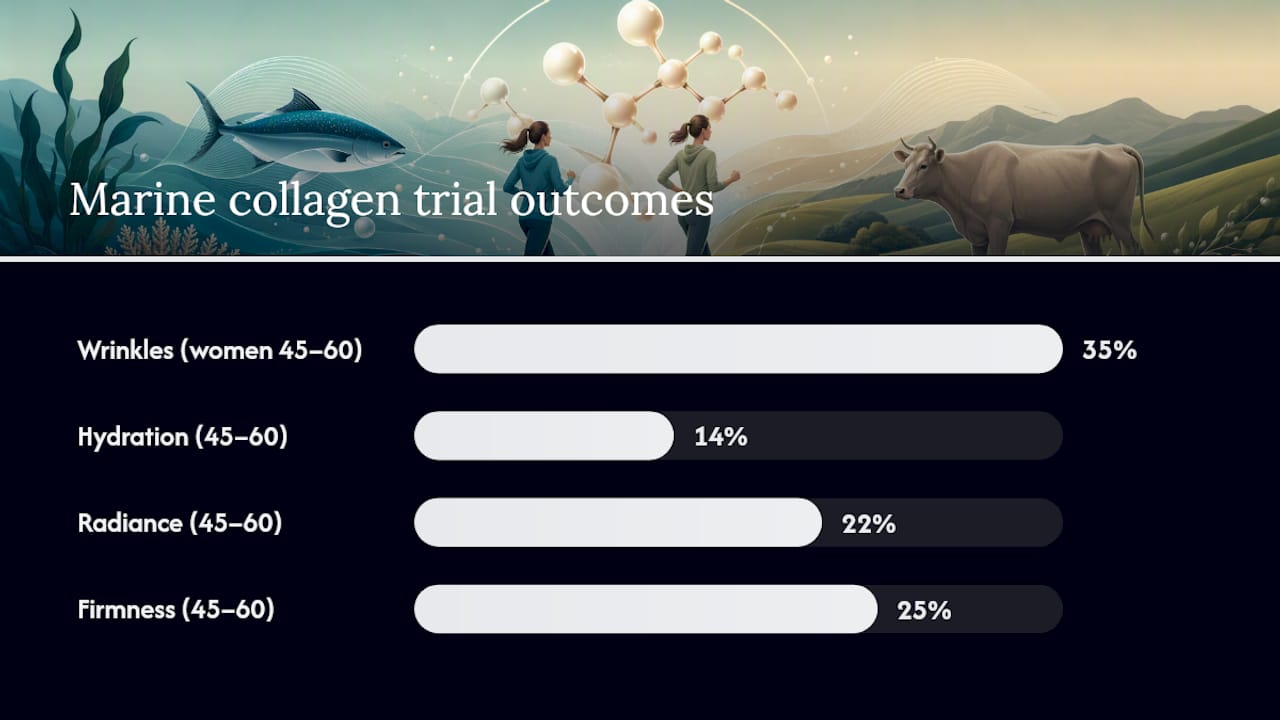
Those are solid numbers for a supplement trial, but read the fine print: this is one trial, on one product formulation, over one specific age bracket. It doesn’t tell you how marine collagen performs on joint pain, or in men, or over a shorter window.
On absorption, a broader review of hydrolyzed marine peptides notes marine fragments often carry lower molecular weight than mammalian peptides, but head-to-head human pharmacology comparing sources directly remains sparse. The absorption edge is real in a test tube. Whether it translates into a meaningfully better result on your skin than a good bovine product is not settled science yet.
Practical trade-offs worth weighing:
- Fish allergy is an automatic disqualifier, no exceptions.
- Sustainability credentials vary by supplier: responsibly sourced marine collagen usually comes from fish-processing byproducts rather than a dedicated catch, but that depends entirely on which brand and region you’re buying from.
- Marine collagen typically costs more per gram than bovine, partly due to smaller-scale extraction and partly due to the skin-focused premium positioning.
- It’s the more natural fit for pescatarians who avoid land-animal products but still eat fish.
Bovine Collagen: What It Does Well and Practical Trade-Offs
Bovine collagen’s advantage is breadth. Because it carries both Type I and Type III, it supports skin structure the way marine does, while also feeding the connective tissue in joints, tendons, and gut lining that Type III is more heavily involved in. If your goal list includes joint comfort alongside skin, bovine is the more logical single-product choice.
The evidence base here is deeper, not thinner. Bovine peptides have been the backbone of collagen research for over a decade, including the well known Proksch trials that helped establish typical dosing protocols still used across the industry.
Bovine collagen research depth: Multiple small randomized controlled trials, including work by Proksch and colleagues, have tested bovine-derived peptides on skin elasticity and joint comfort. Systematic reviews note this body of research is larger and more established than the marine-specific trial pool, which remains smaller and newer.
That research depth is what gives bovine collagen its practical edge in real-world use. When a dosing protocol has been tested repeatedly across multiple small trials rather than one, you can trust the “2.5 to 10 grams daily” range with more confidence.
Other factors that push people toward bovine:
- It’s typically the cheaper option per gram, which matters more than it sounds for a supplement you need to take daily for months to see results.
- Bone broth collagen products, a bovine-derived category, are widely available and often doubles as a gut-support supplement given the Type III content.
- Rare but real: people with alpha-gal syndrome, a mammalian meat allergy usually triggered by tick bites, need to avoid bovine collagen entirely.
- It doesn’t fit strict pescatarian, vegan, or certain religious dietary frameworks depending on how the cattle were processed and certified.
Marine vs Bovine Collagen: Comparing the Decision Points That Matter
Neither source wins across every column. The honest answer depends on which row matters most to you.
| Decision dimension | Marine collagen | Bovine collagen |
|---|---|---|
| Collagen type profile | Predominantly Type I | Type I plus Type III |
| Peptide size / bioavailability | Often lower molecular weight, generally efficient absorption | Larger peptides on average, still absorbed efficiently when hydrolyzed |
| Best for | Skin hydration, firmness, wrinkle reduction | Skin plus joints, tendons, and gut lining |
| Cost per gram | Generally higher | Generally lower |
| Dietary / ethical fit | Works for pescatarians, not vegans | Works for most omnivores, not for strict vegetarians or those avoiding mammalian products |
| Allergen / safety risk | Fish allergy is a hard stop | Alpha-gal syndrome and rare mammalian sensitivities |
The evidence gap is worth being blunt about. Bovine collagen has more RCT coverage behind it, largely because it entered the research pipeline earlier. Marine collagen has fewer, smaller human trials, though the ones that exist show promising skin-specific results. No large trial has directly pitted marine against bovine head to head in the same population using the same protocol, which is the honest reason nobody can hand you a definitive “X percent better” answer. A pooled analysis of collagen supplementation trials found a modest overall benefit for skin hydration and elasticity across sources, but the underlying studies were too heterogeneous to crown one source superior.
That uncertainty cuts both ways. It means neither camp can claim a decisive win, and it means your personal goal, budget, and dietary restrictions should carry more weight than whichever source has the flashier marketing claim this year.
How to Choose the Right Collagen Supplement for Your Goals
Work through this checklist before you buy, not after:
- Define your primary goal. Skin alone points toward marine. Skin plus joints or gut support points toward bovine.
- Check for allergies first. Fish allergy rules out marine. Alpha-gal syndrome or mammalian meat sensitivity rules out bovine.
- Set a realistic budget. Bovine is usually cheaper per gram, which matters for a supplement you’ll take daily for months.
- Look for sourcing certifications. Wild-caught or byproduct-sourced marine, and grass-fed bovine, tend to signal better quality control.
- Confirm the dose per serving. You want 2.5 to 10 grams of actual hydrolyzed peptides, not a proprietary blend that hides the number.
- Check for third-party testing. Independent lab verification is a stronger trust signal than a brand’s own claims.
Once you’ve picked a product, run a real trial: take your chosen dose daily for eight to twelve weeks, and track something measurable, whether that’s monthly skin photos in consistent lighting or a simple joint pain score you jot down weekly.
Pro Tip: Take your “before” photos in the same room, same time of day, and same lighting every time. Inconsistent lighting is the number one reason people think a product “isn’t working” when it actually is.
Before checkout, scan the product page for three things: the exact peptide dose per serve, the raw material source, and whether the batch has been third-party tested.
For a closer look at the evidence, read collagen for joint support: evidence and limits.
Safety, Interactions, and Contraindications You Must Check First
Fish allergy is an absolute contraindication for marine collagen. There’s no “try a small amount and see” workaround here, since collagen extracts can still carry allergenic proteins from the source fish.
Alpha-gal syndrome, a mammalian meat allergy often triggered by tick bites, rules out bovine collagen for anyone diagnosed with it. If you’ve had unexplained reactions after eating red meat, mention that to a doctor before starting a bovine product.
Drug interaction data for collagen supplements is thin across the board. There’s some anecdotal discussion online about collagen and citalopram or other SSRIs, but no solid clinical evidence supports a meaningful interaction. Even so, if you’re on prescription medication, especially anything affecting mood, blood clotting, or the immune system, run any new supplement past your prescriber first.
Common side effects are generally mild:
- Bloating or mild digestive upset, usually resolving after the first week or two.
- A lingering aftertaste or mild heartburn, more common with unflavored bovine products.
- Rare skin reactions, which should prompt you to stop and consult a doctor.
As the Harvard T.H. Chan School of Public Health notes, collagen supplements raise circulating peptide levels, but clinical effects remain modest. Treat any supplement as an adjunct to your routine, not a guaranteed fix.
Dosing, Timing, and Practical Pairing for Better Results
Clinical trials generally use doses between 2.5 and 10 grams a day, and most report the first measurable changes somewhere in the eight to twelve week window. That’s not a fast supplement. Anyone expecting visible results inside two weeks is setting themselves up for disappointment and an early quit.
Vitamin C plays a supporting role worth knowing about: it’s a required cofactor for your body’s own collagen synthesis enzymes, which is why a lot of collagen products are formulated with added vitamin C or recommend pairing with a vitamin C rich meal.
On blends versus single-source products:
- Multi-source blends combining marine and bovine peptides exist and let you cover Type I, Type III, and the smaller-peptide angle in one scoop.
- Single-source products are easier to evaluate honestly, since you’re not guessing which ingredient drove your results.
- Blends often cost more, and there’s no strong evidence yet that combining sources beats a well-dosed single source.
Pro Tip: Take your daily dose at the same time each day, ideally with a vitamin C source like citrus or a berry smoothie. Consistency matters more than the exact hour you take it.
Author Note and Nzsupps’ Approach to Collagen
Marine collagen tends to concentrate its strengths in skin outcomes. Bovine collagen tends to spread its benefits across skin, joints, and gut support, and it usually costs less per gram to sustain over months. Neither claim replaces reading the actual label in front of you.
This article was written by Blake for a New Zealand based retailer of nutritional supplements and fitness products. The retailer carries collagen-adjacent options including bone broth collagen, and the team focuses on giving shoppers full ingredient transparency so you can check peptide dose, source, and certification before you buy. Some product links in this article lead to pages Nzsupps sells directly.
— Blake
Where Nzsupps Fits Into Your Collagen Decision
Once you know whether you’re chasing skin firmness or broader joint and gut support, the next step is picking a product you can actually stick with for two to three months. Nzsupps carries Gaspari Bone Broth Collagen, a bovine-derived option, alongside a wider range of recovery and performance supplements with fully disclosed ingredient lists, so you know exactly what’s in the tub before it ships.
If joint comfort is part of your goal alongside skin, it’s worth reading how omega-3 supports joint health as a complementary addition to your collagen routine, or comparing turmeric against glucosamine if cartilage support is the priority. Start with a trial dose, track your progress over eight to twelve weeks, and reach out to customer support directly if you have questions about a specific ingredient list before you commit to a purchase. Building strength alongside your collagen routine also matters, and a quality protein like Basic Supplements Beef Isolate can support the muscle and connective tissue work your body is already doing.
This article is general information, not a substitute for advice from a qualified doctor. Consult a qualified healthcare professional about your own circumstances before acting on anything here.

Browse the collagen range to compare the source, serving size and format.
Sources
Collagen is the structural protein holding your skin, tendons, cartilage, and bone matrix together. It comes in at least 28 identified types, but supplements almost always focus on two: Type I and Type III. Type I dominates skin, tendons, and bone, while Type III shows up heavily in skin, blood vessels, and gut lining. That distinction matters more than most marketing copy admits, because a product built for joint support and one built for skin firmness are not interchangeable just because both say “collagen” on the label.
Raw collagen is a large, tightly wound triple helix that your gut can’t absorb intact. Manufacturers hydrolyze it, breaking it into shorter chains called peptides, which is why most labels read “hydrolyzed collagen” or “collagen peptides” rather than plain collagen. Smaller peptides generally dissolve more easily and move through digestion faster, which is the whole basis for bioavailability claims on packaging.
Sourcing splits the two categories cleanly:
- Hydrolyzed marine collagen: emerging evidence of benefits via the oral route
- Recent advancements in marine collagen: exploring new sources, processing approaches, and nutritional applications (MDPI / PMC 2024)
- Hydrolyzed marine collagen: review (PMCID PMC12701666)
- Collagen supplements — Harvard T.H. Chan School of Public Health
That processing variable is why “marine is always smaller molecular weight” isn’t a universal rule. It’s a tendency, not a law.