SHOP NOW, PAY LATER










 Informed Sport
 Informed Choice
 NSF Certified for Sport
 HASTA Certified

You've opened the tub, added a scoop to water, and discovered that “plant-based” doesn't automatically mean smooth, mild or easy to use. Maybe whey causes digestive discomfort. Maybe you're avoiding dairy, following a vegan diet, or want another protein option that fits your routine in New Zealand. The question isn't whether pea protein powder is popular. It's whether the product you choose will taste good enough, mix well enough and provide the protein quality your goal demands.
Pea protein can be a practical choice, but the label matters. Isolate and concentrate behave differently, leucine content affects how you plan a serving, and imported supply makes traceability worth checking. You'll also get better results by treating the powder as an ingredient, not just a drink. Use it in a shake, smoothie, oats or baking, then judge it by how reliably it helps you meet your needs.
Table of Contents
- Introduction to Pea Protein Powder and Who It Suits
- What Pea Protein Powder Is and How It Is Made
- Amino Acid Profile Digestibility and Goal Suitability
- Taste Texture and Mixability Tips That Actually Work
- How Pea Protein Compares With Whey Soy and Blends
- Everyday Use Cases From Shakes to Baking and Blends
- Choosing Your Pea Protein Powder With Confidence in NZ
Introduction to Pea Protein Powder and Who It Suits
A dairy-free shopper in Auckland might compare whey with pea protein after noticing bloating from milk-based powders. A vegan strength trainee in Christchurch might want a convenient way to add protein after training. An athlete avoiding unnecessary ingredients might care less about trendy claims and more about whether the tub has a clear label, a dependable batch and a flavour they'll finish.
Pea protein powder is made from yellow peas, usually by separating the protein from much of the pea's starch and fibre. It isn't the same as eating whole peas. The powder gives you a concentrated source of protein in a format that can be measured, mixed and added to recipes.
New Zealand's market has developed around imported ingredients. The country has no commercial-scale pea protein extraction facility, so powders sold locally generally depend on imported protein inputs, as outlined in the NZTE-commissioned Coriolis analysis. That doesn't automatically make a product poor quality. It does mean brand transparency, sealed packaging, batch information and testing claims deserve attention.
The guide starts with the basic journey from pea to powder, then moves into digestibility, amino acids, taste and comparisons with whey, soy and blends. Finally, it turns those details into practical choices for shakes, baking and everyday use.
By the end, you should be able to answer four useful questions:
- What am I buying? Is it an isolate, concentrate or blend?
- How will it perform? Does the protein and leucine content suit your goal?
- Will I use it consistently? Does the flavour and texture work for you?
- Can I trust the product? Is the label clear, and are verification claims specific?
Pea protein won't suit everyone. Some people prefer whey's familiar flavour and fast mixing, while others find pea protein easier to tolerate or more compatible with their diet. The right choice is the one that fits your nutrition needs and your actual habits.
What Pea Protein Powder Is and How It Is Made
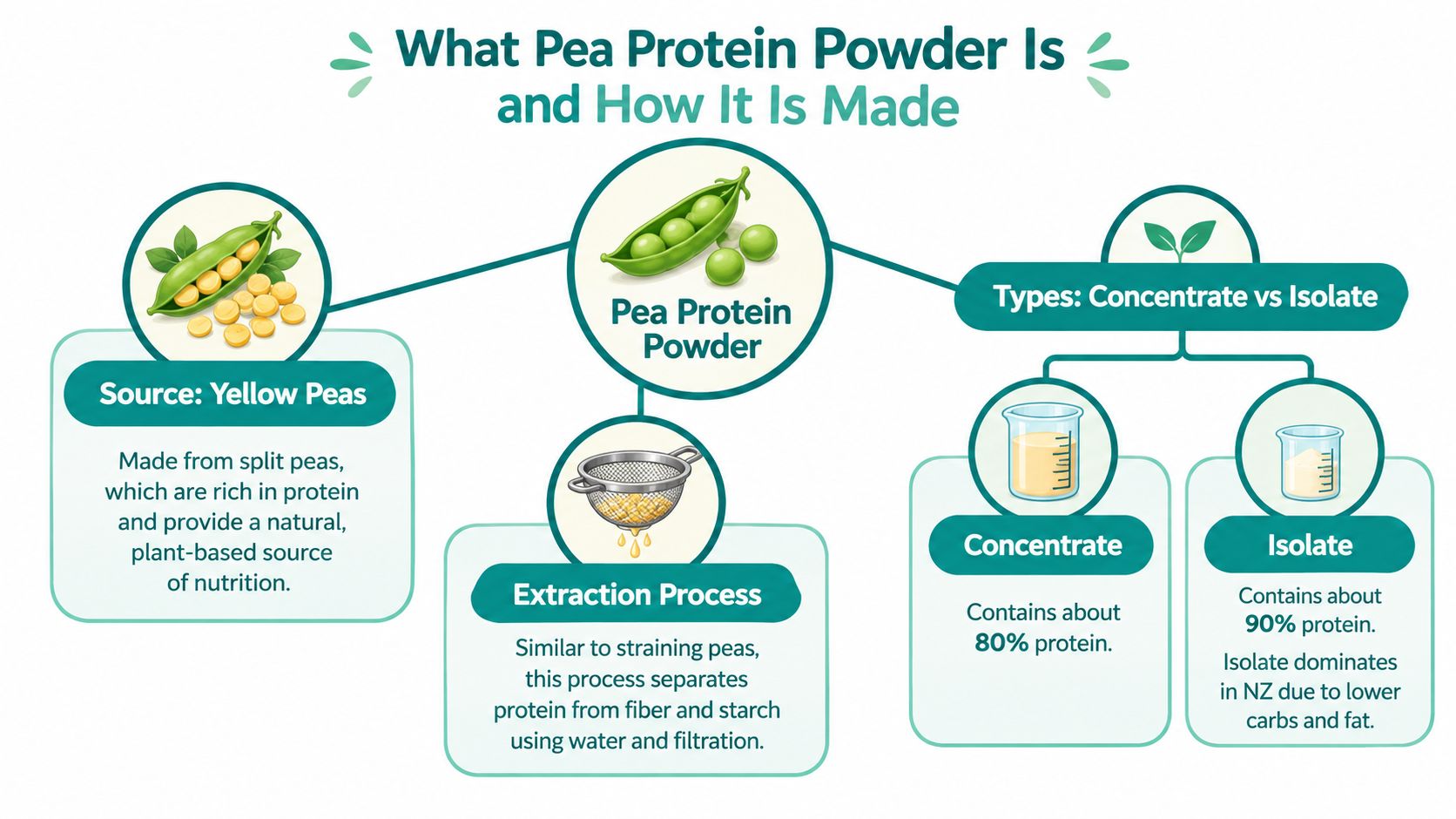
Start with the raw material. Pea protein powder usually comes from yellow peas, the same broad type used for split peas. The manufacturer cleans and mills the peas, then uses separation processes to remove much of the starch and fibre while retaining the protein.
A useful kitchen analogy is straining a blended pea mixture. The liquid and fine material pass through while larger components stay behind. Commercial extraction is more refined than a kitchen sieve, but the basic idea is similar: separate the protein-rich fraction from other parts of the pea.
Core definition: Pea protein powder is a concentrated ingredient made by separating protein from yellow peas, then drying that protein into a mixable powder.
Concentrate and isolate are not interchangeable
A pea protein concentrate retains more of the original pea components. An isolate goes through further purification, removing more starch and other non-protein material. That usually creates a higher-protein ingredient with less carbohydrate and fat, although the final nutrition panel depends on the brand and flavour system.
The supplied NZ market analysis identifies isolate as the dominant format locally. Pea protein isolate accounted for 90% of total pea protein usage in New Zealand and 97% of usage in sports nutrition, according to the Coriolis report commissioned for NZTE. For shoppers, that means many sports-focused powders and bars are built around isolate rather than a less refined concentrate.
The word “isolate” still isn't a complete quality guarantee. Processing can influence flavour, solubility and mouthfeel, while sweeteners, gums and flavourings affect the finished product. Read the full nutrition and ingredients panels rather than assuming every isolate will mix identically.
What the label can tell you
Look first for the protein source near the beginning of the ingredients list. A product may contain pea isolate alone, pea concentrate, or a blend with rice, soy or other plant proteins. Check whether the serving size matches how you plan to use it, and compare protein per serve rather than relying only on the tub size.
The powder has been processed to remove much of the pea's original starch and fibre, so it shouldn't be judged as a direct substitute for whole peas in meals. Whole peas contribute food structure and other nutrients. Pea protein powder is primarily a convenient protein ingredient.
Amino Acid Profile Digestibility and Goal Suitability
Protein quality has two useful layers. The first is the amino acid profile, which describes the building blocks supplied by the protein. The second is digestibility, which indicates how much of that protein the body can use.
Pea protein supplies the essential amino acids your body can't make on its own. It also contains the three branched-chain amino acids, or BCAAs. Leucine receives particular attention because it acts as an important signal involved in muscle protein synthesis.
That doesn't mean a powder with leucine is automatically equal to every other protein for every training situation. The amount per serve, total protein dose, the rest of your diet and the product's processing all matter.
What a normal serving provides
New Zealand pea-protein label examples show about 2.17 to 2.49 grams of leucine per 25 gram serving, with around 5.42 grams of total BCAAs per serve, according to NZ product label information from Xplosiv. Those values give you a practical reason to inspect the label instead of assuming a standard scoop will match a whey serving in every respect.
A 25 gram serving may be perfectly useful for adding protein to breakfast or a smoothie. For a demanding resistance-training session, some people may choose a larger total serving or combine proteins to provide more amino acids. The decision should follow the product's actual panel and your broader daily intake, not a universal scoop rule.
Digestibility is more than the protein percentage
A high protein percentage on the front label doesn't tell the whole story. Digestibility and amino acid availability add useful context.
A randomised human trial summarised by a New Zealand retailer reported mean amino acid digestibility of 93.6% for pea protein isolate compared with 96.8% for casein, while the pea isolate achieved a DIAAS of 1.00, as described on the NZ Protein pea protein isolate product page. In plain language, the isolate performed strongly at the whole-protein level, with the more practical distinction often being amino-acid density and serving size rather than a simple “digestible or not” label.
The term DIAAS is different from PDCAAS, so don't treat scores from different systems as directly interchangeable. What matters for a buyer is that a well-processed isolate can be a credible protein source, while the label still needs to show enough protein for the intended use.
Match the powder to the goal
For muscle gain, pea protein can fit well when you use enough total protein across the day and pay attention to leucine per serving. A larger serve or a complementary blend may make sense if the individual powder's leucine content is modest.
For muscle maintenance, convenience often becomes the deciding factor. A powder that helps you consistently reach your protein intake can be more useful than a theoretically superior option you dislike drinking.
For weight management, pea protein can be added to a meal or snack, but the total recipe still matters. Oats, nut butter, fruit and sweeteners can change the energy content substantially, so assess the complete meal rather than the powder alone.
For vegan or dairy-free diets, pea protein offers a straightforward plant-based option. It doesn't need to replace legumes, tofu or whole-food meals. Think of it as a flexible tool for days when cooking or eating enough protein is difficult.
Taste Texture and Mixability Tips That Actually Work
Pea protein often has a mild earthy or legume-like note. Some people barely notice it, while others find the aftertaste obvious. Texture can vary too, particularly when the powder is mixed with too little liquid or shaken briefly.
Start with the preparation method, not the flavour. Add liquid first, then powder, and shake vigorously. A shaker with a mixing ball usually performs better than stirring with a spoon. A blender gives the smoothest result, especially when you're adding oats, frozen fruit or nut butter.
Fix the texture before changing the product
If your drink feels gritty, increase the liquid gradually rather than dumping in extra powder. Cold liquid can make a shake more refreshing, while room-temperature liquid may help some powders disperse more easily. Letting a freshly mixed shake sit briefly can also soften the texture, although you may need to shake it again before drinking.
For stubborn texture, use a blender with a banana, yoghurt alternative or ice. The extra ingredients create a thicker smoothie that hides some of the powder's natural mouthfeel. If you're baking, whisk the dry powder through the flour or other dry ingredients before adding liquid. That distributes it more evenly and reduces dense pockets.
For more targeted ideas, use this guide on making plant protein less gritty.
Choose flavours that do some work
Chocolate and coffee are strong masking flavours for earthy notes. Vanilla works well when you want to add fruit or spices. Banana can provide sweetness and body, while berry flavours suit smoothies with frozen berries and plant milk.
A simple starting formula is:
- Liquid first: Add your chosen milk or water before the powder.
- Protein second: Use the serving stated on the label, then adjust after you've tested the taste.
- Flavour support: Add cocoa, cinnamon, banana, coffee or berries according to the base flavour.
- Texture control: Blend with ice or fruit, or use a shaker ball for a faster option.
A plain powder gives you more control in porridge and baking, but a flavoured powder may be easier for a daily shake. The better product is often the one you'll use without needing to negotiate with its taste every morning.
How Pea Protein Compares With Whey Soy and Blends
Choosing between protein types is less about finding one universal winner and more about deciding which trade-offs matter to you. Whey suits people who tolerate dairy and want a familiar, often smooth option. Pea suits dairy-free and vegan shoppers, while soy and mixed plant formulas offer different amino-acid patterns and sensory experiences.
The table below keeps the comparison practical. Exact protein and leucine values vary by product, so use the label for the specific tub in front of you.
Pea Protein vs Other Common Proteins at a Glance
| Protein Type | Protein per Serve | Leucine and Digestibility | Best For |
|---|---|---|---|
| Pea isolate | Check the product label | Strong whole-protein quality; leucine may be lower per serving than whey, so inspect the panel | Vegan, dairy-free and general sports nutrition |
| Whey concentrate | Check the product label | Naturally rich in essential amino acids and leucine; dairy-derived | People who tolerate dairy and want a familiar training protein |
| Whey isolate | Check the product label | Dairy-derived, highly refined, and typically chosen for a leaner ingredient profile | Dairy users prioritising a refined whey format |
| Soy protein | Check the product label | Complete plant protein with a different taste and texture profile | People wanting a soy-based dairy-free option |
| Pea and rice blend | Check the product label | Complementary plant sources can broaden the overall amino profile; confirm the formula | Vegan users wanting a mixed plant formula |
Look beyond “plant versus dairy”
Whey can be easier to mix and may provide more leucine in a typical serving, but it isn't suitable for people avoiding dairy or who don't tolerate it well. Pea protein removes the dairy issue, although its texture and flavour may require more preparation.
Soy can be useful for someone comfortable with soy ingredients, while a pea-rice blend may appeal to a shopper who wants complementary plant sources. Neither label should be judged by the blend name alone. Check the actual protein amount, ingredients, allergens and serving guidance.
For a closer look at the plant-protein decision, compare pea and soy protein.
NZ supply changes the buying question
New Zealand's reliance on imported pea protein means the key quality question isn't whether the powder is plant-based. It's whether the brand provides enough information for you to judge the imported input and finished product. Look for a sealed-by-brand product, a clear ingredient list, batch or lot information where available, and specific certification claims rather than broad language about purity.
This matters particularly for drug-tested athletes. A plant-based label doesn't by itself verify that a product is free from prohibited-substance risk. If competition rules apply to you, use products with independently recognised batch-testing certification and check the current product status before purchase.
Everyday Use Cases From Shakes to Baking and Blends
Powder is the core format many New Zealand shoppers encounter because it's easy to store, measure and use across different meals. The same tub can support a post-training shake, a quick breakfast or a baking recipe, but each application needs a slightly different approach.
Shakes and smoothies
For a simple shake, combine the label serving with water or plant milk. Use more liquid if the drink is too thick, and add ice or fruit if you want a colder, fuller smoothie.
A smoothie is useful when plain water exposes too much of the pea flavour. Banana, berries, cocoa, coffee and cinnamon each change the taste in a different direction. Nut butter can improve body, but remember that it also changes the overall nutrition of the drink.
If your training goal makes leucine a priority, start by checking the label. The NZ label examples cited earlier show why a standard serve may not always be the only serving size worth considering. You can increase the total protein dose or use a complementary protein source when that better matches your plan.
Oats, yoghurt and baking
Stir pea protein into cooled porridge rather than boiling it directly in the pot. The powder can thicken the oats, so add liquid gradually and mix thoroughly. It also works in plant-based yoghurt, though you may need fruit or a little extra liquid to keep the texture spoonable.
For muffins, pancakes or slices, mix the dry powder with flour, cocoa or other dry ingredients before adding wet ingredients. Too much powder can make baked food dry or dense, so replace only part of the flour at first and adjust the liquid if needed.
If you're experimenting with higher-protein bread, this resource on protein bread ingredients and techniques offers useful recipe context. Bread dough behaves differently from a shake, so protein powder needs to be treated as part of the formula rather than poured in without adjustment.
Blending plant proteins
Pea and rice proteins are often combined because each contributes a different amino-acid pattern. A blend may also change the flavour and texture, sometimes making the finished drink easier to enjoy.
The important detail is the complete label. Check how much protein the blend provides per serve, whether it contains added amino acids, and whether the flavour system suits your recipes. A blend isn't automatically better than a single-source isolate, but it can be a sensible fit when you want broader plant-protein coverage.
Choosing Your Pea Protein Powder With Confidence in NZ
A reliable purchase starts with the label, not the front-of-tub promise. First decide whether you want a pea isolate, a concentrate or a blend. Isolate is the dominant format in New Zealand sports nutrition, but the finished product still needs to meet your preferences for flavour, texture, ingredients and value.
Then check the serving details. Compare protein per serve, serving size and leucine where the brand provides it. If you're using the powder around resistance training, a product with a modest leucine amount may call for a larger serving or a complementary protein source. If you're adding it to breakfast or baking, taste and texture may matter more than a narrow amino-acid comparison.
A practical NZ buying checklist
- Read the full ingredients panel: Look for pea isolate, concentrate or a named blend, then check sweeteners, flavourings and allergens.
- Compare cost per serve: A larger tub isn't automatically better value if the serving size is also larger.
- Check verification: Drug-tested athletes should look for specific independent certification, not just plant-based or “clean” wording.
- Assess traceability: Imported inputs make clear labelling, sealed packaging and batch information useful buying signals.
- Test the format: Choose a flavour you'll drink repeatedly, and consider whether you'll use a shaker, blender or recipes.
- Match the product to the job: A plain powder may suit baking, while a flavoured isolate may be easier for daily shakes.
For a concrete product example, Macro Mike Golden Smooth Pea Protein Rich Chocolate shows the kind of product page where flavour, serving information and ingredient details can be assessed before buying. You should still compare it with other products according to your own dietary and training requirements.
NZ's pea protein market has room to expand from its historical base. The market projection discussed in the Food Ticker report on New Zealand's protein revolution describes growth from 530 tonnes to 5,500 tonnes, which would mean more products and more imported inputs if that projection is realised. For shoppers, clearer labels and stronger verification will become increasingly useful as choice expands.
NZ Supps offers plant-based powders alongside whey, blends, bars and ready-to-drink options, with product labels, per-serve pricing and comparison tools to help you assess the trade-offs. Visit NZ Supps to compare pea protein products, check the Tested for Sport collection if you're drug-tested, and choose a format that fits your daily routine.