SHOP NOW, PAY LATER










 Informed Sport
 Informed Choice
 NSF Certified for Sport
 HASTA Certified

The highest protein number doesn't automatically make the best bar. Plant protein bars are portable foods built around protein from soy, peas, cereals, nuts, seeds or other legumes, and their usefulness depends on the whole recipe, not just the number on the wrapper.
When browsing protein bars, assess the protein source, serving size, energy, allergens and price together. Taste and texture matter too, but neither a flavour name nor a plant-based claim tells you everything you need to know.
Table of Contents
- Plant Protein Bars Beyond the Protein Claim
- How Plant Protein Bars Fit New Zealand Diets
- Choosing Plant Protein Sources That Complement
- Comparing Currently Stocked Plant Protein Bars
- Reading Flavour Texture and Ingredient Design
- Assessing Macros and Everyday Use
- Checking Vegan Status and Allergen Risk
- Making a Per Serve Buying Decision
Plant Protein Bars Beyond the Protein Claim
A protein claim answers a narrow question: how much declared protein does this food contain? It doesn't tell you whether the bar suits your dietary requirements, delivers the amino acids you're looking for, or makes sense as the snack you want to eat.
New Zealand regulates nutrition content claims under the Food Standards Code. Terms such as source of, good source of and low in sugar must meet applicable criteria, rather than being unrestricted marketing language, as MPI explains in its guidance on nutrition content claims. A compliant claim is useful information, but it still isn't a complete product assessment.
Start with the job you need done
Before comparing wrappers, decide why you're buying a bar.
- A portable snack: Consider the portion, energy and whether you'll enjoy eating it between meals.
- A protein top-up: Give more attention to the principal protein ingredients and the amount supplied by the serving you'll eat.
- Part of a meal: Assess what the bar contributes and what the other foods need to provide.
- A dietary alternative: Check the complete ingredients and allergen disclosure before considering flavour or price.
These are different buying decisions. A bar that suits a longer outing might not be the portion you want at your desk, while a protein-focused option might not provide everything you wanted from lunch.
Practical rule: Choose the eating occasion first. Then decide whether the label supports that use.
My assessment is that a useful bar needs to pass both a formulation test and a practical test. The formulation test covers protein quality, macros and dietary suitability; the practical test covers portability, flavour, texture and value.
There's no need to demand that every bar performs every job. It can be a convenient snack or one component of a broader meal without pretending to replace the whole plate.
How Plant Protein Bars Fit New Zealand Diets
A plant protein bar does not fill a national protein gap by default. Analysis of the 2008 to 2009 New Zealand Adult Nutrition Survey found that plant sources supplied at least 40% of adults' average daily protein intake, despite the country's historical production focus on dairy and meat, according to MPI's report on plant-based protein opportunities.
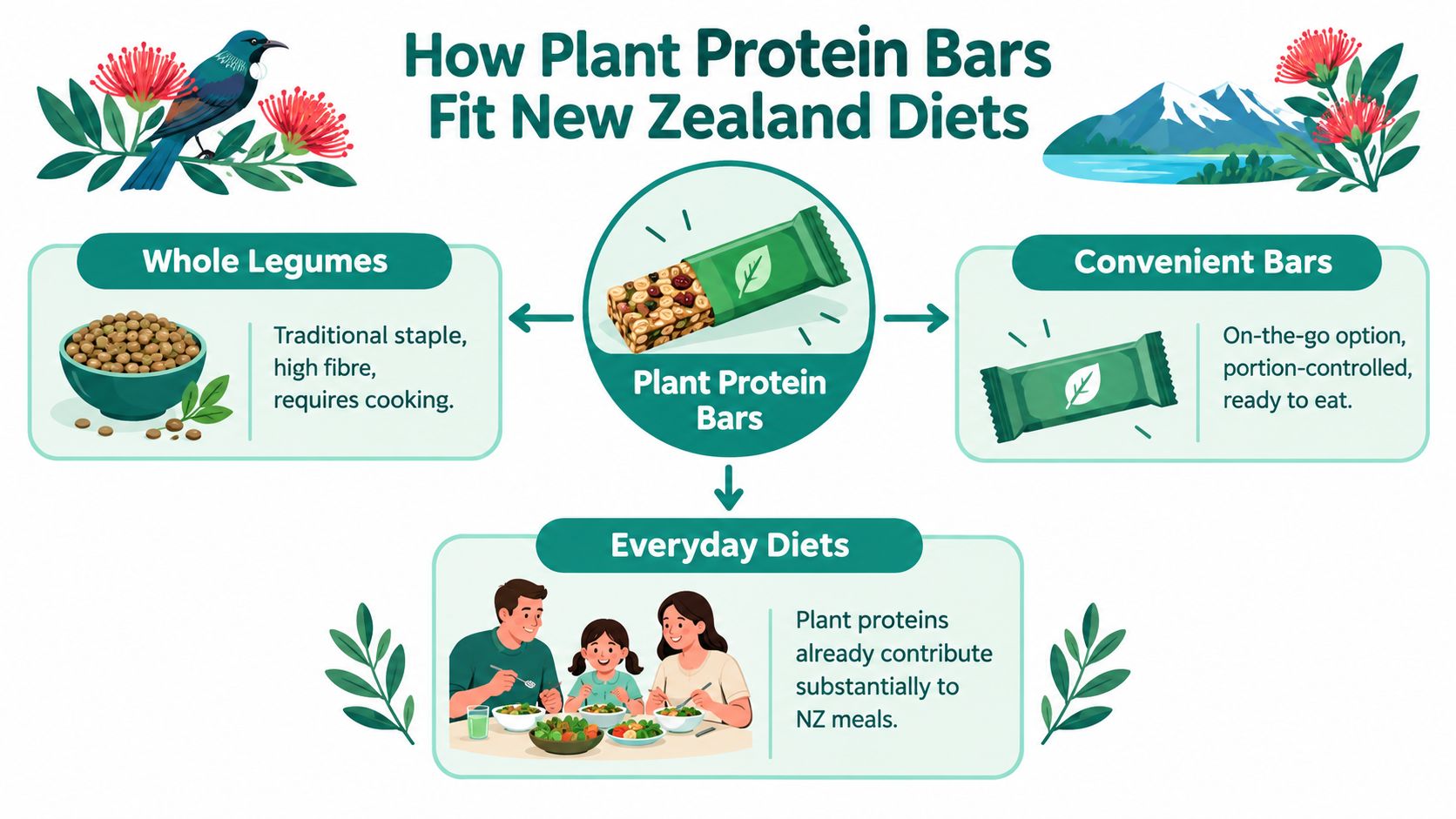
That finding changes the comparison. The relevant question is whether a shelf-stable serving earns its place in a diet already containing substantial plant protein.
Legumes expose the trade-off most clearly. The Ministry of Health describes lentils, chickpeas, kidney beans and baked beans as nutrient-rich foods that are high in fibre and provide protein, while also reporting that nearly half of New Zealand adults ate few or no legumes, according to its Adults' Dietary Habits report.
A serving of chickpeas and a pea-protein bar can share an ingredient family while delivering different nutritional packages. The first is assessed through the food's own nutrient composition. The second is a finished formulation shaped by its principal protein source, supporting ingredients and labelled serve.
| Option | What to assess | Dietary role |
|---|---|---|
| Whole legumes | The complete nutrient composition of the food | A meal component that can supply protein and fibre |
| Plant protein bar | The finished formulation, ingredients and serve | A portable packaged serving when convenience matters |
| A meal containing a bar | Everything eaten together | One contributor to the meal's overall value |
The reported legume gap gives bars a plausible job: they can provide protein when cooking, refrigeration or portion control makes another choice awkward. It also sets a limit on what convenience proves. Pea protein in a bar remains part of a designed recipe, so the full formulation matters more than the crop's reputation.
A bar can earn its place on practicality first. Formulation quality, dietary disclosure and cost per useful serve still decide whether it is a sound buy.
Choosing Plant Protein Sources That Complement
A 2025 Massey University study of 193 long-term vegans in New Zealand found that most participants consumed enough total protein, yet digestibility-adjusted calculations identified lysine and leucine as the principal limiting amino acids, with only about half meeting daily adequacy for both. The same analysis examined plant protein bars and found that soy- and pea-based products supplied more indispensable amino acids, particularly lysine, and sat closer to FAO reference requirements than oat- and rice-based products, according to the published New Zealand protein and amino-acid analysis.
Those findings describe the studied diets and formulations. They do not establish that every vegan shopper falls short, or that a cereal-based bar is automatically a poor purchase. They do change what a protein claim on the front of a pack can reasonably tell you. Grams measure quantity. Digestible essential-amino-acid delivery describes which indispensable amino acids arrive in useful amounts after digestion, and that is the quality question a label rarely answers directly.
What a blend claims and what it proves
A label-led example shows the gap between signal and proof. A bar listing pea protein concentrate first and rice protein second suggests complementary amino-acid profiles, since legume and cereal proteins tend to be limiting in different amino acids. The ingredient list alone, though, discloses neither the ratio between the two sources nor the finished bar's digestibility. The declared protein per serve still needs checking against the portion you would eat.
One word on the pack, "blend", compresses three separate checks: the principal source, the supporting source and the serving definition.
A clearly explained formulation earns more confidence than an unexplained headline. For a focused comparison of the two most common lead sources, the pea versus soy protein guide examines them side by side.
Plant ingredients in a recipe also do work unrelated to protein. Smokey Rebel's guide to filler-free plant based rubs shows how ingredient selection shapes a seasoning blend, a culinary parallel rather than evidence about a bar's amino-acid quality.
The practical position is to treat a blend as a lead worth investigating, weighed alongside fibre, sugars and portion size.
Comparing Currently Stocked Plant Protein Bars
A comparison table earns its place only when every cell traces back to a live product page: the serve size from the nutrition panel, the allergens from the declaration, and the price per serve from the pack price divided by labelled servings. As at October 2026, individual product rows are being confirmed against the NZ Supps product pages, so the table below sets out what each published row will record and where every figure comes from.
Current plant protein bar comparison
| Comparison field | What the row must establish | Where the figure comes from |
|---|---|---|
| Product and flavour | The exact variant, since macros and allergens can differ between flavours of the same bar | Product page title and variant selection |
| Serve size | The labelled serve, checked against the portion you would actually eat | Nutrition information panel |
| Protein per serve | Protein grams on the same serving basis as every other row | Nutrition information panel |
| Carbohydrate, fat and sugars | The full macro picture alongside protein | Nutrition information panel |
| Key allergens | The declared allergen statement, copied rather than inferred from the protein source | Allergen declaration |
| Price per serve | The pack price divided by the labelled servings in that pack | Product page price and serving count |
A worked example shows why the last column matters: a pack priced at $60 containing 12 labelled serves comes to $5 per serve. If another pack defines its serve differently, the per-serve figure stops being comparable, so the serving definition travels with the price in every row.
Availability is part of a recommendation, not an administrative detail. A nutritionally appealing bar only counts as a current buying option when the relevant flavour and pack format can be ordered, and each row is published only after that variant check.
Why empty cells stay visible
Figures copied from a different flavour, an overseas listing or a remembered price would make the table look more helpful while making it less reliable. Fields still awaiting a page check as at October 2026 remain blank and dated rather than filled in from another source.
For ingredient-level context, the New Zealand Food Composition Database contains nutrient information for more than 3,400 foods and ingredients and is used by manufacturers and health professionals, according to its explanation of database ownership, contents and uses. It offers a useful analytical frame for reading plant protein sources, while the finished product's current label and retail price remain the deciding records.
A completed comparison should support different choices rather than manufacture an overall winner. One shopper may prioritise a compact portion; another may want more carbohydrate alongside protein; another may exclude a product on an allergen alone.
Missing data should stay visible. Where a product page does not disclose a detail the table requires, ask for it before treating that bar as a match.
Reading Flavour Texture and Ingredient Design
A "choc peanut" bar and a "salted caramel" bar can print the same protein figure and share almost nothing else. The front of pack names a flavour; the ingredient list in small print describes the actual recipe, and that list is where realistic flavour and texture expectations begin.
New Zealand labels generally list ingredients in descending order by weight, and highlighted ingredients must have their percentage declared where required, as explained in MPI's food labelling guide. A prominently named inclusion can therefore be checked against its position: early placement points to a structural role, late placement to a smaller contribution.
Read properly, the list divides cleanly into what it confirms and what it leaves unresolved.
| The label confirms | The label leaves unresolved |
|---|---|
| Which proteins, nuts, seeds and cereals are present | Whether the finished bar tastes strongly of them |
| The flavour system, such as cocoa, fruit pieces or flavouring | How pronounced that flavour is on the palate |
| Which sweeteners appear and in what combination | How sweet the bar actually eats |
| Binders such as syrups or fats | Whether the texture reads soft, chewy or crisp |
Texture wording sits firmly in the right-hand column. "Soft baked", "crispy" and "chewy" describe the maker's intent, and a single bar sampled before a bulk order answers what a label can only suggest.
Sweetening deserves a second pass because one recipe can draw on several sources at once. The guide to sugar alcohols in protein bars explains the terminology that turns up mid-list, so you can recognise those ingredients and weigh them as part of the whole formulation.
An ingredient list sharpens the questions you ask about texture. Tasting the bar is what answers them.
Sequence matters here. Confirming dietary suitability first, then testing whether one bar's flavour and format suit the intended occasion, costs less than finding out a bulk box misses the mark. Keep any verdict specific: "I prefer this texture" is useful self-knowledge, while "the best-tasting plant protein bar" needs a defined field of competitors and actual tastings behind it.
Assessing Macros and Everyday Use
A bar's role depends on what you're eating it with and why you're carrying it. The following visual distinguishes common uses, but its relative bars should be read as conceptual, not measured product data or universal nutritional targets.
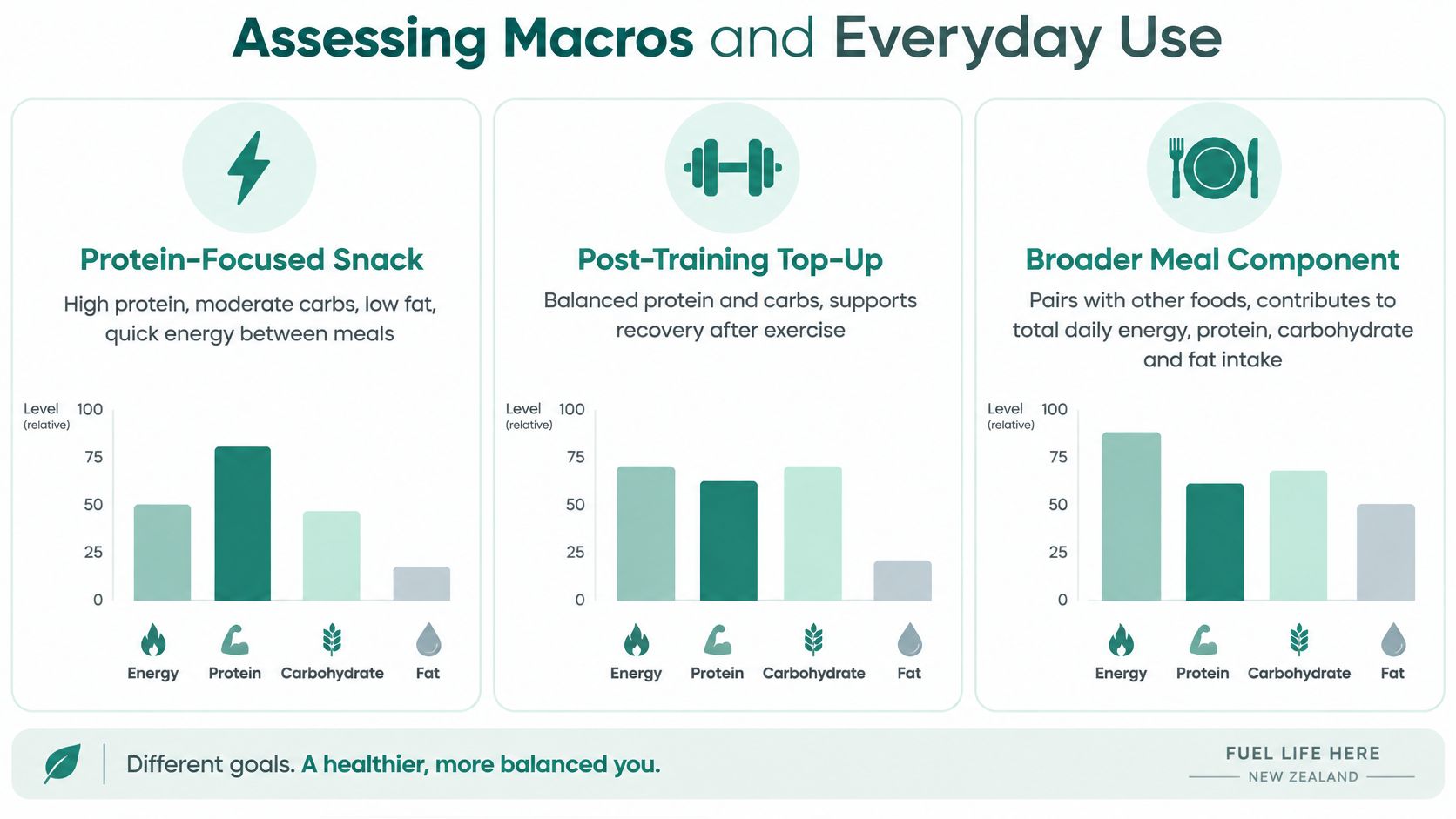
New Zealand's required Nutrition Information Panel includes energy, protein, fat, saturated fat, carbohydrate, sugars and sodium, with information per serving and per standard weight, as detailed in MPI's retail food labelling guidance. Read those values together rather than treating protein as the only relevant contribution.
An example without a product endorsement
Consider a 40 g bar listing 12.1 g protein, 159 calories, 5.0 g sugar and 154 mg sodium. These figures describe a label-reading example only: the product identity, current label and retailer availability haven't been verified, so they shouldn't be used as a buying recommendation.
The analytical point is that protein comes inside a complete food. Without the remaining carbohydrate, fat and fibre information, you still don't have enough detail to judge its full contribution to an eating occasion.
Protein density helps compare foods of different energy content. Calculate it by dividing protein grams by calories, then expressing the answer on a common calorie basis; keep the energy units consistent and don't mix kilojoules with calories.
Match the panel to the occasion
For a snack, decide whether the portion fits what you want between meals. For a post-training top-up, consider what you've already eaten and what your next meal will provide rather than assuming the wrapper establishes a complete recovery plan.
As a meal component, a bar should be assessed alongside the other foods. A protein claim alone doesn't establish meal completeness.
For a separate format comparison, consult protein powder versus protein bars. If you're considering a coffee-based alternative, Cartograph Coffee's best coffee protein ratios is a recipe resource, not evidence that a drink and bar are nutritionally interchangeable.
The embedded video is an optional accompanying resource, not a source for the product calculations.
Checking Vegan Status and Allergen Risk
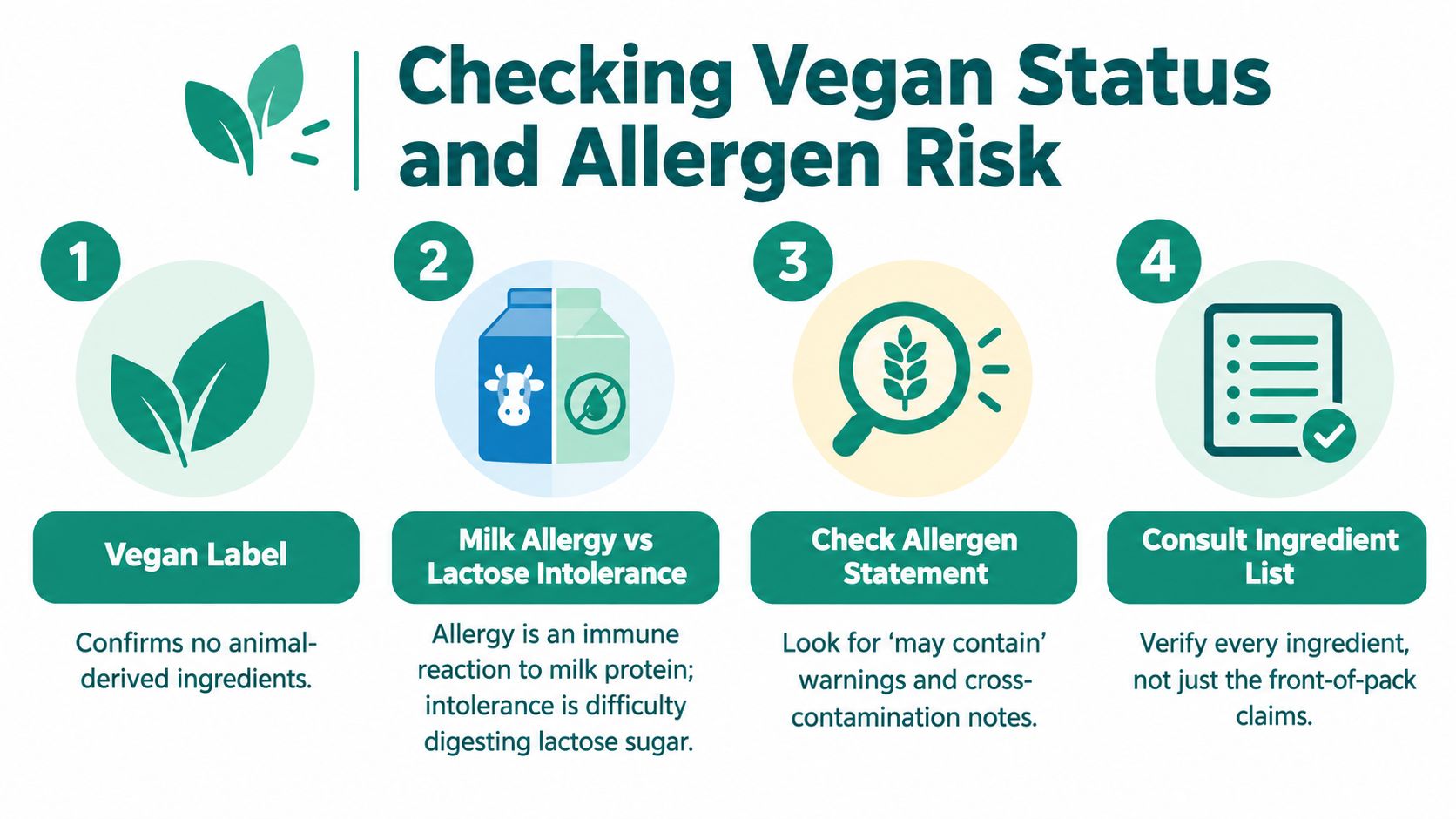
Vegan positioning and allergen suitability are separate checks. Milk allergy concerns milk protein, whereas lactose intolerance concerns difficulty digesting lactose sugar; those aren't interchangeable reasons for avoiding a food.
MPI requires relevant allergens, including milk, soy, peanuts, tree nuts, wheat or gluten, sesame and lupin, to be declared under applicable labelling requirements. Its guide to reading food labels explains why the ingredient list and allergen information deserve attention alongside front-of-pack wording.
The checklist below is a starting point. Its vegan-label shorthand must not be interpreted as proof that a product is safe for someone with an allergy.
Use a repeatable screening process
- Read every ingredient: Include coatings, flavour components and compound ingredients, not just the main protein base.
- Check the Contains statement: Compare it directly with the allergens you need to avoid.
- Read may contain wording: Treat it as relevant cross-contact information, not as an ingredient list or a precise measure of risk.
- Resolve uncertainty: Ask the manufacturer about unclear disclosure or manufacturing controls rather than assuming silence confirms suitability.
There's a concrete reason not to rely on the product name. In July 2025, MPI recorded a recall of Snack Switch Plant Protein Bars because of undeclared milk, with advice that people with milk allergy or intolerance shouldn't consume the affected products, as documented in the official Snack Switch recall notice.
Safety check: Re-read the wrapper you receive, even when you've bought the same named bar before.
A plant-protein base doesn't, by itself, establish the conditions in which the finished product was manufactured. Equally, “may contain” wording shouldn't be converted into a homemade judgement about a safe amount.
For families organising their shopping checks, Guiding Growth's allergen safety tips for parents offers an additional reading resource. Use manufacturer information and official notices to resolve product-specific questions.
Making a Per Serve Buying Decision
Start with intended use, then apply the checks that can rule a product in or out. Brand reputation, packaging and flavour names should come after the information that determines whether you can and want to eat it.
A practical final comparison can be kept on a short shopping note:
- Suitability: Vegan requirements, ingredients and allergen disclosure.
- Protein: Principal sources, complementary formulation and amount in the intended portion.
- Whole-bar contribution: Energy, carbohydrate, fat, sugars, fibre and sodium.
- Eating experience: Flavour preference, portion format and texture expectations.
- Value: Price for the serving you'll use, not merely the cheapest-looking pack.
Distinguish purchase price from protein value
Cost per bar answers what each wrapped item costs. Cost per protein amount answers a different question and is useful only when the products have already passed your suitability checks.
To compare cost per 10 g of protein, divide the price per serving by its labelled protein grams, then multiply by 10. This is a calculation method, not a claim about any product's price or nutritional performance.
Don't call that figure the cost of usable protein unless you have the evidence needed to adjust for amino-acid quality and digestibility. A nutrition panel alone doesn't supply that answer.
Return to the protein bars collection with a defined shortlist of requirements. Check each current product page, selected variant and delivered label because formulations, prices and availability can change.
NZ Supps offers locally held sports nutrition products, ingredient disclosures and per-serve pricing to support practical comparisons. Visit NZ Supps to review the available labels and confirm which options meet your requirements before ordering. Shop all protein bars.