SHOP NOW, PAY LATER










 Informed Sport
 Informed Choice
 NSF Certified for Sport
 HASTA Certified

People often buy protein powder backwards. They see the biggest number on the front of the tub, assume it represents the best result, and then compare discounts on oversized containers. That approach ignores the question that matters more: how complete and usable is the protein in the formula?
New Zealand's market makes this especially relevant. A government-linked Coriolis and NZTE report estimated domestic pea-protein demand at 530 tonnes, with 85% used in sports nutrition and 14% in alternative meats, while demand grew at a 53% CAGR from 2010 to 2021 and was projected to reach 5,500 tonnes. The Ministry for Primary Industries report shows that plant protein isn't a fringe ingredient here. It's becoming part of the local performance-nutrition conversation.
The better buying question isn't “Which scoop has the most protein?” It's “Which blend gives me a transparent, complementary amino-acid profile, suits my digestion and training, and carries credible testing if I need it?” That's the standard I'd use before spending money on nz protein powder blends.
Table of Contents
- Why Most Protein Buying Logic Is Backwards
- What a Protein Powder Blend Actually Means in NZ
- The Three Blend Families NZ Buyers Actually Meet
- DIAAS Protein Quality and Why It Beats the Headline Number
- Label Transparency and the Tested-for-Sport Question
- How to Choose an NZ Protein Powder Blend in Five Minutes
- The Bottom Line Before You Buy Another Tub
Why Most Protein Buying Logic Is Backwards
A large protein number looks objective. It sits in bold type, usually beside a picture of a shaker, and gives you an easy way to compare tubs. But grams of protein are an input, not the whole nutritional outcome. Two products can provide similar headline numbers while differing in amino-acid balance, digestibility, ingredient disclosure, and contamination controls.
That doesn't mean a high-protein serving is useless. Whey, casein, pea, rice, soy, and other sources can all have a place. The problem starts when shoppers treat the front-of-pack number as a complete quality score. A 30-gram serving tells you how much crude protein the manufacturer says is present. It doesn't, by itself, tell you whether the formula supplies enough of each indispensable amino acid or whether the claimed contents have been independently checked.
The label number has limits
New Zealand supplement buyers often encounter bulk tubs, promotional pricing, gym samples, and large displays in retailers such as Chemist Warehouse or online sports-nutrition stores. Those buying environments encourage quick comparisons. More servings, more grams, and a larger discount can feel like a rational decision even when the ingredient panel remains vague.
The smarter comparison starts with the back label. Look for the actual protein sources, their order in the ingredients list, the amino-acid profile where available, and any evidence supporting the product's quality claims. A formula that combines complementary sources may be more useful than a larger serving built around one poorly balanced plant source. That's a nutrition judgement, not a packaging judgement.
New Zealand protein use also reflects a mixed market rather than a simple whey-versus-vegan split. An Otago University thesis reported that 22.1% of respondents used a sports supplement, and 77.7% of those supplement users took a product containing whey protein. The same work cited national nutrition data showing male adolescents averaged 110 grams of protein per day in 1997 and 108 grams per day in 2008/09, with protein contributing 15 to 16% of total energy intake. The Ministry of Health nutrition report helps explain why local shoppers may want convenience without assuming every product needs to be dairy-only.
My buying rule: treat the protein-per-serve figure as the starting point, not the verdict.
A blend deserves proper attention because it can combine complementary amino-acid profiles, improve texture, manage cost, or suit people who want less dairy. In 2025, it isn't merely a dusty shelf label. It's a practical category, provided the manufacturer tells you what's in the scoop.
What a Protein Powder Blend Actually Means in NZ
A protein powder blend combines two or more protein sources in one serving. That might mean whey concentrate with whey isolate, whey with casein, or a plant combination such as pea and rice. It might also mean a hybrid formula that combines dairy and plant proteins.
The word “blend” only becomes useful when the label gives you enough information to judge the mixture. A genuine transparent blend names each protein source in the ingredients panel and, ideally, shows how much of each is present. A product that says “protein blend” without identifying the individual components gives you very little control over the decision.
Separate a real blend from a marketing blend
Read the ingredients from highest to lowest amount. If whey concentrate appears first, followed by a much smaller amount of isolate, the product may function mainly as a whey concentrate formula. That isn't automatically bad. It shouldn't be marketed as though every component contributes equally.
The same applies to collagen. A tub can contain a small quantity of collagen alongside a much larger quantity of whey or plant protein, yet the front label may make the formula sound more advanced than it is. Collagen has a different amino-acid profile from a complete muscle-focused protein, so its presence should be clearly disclosed rather than hidden inside a broad category.
Use the NZ Supps guide to proprietary blends as a useful label-reading reference. The practical lesson is simple: if you can't identify the protein sources and their relative contribution, you can't properly assess the blend.
Why DIAAS changes the conversation
Protein quality isn't only about total protein. DIAAS, or Digestible Indispensable Amino Acid Score, measures indispensable amino acids absorbed in the small intestine, rather than relying only on crude protein content. New Zealand research led by Massey University's Riddet Institute has applied this approach across a database of 97 foods, creating a locally relevant method for comparing dairy and plant proteins. The Riddet Institute research is valuable because it shifts attention from the front label to what the body can access.
Plant proteins often have limiting amino acids. Pea, rice, and canola can complement one another because their weaker points don't perfectly overlap. A careful blend can therefore offer a more balanced amino-acid pattern than one source used alone.
Protein claims still need context. A tub can truthfully advertise protein while leaving shoppers unable to judge source proportions, digestibility, or testing status. That's why I'd rather buy a plainly labelled formula with modest marketing than a premium-sounding product that hides behind a proprietary blend.
The Three Blend Families NZ Buyers Actually Meet
New Zealand shoppers generally encounter three useful blend families. They're not interchangeable, and each solves a different problem. Judge them by their amino-acid logic and label quality, not by phrases such as “sustained release”, “clean”, or “complete plant power”.
Whey and casein
Whey-plus-casein products combine rapidly digested whey with slower-digesting casein. The logic is sensible for people who want a dairy-based option that feels more substantial over a longer period, especially as part of an evening meal or recovery routine.
The trade-off is that both proteins come from dairy. This family won't suit people avoiding dairy, and it may not be ideal for shoppers who experience lactose-related discomfort, depending on the specific ingredients and processing. Dairy proteins are strong reference proteins, but a premium price and a complex label don't remove the need to check quantities, sweeteners, and testing.
The “sustained release” language should also be read carefully. A slower digestion profile can be useful, but it doesn't turn the powder into a magical overnight recovery product. You're still buying a convenient protein source, not a substitute for adequate food, sleep, and training.
Plant-only multi-source formulas
Plant blends commonly combine pea with rice, hemp, quinoa, soy, or another plant protein. The reason for stacking sources is nutritional, not decorative. One plant protein may be relatively weaker in an amino acid that another source supplies more effectively.
New Zealand vegan protein-quality research supports a limiting-factor approach. Improving total protein intake isn't enough if amino-acid balance remains poor, so complementary sources matter when formulators want a more useful plant-based product. The New Zealand vegan protein-quality study provides the relevant framework.
These formulas can suit vegan shoppers, people avoiding dairy, and anyone who prefers a plant-led ingredient list. Their disadvantages include flavour, texture, and digestibility differences between products. Don't assume “plant-based” means automatically better or worse. Check the sources, serving information, amino-acid evidence, and how your own stomach responds.
Whey and plant hybrids
Hybrid formulas combine whey with plant protein. This category makes sense when you want dairy's strong amino-acid profile and familiar texture, but also want to reduce reliance on a single source or include plant ingredients for personal, environmental, or cost reasons.
The honest advantage is flexibility. A well-designed hybrid can provide a more balanced formula than a single plant source while remaining easier to drink than some plant-only powders. The honest disadvantage is that “hybrid” can become a vague marketing term if the label doesn't show the relative amounts.
| Blend family | Typical DIAAS range | Common NZ marketing pitch | Honest trade-off |
|---|---|---|---|
| Whey and casein | Near the upper range for dairy proteins, with values reported near 1.18 in relevant protein-quality work | Sustained release and premium dairy recovery | Dairy-based, potentially costlier, and not suitable for dairy avoiders |
| Plant-only multi-source | Around 0.8 to 1.0 when well formulated | Complete vegan protein and complementary sources | Quality depends heavily on the recipe, processing, and digestibility |
| Whey and plant hybrid | Varies with the dairy-to-plant ratio and formulation | Best of both worlds, balanced performance | The label must prove the balance rather than merely imply it |
For a closer comparison of plant sources, read this guide to pea and soy protein. My preference is clear: choose the family that fits your diet first, then reject any product that refuses to show what the blend contains.
DIAAS Protein Quality and Why It Beats the Headline Number
DIAAS is useful because it asks a more demanding question than “How much protein is present?” It considers the indispensable amino acids your body needs and how much of those amino acids are absorbed in the small intestine. That makes it more informative than a label that only highlights total protein.
A powder can contain a generous serving of protein and still be limited by one amino acid. For plant formulas, lysine or methionine can become important constraints depending on the source. A blend works well when it corrects those weaknesses rather than just adding more powder to the scoop.
Read the formula behind the number
Whey is generally regarded as a high-quality protein source, while plant proteins vary considerably. Rice protein can be limited in lysine, whereas pea protein generally offers a stronger profile in that area but has its own limitations. The exact result depends on the ingredient, processing, digestibility, and formulation.
This is why a well-designed pea-and-rice blend can make more nutritional sense than a larger serving of rice protein alone. It's also why a whey-and-plant formula can be useful for a shopper who wants a complete profile without relying entirely on dairy. The result comes from the combination, not the word “blend” printed on the front.
Don't pay extra for the largest scoop until you know which amino acid limits the formula.
A practical comparison
Use the table below as a screening tool, not as a substitute for product-specific evidence. Approximate values vary by ingredient and formulation, so a manufacturer's published quality data should carry more weight than a generic category estimate.
| Protein source | Approximate DIAAS | Key limiting amino acid |
|---|---|---|
| Whey | Near 1.0 in common reference discussions | No major limitation in the way many plant sources present one |
| Pea | Higher than rice among common plant options, with the final result depending on formulation | Methionine and related sulphur amino acids can be limiting |
| Rice | Around 0.4 in the approximate comparison described in the brief | Lysine |
| Multi-source plant blend | Around 0.8 to 1.0 when well formulated | Depends on the recipe and the weakest indispensable amino acid |
| Whey and plant hybrid | Moves with the ratio and protein sources | Depends on the plant component and dairy contribution |
The rule I'd use in a shop is straightforward. First check the named ingredients. Then look for a complete amino-acid profile or published DIAAS or PDCAAS evidence. Only after that should you compare the protein-per-serve number.
New Zealand's local research base matters here because formulators can compare dairy and plant ingredients using methods relevant to foods consumed in this market. DIAAS literacy gives shoppers an advantage that scoop-size marketing can't provide.
Label Transparency and the Tested-for-Sport Question
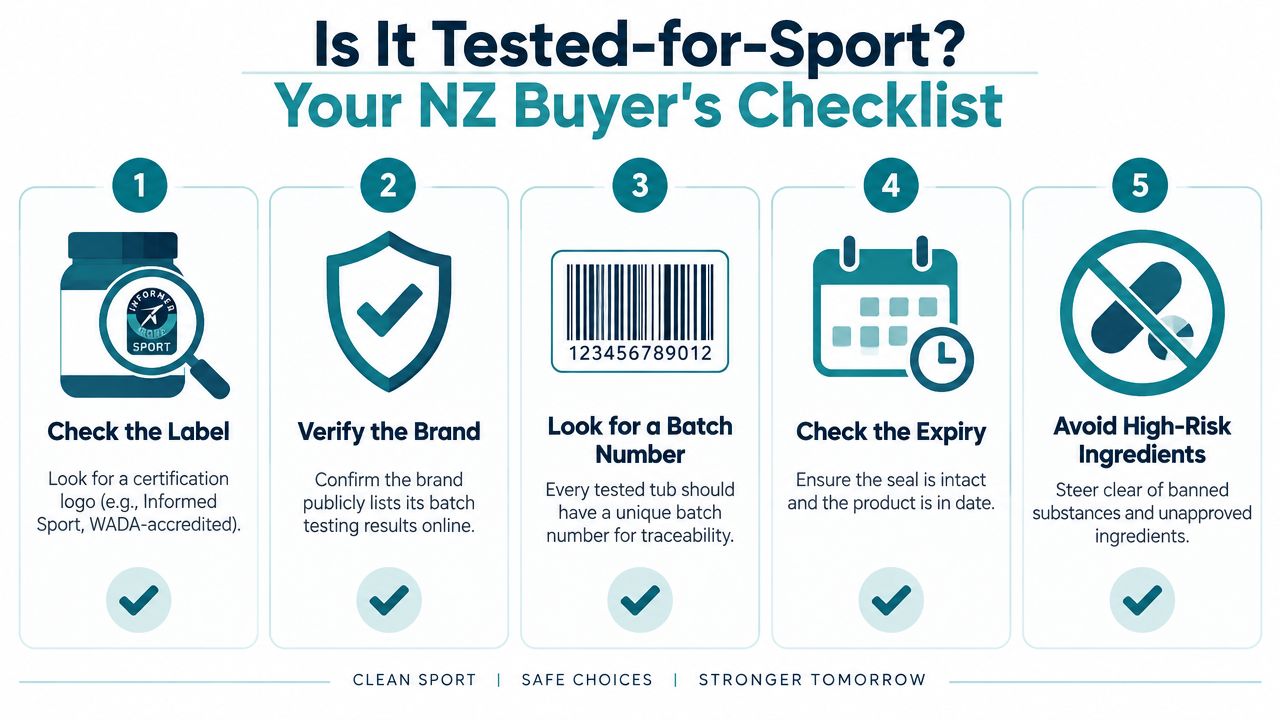
If you're drug-tested, tested-for-sport certification is not an optional bonus. A contaminated supplement can create consequences far beyond wasting money, so the product needs credible batch-level controls rather than a vague statement that it has been “third-party tested”.
Look for a named certification or testing body, such as Informed Sport, Informed Choice, HASTA, or NSF Certified for Sport. ISO 17025 accreditation can also matter when a laboratory performs batch testing, but “third-party tested” without the laboratory, standard, batch information, or certificate isn't enough.
What I check before buying
Start with the label, then verify the claim independently. The product page should name the certification programme, and the container should carry a batch number that connects the physical tub to the relevant testing record.
- Named testing standard: Look for a recognisable certification logo and confirm what it covers.
- Batch traceability: Check that the tub has a printed batch number, not just a generic product code.
- Full ingredient disclosure: Reject a proprietary blend that hides individual protein sources or quantities.
- Business details: Check the country of origin and the NZ distributor shown on the label.
- Date and seal: Confirm the seal is intact and the product is within its stated date.
- Public verification: Use the brand's published testing information or the certification body's records where available.
Independent NZ coverage has shown why “clean” positioning deserves scrutiny. In a local shake comparison, two products marketed as premium were found to contain undisclosed artificial sweeteners, and the coverage warned shoppers about proprietary blends, vague disclosures, and products lacking third-party certificates. The NZ protein shake testing coverage makes the key point: simpler, cheaper formulas can be easier to trust when they disclose exact ingredients and testing status.
Choose traceable stock
NZ-held stock is easier to return, track, and replace than a grey import from an overseas seller. It also gives you a clearer route to the local distributor if the label, seal, batch details, or contents don't match the listing.
Drug-tested athletes should use the NZ guide to checking supplement testing before checkout. If the seller can't explain who tested the batch and how you can verify it, choose another product.
How to Choose an NZ Protein Powder Blend in Five Minutes
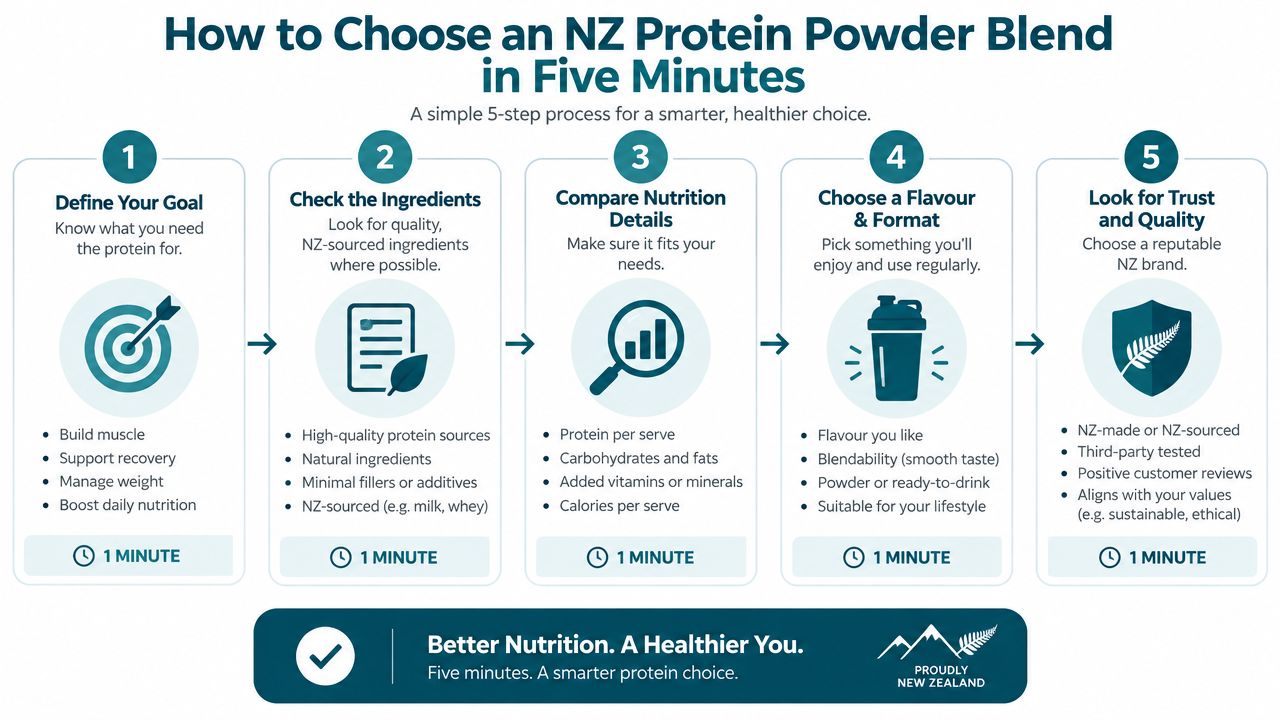
You don't need a spreadsheet. You need a consistent order of decisions that stops a discount sticker from making the decision for you.
Start with the deal-breaker
First, decide whether sport testing is mandatory. If you compete under drug-testing rules, filter for a recognised certification before considering flavour, price, or serving size. That immediately removes products that may be fine for general gym use but don't meet your risk tolerance.
Second, choose the blend family. Whey and casein suit people who want a dairy-based, slower-digesting option. Multi-source plant formulas suit vegan or dairy-avoiding shoppers. Whey-and-plant hybrids suit general training when you want dairy protein alongside plant ingredients.
Then interrogate the back label
Third, name every protein source. Put the tub back if it only says “protein blend” without identifying the components. If the formula lists sources but gives no relative quantities, treat the quality claim as unproven rather than assuming the ingredients are evenly balanced.
Fourth, check the evidence. Look for a complete amino-acid profile, DIAAS or PDCAAS information, clear allergen statements, and a credible manufacturer. A brand doesn't need to make dramatic promises. It needs to provide enough information for a sensible comparison.
Fifth, calculate useful value. Compare the cost per gram of usable protein, not only the price per scoop. That means considering the protein source, amino-acid completeness, serving size, and how much product you'll use. A cheap tub you dislike or can't digest isn't good value.
The label should also tell you whether the stock is held in New Zealand, who distributes it, and how to identify the batch. NZ Supps presents products with ingredient information, per-serve comparisons, and a Tested for Sport collection that groups products by certification standard. That's the kind of shopping tool I'd use when comparing formulas, rather than relying on the front-of-pack claims alone.
For broader support with training habits and food choices, fitness and nutrition coaching can help you connect supplement decisions with a realistic programme.
Here's a short visual walkthrough to reinforce the buying sequence:
My walk-away rule is firm: if the label doesn't name its testing body, doesn't identify the protein sources, or buries the formula under vague ingredient language, leave the tub behind, even if the sale looks attractive.
The Bottom Line Before You Buy Another Tub
Stop treating the protein-per-scoop number as the product's final score. The better assessment combines amino-acid completeness, digestibility, blend design, ingredient transparency, and verified testing. A powder earns its place in your cupboard when you can understand the formula and match it to your actual use.
Before your next purchase, take three actions:
- Scan the ingredient panel: Check that the label names each protein source and doesn't hide the formula behind an unexplained proprietary blend.
- Verify sport testing: If you're drug-tested, confirm Informed Sport, Informed Choice, NSF Certified for Sport, HASTA, or another clearly identified testing route before checkout.
- Match the family to the job: Choose whey and casein for a dairy-based, slower-digesting option, a multi-source plant powder for vegan or dairy-avoiding needs, and a whey-and-plant hybrid for a flexible everyday formula.
The best NZ protein powder blend isn't the tub with the loudest graphics or the biggest scoop. It's the one whose label you can read, whose amino-acid logic makes sense, and whose testing you can verify.
NZ Supps offers whey, isolate, plant-based powders, blended formulas, and a dedicated Tested for Sport range, with stock held locally for NZ delivery. Visit NZ Supps and compare the ingredient panels, blend types, and certification details before choosing your next tub.