SHOP NOW, PAY LATER

















 Informed Sport
 Informed Choice
 NSF Certified for Sport
 HASTA Certified

Probiotics can genuinely help athletes, though the benefits are more specific than the marketing suggests. The strongest evidence points to reduced gastrointestinal symptoms during training and competition, fewer upper respiratory tract infections (URTIs), and modest but real endurance gains. A 2026 Bayesian meta-analysis of 21 trials (N = 685) found a small-to-moderate overall improvement in athletic performance, with the clearest signal in endurance outcomes. What it won’t do is replace a solid training block or fix a poor diet.
The direct and indirect benefits worth knowing:
- Endurance performance: Small-to-moderate gains in aerobic capacity and late-race pacing in several RCTs
- GI symptom reduction: Fewer and less severe gut complaints during training and racing
- URTI incidence: Reduced frequency of colds and respiratory illness, supporting training continuity
- Recovery markers: Indirect improvements through lower systemic inflammation and oxidative stress
- Strength and power: Evidence here is limited and inconsistent, don’t expect a squat PR
The catch: every one of these effects is strain-, dose-, and duration-dependent. A generic “probiotic blend” with no strain identification and an unknown CFU count at expiry is unlikely to replicate what the trials found.
Key Takeaways
Probiotics offer athletes the most reliable benefits in endurance performance, GI symptom reduction, and URTI prevention, with effects that depend entirely on using the right strain at the right dose for long enough.
| Point | Details |
|---|---|
| Evidence verdict | A 2026 Bayesian meta-analysis (21 trials, N = 685) found a small-to-moderate overall effect (SMD 0.38), strongest for endurance outcomes (SMD 0.74). |
| Strain and dose specificity | Medium doses (1×10⁹ to 1×10¹¹ CFU/day) with identified strains like L. plantarum, L. acidophilus, and B. longum show the most consistent trial results. |
| Trial timeline | Expect GI improvements within 2 to 4 weeks; endurance and performance signals require 30 to 90 days of daily, consistent dosing. |
| Anti-doping and safety | Competitive athletes should use only batch-tested products with a CoA; those on immunosuppressants like infliximab must consult a physician first. |
| NZ buying tip | Nzsupps stocks batch-tested, transparently labeled supplements in New Zealand, check strain IDs and request CoAs before competition use. |
Table of Contents
- What the research shows about probiotics for athletes
- How probiotics could actually affect your performance and recovery
- Which strains and doses have the best evidence for athletes
- What athletes should actually check when choosing a probiotic supplement
- Practical timing and dosing guidance for athletes
- Safety, drug interactions, and anti-doping risk
- A step-by-step trial plan you can actually follow
- Buying probiotics in New Zealand: what to check
- The honest case for probiotics in an athlete’s program
- Nzsupps stocks what athletes in New Zealand actually need
- Sources
What the research shows about probiotics for athletes
The evidence base has grown substantially, but it rewards careful reading. The 2026 Bayesian meta-analysis cited above is currently the most rigorous synthesis available, pooling 21 randomized trials and reporting an overall standardized mean difference (SMD) of 0.38, a small-to-moderate effect. Endurance outcomes drove that number, with an SMD of 0.74 for aerobic measures. Medium daily doses in the range of 1×10⁹ to 1×10¹¹ CFU produced the most consistent signal across trials.
Individual trials fill in the picture. A five-week double-blind RCT in amateur marathon runners using L. acidophilus and B. longum at 1.5×10⁹ CFU/day found improved Cooper 12-minute run distance and better GI quality-of-life scores compared to placebo. A separate 28-day RCT in marathon runners using a multi-strain formula at 25 billion CFU showed fewer moderate GI symptoms in weeks 3 to 4 and a notably smaller speed drop in the final third of the race: the probiotic group slowed by 7.9% versus 14.2% in the placebo group. A three-month multi-strain RCT in long-distance runners confirmed reduced GI symptoms and, in women, favorable changes in HDL and lipid markers.
Where the evidence gets thinner:
- Speed and explosive power: A systematic review found no consistent effects on sprint speed, leg power, or agility across studies
- Strength outcomes: Limited trials, heterogeneous protocols, and inconsistent results
- URTI effects: Some large, well-powered athlete trials found no difference in URTI duration or incidence, effects depend heavily on strain and population
The honest methodological picture: most trials are small (median N under 40), use different strains, doses, and outcome batteries, and run for varying durations. That heterogeneity is why the meta-analytic SMD of 0.38 should be read as a direction of effect, not a guarantee.
How probiotics could actually affect your performance and recovery
The mechanisms are plausible and increasingly well-characterized, even if the direct performance evidence is still catching up.
Gut barrier integrity is the most established route. Strenuous exercise increases intestinal permeability, allowing bacterial endotoxins (lipopolysaccharides) to translocate into the bloodstream and trigger systemic inflammation. Probiotics appear to tighten tight-junction proteins in the gut epithelium, reducing that translocation. Less circulating endotoxin means a blunted inflammatory response during and after hard training.

Immune modulation follows directly. The ISSN’s position stand on gut health identifies the gut as a primary gateway for pathogens during strenuous exercise and notes that probiotics can modulate the mucosal immune response, protecting against exercise-associated immune suppression. Fewer URTIs means fewer missed training days, which compounds over a season.
Metabolic and substrate effects are more speculative but worth tracking. Probiotic-driven changes in gut microbiota composition can increase short-chain fatty acid (SCFA) production, particularly butyrate. SCFAs serve as fuel for colonocytes, support gut barrier function, and may influence mitochondrial substrate availability during prolonged exercise. Improved nutrient absorption, particularly of iron, magnesium, and B vitamins, is a secondary benefit that matters for endurance athletes with high micronutrient turnover.
Inflammation and oxidative stress reduction has been documented across several athlete trials. Review evidence shows reductions in pro-inflammatory cytokines and improved markers of oxidative stress in supplemented groups, which plausibly accelerates recovery between sessions.
Gut-brain-muscle axis: mood, sleep quality, and perceived exertion all have bidirectional links to gut microbiome composition. The practical implication for athletes is that a healthier gut environment may reduce perceived effort at a given intensity and support sleep quality during heavy training blocks.
A simple way to map it: probiotics → improved gut barrier and microbiota composition → reduced endotoxin load and better immune function → lower systemic inflammation → faster recovery → more consistent training → performance gains over time. The chain is indirect for most outcomes, which is why the effects take weeks to months to appear.
Which strains and doses have the best evidence for athletes
Not all probiotics are equal, and the strain name on the label matters more than the CFU count alone.
| Strain | Evidence strength | Typical CFU in trials | Typical duration | Reported outcomes |
|---|---|---|---|---|
| L. plantarum (TWK10/PL-02) | Strong (endurance) | 1×10¹⁰ to 3×10¹⁰ | 4 to 12 weeks | VO₂max, muscle strength, body composition |
| L. acidophilus | Moderate | 1×10⁹ to 1.5×10⁹ | 4 to 5 weeks | Cooper run distance, GI symptoms |
| Bifidobacterium longum | Moderate | 1×10⁹ to 1.5×10⁹ | 4 to 5 weeks | GI quality of life, microbiota diversity |
| Bacillus coagulans | Moderate (recovery) | 1×10⁹ to 2×10⁹ | 4 to 8 weeks | Muscle damage markers, recovery |
| L. casei Shirota | Limited | 1.5×10⁹ | 2 to 4 weeks | URTI incidence, immune markers |
| Saccharomyces boulardii | Limited (GI context) | 5×10⁸ to 1×10¹⁰ | 2 to 4 weeks | Traveler’s diarrhea, GI symptoms |
| Multi-strain blends | Moderate (GI, URTI) | 2.5×10¹⁰ | 4 to 12 weeks | GI symptoms, HDL, training continuity |
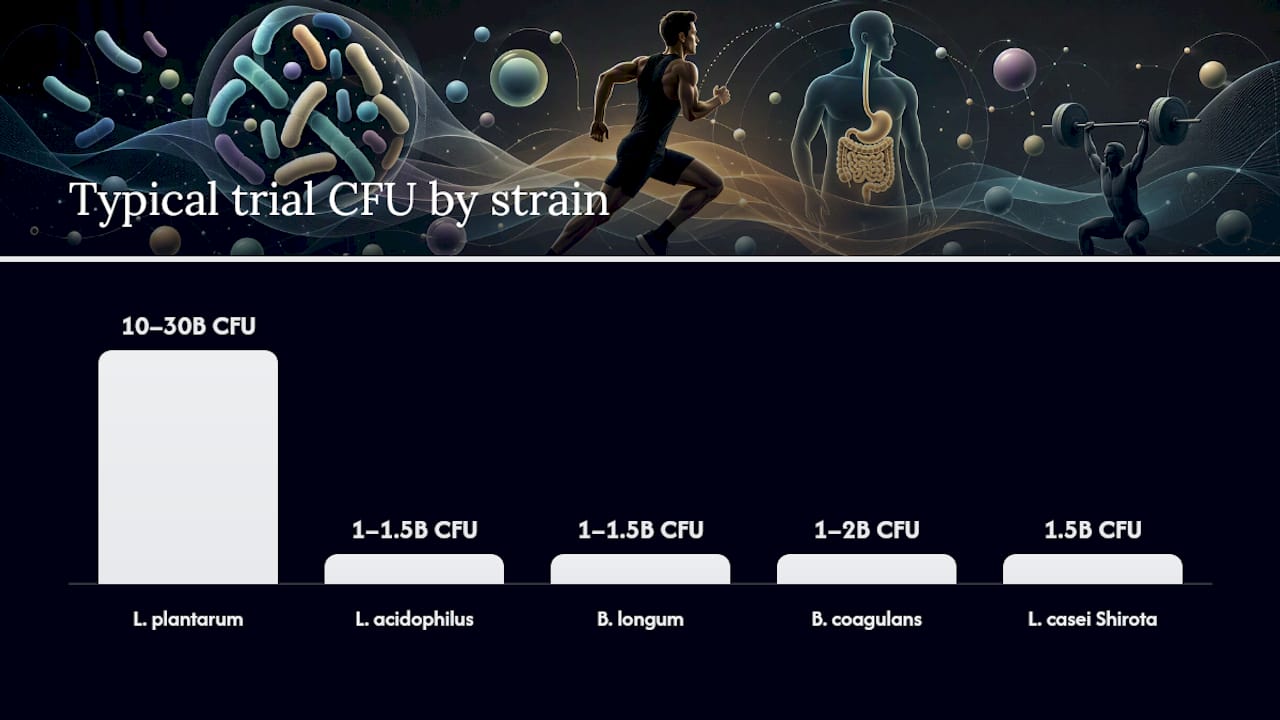
A few things stand out in the data. L. plantarum strains, particularly TWK10 and PL-02, have the most specific endurance and body composition signals. The Cooper 12-minute run trial used L. acidophilus and B. longum in combination at 1.5×10⁹ CFU/day, a relatively low dose that still produced measurable gains. The marathon GI trial used 25 billion CFU (2.5×10¹⁰), which sits in the medium-to-high tier.
The meta-analysis found the medium dose range (1×10⁹ to 1×10¹¹ CFU/day) produced the most consistent performance signal. Below that threshold, effects were less reliable. Above it, there was no clear additional benefit in the pooled data, though individual trials at higher doses have shown GI-specific benefits.
For duration: GI symptom improvements tend to appear within 2 to 4 weeks. Clearer performance signals generally require 30 to 90 days of consistent daily dosing. A multi-strain 3-month RCT in long-distance runners supports the longer end of that window for systemic and metabolic effects.
What athletes should actually check when choosing a probiotic supplement
The supplement aisle is full of products that use the word “probiotic” without giving you the information needed to know whether they’ll work. Here’s what separates a useful product from an expensive placebo:
- Full strain identification: The label must list the genus, species, and strain designation (e.g. Lactobacillus acidophilus NCFM, not just “Lactobacillus blend”). Without the strain ID, you cannot match the product to trial evidence.
- CFU at expiry, not at manufacture: Many products list CFU at the time of production. Viable count at expiry is what matters. Look for explicit “at expiry” or “at best before date” language.
- Dose tier matched to your goal: For endurance and GI outcomes, the medium tier (1×10⁹ to 1×10¹¹ CFU/day) is where the evidence sits. For acute GI symptom management, higher doses (up to 2.5×10¹⁰) have trial support.
- Third-party batch testing: For competitive athletes, contamination risk is a real concern. Informed-Sport certification or equivalent batch testing with a certificate of analysis (CoA) available on request is the standard to look for. The ISSN recommends batch-tested products specifically to reduce anti-doping contamination risk.
- Formulation and storage: Shelf-stable products using microencapsulation or enteric coating survive stomach acid better than unprotected capsules. Refrigerated products are not inherently superior, stability depends on the strain and manufacturing process.
- Transparent ingredient listing: No proprietary blends that hide individual strain doses. You need to know what you’re taking and at what amount.
Pro Tip: When a product lists only genus and species without a strain designation (e.g. “Lactobacillus acidophilus” with no alphanumeric strain code), it cannot be traced to any specific trial. Always cross-reference the strain code against published research before buying.
If you’re dairy-free or lactose intolerant, check the excipients. Many probiotic capsules use dairy-derived carriers. Dairy-free probiotics for athletes are widely available in capsule or powder form using rice maltodextrin or inulin as the carrier instead. The protein-for-lactose-intolerance guide on Nzsupps covers related considerations for athletes managing dairy sensitivities.
Practical timing and dosing guidance for athletes
Timing matters less than consistency, but there are a few rules worth following.
With food or without? Most encapsulated probiotics survive stomach transit better when taken with a meal, since food buffers gastric acid and slows transit time. Enteric-coated products are more flexible. Follow the product’s specific instructions, if none are given, take it with your largest meal of the day.
Training days vs. rest days: Take it every day. Probiotic colonization is transient for most strains; daily dosing maintains the population. Skipping rest days undermines the consistency that trials require to produce effects.
Competition prep timeline: Don’t start a new probiotic the week before a race. GI adaptation can cause temporary bloating or changes in stool frequency in the first 1 to 2 weeks. Build your protocol well in advance.
A practical timeline for athletes:
- Week 0 (baseline): Record current GI symptom frequency, URTI history over the past 3 months, training consistency, and a performance benchmark (time trial, Cooper test, or sport-specific metric).
- Week 1: Start daily dosing at the product’s recommended CFU. Note any GI changes in a simple log.
- Week 2 checkpoint: GI symptoms should be improving or stable. If significant discomfort persists beyond 2 weeks, consider a lower dose or different strain.
- Weeks 4: 6 checkpoint: Reassess training consistency and subjective recovery. Some athletes notice reduced URTI frequency and better sleep by this point.
- Weeks 8: 12 evaluation: Retest your performance benchmark. Compare URTI incidence and GI symptom frequency to baseline. This is the window where endurance-related gains, if present, become measurable.
Research across multiple RCTs and meta-analyses shows early GI symptom changes at 2 to 4 weeks, with progressive performance signals emerging by 30 to 90 days of consistent use.
Safety, drug interactions, and anti-doping risk
Probiotics are safe for the vast majority of healthy athletes. The risk profile is low, but a few specific situations require attention.
General safety: Healthy adults tolerate probiotics well across the dose ranges used in trials. Mild GI adaptation (bloating, altered stool frequency) in the first 1 to 2 weeks is common and typically resolves. Serious adverse events are rare and almost exclusively reported in severely immunocompromised individuals or patients with central venous catheters.
Drug interactions and contraindications:
- Immunosuppressants: Athletes taking biologics such as infliximab or other immunosuppressant medications should consult a physician before starting any probiotic. The interaction risk is not well-characterized in athletes specifically, but the general clinical guidance is to seek medical clearance.
- Antibiotics: Take probiotics at least 2 hours apart from antibiotic doses to avoid the antibiotic killing the probiotic organisms before they reach the gut.
- Antifungals: Saccharomyces boulardii is a yeast-based probiotic and will be inactivated by antifungal medications.
Anti-doping and contamination risk:
Supplement contamination with banned substances is a documented risk across the sports nutrition industry. Competitive athletes in New Zealand governed by World Anti-Doping Agency (WADA) rules carry strict liability, a positive test is a positive test regardless of how the substance entered the body. Batch-tested products with a CoA are the only meaningful protection.
Pro Tip: Informed-Sport certification means every batch of that specific product has been tested for WADA-prohibited substances. A brand-level certification without batch-level testing offers much weaker protection. Always verify the batch number on the CoA matches the product in your hand.
A step-by-step trial plan you can actually follow
Running a structured self-experiment is the most reliable way to know whether a probiotic is working for you specifically. Here’s a protocol built around the evidence:
-
Baseline week (Week 0): Record daily GI symptom scores (1 to 10 scale for bloating, cramping, urgency, and stool consistency), training sessions completed vs. planned, sleep quality (subjective 1 to 10), and a performance benchmark. If you have access to basic bloodwork, CRP and creatine kinase (CK) at baseline give you inflammation and muscle damage markers to compare later.
-
Product selection: Choose a strain-identified product in the medium CFU tier (1×10⁹ to 1×10¹¹/day) with batch testing documentation. Match the strain to your primary goal: L. plantarum variants for endurance, L. acidophilus + B. longum for GI and endurance combined, multi-strain blends for general GI and immune support.
-
Start daily dosing: Take it at the same time each day, with food. Log any changes in a simple daily note, even a phone note works.
-
2-week checkpoint: GI symptoms should be stable or improving. If you’re experiencing persistent discomfort, drop to half the dose for one week before reassessing. No improvement in GI symptoms by week 4 is a signal to try a different strain.
-
4: 6 week checkpoint: Assess training consistency. Have you missed fewer sessions due to illness or GI issues? Subjective recovery and sleep quality are worth logging here too.
-
8: 12 week evaluation: Retest your performance benchmark under comparable conditions. Compare URTI incidence and GI symptom frequency to your baseline week data. A systematic review of endurance athletes found consistent indirect benefits (immune response, oxidative stress reduction, fewer URTIs) that support training continuity, this is the window where those effects compound into measurable performance differences.
Decision rules: Continue if GI symptoms have improved, training consistency has increased, or your performance benchmark has moved. Change strain or dose if no change is observed by week 8. Stop and consult a healthcare provider if you experience persistent GI distress, unusual fatigue, or any signs of infection.
Pro Tip: Keep your diet and training load as stable as possible during the trial period. Changing multiple variables simultaneously makes it impossible to attribute any change to the probiotic. A within-subject comparison (your own baseline vs. your own follow-up) is more informative than comparing yourself to a training partner.
Buying probiotics in New Zealand: what to check
New Zealand’s regulatory framework for dietary supplements sits under the Therapeutic Products Act and consumer protection law, with Medsafe overseeing therapeutic claims. Probiotic supplements sold in NZ as food supplements cannot legally make specific disease treatment claims, but they can carry general health and wellbeing statements. For athletes, the practical implication is that label claims are often conservative and don’t reflect the full trial evidence.
What to check on NZ labels:
- Full strain name with strain designation code (not just genus and species)
- CFU count stated at expiry date, not manufacture date
- Storage instructions that match the product’s stability claims
- Batch number traceable to a CoA
- Manufacturer contact details for CoA requests
Verifying a product for competition use in NZ:
- Confirm the product holds Informed-Sport certification or equivalent batch testing
- Download or request the CoA for your specific batch number
- Cross-reference the batch against the certifying body’s online database (Informed-Sport maintains a searchable product registry)
- Keep the CoA and purchase receipt together for the duration of your competition season
- Declare the supplement to your team’s medical or nutrition staff before competition
Probiotic supplements in New Zealand range from budget single-strain capsules at around NZ$20 to 30/month to multi-strain, batch-tested formulas at NZ$50 to 80/month or higher. The price gap generally reflects strain specificity, CFU count at expiry, and testing documentation rather than marketing. For competitive athletes, the batch-tested tier is worth the premium.
Nzsupps stocks a curated range of supplements with transparent ingredient listings and batch-tested options suited for competitive athletes. For athletes building a complete recovery stack, pairing a quality probiotic with complementary recovery support like BCAA recovery aminos or creatine monohydrate is a practical approach backed by the evidence on multi-modal recovery.
See the probiotic-containing supplements and check the named strain and stated amount on each label.
The honest case for probiotics in an athlete’s program
The evidence for probiotics in athletic performance is real, but it’s been oversold in some corners of the fitness industry and undersold in others. The meta-analytic SMD of 0.38 overall, rising to 0.74 for endurance outcomes, is a meaningful effect at the population level. For an individual athlete, it translates most reliably to fewer GI problems during training and racing, a lower likelihood of missing sessions due to respiratory illness, and modest endurance gains over a sustained protocol.
What the evidence doesn’t support is using probiotics as a substitute for the fundamentals. Solid nutrition, adequate protein, sleep, and progressive training load are the primary drivers of adaptation. Probiotics work as an adjunct, and the systematic review evidence is explicit on this point: they perform best when combined with fiber-rich whole foods and a structured training program.
The athletes most likely to see a meaningful return are endurance athletes who experience GI symptoms during training or racing, athletes with frequent URTIs disrupting their training blocks, and anyone whose gut health is compromised by high training loads, travel, or antibiotic use. For strength and power athletes, the direct performance evidence is thin. The indirect benefits (reduced inflammation, better recovery, fewer sick days) still apply, but the effect size is smaller and less predictable. Our guide on staying healthy in a hard training block covers the other habits that matter.
The strain and dose specificity point deserves emphasis. Buying a generic “probiotic” without strain identification is a gamble. The trials that produced the results summarized here used specific, identified strains at defined doses for defined durations. Matching your product to that evidence is the difference between a supplement that works and one that doesn’t. Our health and wellness range shows current prices and stock.
Nzsupps stocks what athletes in New Zealand actually need
Athletes who’ve read this far know what to look for: strain-identified products, CFU at expiry, batch testing documentation, and transparent ingredient listings. Nzsupps carries supplements that meet those standards, with product pages that disclose exactly what you’re getting.
Beyond probiotics, building a complete recovery stack matters. Nzsupps stocks protein isolate options suited for athletes with dairy sensitivities, alongside tested pre-workout and recovery products. Everything ships within New Zealand, and the ingredient listings are there to read before you buy. Check the Nzsupps supplement range and request batch certificates for any product you’re considering for competition use at Nzsupps.
Sources
- Effect of probiotic intake on athletic ability in healthy people: a systematic review and Bayesian meta-analysis
- Effects of Probiotic Supplementation on Sports Performance …
- Effects of probiotic supplementation on 12 min run performance, mood management, body composition and gut microbiota in amateur marathon runners: A double-blind controlled trial - PubMed
- Impact of Probiotics on the Performance of Endurance Athletes: A Systematic Review
This article is general information, not a substitute for advice from a qualified doctor. Consult a qualified healthcare professional about your own circumstances before acting on anything here.