SHOP NOW, PAY LATER











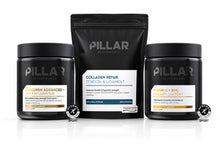




 Informed Sport
 Informed Choice
 NSF Certified for Sport
 HASTA Certified

For most healthy adults already taking a daily vitamin D3 supplement, adding a long-acting form of vitamin K2 (MK-7) at a modest dose is a reasonable, low-risk step that helps direct the calcium D3 mobilizes into bone rather than soft tissue. The logic is straightforward: D3 raises how much calcium your body absorbs from food, and K2 activates the proteins that decide where that calcium ends up. One does the delivering, the other does the directing.
If you’re on warfarin, acenocoumarol, or any vitamin K antagonist, stop here before adding K2 and talk to your prescriber first. K2 can blunt how these medications work, and that’s not a detail to skip past.
Who tends to benefit most from pairing the two nutrients:
- Adults taking D3 doses above 2,000 to 4,000 IU per day
- People over 50 focused on bone density or cardiovascular risk
- Anyone eating little natto, aged cheese, or egg yolk (the main dietary K2 sources)
- People with diagnosed osteopenia or a family history of osteoporosis
Vitamin D3 without enough K2 is a bit like paying a delivery driver to drop off packages with no address on them. The calcium arrives. Where it goes next is the part K2 influences.
A cohort analysis published in PMC found that dietary K2 intake at levels associated in a cohort study with a substantially lower cardiovascular mortality risk, with higher intakes linked to further reduced cardiovascular event risk. That’s an observational association, not proof that K2 supplements prevent heart attacks, but it’s the strongest population-level signal behind why the two nutrients get paired.
Key Takeaways
Pairing daily vitamin D3 with MK-7 form vitamin K2 gives most adults a low-risk way to support bone mineralization and calcium handling, provided they’re not on a vitamin K-sensitive anticoagulant.
| Point | Details |
|---|---|
| Mechanism | D3 increases calcium absorption; K2 activates proteins that direct that calcium into bone rather than arteries. |
| Choose MK-7 | Look for menaquinone-7 specifically at 90 to 200 mcg per day rather than an unspecified “vitamin K” label. |
| Anticoagulant warning | Anyone on warfarin or acenocoumarol must consult their prescriber before starting K2 supplementation. |
| Buying checklist | Prioritize products with a Certificate of Analysis, clear D3 IU and K2 mcg labeling, and a fat-based carrier oil. |
| Nzsupps option | Nzsupps stocks a combined Vitamin D3 + K2 formula with transparent labeling suited to buyers who want both nutrients in one capsule. |
Table of Contents
- NZ Supps Vitamin D3 + K2: What’s in the Bottle
- Why D3 and K2 Get Paired: The Mechanism Explained
- MK-7 vs MK-4: Which Form of K2 Actually Matters?
- How to Choose a Quality D3+K2 Supplement
- Dosage, Timing, and Safety: What to Watch For
- What the Research Actually Shows
- Our Take on the D3+K2 Question
- Where to Buy a Reliable D3+K2 Supplement in NZ
- Sources
NZ Supps Vitamin D3 + K2: What’s in the Bottle
Nzsupps stocks a combined Vitamin D3 + K2 formula built for people who want both nutrients in one capsule instead of juggling two bottles and two schedules. It’s the kind of product this whole article has been describing: cholecalciferol paired with menaquinone-7, dosed to work together rather than sold as isolated afterthoughts.
Before you buy any D3+K2 product, including this one, check the label for these specifics:
- D3 dose in IU, confirm it matches your current supplementation level, not a generic default
- K2 form and amount, look specifically for MK-7 (menaquinone-7) in micrograms, not a vague “vitamin K” listing
- Carrier oil, D3 and K2 are fat-soluble, so a decent oil base (often MCT or olive oil) matters for absorption
- Excipient transparency, capsule shell material, fillers, and allergen disclosures should all be listed plainly
- Serves per bottle, this determines your real cost per day, not just the shelf price
On the trust side, look for a Certificate of Analysis (COA) confirming third-party batch testing, a clearly stated country of manufacture, and dosage information that matches what’s printed on the bottle rather than buried in fine print. Under Medsafe’s regulatory framework, dietary supplements sold in New Zealand have to meet specific labeling and advertising standards, so a compliant NZ-based product page should make all of this easy to find, not something you have to dig for.
Check the product page for subscription pricing if you plan to take it long-term, confirm shipping applies to your address, and read the returns policy before your first order.
Why D3 and K2 Get Paired: The Mechanism Explained
Vitamin D3’s job is absorption. It signals your gut to pull more calcium out of food, which raises circulating calcium levels. Vitamin K2’s job is placement. It activates two proteins, osteocalcin and matrix Gla protein (MGP), that grab that calcium and either build it into bone or block it from depositing in artery walls. Without enough active K2, some of that calcium can end up somewhere you don’t want it.
This isn’t a marketing story someone invented to sell two-in-one capsules. The NIH Office of Dietary Supplements describes vitamin K’s core role in carboxylating these bone and vascular proteins, and lab research backs the interaction between the two vitamins directly:
- MK-7 has been shown to enhance vitamin D3’s induction of osteocalcin expression in mesenchymal stem cell studies, meaning the two nutrients appear to work on the same genetic pathway rather than in isolation.
- The same research points to MK-7 influencing osteogenic and angiogenic gene activity relevant to bone healing and mineralization.
- Cleveland Clinic notes K2’s role in activating both osteocalcin (bone-binding) and MGP (artery-protecting) proteins, tying the mechanism to cardiovascular outcomes as well as skeletal ones.
The cardiovascular mortality figures from the cohort work cited earlier deserve one more caveat: people who eat more K2-rich foods, mostly from fermented sources like natto, often differ from low-K2 eaters in other ways too, diet quality, activity levels, income. Observational data this size is genuinely useful for spotting a pattern worth investigating, but it doesn’t isolate K2 as the single cause of lower mortality. What it does support is the plausibility that boosting D3 without addressing K2 status may leave part of the calcium-handling picture unaddressed.
The practical takeaway: if you’re already taking meaningful doses of D3, the mechanism gives a real reason to think about your K2 intake alongside it, not as an optional add-on but as the other half of the same system.
MK-7 vs MK-4: Which Form of K2 Actually Matters?
MK-7 is the form most people should look for in a daily supplement, and the reason comes down to how long it stays active in your bloodstream. The NIH’s own fact sheet on vitamin K confirms MK-7 persists in circulation considerably longer than vitamin K1, which is why once-daily MK-7 dosing works, while K1 gets cleared much faster.

MK-4, the other common K2 form, behaves differently. It has a short half-life measured in hours rather than days, which means maintaining steady activity typically requires much higher and more frequent doses to achieve a comparable effect. That’s part of why most over-the-counter D3+K2 combination products default to MK-7: it fits a once-a-day capsule far more practically.
Typical dosing ranges look like this:
- MK-7: 90 to 200 mcg per day is the common range in combination supplements
- MK-4: effective doses run much higher, often into the milligram range, which is a different order of magnitude entirely
- D3 pairing: many over-the-counter products pair 1,000 to 5,000 IU of D3 with 90 to 200 mcg of MK-7, according to practitioner-facing dosing guidance
If you’re taking D3 at the higher end (4,000 IU per day or above) or you know your dietary K2 intake is low, leaning toward the upper end of that MK-7 range, closer to 180 to 200 mcg, is a conservative, commonly recommended approach.
Pro Tip: Take your D3+K2 capsule with a meal that contains some fat, even just a tablespoon of peanut butter or a splash of olive oil on your vegetables. Both vitamins are fat-soluble, and absorption drops noticeably when taken on an empty stomach. Magnesium also plays a supporting role in activating vitamin D, so a diet that includes nuts, seeds, or leafy greens rounds out the picture.
How to Choose a Quality D3+K2 Supplement
Not every combination product on a shelf is built the same way, and the differences show up fast once you know what to check.
- Confirm the D3 form and dose. It should say cholecalciferol specifically, not the plant-based D2 (ergocalciferol), which the ODS notes is less effective at raising blood levels of vitamin D.
- Confirm the K2 form is MK-7, and that the mcg amount is stated clearly rather than lumped under a vague “vitamin K complex” label.
- Check for a carrier oil. Since both vitamins are fat-soluble, a dry powder capsule with no oil base is a red flag for poor absorption.
- Look for third-party testing. A Certificate of Analysis confirms the capsule contains what the label claims, at the potency claimed, with no unlisted contaminants.
- Verify manufacturing standards. Good Manufacturing Practice (GMP) certification and a clearly stated country of origin are baseline expectations, not bonus features.
- Compare cost per daily dose, not just the sticker price. A $40 bottle with 120 serves costs less per day than a $25 bottle with 30 serves.
D3-only products still make sense if you’re already getting adequate K2 from diet (frequent natto, aged Gouda, or egg consumption) or if a clinician has specifically recommended D3 alone for a documented reason. For most people supplementing D3 without paying attention to K2 intake, though, the combination product closes a gap that a D3-only bottle leaves open.
Dosage, Timing, and Safety: What to Watch For
A workable starting range for most healthy adults is 1,000 to 4,000 IU of D3 paired with 90 to 200 mcg of MK-7, taken together with a meal that contains fat. Higher D3 doses generally warrant staying toward the upper end of the K2 range, and anyone taking D3 above 4,000 IU per day long-term should have their 25-hydroxyvitamin D levels checked periodically, something the ODS dosing guidance supports as standard practice for higher-dose supplementation.
Safety considerations that matter before you start:
- Anticoagulants: Warfarin and acenocoumarol work by blocking vitamin K’s clotting function, so adding K2 can interfere with your dosing and destabilize your INR. This is not a minor interaction to shrug off.
- Kidney disease: Impaired kidney function changes how the body handles both calcium and vitamin D metabolites, so anyone with chronic kidney disease should get clinical guidance before adding either supplement.
- Hypercalcemia risk: Very high D3 doses over extended periods, well beyond typical over-the-counter amounts, can raise blood calcium to unsafe levels. This is rare at standard doses but worth knowing.
- Pregnancy and breastfeeding: Discuss any new supplement with your midwife or doctor first, since dosing recommendations differ for this stage of life.
- Statins and common medications: Current evidence doesn’t point to a meaningful interaction between K2/D3 and statins, but if you’re on multiple medications, running your full list past a pharmacist takes five minutes and removes any doubt.
If you take warfarin or another vitamin K antagonist, do not start a K2 supplement without talking to the prescriber managing your anticoagulation first. This single interaction matters more than almost anything else in this article.
As one pharmacist-authored consumer guide puts it, the D3+K2 pairing is plausible and generally well-tolerated, but no major health authority mandates it, and your own medical context should drive the final call, not a supplement label.
What the Research Actually Shows
The evidence for pairing D3 and K2 is genuinely promising, but it isn’t the kind of slam-dunk, large-scale randomized trial result that settles a debate outright. Most of what supports the combination comes from observational cohort data and mechanistic lab research, not decades-long controlled trials specifically testing supplemental D3+K2 against hard outcomes like fractures or heart attacks.
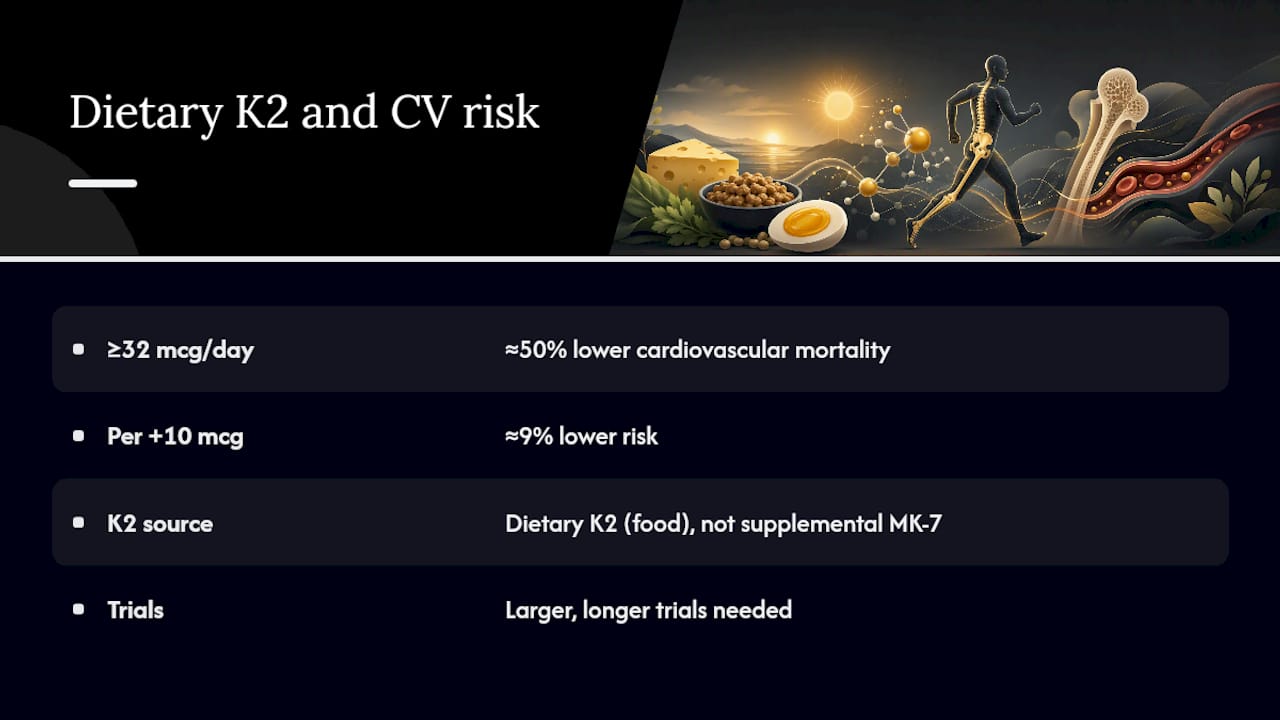
The strongest population-level number remains the Rotterdam-style cohort finding: dietary K2 intake of 32 mcg per day or more associated with roughly 50% lower cardiovascular mortality, with a 9% risk reduction per additional 10 mcg. That’s a meaningful signal, but it’s dietary K2 from food, not supplemental MK-7 in capsule form, which is a distinction worth holding onto.
On the mechanistic side, lab studies on MK-7’s molecular pathways show it amplifies D3’s effect on osteocalcin gene expression, a plausible biological reason the pairing might outperform either nutrient alone. Pooled analyses of smaller randomized trials have found combined K and D supplementation linked to improved bone mineral density markers and better osteocalcin carboxylation, though individual trial quality and size vary considerably, and researchers studying this area continue to call for larger, longer trials before treating the combination as settled science. Readers who want to go deeper into the clinical literature can start with the broader PubMed research index on K2 and bone outcomes.
Our Take on the D3+K2 Question
The conventional framing treats K2 as an optional upgrade, something you add if you’re feeling thorough. That undersells what the mechanism actually implies. If D3’s whole job is increasing how much calcium enters your bloodstream, taking D3 without any attention to K2 status is only addressing half of a two-part system. The other half, where that calcium ends up, doesn’t get automatically handled just because you raised your vitamin D number on a lab report.
Where the conventional wisdom deserves more skepticism is in the assumption that any K2 dose works the same. The MK-4 versus MK-7 distinction gets glossed over constantly in casual health content, and it matters. A product listing “vitamin K2” without specifying the form or without stating the mcg amount clearly is giving you far less information than it appears to. That’s a labeling problem more than a science problem, and it’s exactly the kind of gap third-party testing and clear COAs are meant to close.
None of this changes the anticoagulant warning, which deserves to be treated as absolute rather than a footnote. Everything else here is a reasonable, evidence-informed choice for people without that specific risk factor.
Where to Buy a Reliable D3+K2 Supplement in NZ
Nzsupps carries a combined Vitamin D3 + K2 formula built for exactly the buyer this article describes: someone who wants both nutrients dosed to work together, with the label transparency to verify it before buying. Rather than piecing together two separate supplements from two separate brands, you get one product with a stated D3 IU count and a clearly labeled MK-7 amount. For current prices and stock, see our greens and vitamins NZ range.
Before you order, check the product page for these specifics:
- D3 dose in IU and confirmation it’s cholecalciferol
- K2 form (MK-7) and mcg amount stated explicitly
- Availability of a Certificate of Analysis or third-party test results
- Serves per bottle, so you can calculate real cost per day
Nzsupps ships to addresses across New Zealand and offers subscription ordering if you’re planning to take D3+K2 long-term, which typically works out cheaper per bottle than repeat one-off purchases. Standard returns policies apply if a product doesn’t suit you, and customer support is available if you have questions about dosing alongside other supplements in your routine. If you’re building out a broader supplement stack, the Basic Supplements range on the same site shows how Nzsupps handles ingredient transparency across its catalog. Head to the Nzsupps product catalog to find the current Vitamin D3 + K2 listing and check current stock and pricing directly.
Sources
- PMC7238900
- Molecular pathways and roles for vitamin K2‑7, Frontiers
- Vitamin K, Health Professional Fact Sheet (ODS)
- Medsafe, Regulation of dietary supplements (New Zealand)
This article provides general information about vitamin D3 and K2 supplementation and isn’t a substitute for personalized medical advice. Confirm dosing and any medication interactions with your doctor or pharmacist, especially if you take blood thinners or have an existing health condition.
Do you need to take vitamin K2 with D3? Most people supplementing D3 at moderate to high doses benefit from adding K2, since D3 raises available calcium while K2 helps direct it into bone. It’s not mandatory for everyone, particularly those with regular dietary K2 intake, but for most supplement users it closes a gap that D3 alone leaves open.
What’s the difference between K2 MK-7 and MK-4? MK-7 stays active in the bloodstream far longer than MK-4, making it practical for once-daily dosing at 90 to 200 mcg. MK-4 clears faster and typically requires much higher, more frequent doses to achieve a comparable effect.
Can I take vitamin K2 with D3 if I’m on blood thinners? Not without medical supervision. Vitamin K2 can interfere with warfarin and similar anticoagulants by counteracting how they work, so anyone on these medications needs to consult their prescriber before adding K2 in any form.
How much vitamin K2 and D3 should I take together? A common range is 1,000 to 4,000 IU of D3 paired with 90 to 200 mcg of MK-7 daily, taken with a fat-containing meal. Higher D3 doses generally call for staying toward the upper end of the K2 range.
How long does it take to see benefits from D3+K2 supplementation? Bone-related changes measured by biomarkers like osteocalcin carboxylation can shift within a few months of consistent use, while meaningful bone density changes typically take a year or longer to show up on scans. Cardiovascular benefits, where they exist, are population-level associations observed over years, not something you’d notice day to day.
This article is general information, not a substitute for advice from a qualified doctor. Consult a qualified healthcare professional about your own circumstances before acting on anything here.