SHOP NOW, PAY LATER









 Informed Sport
 Informed Choice
 NSF Certified for Sport
 HASTA Certified


Most runners in races under about 60 to 90 minutes do not need dedicated electrolyte products, because a balanced diet already covers sodium, potassium, calcium and magnesium. For longer, hotter or very sweaty efforts, electrolytes can help comfort and performance. The safety rule matters more than any product: drink to thirst, because overdrinking drives exercise-associated hyponatremia (EAH). We stock the formats worth testing at NZ Supps.
TL;DR:
- Marathoners in heat often need a tested plan, while half marathoners with moderate sweating may need only water; ultramarathons require advance planning.
- Track body weight before and after a run, fluid intake, and conditions to estimate sweat loss; cramps alone do not prove sodium deficiency.
- For races, use 300 to 600 mg of sodium per hour as a starting range, then adjust in training to your sweat rate and stomach.
- Drink to thirst instead of following a fixed schedule; overdrinking can lower blood sodium, and electrolyte supplements do not offset that risk.
- Runners with kidney problems or medications that affect sodium balance should consult a clinician before changing fluid or electrolyte intake.
Table of Contents
- 1. When electrolytes matter during a race
- 2. How to tell if you need electrolytes
- 3. What to use: drinks, tablets, gels and salty food
- 4. How often and how much to take
- 5. What the evidence says about safety and new options
- 6. Build and test your race-day plan
- 7. Our take on testing, not guessing
- 8. Test your electrolyte plan with us
- FAQ
- Sources
1. When electrolytes matter during a race
Duration is the first filter. Electrolyte drinks are useful for long or very sweaty efforts but unnecessary for most shorter or moderate sessions. A shorter race or brisk half marathon rarely crosses that line. A marathon in warm weather often does, and an ultramarathon almost always does.
Conditions shift the math:
- Duration: the case for electrolytes grows once you pass roughly 60 to 90 minutes of hard effort, and it is strongest in ultra distances.
- Heat and humidity: sweat rate climbs, so sodium and fluid losses climb with it.
- Intensity: harder running means more sweat per hour than an easy long run at the same temperature.
- Individual sweat profile: some runners lose far more sodium than others, so two people in the same race can need very different plans.
Intense exercise beyond 60 to 90 minutes in heat, or with very high sweat losses, is where electrolyte beverages may benefit athletes. Below that, plain water and your breakfast usually carry you home.
Picture three runners on a warm morning. The half marathoner can skip electrolytes if sweat is moderate. The marathoner running in warm weather has a real case for them. The ultramarathon runner needs a plan.
2. How to tell if you need electrolytes
Your body and your training log give you better data than any label. Watch for heavy sweat that leaves white salt marks on your shirt or cap, frequent cramps, persistent nausea or lightheadedness late in long runs. Cramps deserve a caution, though: major studies show no consistent link between sodium intake and cramp prevention, so treat them as a clue, not proof.
Run these simple checks in training:
- Weigh yourself nude before and after a typical long run, noting what you drank.
- Estimate sweat loss from the weight change plus fluids consumed.
- Repeat in cooler and warmer conditions to see how much your rate swings.
- Track urine color and frequency through the day as a crude hydration check.
Pro Tip: Aim to keep body-mass loss modest and let thirst guide your drinking, since monitoring weight changes and thirst helps tune intake.
See a clinician first if you have kidney issues or take diuretics or other medications that affect sodium balance.
3. What to use: drinks, tablets, gels and salty food
Each format solves a different problem, so pick based on what your race needs.
- Carb and electrolyte drinks: one bottle delivers fluid, fuel and sodium together, but you carry the volume. Our guide on electrolytes versus sports drinks shows when each makes sense.
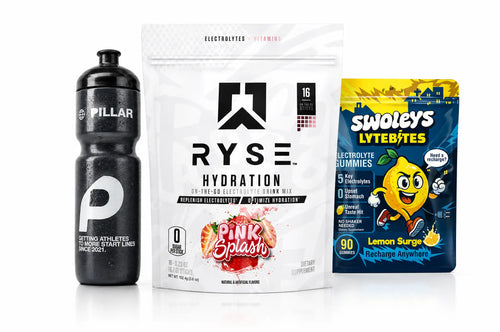
- Electrolyte tablets and powders: low in calories and easy to dose, ideal if you already get carbs from gels. Compare hydration tablets and powder by session length.
- Standard energy gels: compact carbohydrate, best taken with water so they absorb comfortably.
- Bicarbonate plus carb gels: a newer, research-backed option covered below, strictly for training trials first.
- Salty snacks at aid stations: pretzels or similar work when your stomach rejects sweet products late in a race.
The tradeoffs are fluid volume against carb contribution, absorption speed, stomach tolerance and sugar load. A runner relying on gels and tablets carries little weight but must drink water with each gel. A runner using a drink mix gets simplicity but a heavier pack.
Pro Tip: Check which products your race serves at aid stations and train with that exact brand, so you can carry less on race day.

4. How often and how much to take
Numbers help, as long as you treat them as starting points. Research suggests many people absorb up to about 60 g of carbohydrate and around 1 L of fluid per hour, which caps what any schedule can realistically deliver.
Use those limits as ceilings, not targets, and adjust to your own stomach in training.
Practical starting rules:
- Take small, regular intakes rather than large doses, and take gels with water.
- Place electrolyte tablets between gels so you are not stacking everything at once.
- Sodium guidance often lands around 300 to 600 mg per hour for endurance hydration, with heavier sweaters needing more. Dial it in through practice.
- Do not rely on sodium to protect you from overdrinking. In ultramarathons, drinking to thirst is often sufficient, and sodium supplementation is not necessary to prevent EAH if overdrinking occurs.
The primary safety rule is simple: never drink beyond thirst. Overdrinking is the main modifiable risk for EAH, and no electrolyte product cancels it out.
5. What the evidence says about safety and new options
The clinical picture is consistent. Consensus reviews recommend ad libitum drinking, and fixed fluid schedules are inappropriate and can raise EAH risk. EAH is defined as a serum sodium below 135 mmol/L during or up to 24 hours after exercise, driven mainly by excessive fluid intake and impaired water excretion. Field care centers on recognizing neurological warning signs and getting medical help, not on improvising treatment.
Exercise-associated hyponatremia is a fall in serum sodium below 135 mmol/L, with prevention centered on avoiding overdrinking.
On the performance side, a 2026 trial reported that sodium bicarbonate co-ingested with carbohydrate in a gel improved time-trial performance after prolonged exercise versus carbohydrate alone, with only mild stomach discomfort. The underlying work looked at 3 or more hours of exercise before a fatigued time trial.
That is promising, but it is an advanced tactic. Never introduce high-dose sodium or bicarbonate on race day. Test it in training and watch your stomach.
6. Build and test your race-day plan
- Estimate your sweat rate on long training runs.
- Choose one or two formats from the list above.
- Rehearse your plan on at least a few long runs at race pace.
- Map aid-station pickups so you carry only what you need.
- Rehearse the handling: opening gels, dropping tablets, swapping bottles.
Sample shapes: a half marathon may need only water and perhaps one gel; a marathon often adds tablets between gels; a 50K usually layers drinks, gels and salty food. If heat spikes or your stomach turns, slow down, drink to thirst and reach for something salty.
Pro Tip: Plan your finish too, since post-marathon recovery starts the moment you stop.
7. Our take on testing, not guessing
Our view is simple: the evidence is solid on safety and thinner on precise sodium numbers, which is why your own training matters more than any chart. Most shorter races do not need in-race electrolytes, and a measured approach avoids both under-fueling and overdrinking. If a medical condition or medication affects your sodium or fluid balance, talk to a clinician before you experiment.
— Blake
8. Test your electrolyte plan with us
We supply the electrolyte powders, hydration tablets and race fuels covered above, so you can trial formats in training before race day. See our electrolyte sachet guide for starter picks. Browse our shop by category, or contact our team with product-fit questions.
This article is general information, not a substitute for advice from a qualified doctor. Consult a qualified healthcare professional about your own circumstances before acting on anything here.
FAQ
Do you drink electrolytes before a run?
Usually not for short runs, since a balanced diet covers your needs. Before a long, hot effort, some runners add a modest serving, but electrolyte drinks are generally unnecessary for moderate sessions. Test the timing in training.
What are signs of lack of electrolytes?
Common clues include heavy sweating with salt marks, cramps, nausea and lightheadedness. These signs are not specific, and cramps in particular are not reliably tied to sodium intake. Persistent or severe symptoms call for medical advice.
Is Lucozade Sport an electrolyte drink?
Check the product label to see whether it contains electrolytes and what the mix includes. Compare the product with plain electrolyte formats using our guide to electrolytes versus sports drinks.
What should I avoid before a run?
Avoid trying new products on race morning, heavy overdrinking and unfamiliar high-fiber or greasy foods. Overdrinking is the main modifiable factor in exercise-associated hyponatremia, so drink to thirst.
Sources
- Pathophysiology and treatment of exercise-associated hyponatremia - PMC
- Pubmed
- Do I need electrolyte drinks? • The Nutrition Source