SHOP NOW, PAY LATER









 Informed Sport
 Informed Choice
 NSF Certified for Sport
 HASTA Certified

Quick answer
In practice, very little. Mass gainer and weight gainer are marketing names for the same kind of product: a high calorie shake that mixes protein with a lot of carbs, made for people who struggle to eat enough to gain. The two we stock give 1,030 and 1,280 calories a serve with 50 g and 52 g of protein, so compare calories, protein to carb ratio, carb source and serve size rather than the name on the tub.
You want to put on size, so you go looking for a gainer. Then you hit two names: mass gainer and weight gainer. Are they different products for different goals, or the same thing with a different sticker?
The honest answer: mostly the same thing. Both names describe a high calorie shake built from protein plus a lot of carbs. What actually changes from tub to tub is the recipe, and that is what you should compare.
The short answer
- Mass gainer vs weight gainer: mostly marketing labels. We even use both names in our own catalogue for very similar products.
- What matters instead: calories per serve, protein to carb ratio, the carb source, and how big the serve is.
- Who needs one: people who struggle to eat enough to gain. If you can hit your calories with food, whey is usually the smarter buy.
- Big pick: a high calorie formula like Dymatize Super Mass Gainer. Value pick: Basic Mass Gainer in the 6lb or 15lb size.
Why the names overlap
"Mass gainer" and "weight gainer" grew up as marketing terms, not technical ones. There is no rule that says a mass gainer must have more protein or a weight gainer must have more calories.
Here is a real example of how loose the terms are. In our own store, Basic Mass Gainer sits under the product type "Mass Gainers", while Dymatize Super Mass Gainer sits under "Weight Gainer". Both are high calorie protein and carb shakes for people trying to bulk. The label on the category tells you almost nothing.
You will also see "lean gainer". That usually means a lower calorie formula with a bigger share of protein. Again, it is a description, not a standard.
Mass gainer
- Protein plus a big dose of carbs, and often some fats
- Built to add hundreds of calories in one shake
- In our range: Basic Mass Gainer, 1,030 calories and 50 g protein a serve
Weight gainer
- The same protein and carb shake under another name
- No rule says it has more calories or less protein
- In our range: Dymatize Super Mass Gainer is listed as a weight gainer, 1,280 calories and 52 g protein a serve
Lean gainer
- Fewer calories and a bigger share of protein
- Suits people who want a smaller calorie surplus
- We do not stock one. Whey with oats and a banana does a similar job
What to compare instead
Ignore the name on the front and flip the tub around. Four things decide whether a gainer suits you.
Calories per serve. This is the whole point of a gainer. Some formulas land around a few hundred calories, the big ones go past 1,000. More is not always better. If a serve is more than you can comfortably drink, you will skip it.
Protein to carb ratio. Most gainers are mostly carbs. That is by design, because carbs are the easy way to add calories. Check the protein grams too, so you know how much of your daily protein target the shake covers.
Share of calories from protein, per serve
Protein grams times 4 calories, divided by the calories per serve on each label. Gainers in blue, four of our wheys for contrast. NZ Supps range, 24 September 2026.
The rest of a gainer's calories come mostly from carbs: 190 g a serve in Basic and 245 g in Dymatize. That is why a gainer is the easy way to add calories and whey is the easy way to add protein. To see how much of your daily target one shake covers, start with how much protein you need per day.
Carb source. Cheaper gainers lean heavily on maltodextrin. Better ones mix in slower carbs. Basic Mass Gainer 15lb blends maltodextrin with sweet potato starch, quinoa and oat fibre, which is a more thoughtful base.
Serve size. A huge serve can mean a lot of powder and a lot of liquid. If your stomach is small, look for a formula you can split into two shakes a day.
Example gainers we stock
| Gainer | Calories | Protein | Carbs | Serve size |
|---|---|---|---|---|
|
Basic Mass Gainer Mixed carb base |
1,030 | 50 g | 190 g (3.8 to 1) | 265 g |
|
Dymatize Super Mass Gainer Whey blend plus casein |
1,280 | 52 g | 245 g (4.7 to 1) | 333 to 335 g |
Dymatize Super Mass Gainer 12lb Gourmet Vanilla is the heavy hitter. Each shake gives 1,280 calories and 52g of protein from whey concentrate, isolate and hydrolysate plus micellar casein, with a small dose of creatine too. The 12lb bag holds 16 servings. It suits true hard gainers who need a lot of calories in one hit.
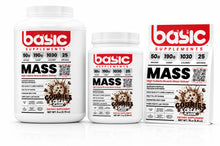
Basic Mass Gainer delivers 50g of protein and 190g of carbs for over 1,000 calories a serve. The protein comes from a whey and milk protein blend, with MCTs, coconut and flaxseed added. If you want to try it before committing to the big tub, the Basic Mass Gainer 6lb Cookie N Cream is the smaller starter.
For a head to head on these two, read Super Mass Gainer vs Basic Mass Gainer.
To see what each tub size costs per serve and per 1,000 calories, read mass gainers compared by price per 1,000 calories.
Who needs a gainer, and who just needs more whey and food
You probably need a gainer if you eat three solid meals, train hard and still cannot move the scale. Your appetite is the limit, so drinking calories is easier than eating them.
You probably do not if you are already gaining on food, or you just want more protein. In that case, a scoop of whey protein with milk, oats and a banana can land you a solid calorie hit and gives you more control. It is also usually cheaper per gram of protein.
A few tips if you go the gainer route:
- Start with half a serve. A full serve of a big gainer can be a lot for your stomach at first.
- Split it. Two smaller shakes a day often go down easier than one huge one.
- Keep eating real food. A gainer adds to your diet, it does not replace it.
- Track the scale weekly. If you are gaining too fast, cut the serve down.
Our guide on how to use a mass gainer covers timing and serve sizes in more detail, and mass gainer vs whey digs into which one suits your goal.
Where NZ Supps fits
We stock both Basic and Dymatize in our mass gainers collection, and you can see the full Dymatize gainers range if you want the bag or tub size. If you are not sure whether you need a gainer or a protein, the Find Your Stack quiz will point you the right way.
FAQ
What is the difference between a mass gainer and a weight gainer? In practice, very little. Both are high calorie shakes that mix protein with a lot of carbohydrate to help you eat in a surplus. Brands and stores use the two names almost interchangeably, so compare the label rather than the name.
What is a mass gainer? A mass gainer is a protein powder with a big dose of carbs, and often some fats, added. The goal is to give you hundreds of extra calories in one shake so you can gain weight without forcing down extra meals.
Is a mass gainer good for beginners? It can be, if you genuinely struggle to eat enough. A beginner who is already gaining weight on food does not need one. Start with half a serve to see how your stomach handles it, then build up.
What is a lean gainer? Lean gainer is a marketing label for a gainer with fewer calories and a higher share of protein. It suits people who want a smaller surplus. A scoop of whey plus oats and banana can do a similar job.
Should I buy a gainer or just whey? If you can hit your calories with food, whey is usually cheaper and more flexible. A gainer earns its place when your appetite is the problem and you need an easy way to add a lot of calories in one go.