SHOP NOW, PAY LATER










 Informed Sport
 Informed Choice
 NSF Certified for Sport
 HASTA Certified

If you can’t hit a calorie surplus through food most days, a mass gainer solves that math problem fast. If you can eat enough but need clean protein without the extra 600 calories, whey is the better tool. Most lifters overestimate how much food they’re actually eating and reach for a gainer before they’ve tried fixing their plate. Either way, the shake only works if your total daily intake and training are already dialed in.
Quick answer
Pick whey protein if you already eat enough and only need more protein: the whey tubs we stock sit around 120 calories and 25 g of protein a serve, from $2.19 per 25 g of protein. Pick a mass gainer when appetite or a big training load stops you eating enough, because the two we stock give 1,030 to 1,280 calories and 50 to 52 g of protein in one serve. In between, a home-made shake of milk, banana, oats, peanut butter and a scoop of whey lands around 600 to 700 calories.
TL;DR:
- Mass gainers are suitable only for those who cannot consume enough calories through food, as they provide 400 to over 1,000 calories per serving.
- Whey protein is better for individuals who eat enough but need additional clean protein, with typical servings offering 20 to 30 grams of protein and fewer calories.
- Cheaper gainers often rely on simple sugars and low-grade oils, which can cause bloating, while clean versions use complex carbs and moderate sugar.
- The calorie gap significantly influences whether a single scoop of mass gainer or additional food intake suffices for weight gain.
- Always check product labels for protein content, sugar sources, and added ingredients, and consider testing small amounts before committing to larger quantities.
Table of Contents
- Mass Gainer vs Whey: A Quick Comparison
- What Is Whey Protein, Exactly?
- What Is a Mass Gainer, and What’s Actually in It?
- How Different Are the Numbers, Really?
- Who Should Actually Use Each One?
- How to Choose and Use Either One
- Can Whole-Food Shakes Replace a Commercial Gainer?
- What Nzsupps Recommends Before You Buy
- Where to Start Shopping Smarter
- Sources
Mass Gainer vs Whey: A Quick Comparison
Before you buy anything, match the product to the actual gap in your day. Here’s the short version:
- Whey protein is best for people who eat enough calories but need more clean protein. Typical serving: 100 to 150 calories with 20 to 30 grams of protein.
- Mass gainer is best for people who genuinely cannot eat enough food to gain weight. Typical serving: 400 to 1,000+ calories with 40 to 80 grams of protein.
- Whey’s upside: cheap per gram of protein, low GI distress, fits any diet plan. Its downside: won’t move the scale much on its own.
- Mass gainer’s upside: solves appetite problems in one shake. Its downside: cheap versions lean on sugar and can trigger bloating.
Those are typical ranges across the market. On the labels of what we stock right now, the split looks like this:
| Product | Calories | Protein / carbs | Powder a serve | Price a serve |
|---|---|---|---|---|
| Dymatize Super Mass Gainer, 5.4 kg gainer | 1,280 | 52 g / 245 g | 335 g | $10.68 |
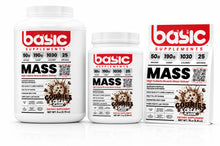
| Basic Supplements Mass Gainer, 6.8 kg gainer | 1,030 | 50 g / 190 g | 265 g | $7.44 |
| MusclePharm Combat 100% Whey, 2.27 kg whey blend | 120 | 25 g / 2 g | 31 g | $2.19 |
| Basic Supplements Whey, 2.27 kg whey blend | 130 | 25 g / 5 g | 36 g | $2.22 |
| Basic Supplements Isolate, 2.27 kg whey isolate | 110 | 26 g / 2 g | 31.6 g | $3.16 |
| Dymatize Iso 100, 2.27 kg whey isolate | 120 | 25 g / 2 g | 32 g | $3.58 |
Whichever you pick, the label matters more than the marketing. That’s covered below.
What Is Whey Protein, Exactly?
Whey is the liquid left over when milk is turned into cheese, dried and processed into a powder that’s roughly 70 to 95% protein depending on the type. It’s popular for a reason beyond convenience: whey is unusually rich in leucine, the amino acid that flips the switch on muscle protein synthesis, especially when you drink it around a training session.

There are three forms worth knowing, and they’re not interchangeable. Hydrolysate is pre-digested into smaller peptides, absorbs the fastest of the three, and costs the most for a benefit most casual lifters will never notice.
For most people asking “should I use mass gainer or whey,” whey is the sensible starting point. It’s flexible, cheap per gram of protein, and it lets you control your own calories instead of drinking someone else’s formula. If lactose is an issue, an isolate protein powder solves that without giving up the leucine benefit.
What Is a Mass Gainer, and What’s Actually in It?
A mass gainer is a high-calorie powder built to solve one problem: getting enough energy in when food alone isn’t cutting it. Instead of protein doing most of the work, gainers lean on carbohydrates, usually maltodextrin or oat-based blends, sometimes with added fats, to stack calories into a single scoop.
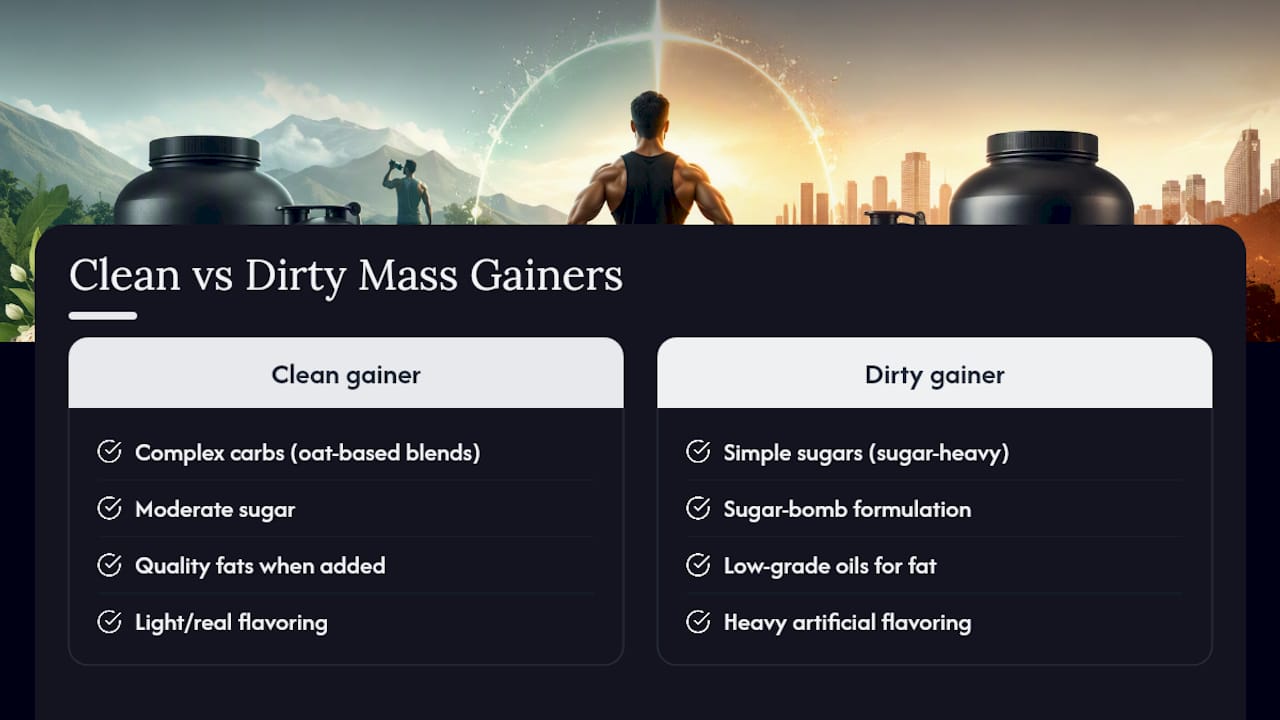
That formulation is also where gainers earn their bad reputation. Cheaper products fill the carb slot with simple sugars, use low-grade oils, and mask the taste with heavy artificial flavoring. This is the real split between a “clean” gainer and a “dirty” one: clean versions use complex carbs and moderate sugar; dirty versions are closer to a sugar bomb with a protein label on the front. Some formulas throw in creatine, digestive enzymes, or a vitamin blend, which can genuinely help since creatine supports strength and size gains and enzymes can ease digestion of a very large serving.
None of that makes a gainer bad. It makes it a tool for a specific job: closing a calorie gap you can’t close with a fork. If your appetite is fine, that job doesn’t need doing.
How Different Are the Numbers, Really?
The gap between these two categories isn’t small. A standard whey shake sits at roughly 100 to 150 calories with 20 to 30 grams of protein, close to what you’d get from a chicken breast. A mass gainer serving can run 400 calories all the way past 1,000, depending on the brand, with 40 to 80 grams of protein riding along.
Here is that gap on the labels of what we stock. Both gainers sit above 1,000 calories a serve, while our six most reviewed whey lines list 110 to 140.
Calories per serve: gainers vs whey
One serve as listed on each label. Gainers in blue, whey in black. NZ Supps range, 24 September 2026.
Whey rows are the six most reviewed whey lines we stock.
The math that actually matters: Adding roughly 500 extra calories a day above maintenance tends to produce about 0.5 kilograms of weight gain per week. Figure out your maintenance number first, then work backward to see whether food and a whey shake can cover that gap, or whether you genuinely need a gainer’s calorie load.
That’s a useful filter. If you’re already 400 calories short most days, a single mass gainer scoop can close it in one shot. If you’re only 150 calories short, whey plus a bigger lunch does the same job with less bloating, since dumping 800+ calories and a large carb load into one sitting is a common trigger for gas and stomach discomfort.
Worth knowing before you buy: the two gainers we stock list 1,030 and 1,280 calories for a full serve, so half a serve (about 515 or 640 calories) already covers a 500 calorie gap. That is also the easiest way to start a new gainer, as the checklist below explains.
Who Should Actually Use Each One?
Your training volume and appetite matter more than your goals on paper. A few patterns show up consistently:
- Hardgainers with a fast metabolism who eat six times a day and still can’t gain weight are the clearest case for a mass gainer.
- Endurance athletes or anyone training 10+ hours a week often burns through calories faster than meals can replace them, making a gainer a practical fix.
- People recovering from illness or appetite loss may need the calorie density a gainer provides, ideally with input from a doctor or dietitian given the health context involved.
- Most recreational lifters focused on lean muscle do better starting with whey and simply eating more at meals, since it’s easier to control fat gain that way.
- Anyone in a cutting phase should stick to whey. A gainer works against a calorie deficit.
If you’re managing a medical condition, on medication, or dealing with kidney or liver concerns, a 2024 review of whey protein research specifically flagged the need for caution and professional guidance in those populations before adding any high-dose protein supplement.
Cost is the other half of the decision. If protein is the only thing you are short on, a gainer is a costly way to buy it: our gainer packs work out at $3.72 to $6.24 per 25 g of protein, against $2.19 to $3.39 for the six lowest-cost whey tubs.
Price per 25 g of protein: gainers vs whey
Pack price divided by the serves on the label, scaled to 25 g of protein. All four gainer packs and the six lowest-cost whey tubs in stock, 24 September 2026.
Gainers in blue. Each gainer serve also carries 190 to 245 g of carbs, which is what you are paying for when calories are the gap.
How to Choose and Use Either One
Reading the label carefully saves you from buying a sugar-heavy product marketed as muscle fuel. Run through this before checkout:
- Check protein per serving first. Anything under 20 grams for a “protein” product, or under 40 grams for a “gainer,” is underdelivering.
- Scan the carb source. Maltodextrin and oat blends are fine; a long list of sugars near the top is a red flag.
- Look for added creatine or digestive enzymes in gainers. Both can genuinely help, one with strength, one with tolerance.
- Confirm total serving calories match your actual gap, not just what sounds impressive on the tub.
- Start with half a serving of any new mass gainer to test how your gut handles it before committing to a full scoop.
Whey works well post workout or as a meal top-up; a gainer works best as an extra feeding between meals, not a meal replacement. Track progress with a weekly weigh-in and your lifts, not the scale after one big shake. Our guide to using a gainer properly goes into more detail.
Pro Tip: If lactose usually gives you trouble, test tolerance with an isolate protein before assuming you need a gainer’s blended formula instead.
Can Whole-Food Shakes Replace a Commercial Gainer?
Often, yes. A blender and a few groceries can match a commercial gainer’s calorie count with better micronutrients and a lot less added sugar. Three worth trying:
- The classic: 1 cup milk, 1 banana, half a cup of oats, 2 tablespoons of peanut butter, and a scoop of whey lands around 600 to 700 calories, with fiber and potassium a powder alone won’t give you.
- The dairy-free version: oat milk, frozen mango, rolled oats, and a plant-based protein scoop for roughly the same calorie range without lactose.
- The fast one: whole milk, a scoop of whey, and a tablespoon of olive oil for a quick 500-plus calorie hit when you’re short on time.
Cost per calorie usually favors the DIY route too, since whole foods aren’t marked up for packaging and flavoring. A commercial gainer still earns its place when you need convenience on the road, or when your daily calorie target is so high that blending enough whole food becomes its own chore.
What Nzsupps Recommends Before You Buy
Nzsupps’ take is simple: read the label before you read the marketing. A protein-per-serve number and a clean ingredient list tell you more than any tub graphic. Prioritize products that disclose sourcing and, where available, third-party testing, especially if you’re a competitive athlete who needs a batch-tested option.
For anyone still deciding between the two, buy small first. A sample size or a single tub beats committing to a bulk bag of something you haven’t tried. Subscription options make sense once you know a formula agrees with your gut and fits your actual calorie gap, not before.
Blake
Where to Start Shopping Smarter
There are whey isolate and mass gainer options available for different dietary needs. That means you’re not stuck picking between one option that fits your goal and one that’s just available.
If your protein numbers are falling short but your calories are fine, the Basic Supplements Isolate in chocolate gives you 72 serves to work with before you need to reorder, which is enough time to actually judge whether it’s doing the job. Prefer to test a smaller commitment first? Starting with a single tub rather than a bulk order can help you confirm tolerance and fit with your training before deciding on subscriptions. Either way, check the full mass gainer and whey lineup and pick based on your actual calorie gap, not the biggest tub on the shelf.
If a gainer is the right call, we stock two. Dymatize Super Mass Gainer is the bigger shake at 1,280 calories a serve, and Basic Supplements Mass Gainer costs less per serve, $7.44 in the 6.8 kg pack against $10.68 for the Dymatize 5.4 kg. Our Dymatize vs Basic mass gainer comparison puts them side by side. If protein is the only gap, start with the whey protein range instead.