SHOP NOW, PAY LATER


















 Informed Sport
 Informed Choice
 NSF Certified for Sport
 HASTA Certified

Most healthy adults need 15 mcg (600 IU) of vitamin D daily to maintain normal blood levels, and the accepted safe upper limit sits at 100 mcg (4,000 IU) per day, according to the NIH’s Office of Dietary Supplements. That’s the number for maintenance in someone with no diagnosed deficiency and no major risk factors.
It’s not a one-size number, though. Adults over 70 need slightly more (20 mcg / 800 IU), and people with diagnosed deficiency, malabsorption conditions, obesity, or limited sun exposure often need higher, clinician-directed doses for a defined period. Vitamin D is fat-soluble, so your body stores it rather than flushing out the excess. Take too much for too long, and it builds up.
UL for adults = 100 mcg (4,000 IU) per day. Go meaningfully above that without medical supervision, and you raise your risk of toxicity symptoms, including nausea, muscle weakness, and kidney stones, per Mayo Clinic. If a doctor has prescribed you a short course of high-dose vitamin D to correct a deficiency, that’s a different conversation entirely, and it should come with blood monitoring.
Key Takeaways
Vitamin D dosing works best when the daily maintenance target (15 to 25 mcg, or 600 to 1,000 IU) is matched to your personal risk profile and confirmed with a blood test rather than guessed from a label alone.
| Point | Details |
|---|---|
| Standard maintenance dose | 15 mcg (600 IU) daily covers most healthy adults 19 to 70; adults over 70 need 20 mcg (800 IU). |
| Know the upper limit | The adult UL is 100 mcg (4,000 IU) daily; chronic excess risks hypercalcemia and kidney stones. |
| Test before assuming deficiency | Serum 25(OH)D below 30 nmol/L (12 ng/mL) is deficient; testing guides whether you need more than maintenance. |
| Higher-risk groups need more attention | Older adults, people with obesity, malabsorption conditions, or limited sun exposure often need clinician-guided adjustments. |
| Check label strength before buying | Nzsupps lists exact mcg/IU strengths and full ingredient disclosures so you can match products to your target dose. |
Table of Contents
- What Is the Recommended Vitamin D Intake by Age?
- Who Needs More Vitamin D Than the Standard Dose?
- What Happens if You Take Too Much Vitamin D?
- When Should You Get a Vitamin D Blood Test?
- How Do You Convert and Apply a Vitamin D Dose?
- How Much Vitamin D Do Sun and Food Actually Provide?
- Why Product Transparency Matters for Getting Your Dose Right
- Where the Standard Vitamin D Advice Falls Short
- Ready to Choose the Right Vitamin D Strength?
- Sources
What Is the Recommended Vitamin D Intake by Age?
The standard reference numbers come from the NIH Office of Dietary Supplements, and they scale gradually with age rather than jumping around. Here’s the breakdown most clinicians and dietitians work from:
- Birth to 12 months: 10 mcg (400 IU) daily
- 1 to 13 years: 15 mcg (600 IU) daily
- 14 to 18 years: 15 mcg (600 IU) daily
- 19 to 70 years: 15 mcg (600 IU) daily
- 71 years and older: 20 mcg (800 IU) daily
- Pregnant and breastfeeding people: 15 mcg (600 IU) daily, though some clinicians recommend higher intake depending on baseline levels
The conversion between the two units trips people up constantly, mostly because supplement labels aren’t consistent about which one they lead with. The rule is simple: 1 mcg = 40 IU. So 15 mcg times 40 gives you 600 IU, and 20 mcg times 40 gives you 800 IU. If your bottle lists 1,000 IU, divide by 40 to get 25 mcg. Keep that math in your back pocket and every label on every shelf becomes instantly readable.
Where things get murkier is guideline disagreement. The Institute of Medicine framework behind the NIH numbers targets bone health specifically, aiming for serum levels that satisfy the vast majority of the population. The Endocrine Society takes a somewhat broader clinical view and, for certain patient groups, supports empiric supplementation at levels above the general population target. Meanwhile, bpac.nz notes that some New Zealand clinicians use maintenance ranges of 25 to 50 mcg (1,000 to 2,000 IU) daily in selected patients rather than sticking rigidly to the 15 mcg baseline.
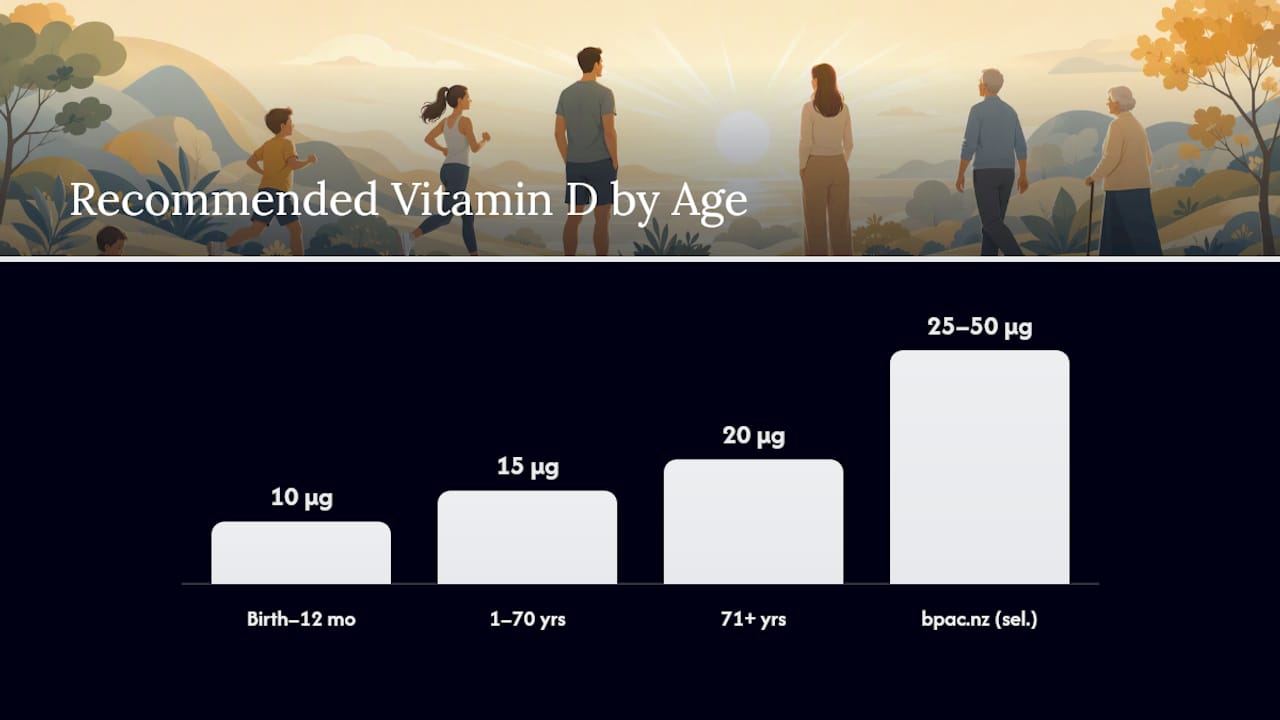
None of this means the guidelines contradict each other in any meaningful way. It means there’s a reasonable range, not a single magic number. For most healthy adults without a diagnosed deficiency, somewhere between 15 and 25 mcg (600 to 1,000 IU) daily covers the practical maintenance zone that most sources agree serves the general population well. If you fall outside “healthy adult with no risk factors,” the next section explains why your number might sit higher.
Who Needs More Vitamin D Than the Standard Dose?
Certain groups run a structurally higher risk of low vitamin D, and if you fit one of these profiles, the standard 15 mcg maintenance dose might not be enough to keep your levels where they should be.
- People with limited sun exposure, office workers, night-shift employees, and anyone living somewhere with long, dark winters produce far less vitamin D through skin synthesis.
- People with darker skin, higher melanin content reduces the skin’s efficiency at converting sunlight into vitamin D, which means the same sun exposure yields less usable vitamin D than it would for someone with lighter skin.
- Older adults, aging skin synthesizes vitamin D less efficiently, and kidney function (which activates vitamin D into its usable form) tends to decline with age too.
- People with obesity, vitamin D is fat-soluble and can get sequestered in body fat, making it less bioavailable in the bloodstream, which often means a higher dose is needed to reach the same blood level.
- People with malabsorption conditions, Crohn’s disease, celiac disease, and prior gastric bypass surgery all interfere with the gut’s ability to absorb fat-soluble vitamins.
- People on certain medications, some anticonvulsants, corticosteroids, and cholesterol-lowering drugs affect vitamin D metabolism.
Athletes and highly active people who train indoors deserve a specific mention here. Sports medicine practitioners frequently target higher serum ranges, sometimes 40 to 70 ng/mL rather than the general population’s 20 ng/mL floor, and recommend seasonal screening for competitive athletes, according to research on vitamin D deficiency in athletes. If you’re training at altitude, doing most of your work in a gym under artificial light, or you’re an indoor sport athlete during winter months, that’s worth flagging to whoever manages your recovery program. Recovery-focused resources like Revo2’s guide for competitive athletes go into more detail on why vitamin D status gets bundled into broader recovery screening for serious training programs.
If you match two or more of these categories, testing is a smarter move than guessing. A blood test costs less than months of taking the wrong dose.
What Happens if You Take Too Much Vitamin D?
The upper limits set by the NIH exist because vitamin D toxicity is real, even though it’s rare and almost always caused by supplements rather than sun exposure or food. Your skin has a built-in shutoff mechanism for vitamin D production, but a pill bottle does not.
There are age-related upper intake limits established to help guide safe supplementation.
Chronic daily intake above the tolerable upper limit without medical supervision is where the risk curve for toxicity symptoms climbs, per Mayo Clinic. The early symptoms are easy to dismiss because they overlap with a dozen other minor complaints: nausea, vomiting, poor appetite, weakness, and confusion. Left unaddressed, sustained excess can progress to hypercalcemia (too much calcium in the blood), kidney stones, abnormal heart rhythms, and in severe, prolonged cases, kidney damage. The mechanism runs through excess calcium absorption in the gut, since vitamin D’s main job is regulating how much calcium your body pulls in.

If you suspect toxicity, stop the supplement and get medical attention rather than waiting it out. Anyone considering long-term high-dose vitamin D, whether for a diagnosed deficiency or a specific medical reason, should be doing so under a clinician who checks calcium and kidney function periodically. The kidney safety concerns that come up with other supplements follow a similar logic: the kidneys are downstream of whatever excess your body can’t use, and monitoring is what catches a problem before it becomes a crisis.
When Should You Get a Vitamin D Blood Test?
A serum 25(OH)D test is the standard way to find out where you actually stand, and it’s more useful than guessing based on symptoms, which are often vague or absent entirely even in genuine deficiency.
The commonly used thresholds break down like this:
- Deficient: below 30 nmol/L (below 12 ng/mL)
- Insufficient: 30 to 50 nmol/L (12 to 20 ng/mL)
- Sufficient: 50 nmol/L and above (20 ng/mL and above)
Most labs report results in both units, so knowing your ng/mL equivalent matters if you’re comparing results across different providers or countries. Testing isn’t recommended as a blanket population-wide screen. Broader reviews of the evidence note that routine testing for everyone isn’t well supported, largely because clear disease-prevention benefits from supplementation beyond bone health remain uncertain in trial data. Testing earns its place in more targeted situations:
- You fit one or more of the risk categories covered above.
- You have symptoms that could plausibly be linked to deficiency (persistent fatigue, bone pain, recurrent muscle weakness).
- A clinician is considering a high-dose treatment regimen and needs a baseline.
- You’re a competitive athlete and performance or recovery concerns have come up, since some sports medicine guidance targets higher serum ranges than the general public. Testing guidance on when to check vitamin D covers this decision point in more detail.
When a test confirms deficiency, clinicians typically don’t just bump you up to the maintenance dose and call it done. The Endocrine Society favors structured, higher-dose regimens for a defined treatment period, followed by a drop back down to daily maintenance once levels normalize, with a repeat test to confirm the correction actually worked.
How Do You Convert and Apply a Vitamin D Dose?
Reading a supplement label shouldn’t require a calculator, but the mcg/IU split on packaging makes it feel that way. Here’s how to translate it quickly and apply it to your own situation.
- Find the unit on your label. Most New Zealand and Australian products list mcg; many US and UK products list IU. Check both.
- Convert using the fixed ratio. 1 mcg equals 40 IU. A 25 mcg tablet is 1,000 IU. A 50 mcg tablet is 2,000 IU. An 800 IU capsule is 20 mcg.
- Match the dose to your life stage or risk profile, using the ranges from the recommended intake section above.
- Choose a daily low-dose product over an occasional high-dose one, unless a clinician has specifically prescribed a bolus regimen.
- Recheck after three to six months if you started supplementing due to a known deficiency, since that’s roughly how long it takes serum levels to stabilize on a new dose.
A few sample regimens illustrate how this plays out in practice:
- A healthy adult without risk factors: 15 to 25 mcg (600 to 1,000 IU) daily, taken year-round or seasonally depending on sun exposure and latitude.
- An adult over 70: 20 mcg (800 IU) daily as a baseline, adjusted upward if a test shows insufficiency.
- A pregnant person: many prenatal vitamins already include 10 to 15 mcg (400 to 600 IU); check the label rather than adding a separate supplement on top without confirming the total. Region-specific guidance, such as the companion statement on vitamin D in pregnancy and infancy, is worth a direct read for anyone in this category.
- A breastfeeding infant: breast milk typically doesn’t provide enough vitamin D on its own, and infant supplementation guidance should come from a pediatrician rather than a general adult dosing chart.
Pro Tip: Daily low-dose formulations are almost always the smarter default over occasional mega-doses. Your body handles a steady 25 mcg far better than an occasional 250 mcg bolus, because daily dosing avoids the sharp peaks that push you toward the upper limit and gives your kidneys a steadier, more predictable amount to process.
How Much Vitamin D Do Sun and Food Actually Provide?
Sun exposure remains the most variable source of vitamin D on this entire list, and that variability is exactly why relying on it alone is a gamble. Skin tone, latitude, season, time of day, cloud cover, sunscreen use, and how much skin is exposed all shift the output dramatically. Someone in a sunny climate with lighter skin might synthesize a meaningful amount in ten minutes; someone with darker skin in a northern winter might get functionally none no matter how long they’re outside.
Food fills part of the gap, though few foods are naturally rich in vitamin D:
- Fatty fish (salmon, trout, mackerel): roughly 10 to 20 mcg (400 to 800 IU) per serving, depending on the fish and how it’s prepared.
- Egg yolks: around 1 mcg (40 IU) per yolk.
- Fortified milk or plant milk: typically 2.5 to 3 mcg (100 to 120 IU) per cup.
- Fortified breakfast cereals: often 2 to 3 mcg (80 to 120 IU) per serving.
Add it up across a typical day, and most people fall well short of the 15 mcg maintenance target from diet alone, which is exactly why supplementation fills such a consistent gap for so many people regardless of where they live.
On the supplement side, vitamin D3 (cholecalciferol) is generally the preferred form over D2 (ergocalciferol) for most people, since D3 tends to raise and sustain blood levels more effectively. Because vitamin D is fat-soluble, taking it alongside a meal that contains some fat improves absorption meaningfully compared to taking it on an empty stomach.
Why Product Transparency Matters for Getting Your Dose Right
Getting the right vitamin D dose starts with knowing exactly what’s in the bottle you’re holding, and that’s where a lot of supplement shopping quietly goes wrong. Vague labeling, inconsistent unit reporting, and unclear sourcing make it genuinely hard to match a product to a target dose with any confidence.
Nzsupps built its catalog around fully disclosed ingredient lists, so the strength listed on the label is the strength you’re actually getting, whether you’re comparing a 400 IU tablet against an 800 IU one or trying to figure out where a product sits relative to the maintenance ranges covered earlier in this guide. That clarity matters more for vitamin D than for a lot of other supplements, precisely because the difference between a sensible daily dose and an unsupervised high dose comes down to reading the label correctly.
Author: Blake
Where the Standard Vitamin D Advice Falls Short
The conventional messaging on vitamin D dosing tends to flatten a genuinely nuanced topic into a single number, and that oversimplification does readers a disservice. Fifteen micrograms is a reasonable population-wide floor, not a personalized prescription. The bigger failure in most consumer advice is treating testing as optional trivia rather than the actual decision point it should be for anyone in a risk category.
What gets underweighted almost everywhere: the difference between correcting a deficiency and maintaining a normal level is not a matter of degree, it’s a different clinical situation entirely, with different monitoring needs. People self-treat suspected deficiency with maintenance-level doses and wonder why nothing changes, or they overcorrect with high-dose products meant for short-term clinical use and never think to ask when they should stop.
If there’s one thing worth prioritizing first, it’s this: figure out which category you’re actually in, healthy maintenance or diagnosed deficiency, before you decide on a number. Everything else follows from getting that distinction right.
Blake
Ready to Choose the Right Vitamin D Strength?
Now that you know your maintenance target in both mcg and IU, matching it to an actual product on a shelf should be the easy part. Nzsupps lists exact strengths and full ingredient breakdowns on every product page, so you’re not stuck guessing whether a “vitamin D3 tablet” means 400 IU, 800 IU, or 1,000 IU until it’s already in your cart.

For most healthy adults without a diagnosed deficiency, a daily 400 IU to 1,000 IU tablet covers the maintenance range discussed throughout this guide, and it’s worth checking your current multivitamin or prenatal formula first to see if you’re already covered before adding a separate product. Browse the supplement range at Nzsupps to compare label strengths side by side, and pick the dose that actually matches what this guide walked you through, not just whatever’s on the front shelf.
Sources
- Vitamin D - Health Professional Fact Sheet
- Vitamin D for the Prevention of Disease | Endocrine Society
- Vitamin D toxicity - Mayo Clinic
- Companion statement on vitamin D and sun exposure in pregnancy and infancy in New Zealand
This article is general information, not a substitute for advice from a qualified doctor. Consult a qualified healthcare professional about your own circumstances before acting on anything here.