SHOP NOW, PAY LATER



















 Informed Sport
 Informed Choice
 NSF Certified for Sport
 HASTA Certified

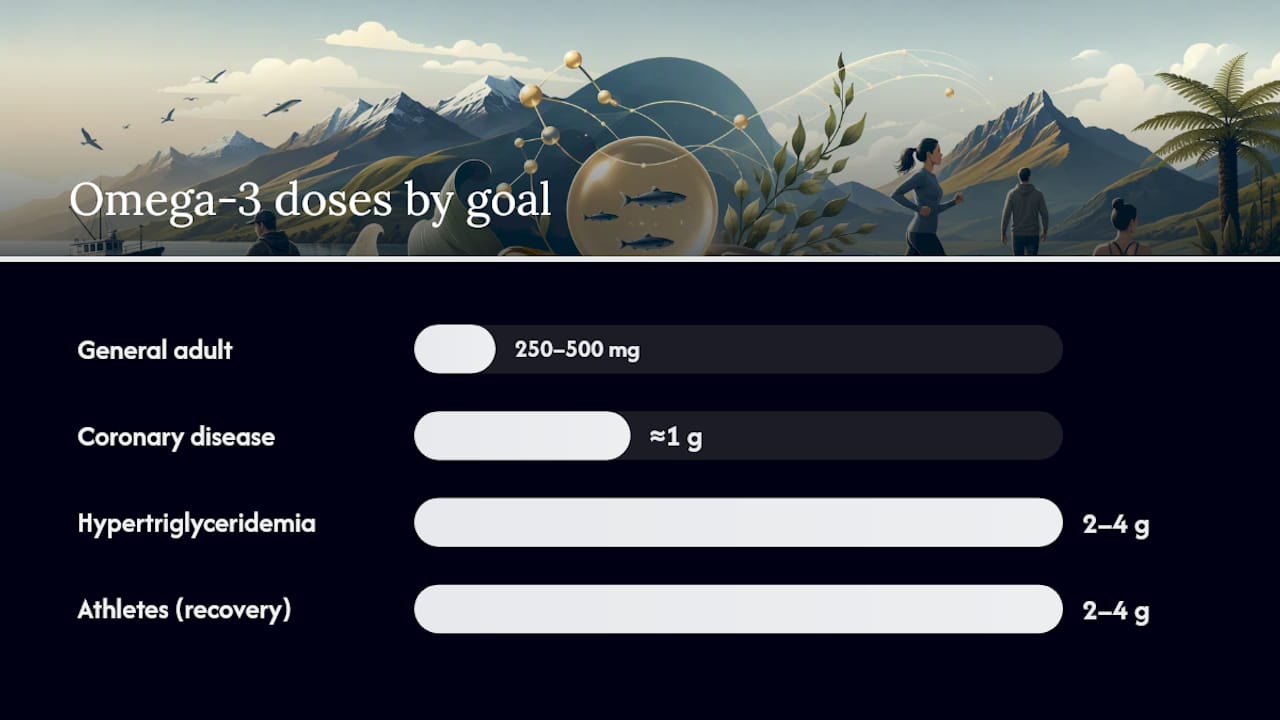
For general health, aim for 250 to 500 mg/day combined EPA and DHA. For triglyceride management or athletic recovery, evidence points to 2 to 4 grams/day, with prescription options reaching 4 grams/day under medical supervision. The single most common mistake is assuming “1,000 mg fish oil” means 1,000 mg of active EPA and DHA. It usually does not, so always check the Supplement Facts panel before you count milligrams.
TL;DR:
- Most adults should start with 250 to 500 mg/day of EPA and DHA for general health, with higher doses like 2 to 4 grams per day needed for triglyceride reduction or athletic recovery.
- Over-the-counter fish oil capsules often contain only a fraction of the listed milligrams as active EPA and DHA, requiring careful label calculation to meet target doses.
- Doses below 1 gram daily are unlikely to produce noticeable effects, while 2 to 4 grams per day are necessary for meaningful benefits in recovery and triglyceride lowering.
- Consistent supplementation over 8 to 12 weeks, coupled with blood testing of the Omega-3 Index, provides the most accurate assessment of progress.
- High-dose omega-3 supplements above 3 grams daily carry increased bleeding risk and should involve medical consultation, especially before surgical procedures or when on blood-thinning medications.
Table of Contents
- What Is the Right Omega-3 Dosage for Your Goal?
- How Dosage Varies by Goal: The Science Behind the Range
- How Do You Read a Fish Oil Label Correctly?
- Is There a Safe Upper Limit for Omega-3 Supplements?
- How Long Does Omega-3 Take to Work, and How Do You Measure Progress?
- How Do You Choose a Quality Omega-3 Supplement?
- What Support Does Nzsupps Offer for Omega-3 Buyers?
- A Straight Answer on Where to Start
- Get Your Omega-3 Numbers Right, Then Shop Smart
- Where This Guidance Comes From
- Sources
- FAQ
What Is the Right Omega-3 Dosage for Your Goal?
The dose that makes sense for a marathon runner chasing faster recovery is not the dose that makes sense for someone taking fish oil purely for general wellness. Omega-3 dosing recommendations split sharply by goal, and lumping them together is how people end up either underdosing or overpaying for capsules they do not need.
Most national and international guidance bodies converge on 250 mg/day of combined EPA and DHA as the baseline for healthy adults, according to a review of intake recommendations across dozens of countries. A number of authorities push that figure to 500 mg/day for a more protective margin. Beyond general health, the numbers climb fast depending on what you are trying to fix.
| Goal or population | EPA + DHA range | Notes | Evidence level |
|---|---|---|---|
| General healthy adult | 250 to 500 mg/day | Most common baseline recommendation globally | Guideline consensus |
| Existing coronary heart disease | ~1 g/day | Commonly cited target for secondary prevention | Clinical guidance |
| Hypertriglyceridemia (elevated triglycerides) | 2 to 4 g/day, up to 4 g/day prescription | Higher doses show greater triglyceride reduction | Clinical dosing evidence |
| Athletes and recovery | 2 to 4 g/day | Benefits often appear after 4 to 12 weeks | Meta-analysis on recovery |
| Pregnant or lactating individuals | Meet or exceed general adult baseline; DHA emphasis | Discuss with an obstetric provider before high-dose supplementation | Guideline-based |
| Children | Lower absolute amounts, scaled to age and weight | No universal fixed target; pediatric guidance varies | Limited consensus |
A few things stand out in that table. First, there is no single “correct” dose. Second, the jump from general health (a few hundred milligrams) to clinical triglyceride management (multiple grams) is not incremental. It is an order of magnitude difference, and that gap is exactly why generic dosing advice fails so many people.
For pregnancy and lactation, DHA gets special attention because it accumulates in fetal brain and retinal tissue during the third trimester. Most prenatal-focused recommendations ask for at least the general adult baseline, with some professional bodies suggesting a modest increase specifically in DHA. This is a conversation worth having with an obstetric provider rather than a decision to make from a supplement label alone, given how tightly dosing intersects with individual pregnancy risk factors.
Children’s dosing is the least standardized corner of this whole picture. There is no widely agreed fixed milligram target the way there is for adults, and pediatric recommendations tend to scale with body weight and age rather than following a flat number. If you are dosing omega-3 for a child, that is a pediatrician conversation, not a label-reading exercise.
A practical rule for timelines: give any dose 8 to 12 weeks before judging whether it is working, whether the goal is joint comfort, triglyceride numbers, or general daily intake. Blood lipids and inflammatory markers do not move overnight. Structural incorporation into cell membranes and blood tests move on their own biological clock, not on your patience.
How Dosage Varies by Goal: The Science Behind the Range
Here is the part most articles skip: omega-3s do not work the same way at every dose. There is a real dose-response curve, and understanding it explains why a bottle labeled “1000 mg fish oil” might do almost nothing for triglycerides while doing something meaningful for general cardiovascular support.
At low doses (250 to 500 mg/day), EPA and DHA primarily support baseline cell membrane composition and modest anti-inflammatory signaling. This is maintenance dosing. It is not designed to move a lab value dramatically, and expecting it to lower triglycerides by double digits is asking a maintenance dose to do a therapeutic dose’s job.
At therapeutic doses (2 to 4 g/day), the mechanism shifts. Higher circulating EPA and DHA measurably suppress hepatic triglyceride synthesis, which is why prescription omega-3 products used for severe hypertriglyceridemia are dosed at 2 to 4 g/day, sometimes reaching 4 g/day in trial protocols. This is also the range where cardiovascular outcome trials, including the landmark REDUCE-IT trial using a purified EPA formulation, demonstrated meaningful reductions in cardiovascular events among high-risk patients. That trial used a specific prescription-strength EPA product, not an over-the-counter fish oil softgel, which matters when you compare its results to what a standard supplement can realistically deliver.
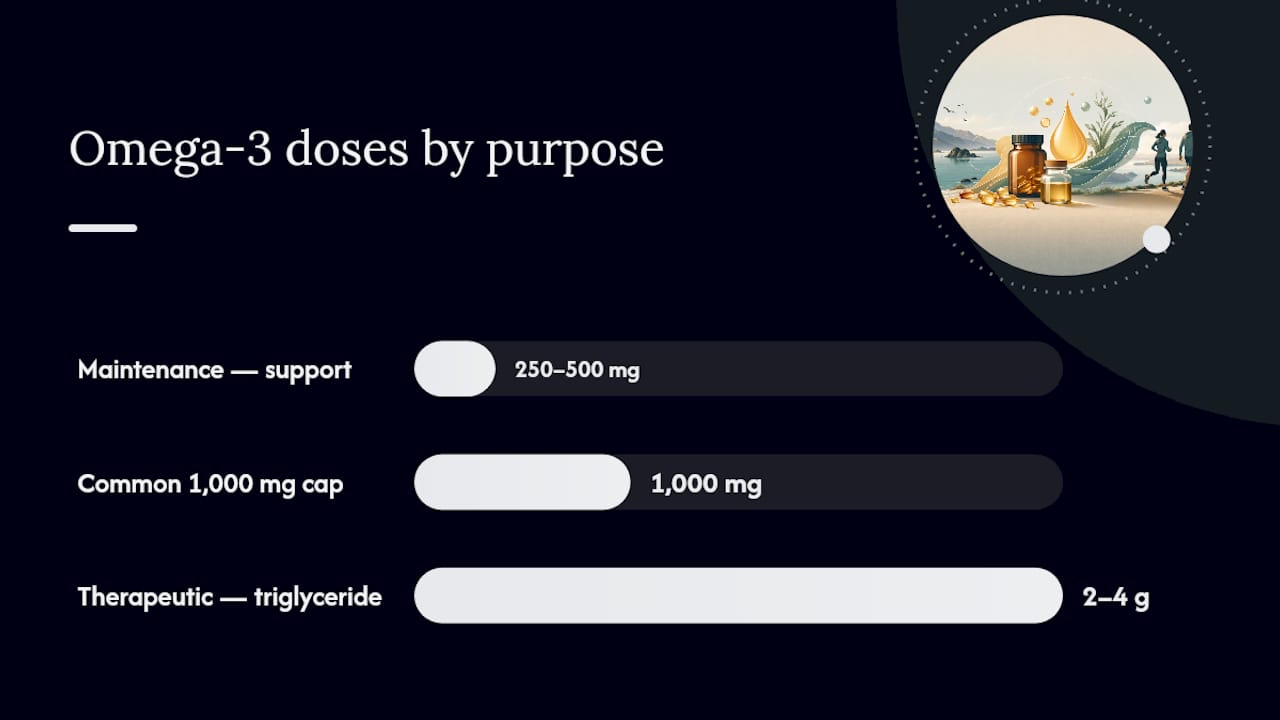
Statistic worth remembering: A 2026 systematic review and network meta-analysis found that omega-3 effects on exercise recovery only reached statistical significance once EPA+DHA intake exceeded 2 grams per day. Below that threshold, the recovery signal was inconsistent across studies. That is a meaningful cutoff for anyone taking a single 1,000 mg fish oil capsule and expecting noticeably less muscle soreness after training.
For athletes specifically, the International Society of Sports Nutrition position stand concludes that omega-3 supplementation reliably raises omega-3 status and can reduce subjective muscle soreness and support recovery, but it stresses that these benefits are dose- and duration-dependent. The ISSN does not treat omega-3 as a one-size-fits-all recovery aid. It treats it as a lever that needs enough weight behind it (2 g/day or more) and enough time (weeks, not days) to actually move the needle.
A few practical takeaways from the dose-response evidence:
- Doses under 1 g/day are reasonable for general maintenance but unlikely to produce measurable clinical or performance effects.
- The 2 to 4 g/day range is where most recovery and triglyceride-lowering evidence clusters.
- Body weight and training volume influence how much an athlete needs, since larger athletes and those training at higher volumes tend to need doses at the higher end of that range to see comparable effects.
- Duration matters as much as dose. Athlete recovery benefits typically emerge over 4 to 12 weeks, not after a single dose or even a single week.
If you train hard and want to know whether omega-3 supplementation is worth the investment for recovery, the research suggests it is, but only at a dose most casual supplement users are not actually taking; see this quick recovery guide for practical prevention strategies. A single softgel a day rarely gets anyone into the range where the evidence shows an effect.
How Do You Read a Fish Oil Label Correctly?
This is where most people get their omega-3 dosage wrong, and it has nothing to do with how much they are willing to spend on supplements. It comes down to a labeling quirk that catches even careful shoppers off guard.
“Fish oil” milligrams on the front of a bottle refer to the total weight of the oil, not the active EPA and DHA inside it. A capsule can say “1,000 mg Fish Oil” and contain only 300 mg of actual EPA and DHA combined, with the rest being other fatty acids and inert oil. The NIH Office of Dietary Supplements notes that a typical 1,000 mg fish oil capsule contains roughly 180 mg EPA and 120 mg DHA, which totals 300 mg of the fatty acids that actually matter. That means you would need over three of those capsules just to hit the low end of the general health baseline, and closer to seven to reach a 2 g/day therapeutic dose.
Here is the math, step by step:
- Flip the bottle to the Supplement Facts panel, not the front label.
- Find the specific lines for “EPA” and “DHA,” listed in milligrams, usually beneath the “Fish Oil” or “Omega-3 Fatty Acids” line.
- Add the EPA and DHA numbers together to get your true active dose per serving.
- Divide your target daily dose (say, 500 mg for general health, or 2,000 mg for recovery) by that per-serving figure.
- That is your daily capsule or softgel count. Round up, not down.
Regulatory label databases confirm this active-versus-total-weight gap is common across the fish oil category, which is exactly why “fish oil dosage” and “EPA+DHA dosage” are not interchangeable terms, even though people use them that way constantly.
Formulation also affects how well your body absorbs what is on the label. Triglyceride-form fish oil (the natural form found in fish) and re-esterified triglyceride oils tend to absorb somewhat better than ethyl ester forms, which are more concentrated but chemically less similar to the fat your body evolved to digest. Algal oil, sourced from algae rather than fish, is the standard option for vegans and vegetarians and delivers DHA (and sometimes EPA) without any marine allergen concern. Our breakdown of fish oil vs. krill oil goes deeper into how these forms compare for absorption and practical dosing.
Pro Tip: Keep a simple note on your phone with your target daily EPA+DHA milligrams and your product’s per-capsule content. When you switch brands, and you eventually will, you can recalculate your dose in ten seconds instead of guessing.
Is There a Safe Upper Limit for Omega-3 Supplements?
Omega-3s have a wide safety margin compared to many supplements, but “wide” does not mean unlimited, and the risks that do exist deserve real attention if you take blood thinners or have a procedure coming up.
Regulatory bodies generally treat doses up to around 3 to 5 grams/day of combined EPA and DHA from supplements as having an acceptable safety profile for most healthy adults, though this is a supplement-level guideline, not a green light to combine high-dose supplements with high fish intake indiscriminately. Above that range, side effects become more likely and more noticeable, without necessarily buying more benefit.
The number that matters here: most bleeding-risk concerns with omega-3 supplementation become clinically relevant above roughly 3 grams/day, which is precisely where triglyceride-lowering and athletic recovery protocols often land. That overlap is not a coincidence. It is the reason doses in that therapeutic range call for more caution and, ideally, clinician awareness, rather than casual self-dosing.
Common side effects at higher doses include:
- Gastrointestinal upset, loose stools, and the well-known “fish burp” aftertaste.
- Mild increases in bleeding time, which matters most for people already on anticoagulant or antiplatelet medications like warfarin, aspirin, or clopidogrel.
- Rare but reported interactions with blood pressure medications, since omega-3s can modestly lower blood pressure themselves, and with certain diabetes medications, where the metabolic effects can compound.
- Belching, reflux, or a fishy aftertaste, especially with lower-quality or oxidized oils.
Mitigating the GI issues is usually simple: take the supplement with a meal rather than on an empty stomach, split the dose across two meals instead of one large dose, or switch to an enteric-coated formulation designed to release past the stomach.
If you are scheduled for surgery, most surgical guidance recommends pausing high-dose omega-3 supplementation roughly one to two weeks beforehand, given the bleeding-risk overlap with anesthesia and surgical recovery. If your triglycerides are severely elevated (often defined as above 500 mg/dL), that is a case for a prescription-strength omega-3 product managed by a physician, not a self-directed supplement regimen, since the therapeutic doses involved (up to 4 g/day) sit at the upper edge of what is generally considered safe without supervision. And if you have a fish or shellfish allergy, algal-oil omega-3 sidesteps the allergen question entirely, since it is derived from algae rather than marine animals.
How Long Does Omega-3 Take to Work, and How Do You Measure Progress?
DHA and EPA do not incorporate into your body at the same speed, which is one reason people give up on omega-3 supplementation before it has had a fair chance to work. DHA tends to build up in cell membranes somewhat faster in the early weeks, while EPA continues rising more gradually over a longer stretch. Most people see meaningful shifts in blood markers somewhere between 4 and 12 weeks of consistent daily dosing, and some effects, particularly on triglycerides, continue improving even beyond that window.
The most useful way to personalize your dose is not guesswork. It is the Omega-3 Index (O3I), a blood test that measures EPA and DHA as a percentage of total fatty acids in red blood cell membranes. It is a far more direct measure of your actual omega-3 status than simply tracking how many capsules you swallow.
Here is how to interpret an O3I result:
- Below 4%: Considered a higher-risk category, associated with elevated cardiovascular risk in observational research.
- 4% to 8%: An intermediate zone, common in people who eat some fish but do not supplement consistently.
- Above 8%: The target range associated with lower cardiovascular risk in population studies, and the zone most clinical and athletic protocols aim for.
Getting from a low baseline to above 8% is not fast. Research on O3I dosing suggests that reaching that target often requires 1,000 to 1,500 mg/day of combined EPA and DHA for at least 12 weeks, and people starting from a very low baseline may need either a higher dose or more time to get there. Body weight plays a role too. Larger individuals generally need more total EPA and DHA to achieve the same percentage shift in their O3I as someone smaller.
Practically, testing O3I once at baseline and again after 12 to 16 weeks of consistent dosing gives you a real answer instead of a guess. If your number has not moved much, the fix is usually a higher dose, better consistency, or both, not necessarily a different product. Athletes, anyone with a family history of cardiovascular disease, and people who eat little to no oily fish tend to get the most practical value out of testing, since their assumptions about their omega-3 status are the ones most likely to be wrong.
How Do You Choose a Quality Omega-3 Supplement?
Picking a product is less about brand reputation and more about a handful of concrete numbers you can check in under a minute on any label.
- EPA+DHA per serving, not total fish oil weight. This is the number you calculated your dose around. Confirm it matches what you actually need.
- Servings per container and real daily cost. A cheap bottle with low EPA+DHA per capsule can cost more per gram of active ingredient than a pricier, more concentrated one.
- Third-party testing. Look for certifications such as IFOS or NSF, which verify potency and screen for contaminants like heavy metals and PCBs independent of the manufacturer’s own claims.
- Oxidation markers. Reputable brands test for peroxide and anisidine values, two measures of how rancid or degraded the oil has become. Fresher oil smells and tastes cleaner, with less of a strong fishy odor.
- Form. Triglyceride and re-esterified triglyceride oils generally absorb better than ethyl ester forms; algal oil is the standard vegan and allergy-safe option.
- Storage and expiry. Fish oil degrades faster in heat and light. Keep it in a cool, dark place, and respect the expiration date rather than assuming supplements never go bad.
Pro Tip: Give any new bottle the smell test. A subtle ocean-like scent is normal; a strong, rancid, or overpowering fishy smell usually signals oxidized oil that has already lost potency, whatever the label claims.
Sustainability certifications, like sourcing from fisheries independently verified for responsible practices, do not change the EPA/DHA math, but they are a reasonable tiebreaker between two products that are otherwise equal on potency and purity. If you are weighing fish oil against krill oil or algal oil for your specific situation, our comparison of fish oil and krill oil walks through the tradeoffs in more depth.
What Support Does Nzsupps Offer for Omega-3 Buyers?
A curated range of nutritional supplements with transparent ingredient listings allows you to check EPA and DHA content before purchase rather than guessing from the front-label claim. That curation matters more in a category like omega-3, where two products with near-identical front labels can differ by hundreds of milligrams of actual active ingredient.
A few ways this plays out practically for omega-3 shoppers:
- Ingredient transparency means you can compare EPA+DHA per serving across products before you buy, using the same math outlined earlier in this guide.
- Products are sourced direct and stored in New Zealand, which avoids the grey-import uncertainty that can plague fish oil sold through unverified third-party sellers.
- Genuine Kiwi customer service staff who personally train can help you cross-check label numbers against your specific goal, whether that is general health maintenance or a higher recovery-focused dose.
- Our blog covers related dosing questions in more depth, including whether omega-3 actually helps joint pain and arthritis, a common reason people start supplementing in the first place.
If you are ever unsure whether a specific product’s EPA+DHA numbers match what your goal requires, reach out to customer support before you buy rather than after. Confirming the math up front saves you from opening a bottle only to realize you would need six capsules a day to hit your target.
A Straight Answer on Where to Start
Most people overthink omega-3 dosing, then underdose anyway because the label math is genuinely confusing. If you take nothing else from this guide, take this: 250 to 500 mg/day of combined EPA and DHA is a sound default for general health, and it is where most people should start unless they have a specific reason to go higher.
The reasons to go higher are specific, not vague. Triglyceride management, athletic recovery, and a documented low Omega-3 Index are the three situations where I would consider 1 to 4 grams/day, and even then, I would not treat that as a fixed prescription. I would test first, or at minimum, track how the person feels and functions over a 12 week window before assuming a low dose is failing them.
The line I would not cross without a clinician is prescription-level dosing, typically 4 grams/day, for confirmed high triglycerides. That is not a self-directed supplement decision. It is a medical one, and treating it otherwise is the one place in this whole topic where the stakes genuinely justify extra caution.
— Blake
Get Your Omega-3 Numbers Right, Then Shop Smart
Once you know your target EPA+DHA dose, the next step is finding a product that actually delivers it without forcing you to do label detective work every time you restock. Ingredient listings are transparent across the Health & Wellness range, letting you check EPA and DHA content per serving before checkout rather than after purchase.
Because the range is sourced and stored direct in New Zealand, customers avoid risks associated with grey-import stock with murky freshness or unclear sourcing, which can occur with fish oil bought through unverified overseas sellers. If your goal is general daily maintenance or a higher recovery-focused dose, browse the full supplement categories, including Health & Wellness, and compare EPA+DHA per serving using the math from this guide. If you are managing clinically elevated triglycerides, talk to your doctor about prescription-strength options first. For other needs, customer service can assist in confirming a product’s actual EPA and DHA numbers before purchase.
Browse the health and wellness range and read the ingredients for the product you are considering.
Where This Guidance Comes From
The dosing ranges, safety limits, and testing guidance in this article draw on national and international nutrition authorities, sports nutrition position stands, and peer-reviewed dose-response research.
- International Society of Sports Nutrition position stand on omega-3 supplementation
- Overview of national and international long-chain omega-3 intake recommendations
- NIH Office of Dietary Supplements omega-3 fatty acids fact sheet
- Comparative meta-analysis on supplementation and exercise recovery
- Evidence on Omega-3 Index dosing and personalization
This article is general information, not a substitute for advice from a qualified doctor. Consult a qualified healthcare professional about your own circumstances before acting on anything here.
Sources
- International Society of Sports Nutrition position stand (PMC)
- An overview of national and international long-chain omega-3 intake recommendations (Cambridge Core)
- Comparative effects of supplementation on muscle strength, endurance, and recovery (PMC)
- Omega-3 Fatty Acids - Health Professional Fact Sheet (NIH ODS)
FAQ
How Much Omega-3 Should I Take Daily?
Most healthy adults do well with 250 to 500 mg/day of combined EPA and DHA. Higher goals like triglyceride management or athletic recovery typically call for 2 to 4 grams/day, ideally guided by testing or clinical advice.
What Is the Difference Between Fish Oil Dosage and EPA/DHA Dosage?
“Fish oil” milligrams on a label describe the total oil weight, while EPA and DHA are the specific active fatty acids inside that oil. A typical 1,000 mg fish oil capsule contains only about 300 mg of actual EPA and DHA combined, so always calculate your dose from the Supplement Facts panel, not the front label.
How Much Omega-3 Do Athletes Need for Recovery?
Evidence points to 2 to 4 grams/day of combined EPA and DHA, with benefits typically appearing after 4 to 12 weeks of consistent use. Doses below 2 grams/day showed inconsistent recovery effects in a recent network meta-analysis.
Is It Safe to Take Omega-3 With Blood Thinners?
Omega-3s can modestly increase bleeding time, so combining higher doses with anticoagulant or antiplatelet medications needs medical oversight. Anyone on warfarin, aspirin, or similar medications should discuss their specific dose with a doctor before starting or increasing omega-3 supplementation.
What Is the Omega-3 Index and Why Does It Matter?
The Omega-3 Index is a blood test measuring EPA and DHA as a percentage of red blood cell fatty acids, with above 8% considered the target range in population research. Reaching that level from a low baseline often requires 1,000 to 1,500 mg/day for 12 or more weeks, which makes testing far more reliable than guessing based on capsule count alone.
Where Can I Buy Reliable Omega-3 Supplements?
Nzsupps lists Health & Wellness products with transparent EPA and DHA content within its shop-by-category range, sourced and stored directly in New Zealand. Reach out to customer support directly if you need help confirming a specific product’s active EPA and DHA numbers before buying.